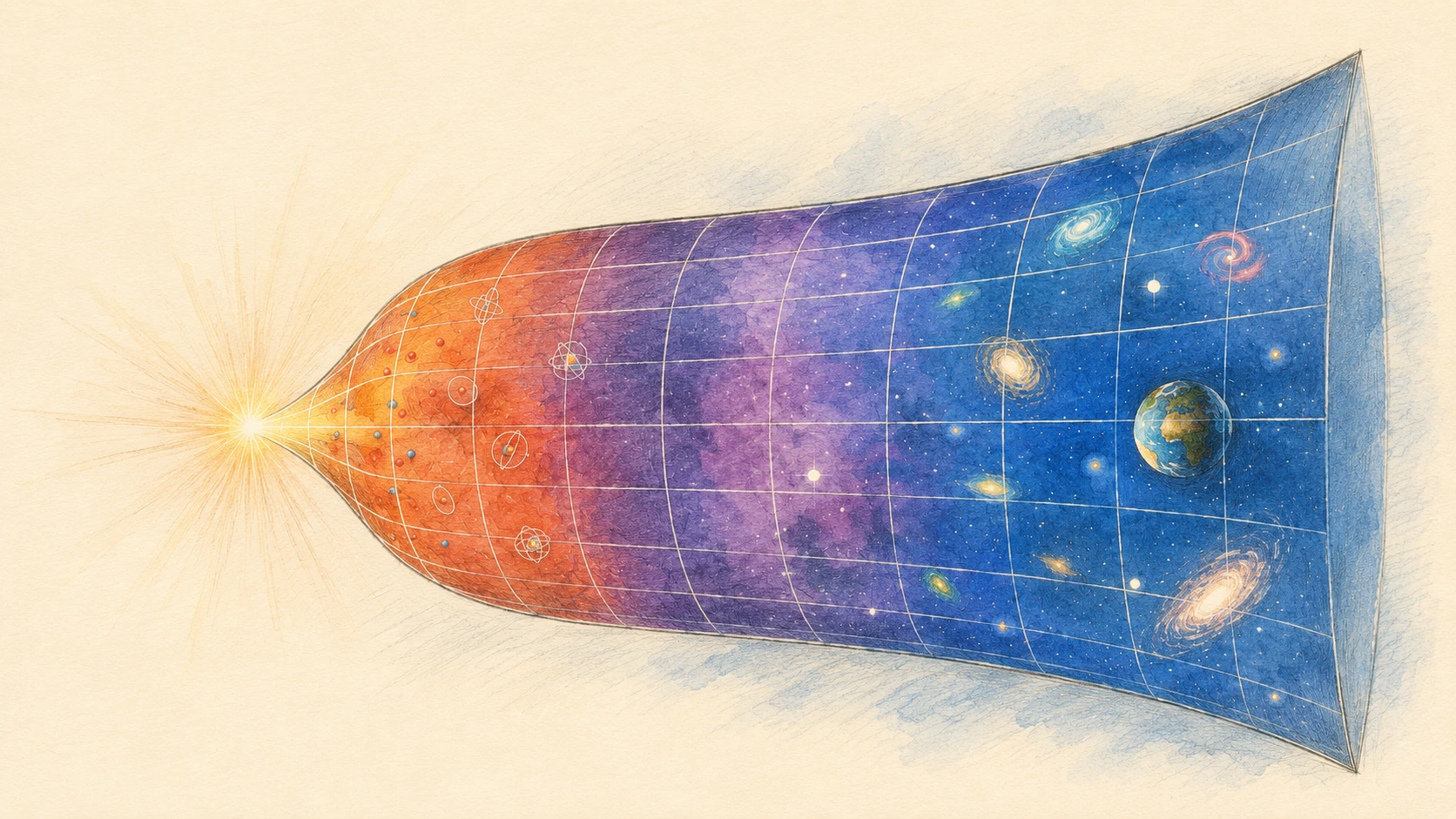
A growing volume can lower a density while raising the total
If this model’s entropy density falls as a universe expands, how can its total entropy still increase?
Imagine an expanding universe divided into tiny cells. The amount of something in each cell can fall even while the total amount across the growing region rises. A drop in density and a rise in the total are not opposites when the volume itself is changing.
That elementary accounting problem sits at the heart of a much more ambitious theoretical paper. In Physical Review D, mathematical physicist Ginestra Bianconi develops a thermodynamic description of Gravity From Entropy (GfE), a recently proposed model in which gravity is encoded through an information-theoretic relation between matter and geometry. Here, “information-theoretic” means that the model starts from a mathematical measure of how two descriptions of geometry differ: the physical geometry and one induced by matter and curvature.
The paper derives local quantities called k-entropies, k-energies, k-temperatures and k-pressures. The prefix separates different geometric sectors in the model; these are not different substances or cosmic eras. Their first-law relation has the same accounting form as in thermodynamics: a change in energy is related to a temperature times a change in entropy, minus a pressure times a change in volume.
The paper then evaluates those quantities using expanding Friedmann cosmologies: standard idealized universes that are homogeneous and isotropic on large scales. In a low-energy, small-curvature regime, the matter- and radiation-dominated examples have decreasing local entropy and energy densities, but expansion supplies enough volume for total entropy to increase. Total energy approaches a constant at leading order, meaning after keeping the dominant large-time term and dropping terms that fade faster as time grows.
That is a clean mathematical result. Its boundary is equally important: the calculation is made inside one proposed theory, and the Friedmann cosmologies used for the concrete examples are only approximate, not exact, solutions of the full GfE equations. Those equations of motion come from varying the proposed GfE action and include the dynamical G-field and higher-order geometric sectors absent from the ordinary Friedmann equations. The paper does not observe entropy generating gravity, identify the dark energy in our Universe or finish a theory of quantum gravity.
What Gravity From Entropy assumes
General relativity describes gravity through the geometry of spacetime. Matter tells spacetime how to curve, and that curvature tells matter how to move. GfE starts from a different proposed action: it treats metric-related objects as quantum operators and builds its Lagrangian from a Geometric Quantum Relative Entropy (GQRE).
Three terms in 120 seconds
A quantum operator is a mathematical rule that acts on a quantum state and represents a quantity or transformation. GfE assumes that its metric-related objects can be treated this way; the article does not ask the reader to reproduce that construction.
A Lagrangian is a compact mathematical recipe for a theory’s dynamics. Integrate it over spacetime to obtain an action, then vary that action to derive the field equations.
The GQRE is the model-specific Lagrangian chosen by GfE. It adapts the idea of quantum relative entropy to compare the physical metric with a higher-order metric induced by matter and curvature. Calling it an entropy does not make it ordinary heat entropy.
Relative entropy is usually a measure of distinguishability between two probability distributions or quantum states. In GfE, the comparison is between the physical metric and a higher-order metric induced by matter and curvature. “Higher-order” does not mean extra spacetime dimensions. It means that the model packages scalar, vector-type and bivector-type geometric sectors into one enlarged object. A dynamical G-field relates these components and “dresses” the metric used in both the gravity and matter parts of the model. The framework is constructed so that, in a low-energy and small-curvature limit, its action reduces to the Einstein-Hilbert action of general relativity plus the matter action.
That last sentence is easy to overread. Recovering Einstein’s equations in a limit is a consistency target for the proposal. It does not show that nature uses the larger theory outside that limit.
The GfE field equations also contain a dynamical term that the framework calls an emergent effective dark-energy term. In this paper, Bianconi identifies the model’s internal-energy density with that term. “Effective dark energy” describes its role in the equations. It is not an empirical identification with the dark energy inferred from cosmological observations.
Three different uses of the word “entropy”
Ordinary thermodynamic entropy counts how many microscopic arrangements can produce a macroscopic state. Quantum relative entropy measures how distinguishable two quantum states are. The GQRE in this paper is a model-specific geometric construction inspired by relative entropy and used as the gravitational Lagrangian. Similar names do not make these quantities interchangeable; the paper derives the connections it uses inside GfE.
The exact thermodynamic result inside the model
The paper first works at the level of the GfE framework itself. For each order and type of geometric degree of freedom, indexed by , it defines:
- a local k-entropy from the GQRE;
- a local k-energy from the model’s internal-energy density;
- a conjugate k-temperature;
- and a k-pressure.
These quantities obey a local first law. In the paper’s notation,
The index is not a list of different substances or eras of the Universe. In the homogeneous and isotropic calculation it labels five entries: one scalar entry; separate timelike and spacelike entries from the vector-type sector; and separate time-space and space-space entries from the bivector-type sector. A scalar has no directional index, the vector-type entries distinguish temporal from spatial directions, and a bivector is built from pairs of directions. Each sector can carry its own temperature and pressure. The k-temperature can also be positive or negative, depending on the corresponding G-field component.
These are not temperatures measured by placing a thermometer near a cosmological horizon. The standard de Sitter quantum-field temperature scales with : the Gibbons-Hawking temperature is assigned to the cosmological horizon, while the Bunch-Davies vacuum is the standard de Sitter-invariant quantum state whose field correlations give the associated thermal response. The paper explicitly distinguishes both from its geometric k-temperatures, which scale with in the de Sitter example. Here, “temperature” names a thermodynamic conjugate variable derived from the model’s entropy and energy definitions.
So the first-law identity is a real derivation, but it is an internal result: accept the GfE action and definitions, and this thermodynamic structure follows.
Why the Friedmann calculation is an approximation
To turn the formalism into a cosmological example, the paper uses homogeneous and isotropic Friedmann-Robertson-Walker (FRW) spacetimes. “Homogeneous” means the large-scale model has the same average properties at every location; “isotropic” means it looks the same in every direction. One scale factor describes how distances grow with time, matter is represented as a smooth perfect fluid, and the Hubble parameter summarizes the expansion rate. This is an idealized background, not a map of individual galaxies.
But there is a structural mismatch. Friedmann universes solve Einstein’s equations. They do not, in general, solve the full higher-order GfE equations, which also track the scalar, vector-type and bivector-type sectors and derivatives of the G-field. Einstein’s equations reappear only in the proposal’s first-order, low-energy and small-curvature limit.
The paper says this directly and treats the Friedmann solutions as approximations, in an approach compared with inserting a mean-field solution into a fuller theory to test where that approximation remains reliable. The regime requires low energy and small curvature, summarized by , where is the Planck length. A second condition requires the product of the induced higher-order metric and the inverse physical higher-order metric to remain positive definite.
The result is therefore not “GfE predicts the history of our Universe.” It is closer to: if a GfE universe is sufficiently well approximated by a familiar Friedmann cosmology, these are the thermodynamic scalings produced by the full GfE quantities.
The local-versus-total result
Inside that regime, the leading local quantities have simple scalings:
- model entropy density scales as ;
- model energy density scales as ;
- for non-de Sitter Friedmann examples at late times, those become approximately and .
Both densities therefore fall as the universe expands. Yet density is not the total.
When the paper integrates over the expanding spacetime region, the growing volume changes the answer. For the physically familiar matter-dominated and radiation-dominated examples, total entropy increases with time even as entropy per unit volume decreases. Total energy does not keep growing; at leading order it approaches a constant.
This is the paper’s most useful conceptual result. Local ordering or dilution does not automatically conflict with a global second law. A region can become locally less entropic per unit volume while the integrated entropy grows because the spacetime volume grows faster.
The calculation does not prove that this is the correct microscopic explanation of the thermodynamic arrow in the real Universe. It shows that the proposed framework can accommodate the local-global split without contradiction in its Friedmann approximation.
A de Sitter comparison, with a different temperature
The paper also considers de Sitter space, an idealized exponentially expanding spacetime with constant . For a single observer it integrates only over a finite causal diamond: the overlap between the future light cone of an earlier event and the past light cone of a later one, which bounds the spacetime region that can participate in observations between them. Over that diamond, the total GfE entropy scales as , the same H-scaling as the familiar Gibbons-Hawking entropy. The total GfE energy is of order one in the model’s units.
One family of cosmological backgrounds
FRW is a family of homogeneous and isotropic geometries, not one extra place. Matter-dominated and radiation-dominated universes are FRW cases distinguished by what fills the model. De Sitter space can also be written in FRW form, but represents a vacuum-dominated case with constant and exponential expansion. The causal diamond is a finite region selected inside that spacetime for one observer; it is not another kind of universe.
Matching a scaling is not the same as deriving the same physical object. The associated GfE k-temperature scales as , unlike the standard de Sitter temperature, which scales as . The paper interprets this difference as evidence that the k-temperature belongs to spacetime geometry rather than to quantum fields living on that background.
It then suggests that such a temperature might be associated with graviton radiation rather than ordinary particle emission. That is a future question, not a result of this paper. The theory would first need to be quantized to establish whether its temperatures correspond to radiation at all.
What this does not prove
- It does not show observationally that gravity emerges from entropy.
- It does not establish that the model’s effective term is the dark energy measured in cosmology.
- It does not replace general relativity with a tested superior theory. General relativity appears here as the proposal’s low-energy, small-curvature limit.
- It does not make Friedmann cosmologies exact solutions of GfE. They are the approximation used to estimate the model’s thermodynamic behavior.
- It does not derive a complete microscopic count of spacetime degrees of freedom.
- It does not provide a finished quantum-gravity theory or detect gravitons.
- It does not show that negative k-temperatures are ordinary negative thermometer readings.
How strong is the result?
This is a peer-reviewed theoretical paper, so “evidence” means something different here than in an experiment. The appropriate questions are whether the definitions are coherent, whether the derivations follow, and whether the approximations are stated and controlled.
On that level, the paper provides a concrete thermodynamic dictionary for GfE and derives a first-law structure rather than relying on analogy alone. It also makes the approximation boundary unusually visible: the Friedmann solutions are borrowed from general relativity, inserted into the GfE quantities and restricted to a regime where the induced metric remains well behaved.
The larger physical claims remain open. The framework is recent, this paper does not compare its cosmology with data, and some of its most interesting implications - quantization, contact-geometric dynamics and possible graviton radiation - are presented as directions for future work. Internal consistency is necessary for a new gravity theory. It is not sufficient to show that the theory describes nature.
Why it matters
The relation between gravity and thermodynamics is old and deep, from black-hole entropy to the temperature of de Sitter space. Many of those results are organized around horizons. GfE instead tries to build a local, volumetric information measure directly from the relation between matter and geometry.
Whether that proposal survives is an open question. But the thermodynamic exercise exposes a useful target for any such theory: it should explain how local structure and falling local entropy density can coexist with increasing total entropy in an expanding universe.
This paper shows one mathematically explicit way that can happen. Its value is not that it closes the gravity-entropy problem. It turns part of that problem into equations whose assumptions, limits and next tests can be stated clearly.
Clean summary
Bianconi derives a thermodynamic description within Gravity From Entropy, a proposed modified-gravity framework based on a geometric quantum relative entropy. The model’s local entropy, energy, temperature and pressure variables satisfy a first law. When the full GfE quantities are evaluated on low-energy, small-curvature Friedmann approximations, local entropy and energy densities fall as the universe expands, while total entropy rises because the spacetime volume grows; total energy approaches a constant at leading order for matter- and radiation-dominated examples. A de Sitter causal diamond gives an entropy scaling as , but a model temperature distinct from standard horizon temperature. These are conditional mathematical results inside GfE, not observational evidence that gravity comes from entropy, a measurement of dark energy or a completed quantum-gravity theory.
Sources
Based on: Thermodynamics of the gravity from entropy theory — Ginestra Bianconi, Physical Review D 114, 024042 (2026).
This article covers a peer-reviewed theoretical paper. Its conclusions are mathematical results within the proposed Gravity From Entropy framework, not an observational test of that framework.
Written by
Laura Nesso · figures and links by
Nova Vela · edited by
Michele Renda
· figures and links by
Nova Vela · edited by
Michele Renda
The Clean Paper · 2 August 2026 · Text on this site is licensed under CC BY-SA 4.0. Images are licensed separately. 


Editorial note
This article was written by AI and reviewed by the editorial team. It is a clear, conservative explanation of the linked work, not a substitute for reading it. Responsibility for selection, interpretation, and final wording rests with the editor.