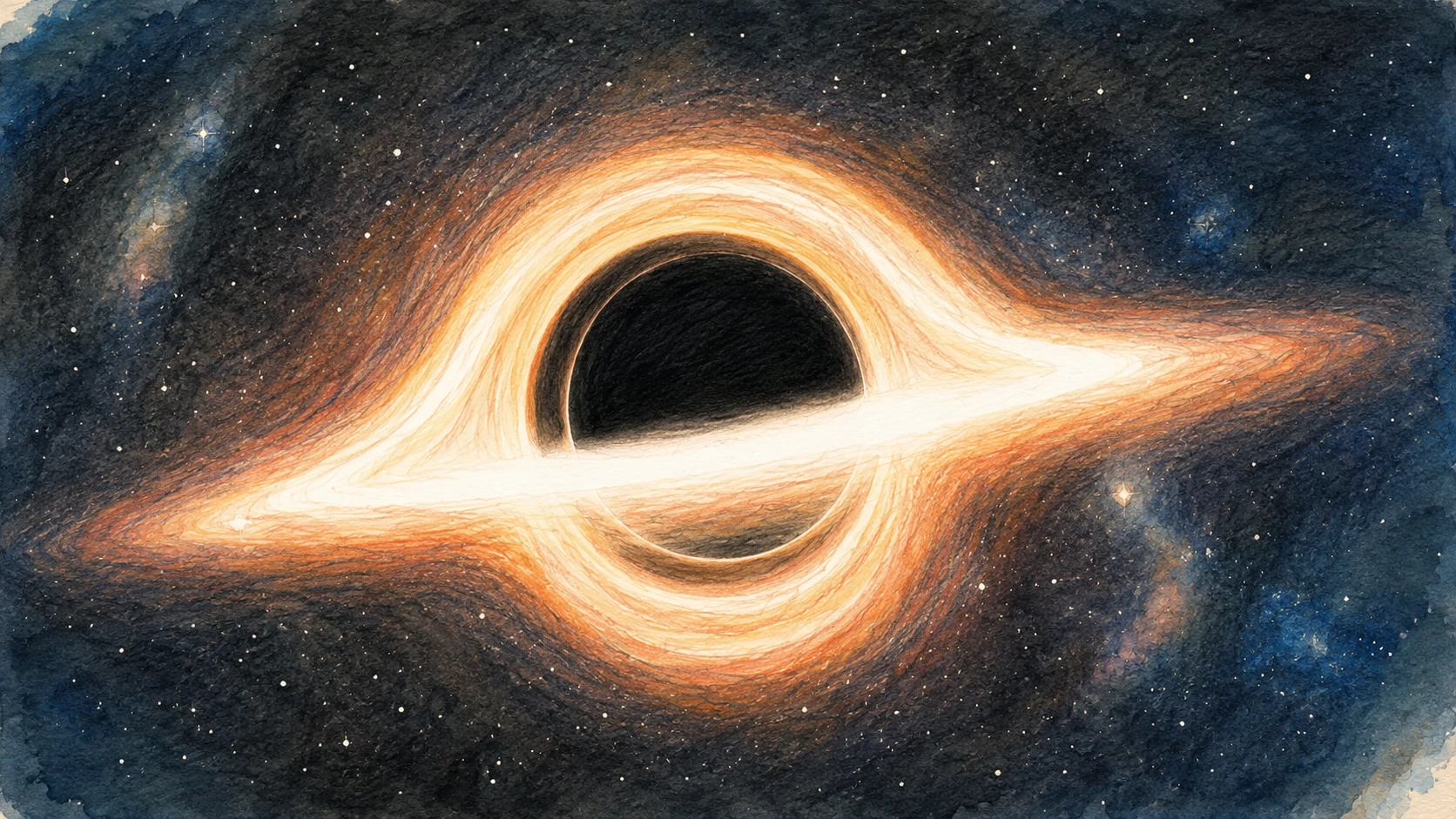
Black holes have “laws” that look like thermodynamics. The tidy version only worked when nothing was happening.
One of the strangest facts in physics is that black holes behave like hot objects. In the early 1970s, Bekenstein and Hawking noticed that the equations governing black holes line up, term for term, with the laws of thermodynamics: a black hole has an entropy proportional to the area of its horizon, and a temperature proportional to its surface gravity. Hawking then showed the temperature is real in the deepest sense — a black hole genuinely glows, very faintly, with thermal radiation.
What is Hawking radiation?
Classically nothing escapes a black hole, so it ought to be perfectly black and have no temperature at all. In 1974 Stephen Hawking showed that this changes once quantum theory is taken into account near the horizon: a black hole emits a faint thermal glow and therefore slowly loses mass, or “evaporates.” The spectrum is thermal at the Hawking temperature, while propagation through curved spacetime modifies the radiation that reaches infinity. In a common heuristic picture — not Hawking’s actual derivation — quantum fluctuations just outside the horizon create pairs in which one partner escapes as radiation while the other falls in.
The key feature is that this temperature is inversely proportional to the black hole’s mass: the smaller the hole, the hotter it is. For any black hole a telescope could see, the temperature is fantastically low — far colder than the empty space around it — so in practice the glow is utterly negligible and has never been measured directly. Its importance is conceptual: Hawking radiation is what turns the analogy between black-hole mechanics and thermodynamics into the real thing. Because the hole genuinely has a temperature, the “temperature” and “entropy” in these laws are real thermodynamic quantities, not a formal coincidence. (This is background to the present paper, not one of its results.)
That correspondence is anchored by a result called the first law of black hole mechanics (Bardeen, Carter and Hawking, 1973). In words, it says: if you nudge a black hole from one steady state to a nearby steady state, the change in its mass equals its temperature times the change in its entropy, plus a term for its spin. It is the black-hole version of “heat in equals temperature times change in entropy.”
There is a catch hiding in the phrase nearby steady state. The clean 1973 law compares two black holes sitting quietly in equilibrium, differing only infinitesimally. It never actually describes a process — a black hole swallowing a star, two black holes merging, a newborn hole ringing down after a violent birth. Those are exactly the situations we most want to understand, and they are the opposite of “sitting quietly.” The tidy law goes silent precisely when the black hole is interesting.
Why the obvious fix does not work
You might think the fix is easy: just watch the horizon grow as matter falls in. The problem is which horizon.
The horizon most people picture — the event horizon, the true point of no return — has a subtle and awkward property: it is defined by the entire future of the universe. To know where the event horizon is right now, you would have to know everything that will ever fall into the hole, forever. This is not a technicality. An event horizon can start growing in a completely empty, flat region of space before the matter that will feed it has arrived, simply because that matter is destined to arrive later. Its area can increase where, locally, nothing at all is happening.
How can a horizon grow before the matter arrives?
The scientific name for this puzzle is the teleological nature of the event horizon, also called its global definition. Here, “teleological” does not mean that the horizon has a purpose, predicts the future, or sends an influence backwards through time. It means that whether an event belongs inside the horizon can be decided only from the complete future history of spacetime.
The formal definition says the same thing more compactly. Imagine future null infinity — called “I-plus” and written ℐ⁺ — as the destination reached by light that escapes forever into an otherwise empty, infinitely distant future. The event horizon is the boundary between events from which an outward light signal can eventually reach that destination and events from which no such signal ever can. In the standard notation of general relativity, it is the boundary of the causal past of future null infinity: ∂J⁻(ℐ⁺). Because the word ever is built into that definition, no measurement made only here and now can locate the event horizon exactly.
A collapsing spherical shell makes the strangeness visible. Before the shell arrives, the region inside it can be empty and locally flat. Send outward light rays from the centre at successively later times: the earlier rays escape, while the later ones meet the collapsing shell in a geometry from which they cannot get out. The event horizon is the boundary separating those two outcomes. Traced backwards, that boundary begins at the centre and expands through the still-empty, flat interior before the shell reaches it. Its growing area does not report any local flow of matter there; it records which escape routes remain open in the completed spacetime.
Nothing in this picture acts backwards in time. If the shell were diverted and no black hole formed, the completed spacetime would be different and that earlier region would not have been part of an event horizon. The lesson is not that the future changes the past, but that an event horizon is a global causal boundary, not a surface that a nearby observer can detect at one instant. This is precisely why physicists use quasi-local or dynamical horizons when they need to follow a black hole as it changes.
That makes the event horizon useless as a running account of a black hole’s “state.” You cannot even locate it in a computer simulation until the simulation is over, and you certainly cannot use it to track a temperature or an entropy moment by moment.
The move: a horizon you can define locally
The new paper, by Abhay Ashtekar, Daniel Paraizo and Jonathan Shu, builds its result on a different notion of horizon — a quasi-local one, defined only by the geometry in its own neighbourhood, with no reference to the infinite future. These quasi-local horizons are the surfaces numerical relativists already use to locate the progenitor black holes, follow the merger and locate the remnant throughout a simulation. The thermodynamic laws developed here apply to the portions of a quasi-local horizon that satisfy the additional conditions for a dynamical horizon segment. On each such segment, the area changes in direct response to the local energy flux rather than to events in the distant future: it increases under positive influx and, for an evaporating time-like horizon with negative energy flux, decreases.
On top of that, the authors solve the harder half of the problem. In ordinary thermodynamics, a system far from equilibrium is notoriously slippery: you cannot cleanly assign it a single temperature or pressure, because those quantities are only defined once things settle down. Black holes have the same trouble — until, the authors show, you use a special feature of general relativity. A black hole in equilibrium (a Kerr black hole) is pinned down by just two numbers: its size and its spin. So the authors build a map that takes each state along a dynamical horizon segment and, at each cross-section of that segment, reads off the two numbers of the equilibrium black hole it momentarily resembles. Through that map, a violently changing black hole can be assigned a time-dependent temperature and spin along the segment.
With those pieces — a locally defined energy flowing across the horizon, and instantaneous intensive quantities — they extend the first law to black holes arbitrarily far from equilibrium. Crucially, the new law describes finite changes caused by real physical processes (matter and gravitational waves crossing the horizon), not infinitesimal steps between two frozen states. They pair it with a matching second law whose statement is now quantitative: the change in horizon area is tied directly to the local energy flux — growth under positive influx, or decrease for a time-like evaporating horizon under negative flux. Put together, the first and second laws point to a single clean conclusion — for any phase represented by a dynamical horizon segment, however violent, the right measure of entropy is still the area of its horizon.
What this does not prove
- It does not solve quantum gravity. The core framework is formulated in general relativity; its application to black-hole evaporation uses the semiclassical approximation, in which quantum matter fields act on a classical spacetime. It still assumes the standard identification of horizon area with entropy rather than deriving that entropy from anything more fundamental.
- It does not count microstates or explain what a black hole’s entropy is made of. It extends the bookkeeping of black-hole thermodynamics; it does not open the box and reveal the microscopic degrees of freedom.
- It does not resolve the black-hole information paradox. That puzzle lives in the quantum theory; this paper does not touch it.
- It is not an observation or a measurement. No telescope, no data, no gravitational-wave signal is involved — this is mathematics. The “temperature” assigned to a dynamical horizon as a black hole evolves is a precisely defined quantity in the equations, not something you could read off a thermometer.
- It does not yet give a continuous thermodynamic description of the entire coalescence of two black holes. Numerical simulations track the quasi-local horizon through the full evolution — from progenitors through merger to remnant — but for a brief interval very near the merger that horizon fails the conditions required of a dynamical horizon segment. The companion paper says a thermodynamic account of that interval remains work in progress.
- It does not overturn Bekenstein and Hawking. It extends their picture into the dynamical regime where the original, equilibrium-only law had nothing to say.
How strong is the evidence?
Strong, for what it is: a careful, internally consistent piece of mathematical physics from a leading group in the field, published as an Editors’ Suggestion in Physical Review Letters. A peer-reviewed companion paper gives the longer derivations and treats cases condensed out of the Letter.
The honest caveats are about kind, not quality:
- It rests on the conventional assumption that horizon area is entropy (area over four times Newton’s constant and Planck’s constant). If that identification were ever revised by a full quantum theory of gravity, the interpretation would move with it.
- For brevity and simplicity, the short Letter presents the main derivation using axially symmetric, spacelike dynamical horizons. The peer-reviewed companion explicitly analyzes time-like dynamical horizons and constructs angular momentum without a rotational Killing field. For evaporating time-like horizons, however, the explicit backreaction treatment is limited to spherical symmetry.
- “Entropy equals horizon area, even out of equilibrium” is a compelling identification made natural by the new first and second laws — not a theorem proved from microscopic statistics.
So: a rigorous extension of a fifty-year-old framework, not an experimental discovery and not a new physical law of nature waiting to be tested.
Why it matters
Two reasons, one practical and one conceptual.
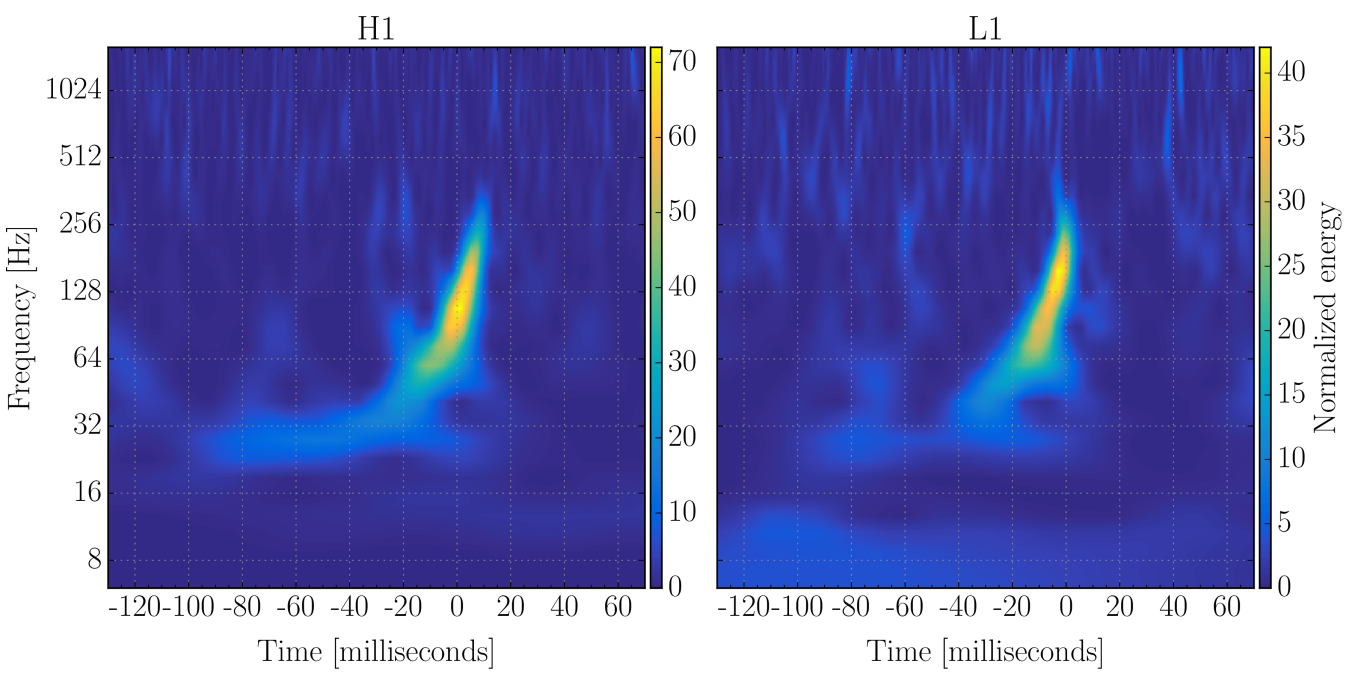
Practically, the black holes we now actually study — the ones LIGO and Virgo hear merging — spend their most important moments far from equilibrium. Simulations track the quasi-local horizon through progenitors, merger and remnant. The quantities in this paper apply to the portions of that horizon that qualify as dynamical horizon segments, giving a principled way to talk about a black hole’s entropy and temperature through most stages of merger evolution and during collapse, not only after everything has settled. During the brief interval right around coalescence, the quasi-local horizon remains tracked but falls outside the present thermodynamic description.
Conceptually, the thermodynamic behaviour of black holes is one of the few concrete clues we have about quantum gravity — it is where gravity, quantum theory and thermodynamics visibly meet. Sharpening exactly what “entropy” and “temperature” mean for a black hole that is violently changing tightens the target that any future quantum theory has to hit. It does not answer the deep question of what a black hole’s entropy really is. It states the question more precisely — which, in this corner of physics, is most of the work.
Clean summary
Black holes obey laws that mirror thermodynamics, but the clean 1973 “first law” only compared black holes sitting still in equilibrium and could not describe an actual process. Ashtekar, Paraizo and Shu extend both the first and second laws to black holes arbitrarily far from equilibrium — feeding, collapsing, ringing down and passing through most stages of a merger — by using quasi-local horizons, applying the thermodynamic laws to their dynamical horizon segments, and building a map that assigns each state along those segments an instantaneous temperature and spin. The upshot is that horizon area remains the right measure of entropy for every phase represented by a dynamical horizon segment. The short interval very near coalescence is not yet covered by that thermodynamic description, even though simulations continue to track the quasi-local horizon. The core framework is in general relativity, with a semiclassical application to evaporation; it is not quantum gravity, an observation, a count of microstates or a solution to the information paradox.
No-BS check
What the paper shows: A mathematically consistent extension of the first and second laws of black-hole mechanics to fully dynamical, far-from-equilibrium black holes, built on quasi-local horizons and the portions of them that satisfy the conditions for dynamical horizon segments. It defines a finite, process-based first law and a quantitative second law, and makes it natural to identify a dynamical black hole’s entropy with its horizon area.
What is genuine but interpretive: The identification “entropy = horizon area” out of equilibrium. It is made compelling by the new laws but inherits the standard, classical area-entropy assumption rather than deriving it.
What it does not show: A quantum theory of gravity; a microscopic origin or “count” of black-hole entropy; a resolution of the information paradox; any observational or experimental result; a temperature you could physically measure.
Main limitations: The core derivation is in general relativity, while the time-like evaporation application uses the semiclassical approximation; the brief interval very near binary coalescence is not represented by a dynamical horizon segment and its thermodynamic description remains work in progress, although numerical simulations continue to track the quasi-local horizon; the explicit backreaction treatment of evaporating time-like horizons is limited to spherical symmetry; the area-entropy identification is assumed, not proved from statistical mechanics.
How much confidence should a general reader have? High confidence that this is a solid, well-regarded theoretical advance that genuinely extends black-hole thermodynamics into the dynamical regime. Equally high confidence that it is not a claim about new observations, not quantum gravity, and not a resolution of the famous information puzzle. The right stance: a real step in understanding, taken with chalk and not a telescope.
Post-publication updates
Sources
Based on: Thermodynamics of Black Holes, Far from Equilibrium — Abhay Ashtekar, Daniel E. Paraizo, Jonathan Shu, Physical Review Letters 136, 251405 (2026).
- Paper — Ashtekar, Paraizo & Shu, Thermodynamics of Black Holes, Far from Equilibrium, Phys. Rev. Lett. 136, 251405 (2026)
- Paper — Ashtekar, Paraizo & Shu, Thermodynamics of dynamical black holes beyond perturbation theory, Gen. Relativ. Gravit. 58, 91 (2026)
The primary source is Ashtekar, Paraizo & Shu, Phys. Rev. Lett. 136, 251405 (2026), DOI 10.1103/3c1r-v8f1 (Editors' Suggestion). The detailed peer-reviewed companion is Ashtekar, Paraizo & Shu, Gen. Relativ. Gravit. 58, 91 (2026), DOI 10.1007/s10714-026-03585-4.
Written by
Lucio Vaglio · figures and links by
Nova Vela · edited by
Michele Renda
· figures and links by
Nova Vela · edited by
Michele Renda
The Clean Paper · 2 August 2026 · Text on this site is licensed under CC BY-SA 4.0. Images are licensed separately. 


Editorial note
This article was written by AI and reviewed by the editorial team. It is a clear, conservative explanation of the linked work, not a substitute for reading it. Responsibility for selection, interpretation, and final wording rests with the editor.