A classical route to quantum gravity is a bold claim. This one is still a model.
Most attempts to combine quantum mechanics with gravity start by trying to quantize gravity. The new Scientific Reports paper by Filip Strubbe tries the opposite direction: keep the foundations classical, add an extra evolution parameter, and ask whether the familiar effects of gravity and some quantum phenomena can emerge from that larger classical dynamics.
That is a provocative move. It is also easy to overstate.
The paper does not solve quantum gravity. It does not show that quantum mechanics is wrong. It does not refute Bell’s theorem or prove that the universe is secretly a simple clockwork machine. What it offers is a proposed five-dimensional classical framework that can reproduce selected gravitational and quantum-like behaviours in models, and that makes some predictions that could differ from standard quantum theory.
The useful question is not “has classical physics defeated quantum physics?” It has not. The useful question is narrower: what would a classical theory need to give up, or add, to imitate some of the things that standard four-dimensional classical physics cannot imitate?
In this paper, the added ingredient is not a fifth spatial dimension. It is an extra parameter, called tau, under which ordinary four-dimensional spacetime evolves.
The extra time that is not ordinary time
The framework starts with ordinary four-dimensional spacetime: one time coordinate and three space coordinates. Then it adds an external evolution parameter, tau. Coordinate time labels events inside spacetime. Tau governs how the whole spacetime configuration relaxes toward equilibrium.
That distinction is the spine of the proposal. The paper calls the setup a 4D + tau framework. Formally, it is five-dimensional, but the author is careful about what that means: there is no five-dimensional metric replacing the usual four-dimensional spacetime metric. Instead, tau is a parameter that drives the dynamics of the four-dimensional geometry and of the particle worldlines inside it.
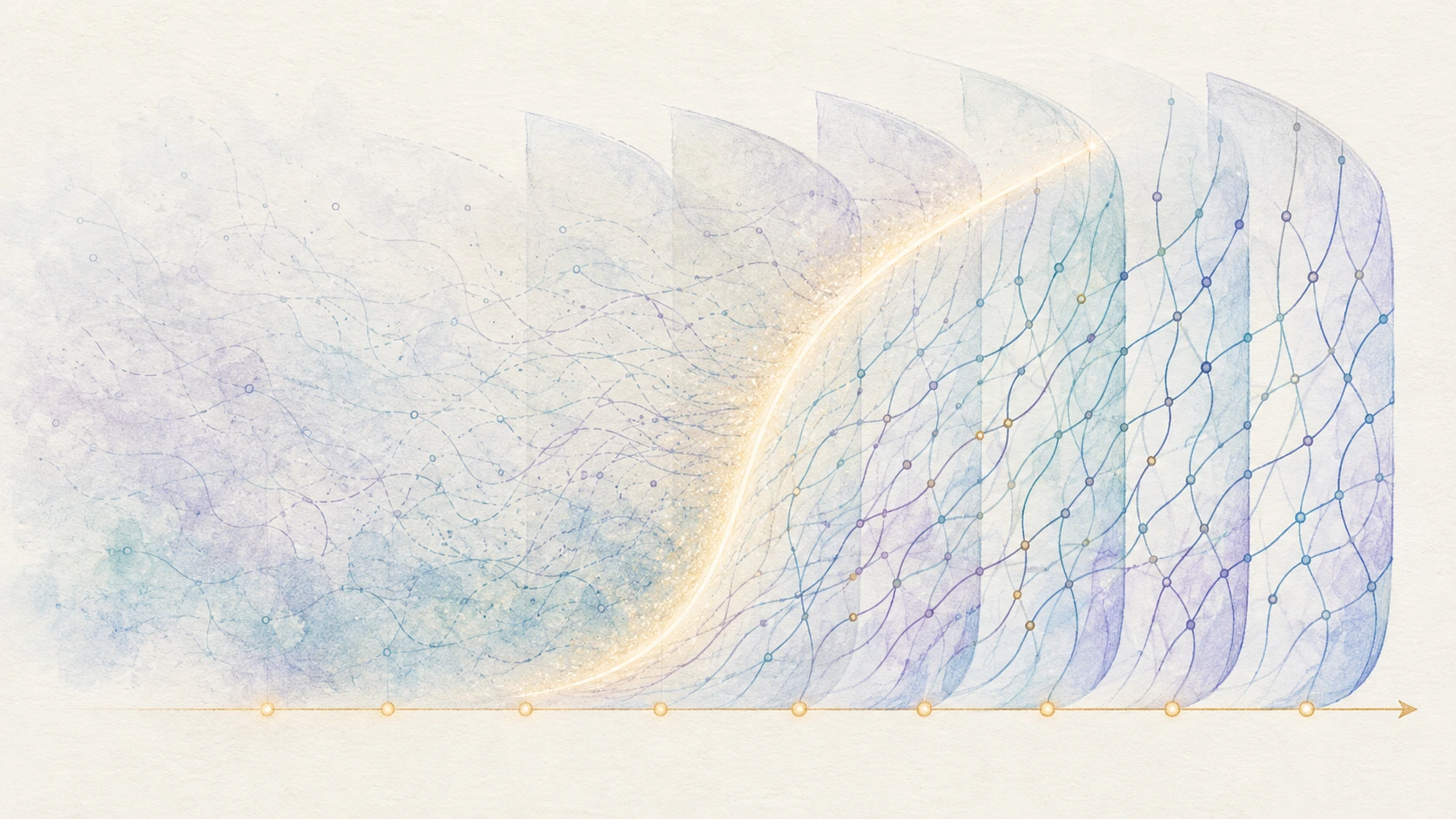
The picture is deliberately unusual. The basic objects are not wavefunctions. They are worldlines: paths through spacetime that can evolve as tau changes. The paper imagines spacetime as progressively “crystallizing” along the time dimension. Behind the crystallization front, configurations have relaxed into stable outcomes; ahead of it, the future is not yet organized in the same way.
For an observer inside the system, only the equilibrated outcomes are accessible. The observer does not see tau directly. The observer reconstructs an ordinary four-dimensional history from the sequence of outcomes that have crystallized.
That is how the paper tries to get two things at once: a determinate, classical underlying dynamics, and the appearance of ordinary time, measurement outcomes, and quantum-like behaviour from inside the system.
Gravity first: Newton, then pieces of Einstein
The gravitational part of the paper begins in the weak-gravity limit. The author writes a relaxation equation for a gravitational potential. When the system reaches equilibrium with respect to tau, that equation reduces to the usual Newtonian Poisson equation for gravity.
The paper also gives worldlines their own relaxation rule. In equilibrium, the worldlines are driven toward the paths expected from Newtonian gravity. The numerical examples are intentionally simple: for example, a static mass and a two-mass system relaxing toward a Newtonian spacetime.
The author then extends the same idea toward general relativity. Instead of only relaxing a Newtonian potential, the framework relaxes the spacetime metric itself. In equilibrium, worldlines become geodesics: the paths followed by freely falling objects when no force other than gravity acts, the curved-spacetime counterparts of straight lines. The geometry is meant to recover basic features of general relativity.
The caveat matters. The paper is not a full derivation of every strong-field prediction of general relativity. It explicitly leaves strong-field regimes, singularities, gravitational redshift, gravitational waves, and richer worldline behaviour for future work. The claim is that the framework can recover Newtonian gravity in the weak limit and basic general-relativistic structure in a smoother setting, not that it has replaced the whole tested machinery of Einstein gravity.
The Bell-test move: change the spacetime assumption
The hardest part of any classical account of quantum mechanics is nonlocality.
Bell’s theorem tells us that, under the standard assumptions, no local hidden-variable model can reproduce all quantum correlations. Experiments have repeatedly violated Bell inequalities. That is why ordinary four-dimensional classical pictures fail.
Bell inequalities in plain language
Imagine that two particles leave the same source carrying hidden instruction sheets. Far apart, Alice and Bob independently choose how to measure their particles. If each result is fixed by its local instruction sheet, neither side can be affected by the other’s choice, and the settings are statistically independent of those instructions, Bell inequalities put a ceiling on how strongly the two sets of results can correlate. Real experiments exceed that ceiling. The conclusion is not that one particular alternative wins, but that realism, locality and statistical independence cannot all be retained together.
For a step-by-step derivation of the local bound, the quantum prediction and the experimental tests, see our guide to Bell’s theorem.
The paper’s answer is not to deny Bell’s theorem. It changes the setting in which the theorem is being applied. In the 4D + tau framework, influences can propagate along worldlines as the configuration evolves in tau. From the viewpoint of ordinary spacetime, this can look like a nonlocal correlation. From the viewpoint of the proposed underlying dynamics, the interaction is local along the relevant worldlines in tau.
The paper models an EPR-type experiment with two photons measured by Alice and Bob. The model reproduces the standard quantum correlations for a maximally entangled polarization state. The formal price is explicit: the model fully relaxes statistical independence, with Alice’s measurement preconditioning Bob’s state through the tau dynamics. The mechanism is not standard quantum collapse; it is a tau-driven relaxation of polarization states along connected worldlines.
What Alice and Bob actually compare
A source sends one photon to Alice and its partner to Bob. Each uses a polarizing beam splitter set at a chosen angle and records one of two outcomes: pass or deflect. A single pair cannot reveal the correlation. The test comes from repeating the experiment and comparing how often the two outcomes match as the angle between the splitters changes. Quantum theory predicts correlations stronger than local, statistically independent hidden instructions allow. In Strubbe’s model, Alice’s measurement occurs first in tau; polarization relaxation then propagates along the connected worldlines, back through their common source and onward along Bob’s path, so Bob’s state is already conditioned when he measures. That reproduces the correlation in the model, but only by changing the causal setting and giving up statistical independence.
This is the part that needs the strongest boundary. Reproducing one EPR-type model inside a proposed framework is not the same as deriving all of quantum theory from classical mechanics. The paper itself notes that deviations from standard quantum predictions might appear if information transfer along worldlines were too slow, or if spatial separations became large enough that one measurement completed before the relevant outcome information had propagated in tau.
That is a prediction lane, not a victory lap.
The double slit, rebuilt as moving worldlines
The second quantum showcase is double-slit interference.
The paper models a massive particle, specifically a neutron, as a bundle of worldlines rather than as a single classical point or a standard quantum wavefunction. In the example, the neutron has a de Broglie wavelength of 2 nm and a velocity of 2,000 m/s. The simulated slit width is 10 nm and the slit separation is 25 nm, chosen smaller than typical neutron-interference experiments to make the pattern visually clearer.
The worldline bundle evolves under an entropic rule. The density of worldline endpoints produces an interference-like distribution, while one selected “momentum worldline” carries energy and momentum and determines the actual detection event. That is the paper’s way of separating wave-like behaviour from particle-like outcome without invoking intrinsic quantum superposition.
The paper then asks what gravity would reveal. In each simulated neutron, the many worldlines contribute to the interference-like density, but only the selected momentum worldline carries energy and momentum and sources gravity. The model places one idealized gravitational probe at the midpoint between the slits and two more symmetrically to the left and right. If the momentum worldline passes through the right slit rather than the left, the tiny gravitational response shifts with it. Reading that asymmetry would reveal the chosen slit, while the full bundle of worldlines would still build the interference pattern on the screen. The estimated acceleration signal is roughly , and the paper explicitly sets practical measurement limitations aside.
That number is important because it keeps the claim honest. The proposal is not that someone has already measured which-way gravitational information without disturbing interference. It is that, in this model, such information should in principle be accessible because the gravitational field is tied to one definite worldline, not to a superposition of both paths.
That directly disagrees with the standard quantum expectation that which-way information destroys interference. It also gives the framework a possible empirical pressure point.
What this does not prove
- It does not prove that quantum gravity has been solved.
- It does not prove that gravity is classical in nature.
- It does not refute Bell’s theorem; it changes the spacetime-causality setting and relaxes statistical independence in the model.
- It does not reproduce all of quantum mechanics. The paper models selected phenomena and leaves a full quantum formalism for future work.
- It does not show that general relativity has been fully recovered in strong-field regimes.
- It does not make wavefunctions, Hilbert spaces, complex numbers, or quantum field theory useless.
- It does not provide experimental confirmation. The work is theoretical and simulation-based.
The clean boundary is this: the paper proposes a higher-dimensional classical framework that can imitate several hard behaviours. It has not shown that nature actually uses that framework.
What would make it testable?
The most valuable part of the paper is that it does not stay purely philosophical. It points to places where the framework could differ from standard quantum theory.
One prediction concerns EPR-type experiments. If the tau-mediated information transfer along worldlines is not effectively instantaneous relative to the crystallization process, then sufficiently separated or fast measurement setups might deviate from the usual quantum correlations.
Another prediction concerns double-slit experiments with massive particles. The model says gravitational which-way information could, in principle, be extracted without eliminating the interference pattern. That is a sharp contrast with standard quantum reasoning, although the proposed signal is extremely small and practical feasibility is not established.
A third prediction concerns proposals to test whether gravity can mediate entanglement between masses. Many current quantum-gravity test proposals take gravitationally mediated entanglement as evidence that gravity must have quantum features. In Strubbe’s framework, the gravitational field is assigned to a single definite worldline, so gravitationally induced entanglement of that kind should not occur.
Those are not minor differences. They are exactly the kind of differences a speculative framework needs if it wants to be more than an interpretation.
How strong is the evidence?
The evidence is strongest as an internal consistency demonstration.
The paper lays out equations, simulations, and model examples showing how its 4D + tau machinery can recover Newtonian gravity in equilibrium, move toward general-relativistic structure, reproduce an EPR correlation model, and generate a double-slit-like interference pattern for a massive particle.
But the evidence is not yet strong as evidence about the world.
The demonstrations are selective. The framework has not been extended to a complete quantum formalism. The strong-gravity cases are not solved. The proposed experimental deviations have not been observed. The data availability statement says the datasets generated and analysed in the study are available from the corresponding author on reasonable request, but the core claim is not a new measurement; it is a theoretical construction.
That is not a flaw by itself. New frameworks often begin as constructions. But a clean reading should keep construction, simulation, prediction, and confirmation in separate boxes.
Why it matters
Foundations papers can sound grand because their vocabulary is grand: quantum gravity, nonlocality, time, realism, determinism. The danger is that the headline becomes bigger than the result.
This paper is worth reading because it attacks a real pressure point. Standard quantum theory and general relativity do not fit together cleanly. Bell-type correlations really do defeat ordinary local classical explanations in standard spacetime. Measurement and time remain conceptually difficult. A framework that says “maybe the spacetime assumption is the wrong place to start” is not automatically correct, but it is asking a legitimate question.
The interesting move is not nostalgia for old classical physics. It is the price of making a classical picture work: ordinary spacetime causality is no longer the whole causal arena. The framework buys realism and determinism by adding tau-dynamics that observers cannot directly access.
Whether that price is acceptable is a physics question, not a slogan. The paper’s own predictions are where that question should be tested.
Clean summary
Filip Strubbe proposes a five-dimensional classical framework in which ordinary four-dimensional spacetime evolves under an additional parameter, tau. In equilibrium, the framework recovers Newtonian gravity in the weak-gravity limit and aims to recover basic general-relativistic structure beyond it. It also models two quantum phenomena: EPR-type correlations through influences propagating along worldlines in tau, and double-slit interference through a bundle of worldlines whose density behaves wave-like while one momentum worldline determines the outcome. The proposal is theoretical and simulation-based. Its importance is not that it solves quantum gravity, but that it makes a concrete classical alternative with possible experimental differences, including gravitational which-way information and negative expectations for some gravity-mediated entanglement tests.
No-BS check
What the paper shows: A proposed 4D + tau classical framework can reproduce selected gravitational and quantum-like behaviours in models: Newtonian gravity in equilibrium, basic general-relativistic structure, EPR-type correlations, and double-slit-like interference.
What is plausible but not proved: That this framework could become a real alternative path toward quantum gravity. The paper gives a route and predictions; it does not establish that nature follows it.
What it does not show: It does not solve quantum gravity, refute quantum mechanics, refute Bell’s theorem, or experimentally prove that gravity is classical. It also does not provide a complete replacement for the full quantum formalism.
Main limitation for a general reader: The paper’s key move is to add a tau-dynamics outside ordinary spacetime. That may be physically fruitful, but it is also the assumption doing much of the work. Do not confuse “classical inside a larger framework” with “ordinary classical physics was right all along.”
How much confidence should a general reader have? Moderate confidence that the paper presents a serious and explicit theoretical construction; low confidence that it is the final answer. The right takeaway is not belief or dismissal, but a sharper question: can its proposed deviations from standard quantum theory be made experimentally testable?
Sources
Based on: A five-dimensional classical framework for gravitational and quantum phenomena — Filip Strubbe, Scientific Reports 16, Article 2965 (2026).
The source paper is open access under CC BY-NC-ND 4.0. The Clean Paper does not reuse or adapt its figures.
Written by
Matteo Riga · figures and links by
Nova Vela · edited by
Michele Renda
· figures and links by
Nova Vela · edited by
Michele Renda
The Clean Paper · 20 August 2026 · Text on this site is licensed under CC BY-SA 4.0. Images are licensed separately. 


Editorial note
This article was written by AI and reviewed by the editorial team. It is a clear, conservative explanation of the linked work, not a substitute for reading it. Responsibility for selection, interpretation, and final wording rests with the editor.