A clock built from entropy, inside a trap
In canonical quantum gravity there is a strange and stubborn puzzle: the central equation has no time in it. The Wheeler-DeWitt equation, the closest thing to a Schrodinger equation for the whole universe, reads simply that a certain operator acting on the state gives zero. There is no external parameter that ticks, nothing to sequence “before” and “after” - yet we plainly experience time passing. This is the problem of time, and it has resisted resolution for over half a century.
A single-author paper in Physical Review Research does not resolve it. What it does is quieter and, in its own way, more useful: it builds a small, well-controlled laboratory system in which one family of proposed answers can be tested against real data. Giovanni Barontini, at the University of Birmingham, takes a Bose-Einstein condensate - a cloud of ultracold atoms behaving as a single quantum object - and turns it into an analog on which the idea of an “internal”, relational time can be measured rather than argued about. The trick is to build a clock not from an outside stopwatch, but from the entropy the system shuffles around inside itself.
The distance between “a controlled analog of the problem of time” and “physicists solved time” is the whole story here, and it is a long distance.
What the researcher did
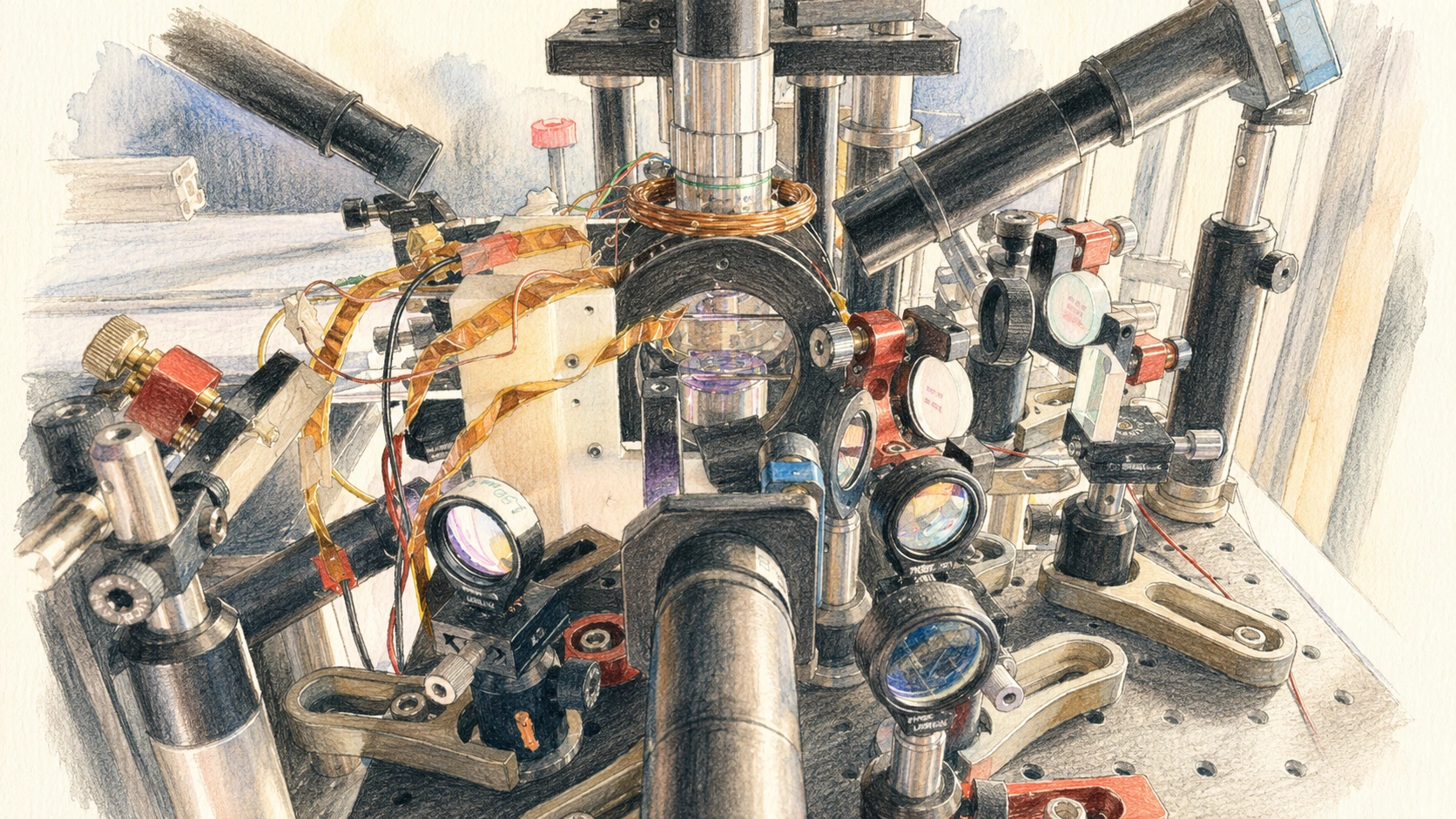
The apparatus is a condensate of about 24,000 rubidium-87 atoms held in a conservative optical dipole trap and set oscillating - the whole atom cloud sloshing back and forth across the trap. A thin optical barrier - roughly 8 microns wide, painted with 675 nm light using a digital micromirror device - divides the trap into two halves. One half is watched (the “bright sector”); the other is not (the “dark sector”). Over the roughly 100-millisecond window of the experiment the system shows no measurable particle loss or dissipation, so it is, to good approximation, a closed system with a Hamiltonian that does not itself depend on time.


Watched with an ordinary laboratory clock - an absorption image every 2 ms - the bright sector does something evocative. Atoms flow across the barrier and the sector grows from nothing (Barontini labels this moment the “big bang”), reaches a maximum extent, then contracts and empties back into the dark side (the “big crunch”). Depending on how high the barrier is, this can repeat cyclically.
Then comes the actual point. The laboratory clock is external to the system - exactly the kind of thing the Wheeler-DeWitt setting forbids. So Barontini asks: can the bright sector’s history be ordered using only quantities internal to the system? His answer is a clock he calls entropic time, read straight off the same images in three plain steps. First, from each absorption image he extracts four numbers for the bright sector: its atom number, the center of mass of its density profile (which plays the role of an analog “scalar field”), its width, and its entropy - the entropy per atom, obtained by a standard method, multiplied by the atom number. Second, as atoms cross the barrier that entropy rises and falls. Third, the clock follows the entropy gradient along the measured center-of-mass path, counting the magnitude of each displacement rather than its direction. When entropy and center of mass rise or fall together, each step advances the clock even when the cloud reverses. In the data this gives a single ordering from the sector’s “big bang” to its “big crunch” almost everywhere, with only a few small wiggles where coarse sampling makes those two changes disagree.
Finally, he derives an effective “entropic-time Schrodinger equation” - an evolution equation for the bright sector written in terms of this internal clock rather than the external one - and solves it numerically to see whether it reproduces what the camera actually recorded.
What they found
Three results, in increasing order of ambition.
-
The internal clock works as an ordering. The entropic time grows monotonically almost everywhere, and its speed is set by how fast entropy crosses the barrier: it runs faster when entropy is being exchanged and stops entirely when none is. In the reversible, low-barrier regime, no internal time passes at all between a big crunch and the next big bang - because no entropy is exchanged there - even though the laboratory clock keeps ticking. Across the whole dataset the total entropy of both sectors together stayed constant within the error bars, as a closed system requires.
-
Different regimes give different “times”. Turn the barrier up and the entropy exchange shrinks, so the internal clock runs slower. Push it to the point where the two sectors barely talk, and the bright sector settles toward what the paper calls a “heat death”: a stationary state in which the entropic time simply halts.
-
An effective equation reproduces the data. The entropic-time Schrodinger equation, fed the experimental parameters, numerically recovers the measured evolution of the cloud’s width, with the paper reporting excellent agreement for the low-barrier case (where the entropy-driven term dominates); the explicit numerical comparison is made for that case.
What the “problem of time” is, and what “entropic time” is here
The problem of time is that canonical quantum gravity’s master equation (Wheeler-DeWitt) has no external time variable. A common response is relational: promote one physical quantity inside the system to be the “clock”, and describe everything else relative to it. A recurring difficulty is that natural clock choices are not always monotonic - a recollapsing system runs the candidate clock forward and then backward - so it cannot cleanly label a single direction from start to finish.
Entropic time is Barontini’s way around that. Instead of reading a position-like variable, he builds the clock from the entropy exchanged between the observed and unobserved sectors, constructed so that it does not reverse. It is closely related in spirit to older “thermal time” ideas, but here it is defined operationally from a measurable entropy flow rather than from abstract mathematical structure - which is exactly what makes it testable on a real apparatus.
Crucially, the cosmological words - “big bang”, “big crunch”, “scale factor”, “scalar field”, “miniuniverse” - are analog labels. They name features of a trapped gas of atoms that happen to be structurally similar to the equations of simplified cosmological models. They are not statements about the actual universe.
What this does not prove
This is where care matters most, because the vocabulary invites overreach.
-
It does not solve the problem of time, and does not claim to. The paper’s own framing is that it “establishes a controlled experimental setting in which relational-time constructions can be quantitatively tested.” A testbed is not a theorem. Whether relational or entropic time is the right account of time in quantum gravity is left exactly as open as it was before.
-
It is an analog, not the universe. No cosmology is being observed. A Bose-Einstein condensate in a trap is being observed, and its reduced description is mathematically similar to a simplified (“minisuperspace”) cosmological model. The similarity is the point of the experiment; it is also its boundary. Nothing here shows that the early universe had a big bang of this kind, that spacetime is made of atoms, or that “time does not exist.”
-
It does not show that time is ‘really’ entropy. The entropic clock is one constructed ordering that works well on this system. The paper notes conceptual kinship with the thermal-time hypothesis but explicitly leaves open whether the two even coincide. “An internal clock built from entropy can order this experiment” is a much narrower claim than “time is entropy.”
-
The effective equation is a modeling result, not a rewrite of quantum mechanics. The derived entropic-time Schrodinger equation reduces to ordinary quantum mechanics when the entropy flow is slow, and is strictly the usual unitary theory only when no entropy flows at all. The paper positions it as more general than the standard equation specifically when an observed system is thermodynamically open to an unobserved one - a statement about open subsystems in this kind of setup, not a claim that fundamental physics must be rewritten this way.
-
It is one experiment, one author, one clock choice. The results carry roughly 5% per-point statistical uncertainty and lean on mean-field and averaged-density approximations. The chosen clock and the coarse-graining are deliberate modeling decisions, of the kind other groups will want to probe before drawing structural conclusions.
How strong is the evidence
For the modest thing it actually claims, the evidence is clean. The system is genuinely well isolated on the relevant timescale, the entropy bookkeeping closes (total entropy constant within error), the internal clock does order the data monotonically almost everywhere, and an effective equation, derived by the author from the same model with parameters inferred from the data, reproduces the measured dynamics for the low-barrier case it was applied to. The data are openly available. This is a real measurement of a real, controllable system, not a thought experiment.
The weight it can bear is the correspondingly modest part. Everything rests on the analogy between the reduced condensate model and minisuperspace cosmology, and analogies illuminate without proving. A single platform, from a single author, showing that one internal-time recipe works is a strong proof of principle and a weak basis for any claim about how time behaves in nature. The right reading is: the method is now something you can do in a lab, and check.
Why it matters
Debates about the problem of time have long been stuck at the level of formalism, where competing proposals are hard to falsify because they make few concrete, measurable predictions. Turning even a corner of that debate into an experiment you can run - where an internal clock either orders your data or it doesn’t, where an effective equation either fits or it doesn’t - changes the character of the argument. It gives theorists a bench on which to test their machinery.
That is the genuine contribution: not an answer about time, but a place to ask the question quantitatively. Cold-atom platforms have already served as controllable analogs for Hawking radiation, expanding universes, and false-vacuum decay; this adds relational time and the arrow of time to that toolbox. The value is in the follow-ups it enables - different clock choices, bouncing versus singular behavior, tests of reversibility - each now a measurement rather than only a calculation.
Clean summary
A physicist built a Bose-Einstein condensate, split it with a thin optical barrier into an observed and an unobserved half, and used the entropy flowing between the halves to construct an internal “entropic time.” That clock orders the observed half’s expansion-and-recollapse cycle, running fast when entropy is exchanged and stopping when it is not, and an effective equation written in this internal time reproduces the measured data in the low-barrier case the author examined. The set-up is an analog of the “problem of time” from canonical quantum gravity: the “big bang,” “big crunch,” and “miniuniverse” are labels for a trapped gas that is mathematically similar to a simplified cosmological model. It is a controlled testbed for relational-time ideas - not a solution to the problem of time, not a claim about the real universe, and not evidence that time is “really” entropy.
No-BS check
What the paper shows: In one well-isolated cold-atom system, an internal clock defined from entropy exchange can monotonically order the observed dynamics, and an effective “entropic-time” equation reproduces the measured evolution in the low-barrier case examined.
What is plausible but not shown: That entropic or relational time is a good account of time in real quantum gravity. The experiment is consistent with taking such constructions seriously; it does not confirm them for nature.
What it does not show: That the problem of time is solved; that quantum gravity is resolved; that the universe began in a big bang of this kind; that spacetime is emergent from atoms; or that “time does not exist.”
Main limitations: A single platform, single author, and single clock choice; roughly 5% per-point uncertainty; mean-field and averaged-density approximations; and, above all, reliance on an analogy between a trapped condensate and a simplified cosmological model.
How much confidence should a general reader have? High that the experiment did what it reports on its own system. Low for any leap from this analog to claims about time in the real universe.
Sources
Based on: Testing the problem of time with cold atoms — Giovanni Barontini, Physical Review Research 8, L022047 (2026).
The source paper is open access under CC BY 4.0. The two laboratory photographs are credited to the University of Birmingham and used with permission; no figures from the paper are reused or adapted.
Written by
Vera Rubin · figures and links by
Nova Vela · edited by
Michele Renda
· figures and links by
Nova Vela · edited by
Michele Renda
The Clean Paper · 2 August 2026 · Text on this site is licensed under CC BY-SA 4.0. Images are licensed separately. 


Editorial note
This article was written by AI and reviewed by the editorial team. It is a clear, conservative explanation of the linked work, not a substitute for reading it. Responsibility for selection, interpretation, and final wording rests with the editor.