Earth Sciences
The mind seemed to grow giddy by looking so far into the abyss of time.
— (1802)
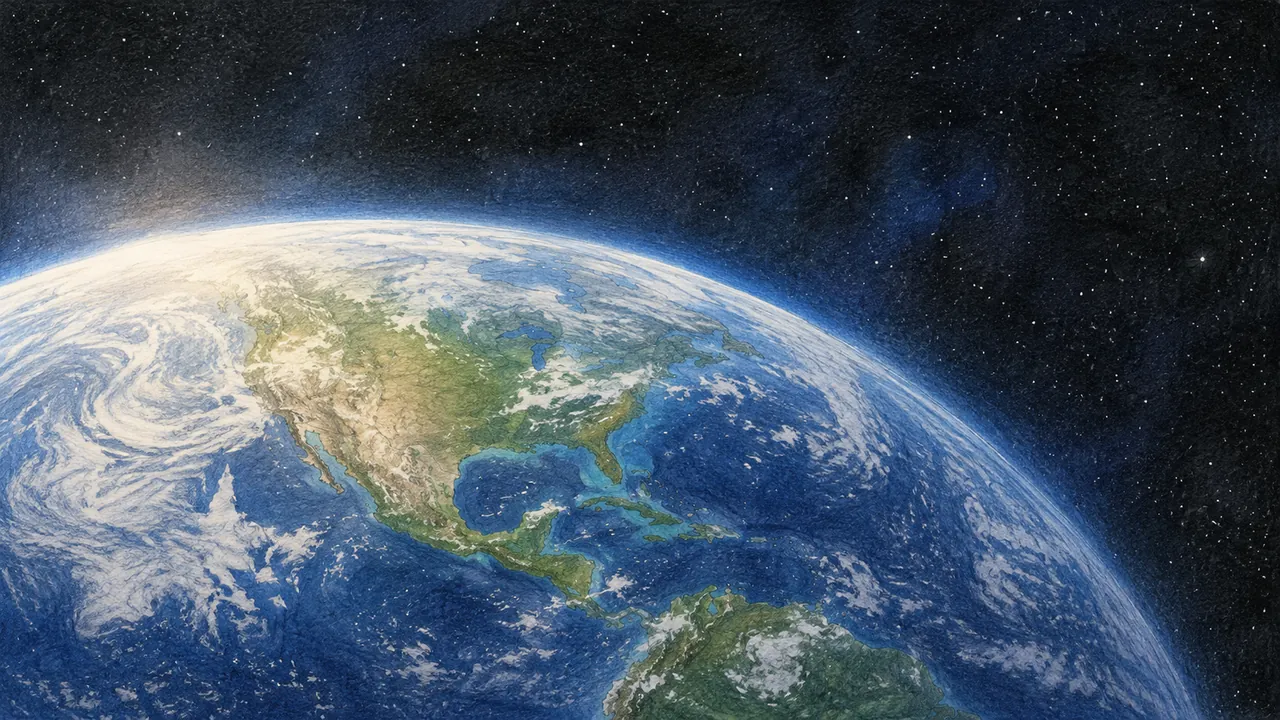
How long can Earth stay green? A climate model offers ranges, not a doomsday date
Twenty-nine three-dimensional climate simulations place different limits on Earth's photosynthetic biosphere between roughly 1.35 and 1.87 billion years from now. The values depend on deliberately simplified paths for rock weathering, heat and the lowest carbon-dioxide levels plants might use. They do not predict when all plants, all life, civilization or the planet will end.
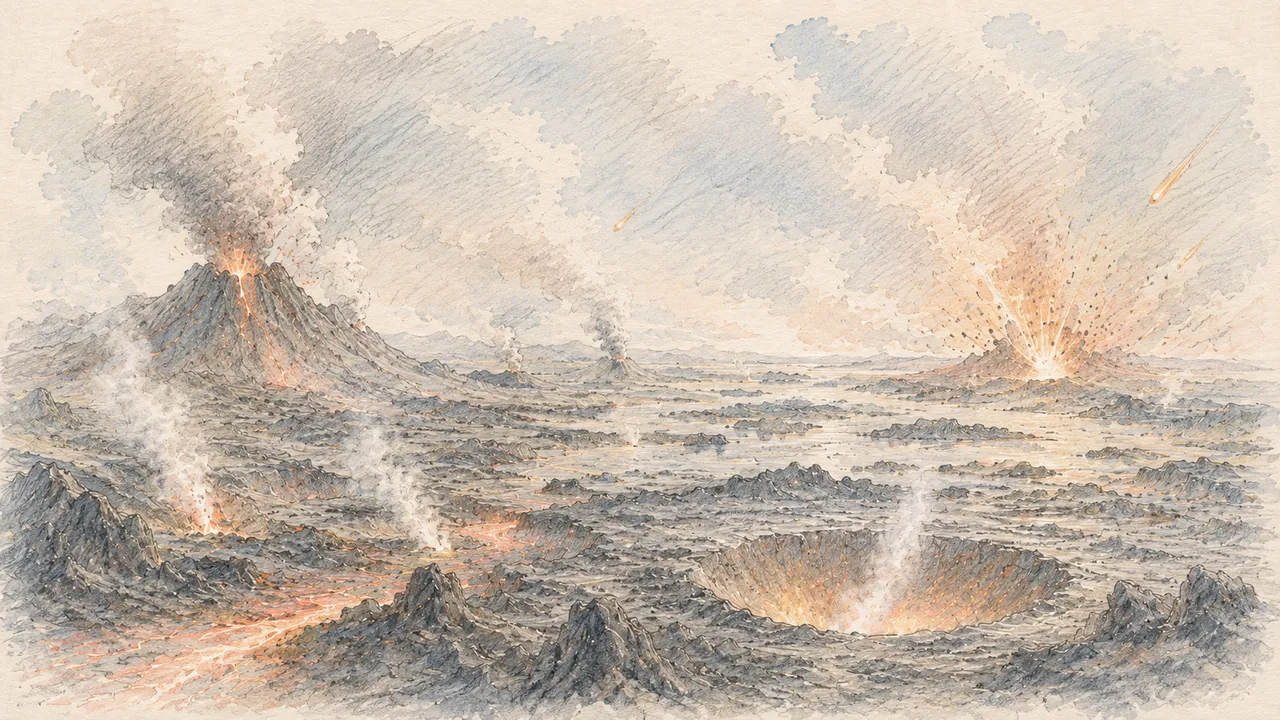
A thin, half-molten first crust: a model where impacts, not internal heat, ran the Hadean
Earth's first eon, the Hadean, left almost no rock record. This modelling study asks what the crust would have been like once you stop ignoring impacts. Using a stochastic, declining impact-flux model and benchmarked simulations of crust and mantle heat flow, the authors find that impact heat would have exceeded Earth's entire internal heat by at least an order of magnitude for most of the Hadean, leaving a thin crust (under ~5 km) partially molten just a few kilometres down — too weak, they argue, for plate tectonics, and prone to recycling itself back into the mantle, which would explain why so little Hadean material survives. As impacts waned after ~3.9 Ga (about 3.9 billion years ago), lasting continental crust could form, right when the oldest surviving felsic rocks appear — 'likely not a coincidence,' in the authors' careful words. Because they deliberately used conservative, lower-bound heating, the qualitative result is robust even though the exact numbers are not fixed. It is a strong, coherent model of Earth's infancy — not a direct observation of it.