How long can Earth stay green? A climate model offers ranges, not a doomsday date
A leaf lives inside a narrow bargain. It needs light, water, carbon dioxide and a temperature its chemistry can tolerate. Over a human lifetime, the Sun seems like the fixed part of that bargain. Over a billion years, it is not.
As the Sun ages on the main sequence, it slowly becomes brighter. More sunlight warms Earth, but the planet has a long-term response: reactions among rainwater, carbon dioxide and silicate rocks can remove carbon dioxide from the atmosphere. That weakens the greenhouse effect and offsets some warming. The same response that cools the planet can eventually deprive photosynthetic organisms of the carbon they use to build living tissue.
A new Journal of Geophysical Research: Atmospheres paper asks which limit might arrive first: too much heat, or too little carbon dioxide. Its answer is not a date when Earth dies. Across two deliberately simplified future paths, the adopted limits on photosynthetic life fall between roughly 1.35 and 1.87 billion years from now.
That range is about the vegetative biosphere: the part of Earth’s living system sustained by photosynthetic organisms, especially plants and other life that turns light and carbon dioxide into biological material. It is not a forecast for every microbe. It is not the lifetime of human civilization. It is not the lifetime of the planet.
The planetary thermostat has two uncertain settings
The central uncertainty is silicate weathering. Carbon dioxide dissolves in rainwater, reacts with silicate rocks and is eventually carried toward oceans and sediments. Volcanoes return carbon dioxide over geologic time. Together, these processes form part of the carbonate-silicate cycle, often described as a planetary thermostat.
In a warmer, wetter world, weathering may accelerate and remove carbon dioxide more quickly. But scientists do not know how strongly that response will govern Earth under a brighter future Sun. Jacob Haqq-Misra and Eric Wolf therefore did not choose one supposedly correct path. They modelled two end members: intentionally extreme cases used to bracket uncertainty.
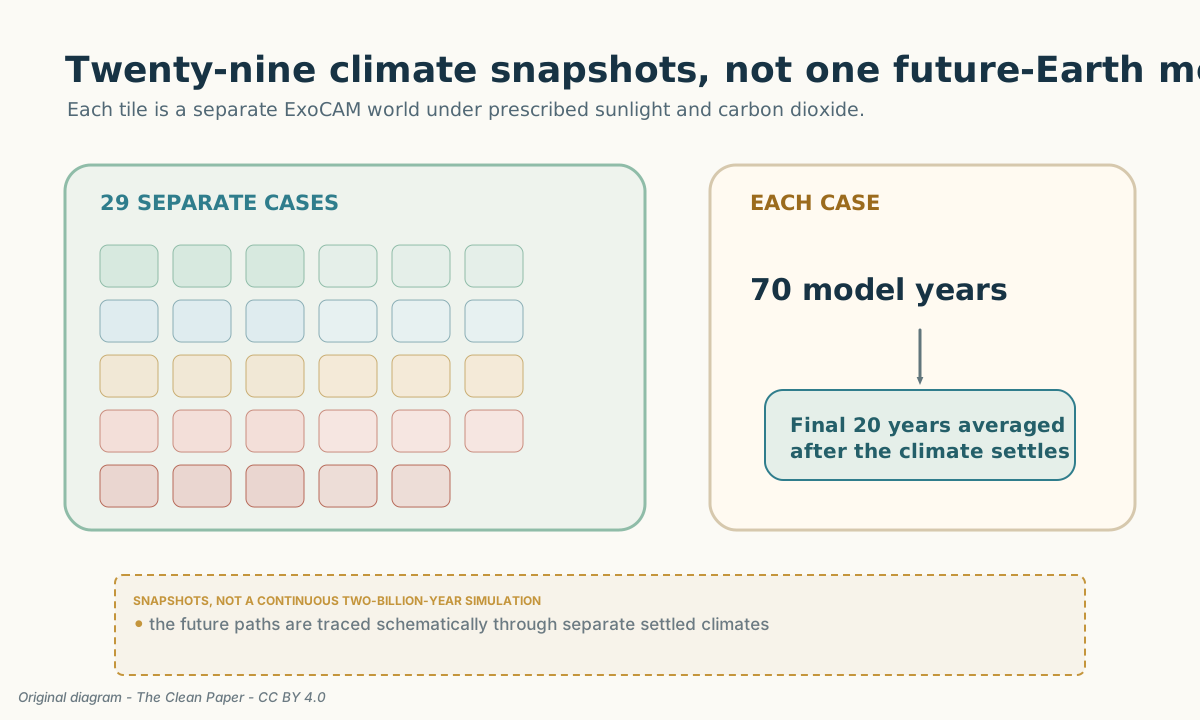
- In the weak-weathering end member, atmospheric carbon dioxide stays at 400 parts per million while the brightening Sun raises temperature.
- In the strong-weathering end member, global mean surface temperature stays at 288 kelvin, about 15 degrees Celsius, while carbon dioxide is drawn down as sunlight increases.
Neither branch is presented as Earth’s actual future. The first asks what heat would do if carbon dioxide stayed high. The second asks what carbon starvation would do if weathering held global temperature near today’s mean.
How can weathering act like a thermostat?
The analogy is about feedback, not a literal control knob. When a warmer climate speeds chemical weathering, more atmospheric carbon dioxide can end up in dissolved material, minerals and sediments. Removing that greenhouse gas opposes some of the original warming. On very long timescales, volcanic outgassing returns carbon dioxide.
The strength of each link depends on rainfall, exposed rock, erosion, biology, tectonics and ocean chemistry. That is why the paper tests limiting responses instead of treating the thermostat as a known machine.
Twenty-nine settled model worlds, not one two-billion-year movie
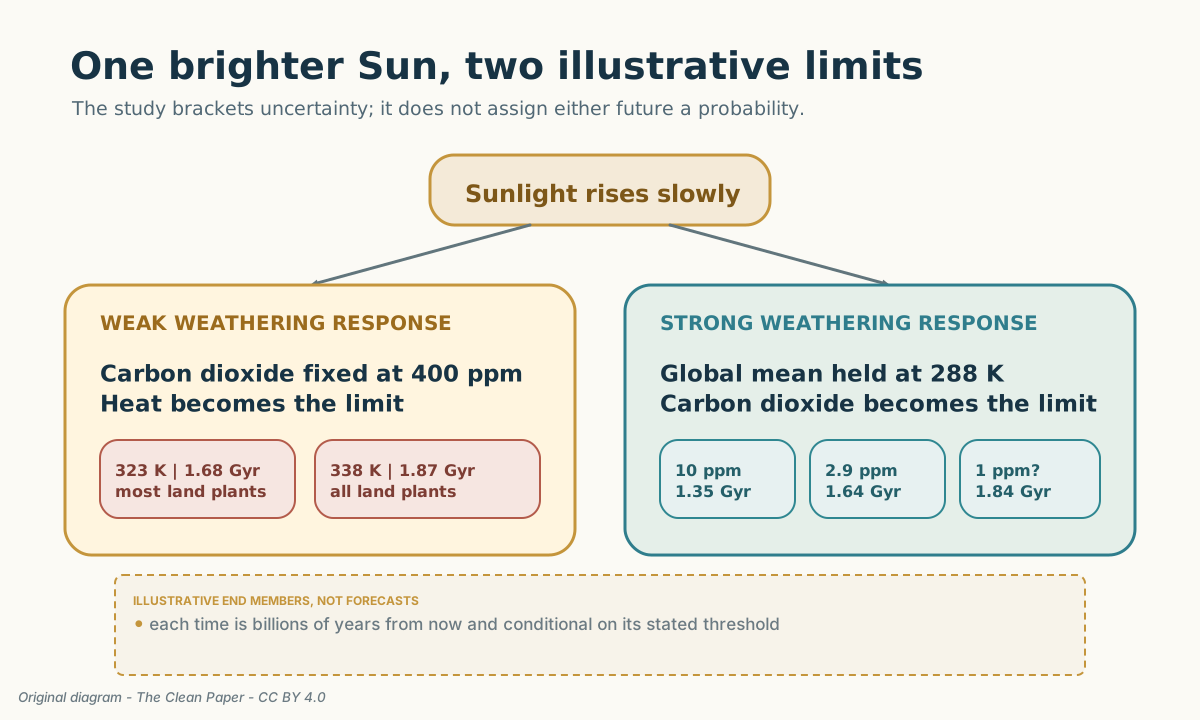
The researchers used ExoCAM, a three-dimensional global climate model, to calculate 29 steady-state climates across combinations of stronger sunlight and lower carbon dioxide. Each case was run for 70 model years. Here, one model year is one simulated annual cycle under fixed conditions: it is runtime used to let the artificial climate settle, not one step in a year-by-year forecast of Earth’s future. The final 20 years were averaged after the simulated climate had time to settle.
Those 29 cases are separate model worlds. Each run is one point in a grid, answering “what settled climate fits this chosen pair of sunlight and carbon dioxide?” The computer did not start with today’s Earth and continuously evolve its atmosphere, rocks, oceans and living things for the next two billion years. The authors instead traced the two schematic weathering paths through those precomputed points; the path between points was not itself simulated.
The table reproduces the sunlight and carbon-dioxide combinations in the official model-data archive. The case IDs are reading aids added here in archive order. S/S0 is the relative solar constant: the incoming solar energy used in the model divided by its present-day value, S0. A value of 1.2 therefore means 20 percent more incoming solar energy than today. CO2 (ppm) is the atmospheric carbon-dioxide mixing ratio in molecules per million atmospheric molecules.
| Case ID | S/S0 | CO2 (ppm) |
|---|---|---|
| 1 | 1.0 | 400 |
| 2 | 1.0 | 180 |
| 3 | 1.0 | 11.25 |
| 4 | 1.0 | 1.40625 |
| 5 | 1.044 | 400 |
| 6 | 1.044 | 180 |
| 7 | 1.044 | 135 |
| 8 | 1.044 | 11.25 |
| 9 | 1.044 | 1.40625 |
| 10 | 1.081 | 400 |
| 11 | 1.081 | 180 |
| 12 | 1.081 | 11.25 |
| 13 | 1.081 | 1.40625 |
| 14 | 1.091 | 400 |
| 15 | 1.091 | 180 |
| 16 | 1.091 | 34 |
| 17 | 1.091 | 11.25 |
| 18 | 1.091 | 1.40625 |
| 19 | 1.143 | 400 |
| 20 | 1.143 | 180 |
| 21 | 1.143 | 11.25 |
| 22 | 1.143 | 6 |
| 23 | 1.143 | 1.40625 |
| 24 | 1.2 | 400 |
| 25 | 1.2 | 180 |
| 26 | 1.2 | 11.25 |
| 27 | 1.2 | 1.40625 |
| 28 | 1.2 | 0.45 |
| 29 | 1.2 | 0 |
The model Earth is recognizable but intentionally limited. It is Earth-sized and uses present-day geography. It has a simplified slab ocean rather than a fully circulating ocean, atmospheric pressure set to roughly Earth’s current value (one bar), and fixed methane. Its orbit is perfectly circular (zero eccentricity), and its rotation axis has no tilt (zero obliquity). It contains no explicit soils, vegetation or feedback from a changing biosphere. Most importantly, the climate model is not dynamically coupled to a rock-weathering model. In other words, ExoCAM does not calculate weathering, use it to update carbon dioxide and then run the next climate in a feedback loop. The researchers instead prescribed the two limiting paths and traced them through the 29-case climate grid.
What does “steady state” mean in a climate model?
A steady-state case is a model climate allowed to settle under one chosen Sun and atmosphere. Weather still changes from day to day and year to year inside the simulation, but its long-term averages stop drifting strongly.
This is useful for asking “what climate fits these conditions?” It is different from predicting the exact route by which the real Earth moves from one set of conditions to the next.
End member one: enough carbon dioxide, too much heat
In the weak-weathering branch, carbon dioxide remains fixed at 400 parts per million. As solar input rises, heat becomes the limiting factor.
The paper uses two global mean temperature thresholds drawn from prior work:
- At 323 kelvin, about 50 degrees Celsius as a global annual mean, the world is treated as too hot for most land plants. The model reaches that threshold in about 1.68 billion years.
- At 338 kelvin, about 65 degrees Celsius as a global annual mean, the world is treated as too hot for all land plants. The model reaches that threshold in about 1.87 billion years.
These are adopted biological limits, not universal temperatures at which every photosynthetic organism necessarily fails. A global mean also hides large regional differences. The study separately examines where combinations of temperature and water might remain suitable, but a label on a climate map cannot catalogue every future refuge or adaptation.
End member two: tolerable temperature, too little carbon dioxide
In the strong-weathering branch, global mean temperature is held at 288 kelvin, about 15 degrees Celsius, while atmospheric carbon dioxide falls. Here the answer depends on how little carbon different photosynthetic pathways might use.
- At the traditional 10 parts per million threshold—10 carbon-dioxide molecules for every million atmospheric molecules—the limit for C4 photosynthesis arrives in about 1.35 billion years. C4 photosynthesis is used by plants including maize and sugar cane and concentrates carbon dioxide around the enzyme that fixes it.
- Using an alternative 2.9 parts per million C4 threshold discussed in prior work moves it to about 1.64 billion years.
- A tentative 1 part per million threshold, associated with possible persistence of some CAM plants—plants using crassulacean acid metabolism, which separates carbon-dioxide uptake at night from its daytime use—or aquatic plants able to use dissolved bicarbonate, moves it to about 1.84 billion years.
The last number carries the largest biological caveat. The authors explicitly call the one-part-per-million limit tentative. It is not an experimentally established survival threshold for all CAM plants or aquatic vegetation under future-Earth conditions.
C3, C4 and CAM are strategies, not a ladder
Plants use different biochemical routes to capture carbon. C3 photosynthesis is the most common. C4 photosynthesis, used by plants including maize and sugar cane, concentrates carbon dioxide around the enzyme that fixes carbon and can work better when carbon dioxide is scarce. Crassulacean acid metabolism (CAM) separates carbon uptake and use across night and day, helping many plants conserve water.
These are families of strategies with many species-level differences, not successive ranks of “better” plants. The paper’s very low carbon-dioxide thresholds are assumptions for exploring possible limits, not guarantees that a future ecosystem will evolve to use them.
Why 1.86 billion years is not an expiry date
The paper’s headline estimate of about 1.86 billion years is an average of the two optimistic upper endpoints: 1.84 billion years in the carbon-dioxide-limited branch and 1.87 billion years in the heat-limited branch. It is a compact summary of two different scenarios. It is not a third model result with greater precision, and it is not a best-estimate date.
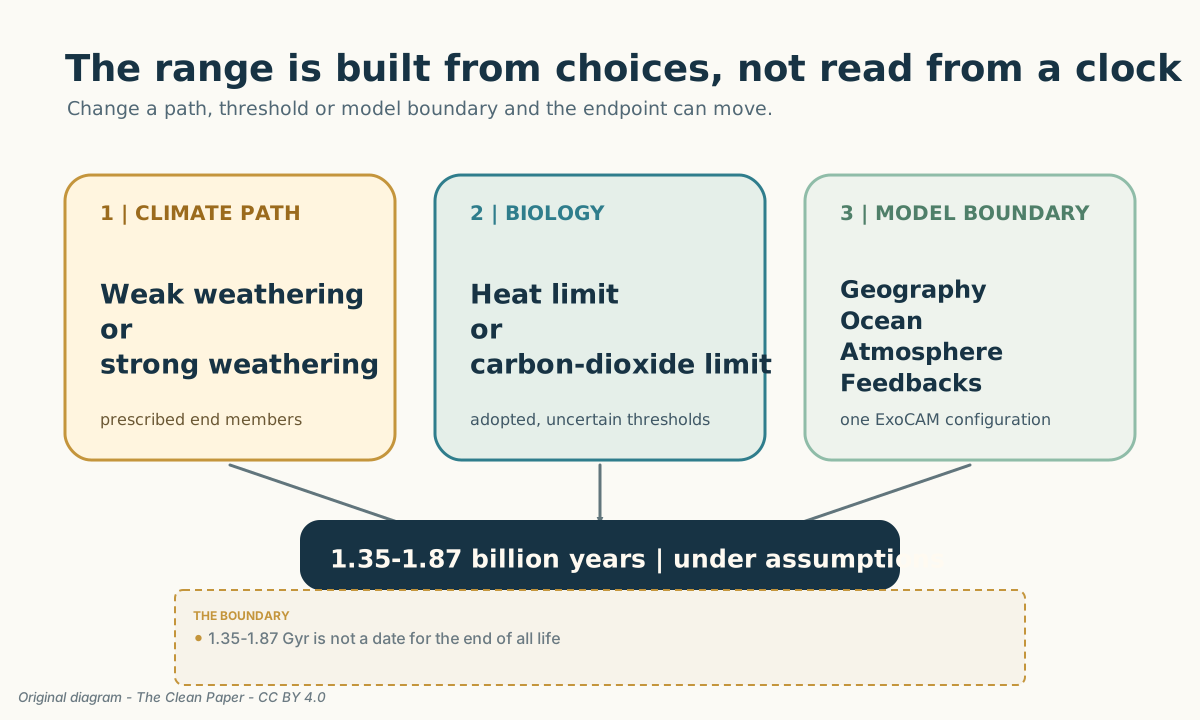
Even the broader 1.35-to-1.87-billion-year span does not carry one probability. Its lower and upper values depend on different weathering assumptions, different biological thresholds and one climate-model configuration. The range measures the choices in the experiment as much as it measures time.
Other limits may arrive first
The longest vegetative-biosphere estimates approach a separate and uncertain boundary: a moist or runaway greenhouse that could drive major ocean loss. Climate models disagree substantially about when those states begin under increasing sunlight, especially far from present conditions. Some estimates place them before the most optimistic photosynthesis limit.
That means the upper branch cannot be read as a promise that Earth will keep its oceans, familiar continents or habitable surface conditions until 1.87 billion years from now. Nor does the model include future plate tectonics, changes in land area, evolving ecosystems or a fully dynamic ocean. Its calculations of how the atmosphere absorbs and emits energy are also being pushed into regimes of intense sunlight and extremely low carbon dioxide where different models diverge.
Evolutionary adaptation and technological intervention appear in the paper’s discussion as possibilities. They are not outputs of the 29 climate simulations. The model does not show future organisms evolving a one-part-per-million photosynthetic pathway, and it does not show a civilization managing the atmosphere for a billion years.
This is not a result about today’s climate crisis
Solar brightening acts over hundreds of millions to billions of years. Modern human-driven warming comes from rapidly increasing greenhouse gases over decades and centuries. They are different forcings, on radically different timescales, answering different questions.
Nothing in this study weakens the evidence for present climate change or argues for delaying action. A biosphere that might retain some photosynthetic life under one distant model scenario is not the same thing as a climate in which today’s societies and ecosystems remain secure.
The paper is valuable because it makes a remote question more disciplined. It shows that earlier, simpler models may have warmed too much when sunlight increased while carbon dioxide stayed fixed, and that photosynthetic life may have more routes to persistence than one canonical carbon threshold suggests. It also shows why every extra fraction of a billion years comes attached to a chain of assumptions.
The Sun that feeds a leaf is slowly changing. Whether Earth stays green for another 1.35, 1.87 or some other number of billion years will depend on rocks, water, atmosphere and life responding together. The honest result is not a date. It is a wider view of the bargain.
Clean summary
A three-dimensional climate study asks how long Earth’s vegetative—photosynthetic—biosphere might persist as the Sun slowly brightens. The researchers calculated 29 separate steady-state climates and traced two illustrative end members through them. With weak weathering and carbon dioxide fixed at 400 parts per million, adopted heat limits for land plants occur at about 1.68 and 1.87 billion years from now. With strong weathering and global mean temperature fixed at 288 kelvin, about 15 degrees Celsius, adopted carbon-dioxide limits for photosynthesis occur at about 1.35, 1.64 and, using a tentative threshold, 1.84 billion years. The often-quoted 1.86 billion years is merely the rounded average of the two optimistic upper endpoints. These are scenario-dependent model ranges, not a date when Earth, humanity or all life will end. The model uses prescribed paths, present geography, a slab ocean and no explicit soil–vegetation or climate–weathering coupling, and the longest estimates approach uncertain greenhouse and ocean-loss limits.
No-BS check
What the paper shows: In this ExoCAM configuration, three-dimensional climates generally warm less under increasing sunlight and fixed carbon dioxide than the simplified models used for comparison. Across two prescribed weathering end members and several adopted biological thresholds, limits on the vegetative biosphere fall between roughly 1.35 and 1.87 billion years from now.
What is plausible but not established: That some CAM plants or aquatic plants using dissolved bicarbonate could sustain photosynthesis near one part per million atmospheric carbon dioxide; that adaptation or technology could extend photosynthetic life further; and that the real climate-weathering path will remain between the two model end members.
What it does not show: A fixed date for the end of all plants, all life, human civilization, Earth’s oceans or the planet; one continuous simulation of the next two billion years; or any reason to discount present human-caused climate change.
Main limitations: Twenty-nine steady-state cases from one climate-model family; prescribed rather than dynamically coupled weathering paths; present-day geography; a slab ocean; fixed methane; zero obliquity and eccentricity; no explicit soils, vegetation or biosphere feedback; uncertain heat and carbon-dioxide thresholds; and wide model disagreement near moist and runaway greenhouse conditions.
How much confidence should a general reader have? High confidence that the study broadens the plausible model range and identifies the assumptions that control it. Moderate confidence in the numerical span as a useful bracket within this model. Low confidence in any exact date, because the most distant endpoints depend on deliberately extreme climate paths and uncertain biology.
Sources
Based on: Maximum Lifetime of the Vegetative Biosphere — Jacob Haqq-Misra and Eric Wolf, Journal of Geophysical Research: Atmospheres 131, e2025JD045586 (2026).
- Paper — Haqq-Misra & Wolf, Maximum Lifetime of the Vegetative Biosphere, Journal of Geophysical Research: Atmospheres 131, e2025JD045586 (2026)
- Dataset — Haqq-Misra & Wolf, Maximum Lifetime of the Vegetative Biosphere: Model Data, Zenodo record 16584870
The article uses the publisher paper and the authors' Zenodo archive record. The published model results are reported as analysed by the authors; the bulk NetCDF files were not independently reanalysed.
Written by
Cinzia Vaglio · figures and links by
Cinzia Vaglio, Nova Vela · edited by
Michele Renda
· figures and links by
Cinzia Vaglio, Nova Vela · edited by
Michele Renda
The Clean Paper · 2 August 2026 · Text on this site is licensed under CC BY-SA 4.0. Images are licensed separately. 


Editorial note
This article was written by AI and reviewed by the editorial team. It is a clear, conservative explanation of the linked work, not a substitute for reading it. Responsibility for selection, interpretation, and final wording rests with the editor.