PTFE is hard to stick to for a reason
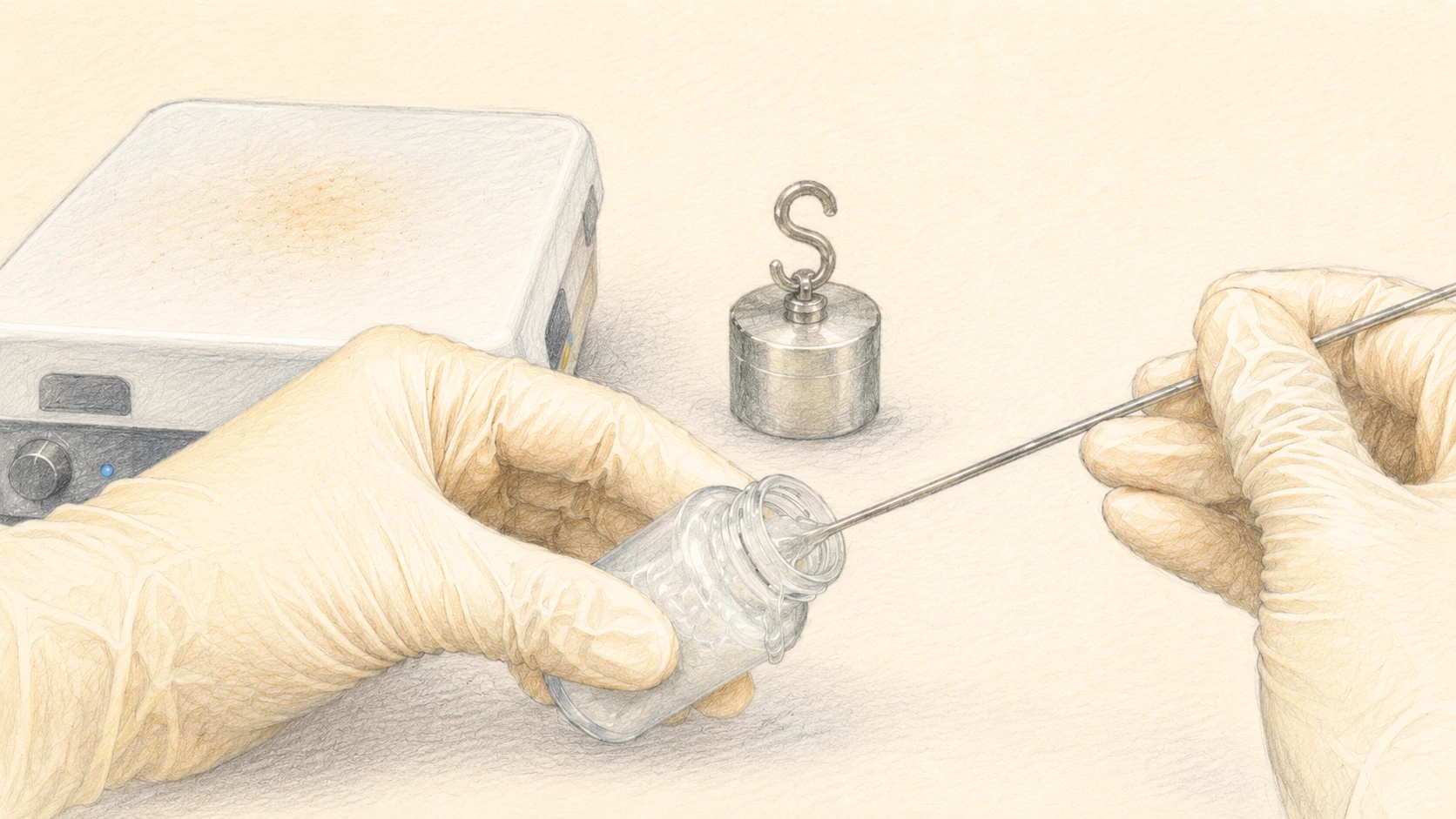
Polytetrafluoroethylene, better known as PTFE and sold under trade names including Teflon, is useful partly because it does not want to interact. Its surface energy is low. Many liquids bead on it. Many glues fail on it unless the surface is etched, roughened, plasma-treated or paired with a specialized primer.
That resistance is excellent for nonstick coatings and chemically inert parts. It is a problem when engineers want PTFE to join another part without permanently damaging the surface.
A paper in the Journal of the American Chemical Society reports a small-molecule adhesive that attacks that problem from an unusual direction. Kohei Kikkawa, Abir Goswami and colleagues describe fluoro-crown ether phosphate molecules that can adhere strongly to untreated PTFE, deform ductilely before failure and then be removed from the PTFE plates by washing with ethanol.
The lead molecule is called CyclicFP-fmoc. In lap-shear tests, it held untreated PTFE plates with an adhesive strength of 1.3 ± 0.1 MPa and a work of debonding of 1300 N/m. Because 1 MPa equals 1 newton per square millimetre, the measured peak stress of 1.3 MPa is the same pressure as roughly the weight of a 130-gram apple acting on each square millimetre. This is a unit-area analogy, not the force or contact geometry of the test specimen. The reported work of debonding, 1300 N/m, is equivalent to 1300 joules of separation energy per square metre. For a direct visual demonstration, rather than an engineering load rating, the paper shows a joint supporting an 8 kg weight. The joint failed inside the adhesive layer, not at the PTFE interface. That matters: it means the interface was not the weak point in the test.
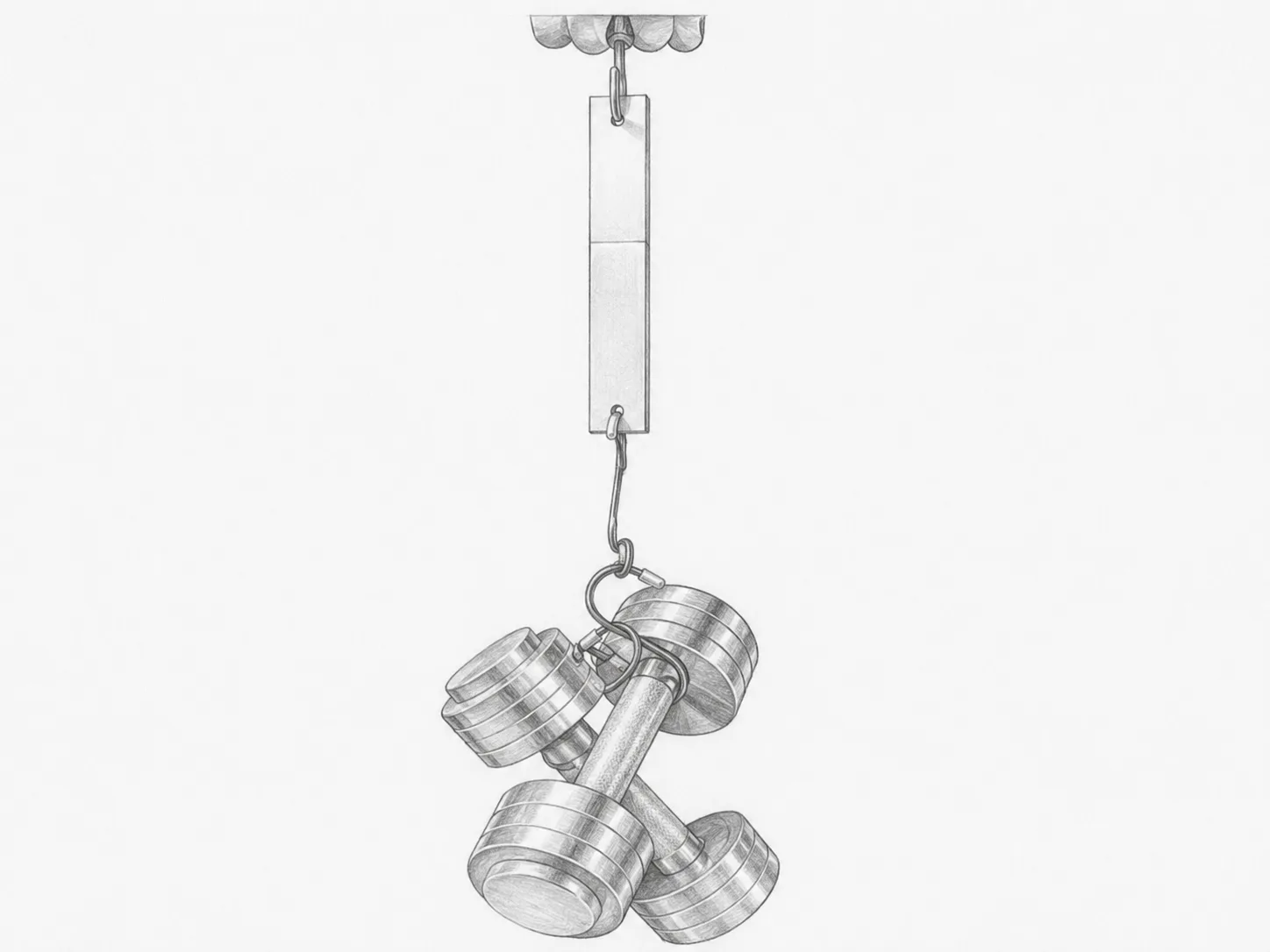
The result is not “PTFE is solved.” It is a controlled laboratory materials result. But it is a clean example of a difficult combination: strong adhesion, ductile failure and wipe-off removal from a surface famous for resisting adhesion.
Why ordinary strength and easy removal fight each other
Adhesives usually make a bargain. Rigid cross-linked polymer glues can be strong, but they often fail suddenly and are hard to remove cleanly. Softer tape-like adhesives can stretch and dissipate energy, but they usually give up strength.
The trade-off is molecular. Strength asks for efficient stress transfer. Ductility asks for motion, rearrangement and energy dissipation. Easy removal asks for bonds that can be broken without destroying the substrate. Those requirements pull in different directions.
Small-molecule adhesives are attractive because they can, in principle, be removable and recyclable. They do not form the long entangled polymer networks that make many conventional glues tough. That is also their weakness: without entanglement, small molecules normally struggle to deliver ductile, high-strength adhesion.
The JACS paper tries to replace polymer entanglement with a stack of reversible noncovalent interactions. The molecule combines a fluorinated crown-ether phosphate region with a urethane-linked fmoc group. In plain language, its fluorinated ring can interact with the fluorine-rich PTFE surface, its urethane groups can hydrogen-bond to neighbouring adhesive molecules, and its flat fluorenyl groups can stack against one another. The design target is not one magic bond. It is a set of weak, reversible interactions that can cooperate:
- fluorine-fluorine interactions near PTFE;
- hydrogen bonding between adhesive molecules;
- pi-pi stacking between fluorenyl groups;
- and enough molecular mobility to relax stress instead of cracking immediately.
What the main PTFE test showed
The authors placed CyclicFP-fmoc between PTFE plates that had not been surface-treated or cleaned, heated the adhesive and left the plates at room temperature for 10 minutes before testing.
For quantitative testing, they used lap shear. PTFE plates bonded with CyclicFP-fmoc reached 1.3 ± 0.1 MPa in tensile stress, reported as mean ± standard deviation for three measurements. Applying the adhesive around 50 C with a hair dryer gave a similar value, 1.1 ± 0.1 MPa, rather than requiring only high-temperature melting.
The authors compared those values with commercial epoxy, acrylic, silicone and urethane adhesives in the same PTFE lap-shear setup. Those controls reached around 0.1 to 0.7 MPa, compared with 1.3 ± 0.1 MPa for CyclicFP-fmoc. This same-substrate, same-method comparison is more informative than placing MPa values from different materials and test geometries on one leaderboard.
The number stayed similar after storage. After 30 days at ambient conditions, the adhesive strength was 1.3 ± 0.2 MPa. After the plates were forcibly separated, overlapped again and reheated, the strength was 1.2 ± 0.2 MPa. Repeating that cycle ten times still gave about 1.3 ± 0.3 MPa.
The best variant was not the lead molecule. A related molecule with three fmoc groups, CyclicFP-fmoc3, reached 2.3 ± 0.2 MPa on PTFE. The paper still focuses heavily on CyclicFP-fmoc because it gives the full combination of strength, ductility, mechanistic evidence and wipe-off removal.
Ductility is the second half of the claim
Strength alone would not be enough. A brittle adhesive can reach a high peak stress and then fail suddenly. The paper’s more distinctive claim is that CyclicFP-fmoc also behaves ductilely.
In lap-shear curves, CyclicFP-fmoc reached its maximum stress and then gradually lost stress as displacement continued. The commercial adhesives tested in the paper behaved more like brittle joints: failure came soon after their peak stress.
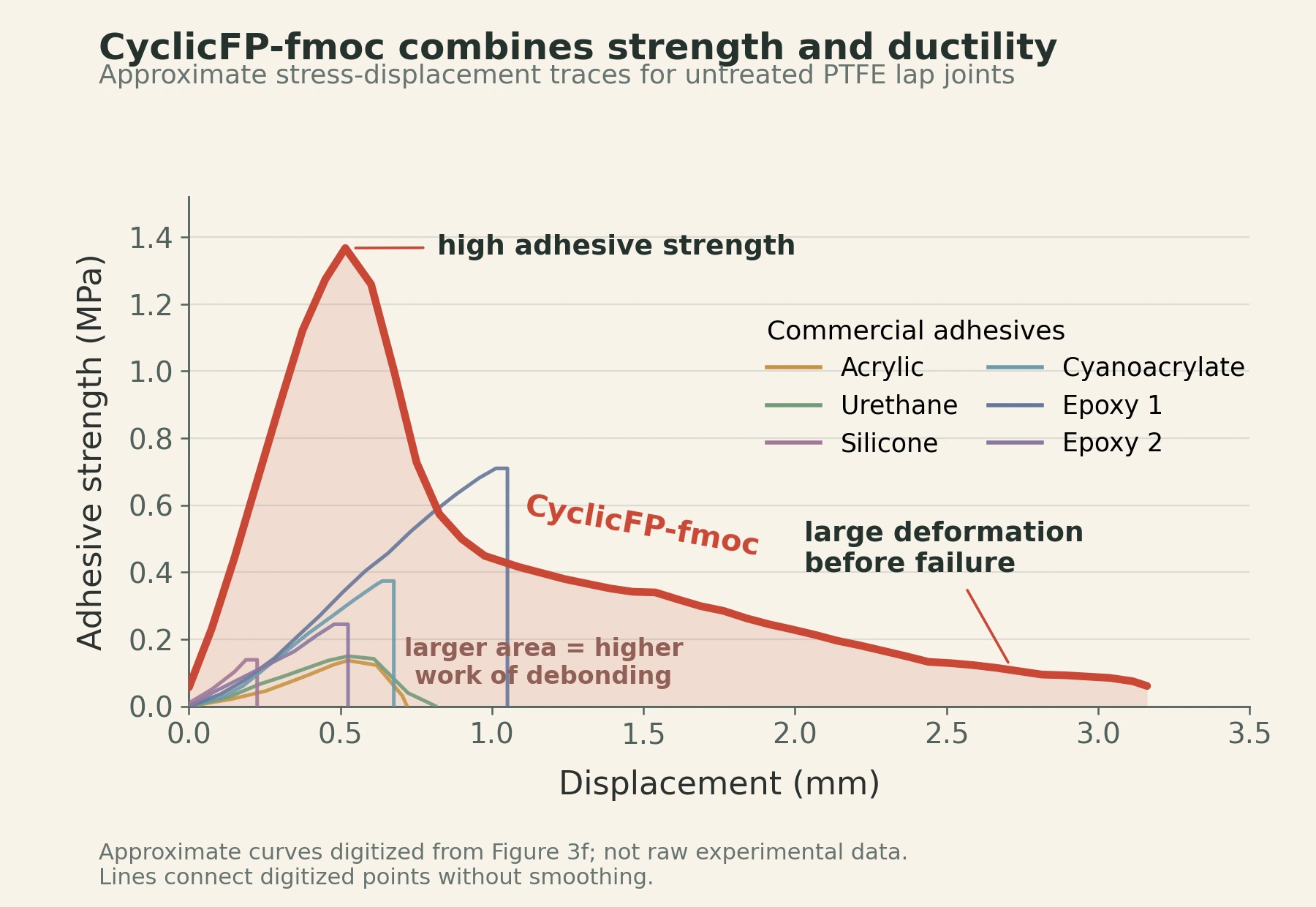
The authors quantified the area under that stress-displacement curve as work of debonding. CyclicFP-fmoc gave 1300 N/m on PTFE. The tested commercial adhesives ranged from 26 to 314 N/m.
The failure mode fits that interpretation. PTFE joints with CyclicFP-fmoc failed cohesively, inside the adhesive. That implies the adhesive could dissipate energy by deforming internally, while the PTFE interface remained stronger than the bulk adhesive layer in these tests.
Stress relaxation experiments add the molecular timescale. At 20 C, the characteristic relaxation time was 60 ms, and the Arrhenius analysis gave an activation energy of 33.8 kJ/mol. In plain terms, the adhesive layer can rearrange quickly enough to soften a sudden stress concentration rather than behave as a static brittle solid.
Wipe-off removal is real, but bounded
The removal result is the practical hook. The authors washed detached PTFE plates with ethanol and report complete removal of CyclicFP-fmoc without residue in their demonstration. They also recovered adhesive and reused it repeatedly, maintaining about 1.2 ± 0.1 MPa adhesive strength in reuse tests.
That is important because conventional strong adhesives are often hard to remove cleanly. A glue that can hold PTFE and later wash off would be useful for repair, disassembly and reuse.
But the boundary matters. The paper tests controlled samples, not every contaminated industrial surface, weathered joint, solvent exposure or long-term aging condition. Ethanol wipe-off on PTFE plates is not the same as proving a full recycling process for assemblies made from many materials.
The paper also says CyclicFP-fmoc is not a PFAS “forever chemical.” That statement should not be expanded into a complete environmental-risk assessment. Persistence, toxicity, manufacturing scale, release pathways and regulation are separate questions.
What this does not prove
- It does not show a market-ready adhesive product.
- It does not prove that PTFE can now be glued reliably in every industrial setting without surface preparation.
- It does not show that ethanol removal works equally well on every substrate, surface condition or aged joint.
- It does not prove that F-F interactions alone explain the adhesion. The paper’s mechanism combines F-F, hydrogen bonding and pi-pi stacking.
- It does not show a complete plastic-recycling workflow.
- It does not establish a full environmental or toxicological safety profile for the adhesive molecules.
- It does not mean commercial adhesives are generally worse. The comparisons are specific to the materials and PTFE lap-shear setup tested in this paper.
How strong is the result?
For a lab materials paper, the result is strong because the authors do more than report a single high number. They test strength, ductility, durability over 30 days, water tolerance, repeated readhesion, ethanol removal, molecular variants and spectroscopic evidence for the proposed interactions.
The most persuasive combination is the failure mode plus the controls. If the PTFE interface had failed first, the claim would be weaker. Instead, the joint fails inside the adhesive layer. And when the fluorinated cyclic structure is removed or changed, PTFE adhesion drops sharply.
The remaining questions are scale and use case. Lap-shear tests are standardized and useful, but real joints see peel, impact, fatigue, contamination, temperature cycles and mixed materials. A molecule that works beautifully between controlled laboratory plates still has to become a formulation, a process and a durability dataset before it becomes an engineering adhesive.
Why it matters
PTFE sits at an awkward materials boundary. Its inertness is the feature that makes it valuable, and the same feature makes it hard to integrate into repairable or recyclable assemblies.
This paper offers a route that is chemically specific rather than brute-force. Instead of roughening or chemically attacking the PTFE surface, it designs a small molecule that can interact with that surface while maintaining a ductile, reversible adhesive layer.
If that design logic generalizes, it could help build adhesives that are easier to remove and reuse without giving up all mechanical performance. That is the real promise: not one molecule as a finished glue, but a molecular strategy for strong, ductile and debondable adhesion.
Clean summary
Kikkawa, Goswami and colleagues report fluoro-crown ether phosphate small molecules as adhesives for PTFE and other substrates. The lead molecule, CyclicFP-fmoc, bonded untreated PTFE plates at 1.3 ± 0.1 MPa in lap-shear tests, failed cohesively rather than at the PTFE interface, showed a work of debonding of 1300 N/m, retained performance after storage and repeated readhesion, and could be removed from PTFE plates by ethanol washing. A related variant reached 2.3 ± 0.2 MPa. Spectroscopy and control molecules support a mechanism in which F-F interactions help the PTFE interface while hydrogen bonding and pi-pi stacking help the adhesive layer dissipate stress. The result is a promising laboratory demonstration of strong, ductile, wipe-off adhesion to PTFE, not yet a commercial glue, universal recycling solution or full environmental-safety assessment.
Sources
Based on: Small-Molecule Adhesives with Strong and Ductile Adhesion to PTFE, Yet Allowing Easy Wipe-Off Removal — Kohei Kikkawa, Abir Goswami, Kiyoshi Morishita, Hao Wang, Takashi Nakamura, and Takuzo Aida, Journal of the American Chemical Society 148, 29138-29145 (2026).
This article covers a peer-reviewed materials-chemistry paper. The reported adhesion and wipe-off behavior were measured in controlled laboratory tests on prepared samples.
Written by
Cinzia Vaglio · figures and links by
Michele Renda
· figures and links by
Michele Renda , Nova Vela · edited by
Michele Renda
, Nova Vela · edited by
Michele Renda
The Clean Paper · 20 August 2026 · Text on this site is licensed under CC BY-SA 4.0. Images are licensed separately. 


Editorial note
This article was written by AI and reviewed by the editorial team. It is a clear, conservative explanation of the linked work, not a substitute for reading it. Responsibility for selection, interpretation, and final wording rests with the editor.