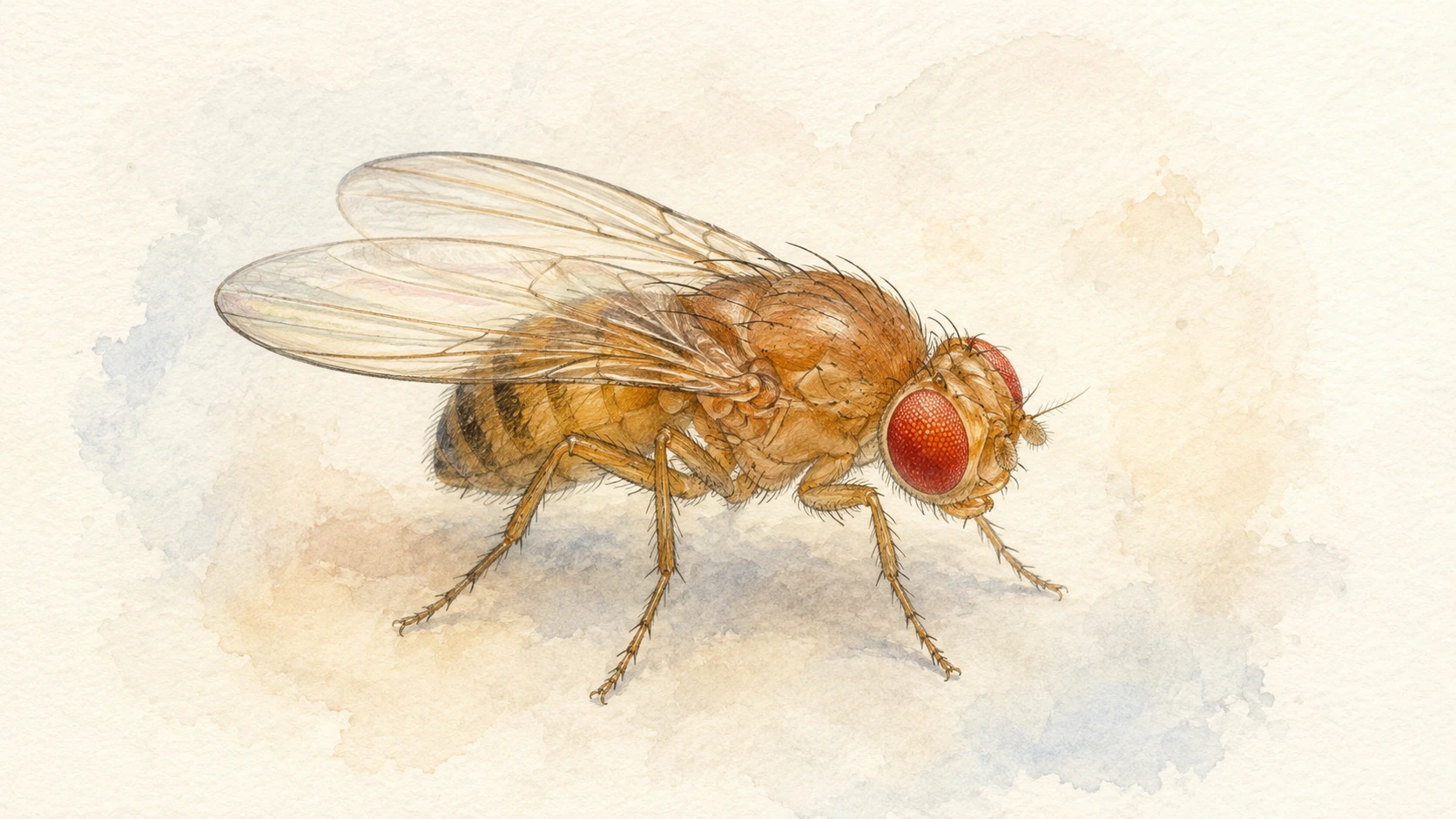
A fly can lose a scent and still turn back toward it
The fly had left the smell behind.
It kept walking through clean air, sometimes for tens of seconds and hundreds of virtual millimetres. Then it turned toward the boundary it had crossed and found the odor again. At that moment, the scent itself could not point the way back.
That is the central observation in a new Nature study of fruit-fly navigation. The researchers argue that the flies used a compact memory of direction: not a map of the whole odor plume, and not a memory of the distance travelled, but a remembered bearing toward a boundary that was no longer detectable.
The result is striking because it shows how little stored information can be enough. It is also easy to overstate. These flies did not fly freely through a natural landscape. They walked while tethered on an air-supported ball inside a tightly controlled virtual world. The study supports a vector-based strategy in that apparatus; it does not show that flies build mental maps, explain every way animals follow smells or identify the cells in which a memory is physically stored.
The invisible corridor was made by software
An odor plume is the moving region of odor carried by air. Outdoors, a plume bends, breaks apart and reconnects as the wind changes. That makes it hard to know exactly what an animal smelled at each moment.
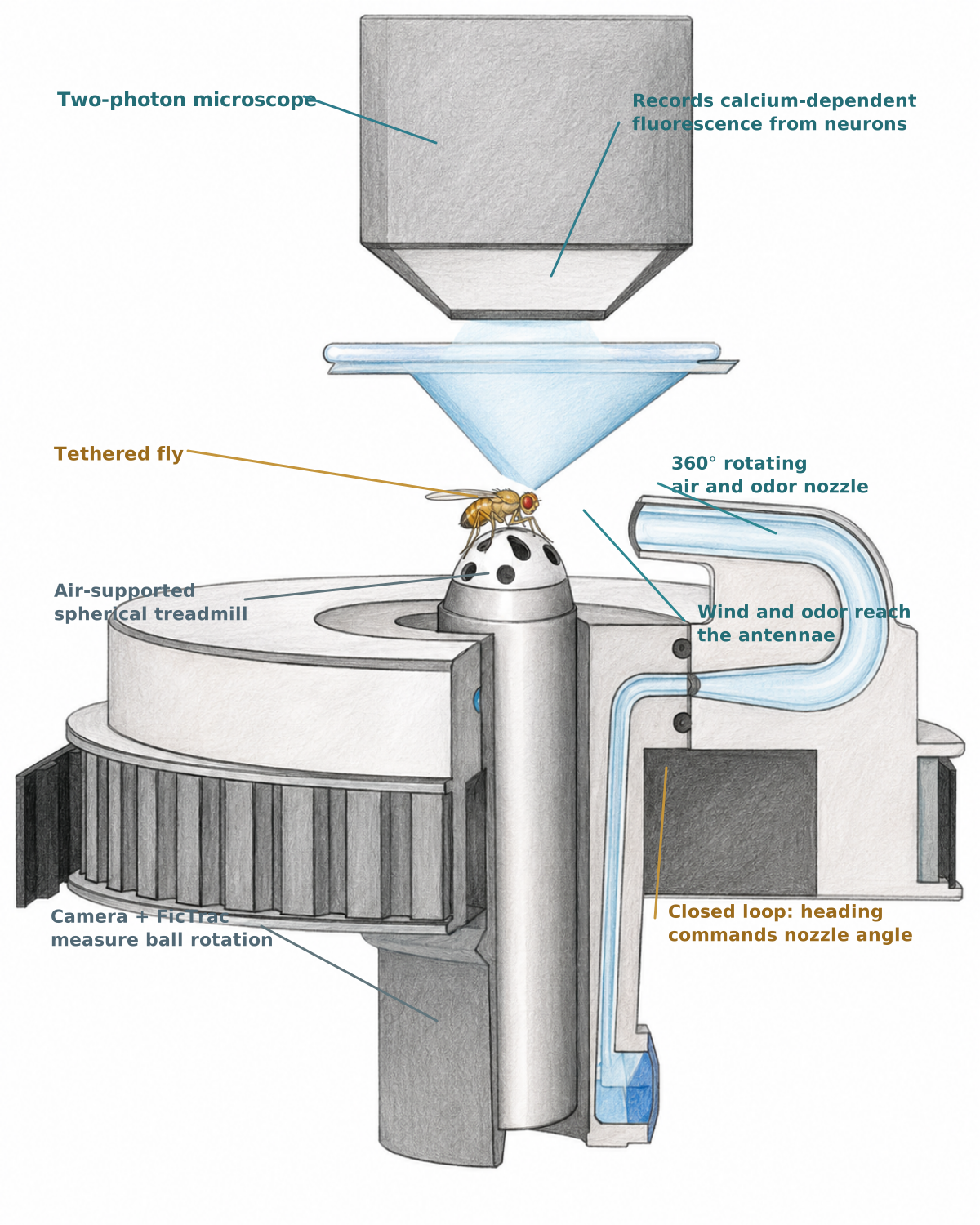
The researchers made the problem controllable with closed-loop virtual reality. The fly’s body was tethered in place above a lightweight ball floating on air. As the fly walked, a camera measured the ball’s rotation about 60 times per second. Software translated that rotation into a virtual two-dimensional position and heading.
That heading controlled a motorized nozzle that could rotate through 360 degrees. As the fly changed its virtual heading, the nozzle moved around it to keep the wind aligned with a stable direction in the fly’s virtual world. At the same time, mass-flow controllers changed how much clean air or apple-cider-vinegar odor reached the antennae according to the fly’s virtual position. Crossing a software-defined boundary therefore switched the odor on or off, creating a fictive corridor 50 millimetres wide and one metre long even though the fly never left the ball.
The apparatus produced a synchronized record of the fly’s virtual position, heading, odor state and airflow controls at each time point. From that record, the researchers reconstructed trajectories, marked each entry and exit and measured how directly the fly returned. Wind provided the external direction cue; the fly’s own movement determined when it encountered either side of the virtual odor boundary.
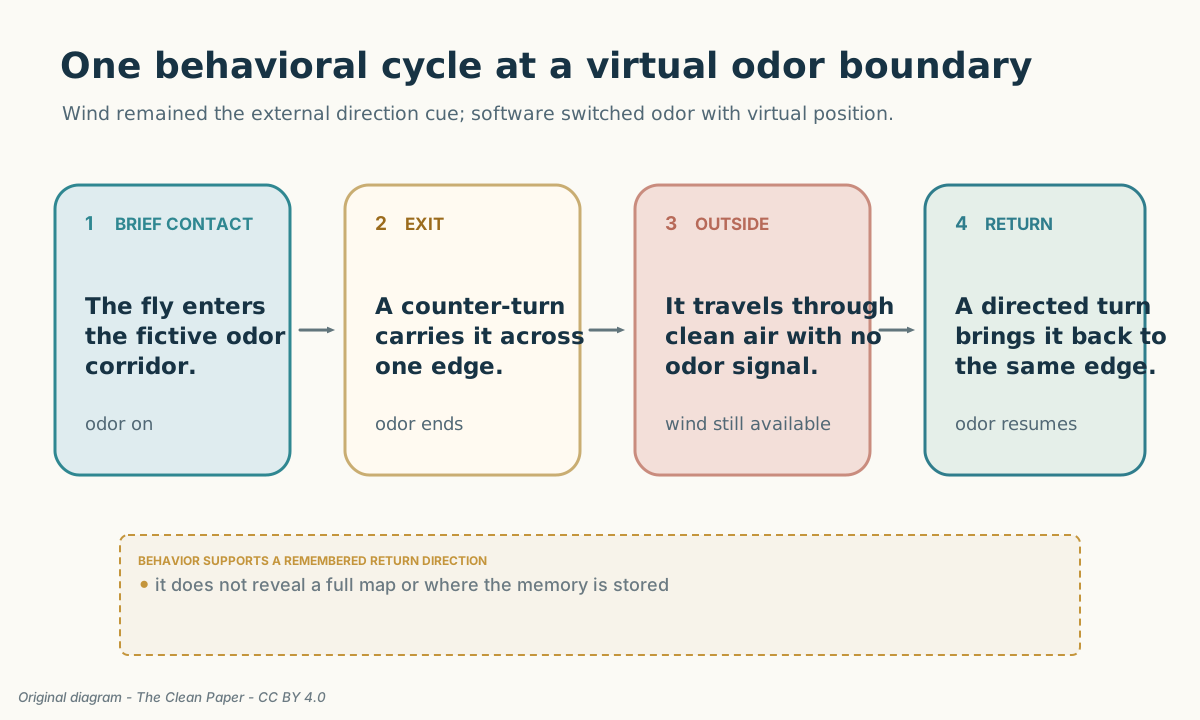
In the main vertical-corridor experiment, 40 flies repeatedly entered the odor, counter-turned out of it and returned to the same edge. “Vertical” is the paper’s name for the 0-degree geometry: the corridor’s long axis ran parallel to the upwind direction. It does not mean that the apparatus stood upright.
The authors call this pattern edge tracking. A bout is one continuous episode between boundary crossings: an inside bout runs from entry to exit, and an outside bout from exit until the fly returns. Across 755 inside bouts, a visit lasted 4.9 seconds on average. During returns, the mean distance from the boundary was 10.4 millimetres. Fewer than 4% of 793 bouts crossed all the way to the corridor’s opposite edge.
Those last two numbers describe bouts, not hundreds of independent flies. The distinction matters because one animal can contribute many bouts.
The returns were not just a fixed upwind reflex
Several experiments tested simpler stories.
The researchers first changed what happened along the corridor as a fly walked upwind. The odor could grow stronger toward the virtual source, stay constant or grow weaker. The flies produced similar paths in all three cases. A simple rule such as “keep going wherever the smell gets stronger” therefore cannot explain edge tracking in this apparatus.
They then softened the corridor’s sideways edge into a Gaussian profile, where concentration changed gradually instead of switching sharply. The flies gathered near the flank where concentration changed fastest, not at the centre where odor was strongest. The relevant cue was therefore the lateral change that marked an effective boundary, rather than a required sourceward increase along the corridor.
That does not mean concentration gradients never matter in nature. It means that a sourceward increase was not required for this behavior under the tested conditions.
The researchers also changed the corridor’s orientation. Separate groups tracked vertical, 45-degree and 90-degree corridors, and another group encountered a corridor that jumped sideways after exits. The group sizes were 40, 21, 20 and 24 flies, respectively. Their outside paths changed with the geometry. A generic rule such as “always turn upwind” cannot explain that flexibility.
In this setup, odor reached the two antennae within about two milliseconds. Pairing bilateral optogenetic activation with wind could reproduce an edge-tracking-like pattern. Optogenetics uses light-sensitive proteins to alter selected cells. Here the result suggests that a left-versus-right difference in odor arrival was not necessary for this behavior. It does not make bilateral comparison irrelevant to freely moving animals in other plumes.
A vector is smaller than a map
A vector is a direction together with a size. The useful stored quantity here was mainly directional: which way should the fly turn to reach the plume boundary? The study did not find evidence that the fly stored a full layout of the plume or its own position within one.
The authors first made artificial paths by shuffling the ingredients of real fly movement. They drew observed run lengths and turn angles at random and stitched them together. Some of these synthetic walkers eventually hit the odor boundary again, but they wandered farther and took less direct routes than real flies. Even adding the flies’ ordinary tendency to turn upwind did not reproduce the short, directed returns. The real behavior therefore contained more direction than a random remix of the same movements.
The researchers next built a model with two modes: leave the boundary and return to the boundary. These modes were not labels for every moment inside or outside the odor. They were alternative steering rules that could switch as the fly moved.
Each boundary crossing gave the model a direction to remember. On exit, it updated a direction used while leaving. On entry, it updated a separate return direction: in effect, “when I found the boundary, I was moving this way.” During a later return, that remembered direction biased the simulated fly’s motion back toward the edge.
The researchers fitted the model to trajectories across the 0-, 45- and 90-degree corridors. In the summary comparison, 72 real flies and 75 simulations produced similar path statistics. When the return direction learned at entry was removed, tracking became less efficient across all corridor orientations. That supports the usefulness of an entry-direction memory; it does not prove that a fly’s brain literally runs the model’s equations.
What does “memory” mean in this paper?
The researchers did not read a stored arrow directly from a fly’s brain. “Directional memory” is an inference supported by behavior, a model and neural measurements. The model says that a few changing directions can reproduce important path statistics. It does not prove that the fly implements the equations literally, or that one named group of neurons is the storage location.
An additional experience with an oppositely oriented 45-degree segment shifted later behavior in 10 flies, alongside 29 model simulations. That makes the directional account more specific than a post-hoc description, while remaining a model-based interpretation.
A heading reference and a current goal
The study next measured and disrupted activity in the fly’s central complex, a brain region involved in navigation.
Two signals with different jobs
EPG and FC2 are names for two neuron populations in the central complex. EPG activity acts like a compass reading: it tracks the direction the fly is currently facing relative to the wind. FC2 activity is associated with the direction the fly is trying to travel. A downstream steering circuit can compare current heading with that goal. The study tests both populations, but it does not show that either one alone stores the entire memory.
EPG neurons carry a heading signal: their pattern of activity tracks the direction the fly is facing relative to an external cue. Using calcium imaging, an indirect optical readout of neural activity, the researchers found that the EPG activity phase followed heading relative to wind during edge tracking. This analysis used 16 trials from 9 flies.
To inhibit EPG neurons, the researchers engineered them to express GtACR1, an anion channel switched on by green light. An LED remained on throughout the test trial, activating that channel and suppressing the selected neurons; the same illumination did not impair genetic-control flies.
When EPG neurons were inhibited this way, 12 experimental flies made less effective directed returns than 6 genetic-control flies. The bounded conclusion is that the heading reference carried by EPG activity was needed for effective edge tracking under the tested conditions. It is not evidence that EPG neurons alone stored the boundary direction.
FC2 neurons showed a different relationship. Their population activity was associated with the current navigation goal and pointed toward the plume boundary before turns in the assay. Imaging used 6 flies, and silencing comparisons used groups of 9 to 14 flies depending on the analysis. Silencing impaired edge tracking.
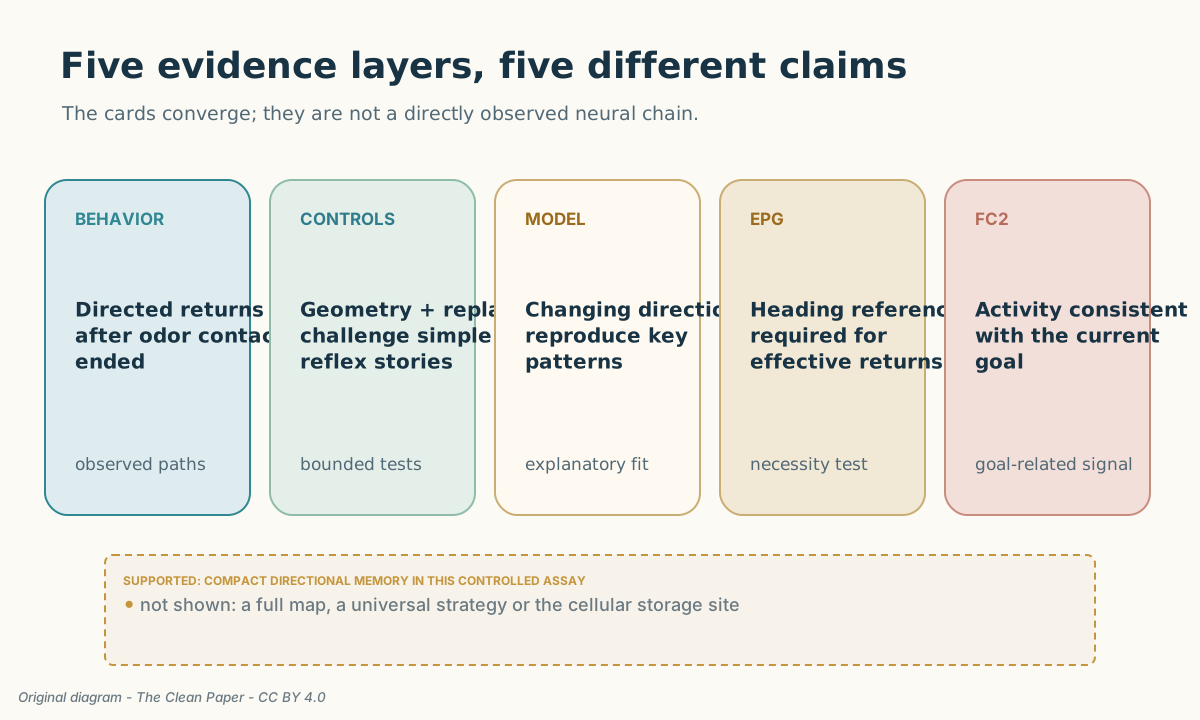
This is converging evidence, not a photographed chain of causation. EPG activity supplied a required heading reference. FC2 activity was consistent with a goal direction and was needed for effective behavior. The experiments did not locate a single memory “engram” or prove that FC2 synapses physically stored the direction.
As a rough human-scale analogy, imagine stepping out of a narrow bank of fog while a steady wind still tells you which way is north. A compass can tell you which way you are facing, but returning to the fog also requires a remembered bearing to its edge. Comparing the current heading with that desired bearing tells you which way to turn. That is the division of labor suggested here for EPG and FC2 signals. It is an explanatory analogy, not evidence that humans use the same cells or algorithm.
The memory depended on action, not odor timing alone
In a replay experiment, flies received the same sequence of odor times as before, but the timing was disconnected from what they were currently doing. The learned directional bias weakened across replay bouts. That supports an operant, action-linked update: what mattered was not passive exposure to an odor sequence alone, but the relationship between odor and the fly’s movement.
The denominator changes across those analyses. Extended Data panels include 8 or 9 flies depending on the comparison; the sequential-bout series uses 8 flies; trajectory panels require at least 10 effective entries; and the paired model panels use 21 simulated trajectories that also meet that entry threshold. Those are not one pooled sample of eight.
A more irregular plume was useful, but still virtual
The researchers also replayed a previously recorded, more irregular plume. They scaled it fivefold in space and time so tethered flies could encounter it often enough. Ten of 12 flies reached within 50 virtual millimetres of its source.
That is not ten flies finding a real source in open air. It is performance in a controlled replay of a naturalistic plume.
For each dynamic-plume type, the model generated 2,000 trajectories. The scaled-plume comparison analysed 1,850 of those 2,000 after requiring an effective entry and excluding trajectories that began too close to the source. Memory helped more near the source, where successive encounters retained coherent directional structure, and less in the more turbulent region farther downwind.
The qualification is part of the result. A compact direction can help only when the world remains coherent enough for a previous encounter to say something useful about the next one.
What the study does not show
- It does not show a fly building a complete spatial map.
- It does not show free flight through an unmodified natural plume.
- It does not establish that all odor-guided navigation uses this strategy.
- It does not show that EPG or FC2 neurons are the exclusive physical storage site of the memory.
- It does not turn the fitted model into the fly’s literal biological algorithm.
- It does not generalize directly to human navigation.
The study is strongest where it is most specific. Closed-loop control gave the researchers precise access to each odor encounter. Geometry changes, replay, modeling, calcium imaging and silencing then tested different parts of one account. But behavioral, imaging and silencing cohorts were separate; sample sizes were not predetermined; data collection and analysis were not randomized or blinded; and fewer than 10% of tethered flies were excluded for acclimation, response or tracking problems.
Those limits do not erase the phenomenon. They define it.
Clean summary
Tethered fruit flies walking through a virtual odor corridor repeatedly returned to a boundary after leaving the smell behind. Changes to concentration and corridor geometry, a fitted switching model, neural imaging and optogenetic silencing support an account in which the fly uses a compact remembered direction rather than a full map. EPG neurons supplied a required heading reference, while FC2 activity was consistent with the current goal direction. The result is bounded to a controlled walking assay; it does not identify the memory’s cellular storage site or show the same computation in free natural flight.
No-BS check
What the paper shows: In a closed-loop tethered assay, flies made directed returns to virtual odor boundaries they could no longer sense. Multiple behavioral controls, modeling and neural perturbations support a vector-based strategy.
What is inferred: That the behavior uses a compact directional memory, and that FC2 population activity represents a current navigation goal. The memory content was not read directly.
What it does not show: A full mental map, a universal olfactory strategy, free-flight performance in a natural plume, a single memory-storage site or a human analogue.
Main limitations: One species and controlled apparatus; different fly cohorts and analysis units across experiments; indirect calcium signals; necessity tests that do not prove sufficiency; and a naturalistic plume that was replayed and scaled.
How much confidence should a general reader have? High confidence that the directed-return phenomenon is real in this apparatus and that heading and goal-related central-complex activity matter. Moderate confidence in the model as a compact explanation. Low confidence in any claim that extends it unchanged to the open air or calls it a complete map.
Sources
Based on: A vector-based strategy for olfactory navigation in Drosophila — Andrew F. Siliciano, Sun Minni, Chad Morton, Charles K. Dowell, Noelle B. Eghbali, Silas E. Busch, Juliana Y. Rhee, L. F. Abbott and Vanessa Ruta, Nature (2026).
- Paper — Siliciano et al., A vector-based strategy for olfactory navigation in Drosophila, Nature (2026)
- Dataset — Siliciano et al., data archive for A vector-based strategy for olfactory navigation in Drosophila
- Code — Ruta Laboratory, Edge-Tracking-Model
The article is based on the complete Nature paper, including Methods, Extended Data and reporting summary. The reported data archive and model-code repository were identified but were not independently reanalysed.
Written by
Matteo Riga · figures and links by
Matteo Riga, Laura Nesso, Nova Vela · edited by
Michele Renda
· figures and links by
Matteo Riga, Laura Nesso, Nova Vela · edited by
Michele Renda
The Clean Paper · 2 August 2026 · Text on this site is licensed under CC BY-SA 4.0. Images are licensed separately. 


Editorial note
This article was written by AI and reviewed by the editorial team. It is a clear, conservative explanation of the linked work, not a substitute for reading it. Responsibility for selection, interpretation, and final wording rests with the editor.