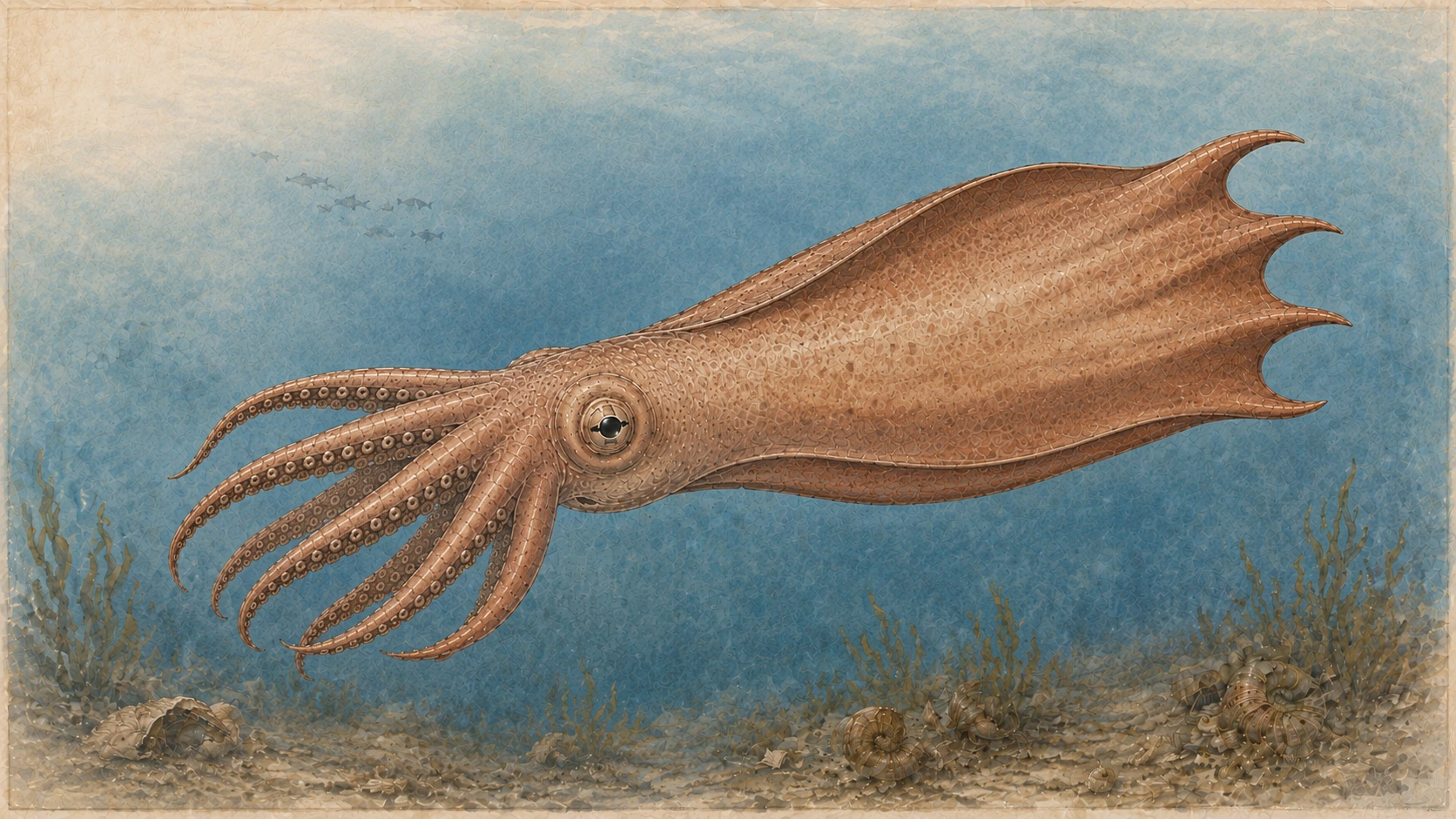
The kraken story, stripped back to fossils
A fossil jaw is not an animal. It is a hard remnant of a soft body, a fragment from which paleontologists have to reconstruct anatomy, behavior, and ecology without pretending they saw the creature alive. That is why this paper is both irresistible and easy to oversimplify. The headline version is tempting: giant kraken-like octopuses ruled Cretaceous oceans. The careful version is better: exceptionally preserved fossil jaws suggest that some of the earliest known finned octopuses were very large carnivores that repeatedly crushed hard prey and may have reached the top tier of Late Cretaceous marine food webs.
That is still spectacular. It should be read not as a sea-monster story, but as a reconstruction from jaws, wear patterns, taxonomy, and body-size scaling.
What they found
These were probably early finned octopuses, not vampire squids. The supplementary taxonomy separates two linked steps. Each bridge is a strip of jaw material connecting the hood to a lateral wall. In Nanaimoteuthis, these bridges are completely hidden by the inner and outer jaw plates, a pattern that supports placing the genus within Cirrata. Its broad jaw wings then support assigning it to the long-bodied group of finned octopuses. That matters because the paper is not just saying “large cephalopod”; it is changing where these fossils sit in octopus history.
They were old. The new specimens place finned octopuses around 100 million years ago, in the Late Cretaceous. That makes them some of the earliest octopus-line animals known.
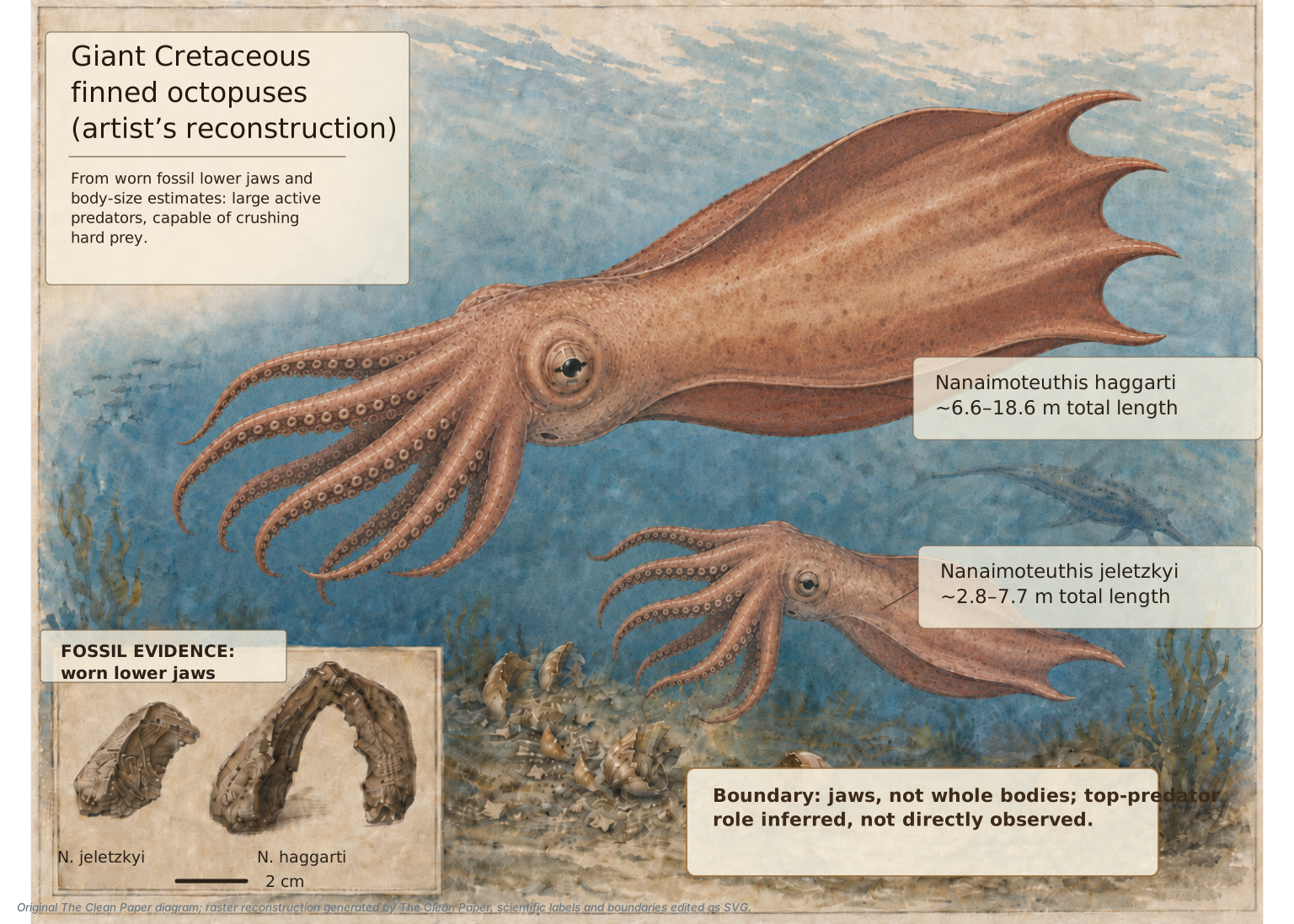
They could have been enormous. The body-size estimates are not single measurements of preserved bodies; they are calculations from jaws. But the numbers are large even when stated carefully. The smaller species, N. jeletzkyi, is estimated at several meters total length. The larger, N. haggarti, is estimated up to roughly 18.6 meters, comparable in scale to the largest marine predators of the time and to the largest living cephalopods.
The jaws were heavily worn. In the largest specimens, the lost jaw material reached roughly 10% of total jaw length. The paper argues that this wear is not preparation damage or transport abrasion: specimens came from low-energy outer-shelf deposits, chips and scratches are preserved in ways consistent with use, and co-occurring fossil squid jaws do not show the same pattern. The authors compare the wear to modern durophagous cephalopods — animals that eat hard prey.
The wear was asymmetric. The right jaw edge was more worn than the left in both species. The authors interpret that as possible behavioral lateralization: a preference for using one side more than the other. Since lateralized behavior is associated with complex nervous systems in modern animals, they suggest that these early octopuses may already have had advanced intelligence.
What this probably means
The strongest ecological interpretation is that Late Cretaceous finned octopuses were not all small background animals in ecosystems dominated by large vertebrates. The authors’ top-predator case combines two findings: gigantic estimated body size and durophagous carnivory — repeated processing of hard animal prey — inferred from jaw wear. Together, those findings support the possibility that an invertebrate lineage joined the top tier of a food web otherwise associated with mosasaurs, plesiosaurs, large fish, and sharks.
The evolutionary story is also interesting. Vertebrate marine predators and octopus-line cephalopods took very different routes toward predation. Vertebrates acquired jaws, streamlined bodies, and often reduced external armor. Octopus relatives reduced or internalized shells, becoming soft-bodied and mobile, while keeping powerful jaws and flexible arms. The paper frames this as a convergent path toward large, intelligent marine predators.
The more speculative part is behavior. Extensive wear supports hard-prey feeding. Large size supports ecological importance. Asymmetric wear supports possible lateralized behavior. But “advanced intelligence” is an inference, not a direct fossil measurement. It is plausible in the context of octopus biology, but it should not be made stronger than the evidence.
What this does not prove
- It does not preserve a whole giant octopus body. The reconstruction is based mainly on jaws, with body size inferred from modern finned-octopus scaling.
- It does not show stomach contents or direct prey remains. Hard-prey feeding is inferred from jaw wear, not from a fossilized meal.
- The authored research article does not propose that they ate mosasaurs, plesiosaurs, or any other large marine reptiles. Its research text includes those animals only as comparisons of body size and ecological position.
- It does not give a precise body length. The estimates are ranges, and the largest claim is an upper estimate.
- It does not directly measure intelligence. Lateralized jaw wear is interpreted as possible behavioral lateralization, which may suggest complex behavior; that is several inferential steps away from knowing what the animal could do.
- It does not mean all early octopuses were giants. The claim concerns these Nanaimoteuthis species, especially N. haggarti, not every early octopus lineage.
How strong is the evidence?
For the existence of very large Cretaceous octopus-line jaws, the evidence is strong: the paper presents described specimens, digital models, stratigraphic context, and comparisons with modern and fossil cephalopod jaws.
For hard-prey feeding, the evidence is also reasonably strong. The wear patterns are detailed — chips, scratches, polish, cracks, asymmetric loss — and the authors spend effort excluding preparation damage and transport abrasion. The comparison to modern durophagous cephalopods is a plausible bridge.
For exact body size and top-predator status, confidence should be more moderate. Size estimates depend on allometric scaling from living long-bodied finned octopuses. Ecological role is inferred from the combination of estimated size and durophagous carnivory, not directly observed. The argument is coherent, but it is an ecological reconstruction, not a direct census of a food web.
Why it matters
This paper is a good example of how paleontology makes strong claims from partial evidence without magic. The jaw is the object. The wear is the behavioral trace. The scaling curve is the bridge from a hard fossil to a soft body. Each step adds power, and each step adds uncertainty. That is the lesson worth preserving.
It also corrects a familiar picture. Cretaceous oceans are usually imagined as a world of big vertebrate predators and smaller shelled prey. These fossils suggest that some soft-bodied invertebrates were not merely hiding under that food web. They may have been competing in its upper levels.
The result is wonderfully visual, but the clean story is not “the kraken was real.” It is that large, early finned octopuses left jaws from which researchers reconstructed gigantic bodies and repeated hard-prey feeding — a combination that makes a serious, but still inferential, case for invertebrate top predators in the age of marine reptiles.
Clean summary
Researchers reexamined Cretaceous fossil cephalopod jaws from Japan and Vancouver Island, and used full-color grinding tomography plus zero-shot AI segmentation to digitally reconstruct hidden jaws as detailed 3D specimens from Japanese rocks. They reorganized several fossil taxa into two species of Nanaimoteuthis, interpreted here as early finned octopuses. The fossils extend the record of finned octopuses to about 100 million years ago. From jaw-size scaling, the authors estimate total lengths of about 2.8–7.7 m for N. jeletzkyi and 6.6–18.6 m for N. haggarti. Heavy jaw wear — chips, scratches, polish, cracks, and asymmetric edge loss — suggests repeated hard-prey crushing and possibly lateralized behavior. Gigantic estimated size plus durophagous carnivory supports the interpretation that these octopuses may have occupied the top tier of marine food webs. The evidence does not include whole bodies, exact lengths, identified prey, or direct measurements of intelligence. The authored research article does not propose predation on large marine reptiles.
No-BS check
What the paper shows: Large Cretaceous octopus-line jaws, revised as two Nanaimoteuthis species and placed within finned octopuses; an older record for Cirrata; body-size estimates reaching several meters and possibly up to 18.6 m; extensive adult jaw wear consistent with hard-prey feeding; asymmetric wear consistent with possible lateralized behavior.
What is plausible but not proven: That N. haggarti was among the largest invertebrates ever known; that these animals occupied true top-predator roles; that asymmetric wear reflects behavioral lateralization and advanced cognition.
What it does not show: Whole-body fossils; direct prey or stomach contents; exact body lengths; predation on large marine reptiles; direct evidence of intelligence; that all early octopuses were giants.
Main limitations: Body size is inferred through a multi-step jaw-to-mantle-to-total-length scaling model; top-predator status is inferred from estimated size plus durophagous carnivory; behavior is inferred from asymmetric wear; the fossils preserve jaws rather than whole animals or direct prey.
How much confidence should a general reader have? High that these fossils include very large early finned-octopus jaws with strong wear evidence. Medium that the largest animals reached the upper end of the 6.6–18.6 m estimate. Medium that they were true top predators rather than very large hard-prey carnivores. Low that we can say much specific about their intelligence. Appropriate stance: a spectacular fossil story, but one built from jaws and inference, not from a complete sea monster.
Post-publication updates
Sources
Based on: Earliest octopuses were giant top predators in Cretaceous oceans — Shin Ikegami, Jörg Mutterlose, Kanta Sugiura, Yusuke Takeda, Mehmet Oguz Derin, Aya Kubota, Kazuki Tainaka, Takahiro Harada, Harufumi Nishida, and Yasuhiro Iba, Science 392, 406–410 (2026).
- Paper — Science 392, 406–410 (2026)
- Source — Supplementary methods, text, figures S1–S6, and references
- Source — Supplementary tables S1–S6
- Source — MDAR reproducibility checklist
- Dataset — Fossil lower jaws dataset — Figshare
- Dataset — Tomographic animations — Figshare
- Code — CPU-enabled AI segmentation code — Zenodo
Written by
Laura Nesso · figures and links by
Laura Nesso, Nova Vela · edited by
Michele Renda
· figures and links by
Laura Nesso, Nova Vela · edited by
Michele Renda
The Clean Paper · 25 June 2026 · Text on this site is licensed under CC BY-SA 4.0. Images are licensed separately. 


Editorial note
This article was written by AI and reviewed by the editorial team. It is a clear, conservative explanation of the linked work, not a substitute for reading it. Responsibility for selection, interpretation, and final wording rests with the editor.