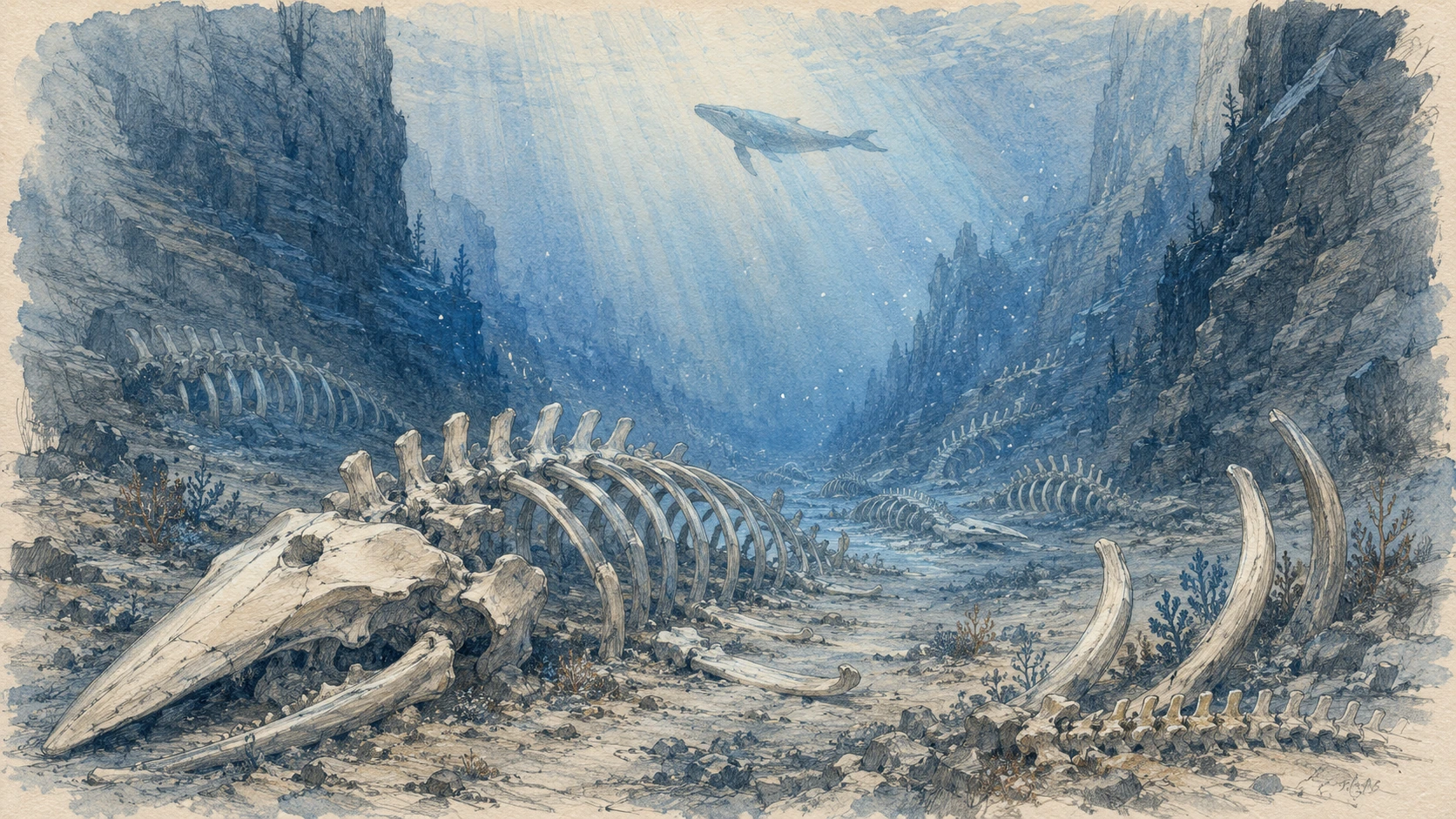
The ocean floor kept the bones
Most whale falls disappear into a dark accounting problem. A whale dies, sinks, feeds a burst of deep-sea life, and then the record is scattered, buried or eaten away. Scientists know whale falls are ecological oases, but the archive is thin: most known sites are isolated, shallow compared with the deepest trenches, or too young to say much about deep time.
The Diamantina Zone changes the scale of that problem. In a new Nature paper, Xiaotong Peng, Peng Zhou, Xikun Song, Giovanni Bianucci, Mengran Du and colleagues report a long, deep concentration of whale falls and whale fossils in the southeastern Indian Ocean. The site stretches about 1,200 kilometres along the seafloor and sits at about 4,600-7,000 metres depth. Across 32 dives with the Fendouzhe human-occupied submersible, the team documented 485 whale-fossil sites and active whale falls; in the abstract they summarize the find as five modern natural whale-fall communities plus 476 fossil cetaceans. Those are different paper counts, not a simple addition: 485 is the site-level record, while 476 is the fossil-cetacean tally used in the abstract.
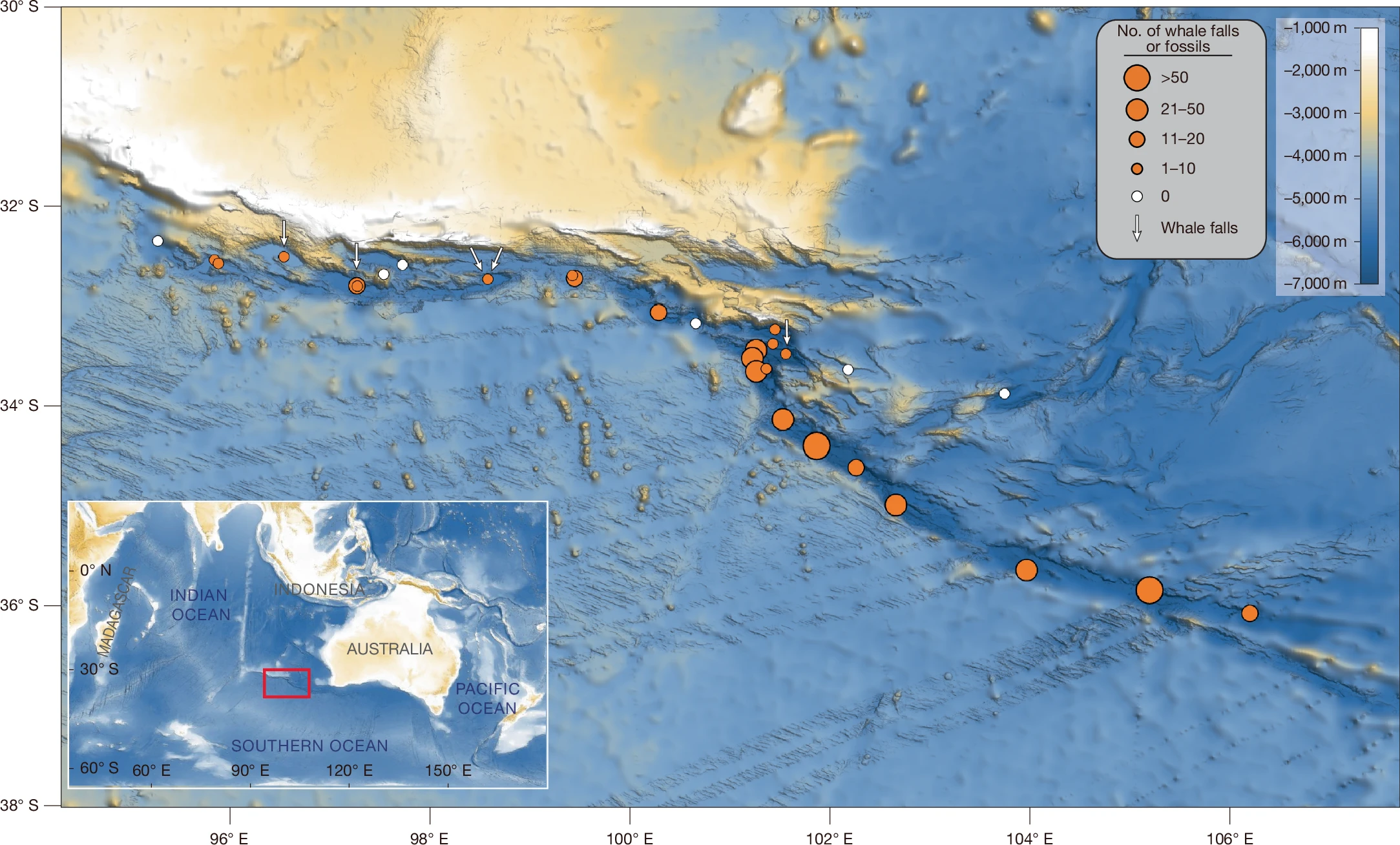
The oldest dated material reaches 5.26 million years, which is why the paper calls it a 5.3-million-year whale necropolis. That phrase is vivid. It is also the phrase that needs the most care.
This is not evidence that whales intentionally went there to die. It is not a single mass-death event. It is not a cemetery in the human sense. It is a place where carcasses and bones accumulated, stayed exposed, mineralized and became readable.
What they found
- A large, deep concentration. The authors report 485 whale-fossil sites and active whale falls in the Diamantina Zone, with observations spanning about 4,600-7,000 metres in the supplementary table.
- Five active whale falls. The five active sites are in the sulfophilic stage: bones covered by microbial mats and bone-boring worms, where chemical energy from decomposition supports a specialized community.
- A dense living community. The associated fauna includes 35 recognized macrofaunal taxa, dominated by annelids, crustaceans and molluscs. Bone-eating worms, gastropods, vesicomyid bivalves and brittle stars dominate the larger animals, with local densities reported up to 2,840 individuals per square metre.
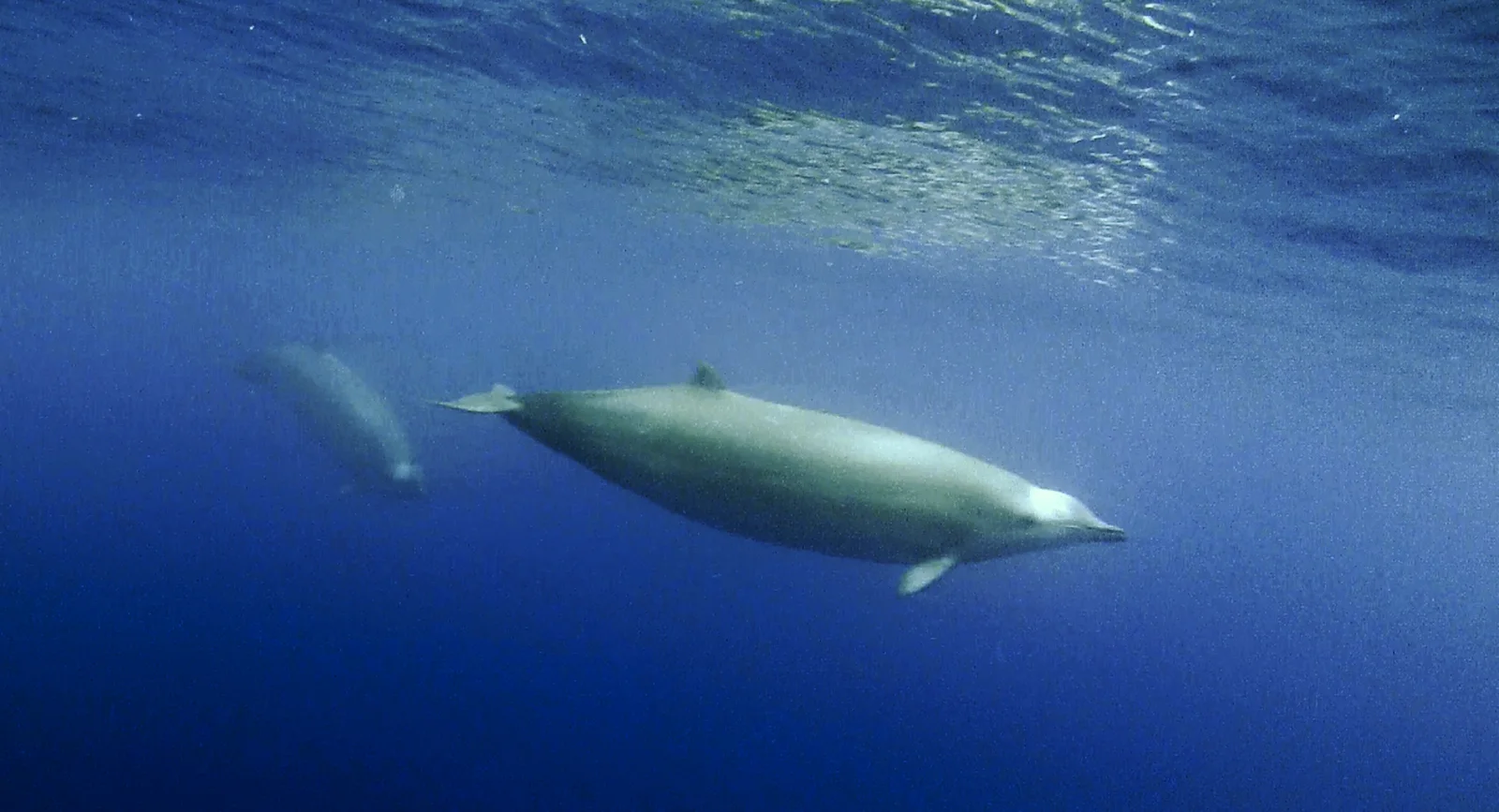
- A fossil archive of beaked whales. The 43 recovered fossils include living beaked-whale species known from the region, extinct forms such as Pterocetus and Izikoziphius, and some baleen-whale remains. One specimen is described as a new species, Pterocetus diamantinae.
- A long time range. Of 33 fossil bones tested for strontium isotopes, 25 produced ages between 0.12 and 5.26 million years. The oldest dates imply whale-fall events in this region since at least the Early Pliocene.
Why so many whales there?
The paper’s answer is not one simple cause. It is a stack of plausible filters.
Some carcasses may come from baleen whales moving through a broad migratory corridor. Minke and sei whales feed near the surface, not at 6 or 7 kilometres down, so their bones at those depths are best understood as carcasses that sank after death.
The beaked whales are different. They are deep-diving specialists, feeding on squid and fish in steep, deep seafloor settings. The Diamantina Zone is exactly that kind of landscape: extreme depths, complex V-shaped topography, and prey observed during the dives. The authors argue that normal mortality, the physiological risks of deep foraging, and possibly fatal exhaustion or decompression stress could all add remains to the seafloor.
Then the seafloor keeps them. The zone’s topography can funnel sinking carcasses. Low sedimentation means bones can stay exposed for a long time. Dense beaked-whale rostra are unusually resistant to destruction. Ferromanganese oxides and carbonate precipitation can help preserve skeletal material. Put those together and the “graveyard” becomes less mysterious: not a place whales choose, but a place where deaths are more likely to be recorded.
What this does not prove
- It does not show a deliberate whale cemetery. “Necropolis” is a metaphor for the accumulation, not evidence of behaviour.
- It does not show one catastrophic die-off. The dates span millions of years, and the authors describe a long-lived archive built from repeated events.
- It does not mean the deep sea is now well mapped. This site was found through rare, expensive submersible work in one geological corridor; the paper itself matters because such records are normally sparse.
- It does not turn every species in the community into a newly discovered species. The authors say many recovered taxa may be new, but most are identified only to genus or family; only one vesicomyid bivalve is confidently assigned to species level through barcoding comparison.
- It does not establish the full cause of every whale death. The authors propose a converging explanation: migration, deep foraging, topography, preservation and sedimentation. That is not the same as proving the death mechanism for each animal.
How strong is the evidence?
The evidence for the site itself is strong: direct submersible observations, hundreds of mapped records, physical specimens, genetic identifications for some animals, and isotope dating of fossil bone. The strongest claims are the observational ones: the site exists; it is deep; it is extensive; active whale-fall communities are present; and some fossil material is millions of years old.
The explanatory claims are necessarily softer. The paper can show where the remains are, what some of them are, how old some are, and what lives on the active falls. It cannot replay the deaths. The proposed genesis is a reconstruction from ecology, physiology, seafloor shape and preservation conditions. That is normal palaeoecology: powerful, but built from converging traces rather than direct observation of the original events.
Why it matters
Whale falls are short-lived feasts that can become long-lived habitats. They connect a surface animal to the deep seafloor, carrying carbon, bone and chemical energy into an environment where food is scarce. They also act as islands for specialized animals: worms that bore into bone, bivalves with sulfur-oxidizing symbionts, brittle stars and gastropods that can cluster around the remains.
The Diamantina Zone adds time to that picture. It suggests that some deep seafloors can preserve whale-fall ecosystems not just as scattered events, but as archives of whale ecology and evolution. Beaked whales are notoriously hard to study because they live and feed far from view; a seafloor accumulation of their bones can reveal species, distributions and evolutionary history that surface observations miss.
The clean story is not “scientists found the ocean’s whale cemetery.” It is stranger and more useful: a deep geological corridor preserved enough whale deaths to turn a normally fleeting ecosystem into a record.
Clean summary
Researchers surveying the Diamantina Zone in the southeastern Indian Ocean report a vast deep-sea accumulation of whale falls and whale fossils: 485 recorded sites and active falls across about 1,200 kilometres, at depths down to about 7,000 metres, with fossil dates reaching back 5.26 million years. The site hosts specialized whale-fall communities and preserves both modern and extinct whale lineages, especially beaked whales. The result is a rare deep-sea archive, not a literal cemetery, not a single mass-death event, and not proof that the deep ocean is now understood. The important claim is narrower and stronger: under the right seafloor conditions, whale deaths can leave a record that lasts for millions of years.
Sources
Based on: A 5.3-million-year-old deep-sea whale necropolis in the Diamantina Zone — Xiaotong Peng, Peng Zhou, Xikun Song, Giovanni Bianucci, Mengran Du and colleagues, Nature 654, 978-983 (2026).
Written by
Laura Nesso · figures and links by
Laura Nesso, Nova Vela · edited by
Michele Renda
· figures and links by
Laura Nesso, Nova Vela · edited by
Michele Renda
The Clean Paper · 14 July 2026 · Text on this site is licensed under CC BY-SA 4.0. Images are licensed separately. 


Editorial note
This article was written by AI and reviewed by the editorial team. It is a clear, conservative explanation of the linked work, not a substitute for reading it. Responsibility for selection, interpretation, and final wording rests with the editor.