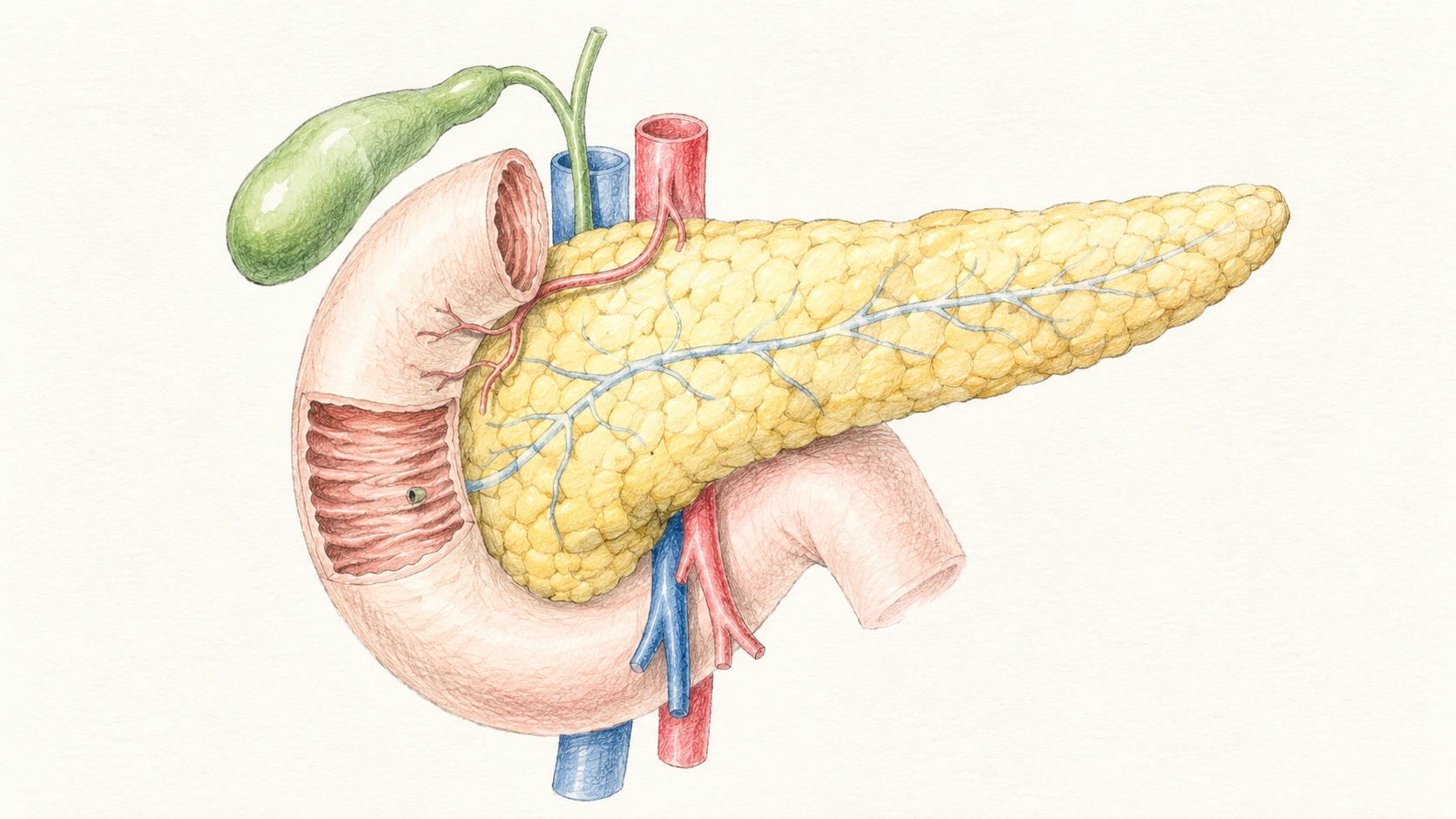
The vaccine produced an immune response. Prevention is still an open question
An experimental vaccine aimed at six common mutant forms of KRAS, the gene altered in most pancreatic cancers, triggered a measurable T cell response in 18 of 20 people at inherited or familial risk of the disease. The vaccine-related adverse events reported in this phase I study were grade 1 or 2 on the National Cancer Institute’s CTCAE scale: grade 1 generally means mild and grade 2 moderate; the scale continues through grade 3 severe, grade 4 life-threatening and grade 5 death related to an adverse event. Some vaccine-induced T cell clonotypes could still be found one or two years later. A clonotype is a lineage of T cells identified by a shared T cell-receptor sequence, so following clonotypes lets researchers ask whether the same vaccine-reactive lineages remain over time.
Those are meaningful early results. They are also much narrower than “a vaccine prevented pancreatic cancer.” The trial was small, single-arm, open-label and designed around safety and immunogenicity, not cancer incidence. No participant developed pancreatic ductal adenocarcinoma (PDAC) during a median follow-up of 16.5 months, but with 20 selected participants, no randomized control group and limited follow-up, that observation cannot establish prevention.
The right reading is therefore two-part: the vaccine appears feasible enough and immunogenic enough to justify larger trials, while its clinical benefit remains unknown.
Who entered the trial
The Johns Hopkins phase I trial, registered as NCT05013216 Cohort A, enrolled 20 people between April 2022 and February 2026. Participants were not a general screening population. They met at least one predefined high-risk criterion based on family history or a germline cancer-predisposition variant — an inherited DNA change present throughout the body, rather than a mutation acquired only in a tumour — and all had a radiographic pancreatic abnormality classified as an intraductal papillary mucinous neoplasm (IPMN).
The cohort’s median age was 66.5 years. Seventeen of 20 had a first-degree relative with PDAC, 12 carried a germline variant, and the largest pancreatic cyst had a median diameter of 0.7 centimetres. Nine participants had cysts in more than one part of the pancreas.
That selection matters. The study asks whether vaccination is tolerable and can train T cells in a monitored, unusually high-risk group. It does not tell us how the vaccine would perform in people at average risk, in patients who already have pancreatic cancer, or in a broader and more diverse population: 19 of the 20 participants were White.
What mKRAS-VAX is
KRAS is a signalling protein. Mutations that leave it switched on are early driver events in more than 90% of PDACs and are also common in pancreatic precursor lesions. mKRAS-VAX is a pooled synthetic long-peptide vaccine covering six recurrent mutations: G12V, G12A, G12R, G12C, G12D and G13D. Peptides are chains of amino acids, the building blocks of proteins; here each “long” peptide was a 21-amino-acid KRAS fragment containing one mutant site. Pooled means that the six pre-made fragments were mixed into one off-the-shelf vaccine strategy rather than custom-building a sequence for each participant.
Participants received four vaccination rounds at weeks 1, 3, 5 and 13. Each round combined the peptide pool with the immune-stimulating adjuvant poly-ICLC and delivered it through several subcutaneous injection sites. An adjuvant is a helper ingredient that strengthens or directs the immune response to the vaccine’s target; poly-ICLC was not itself a KRAS target. The intended lesson for the immune system was not “recognize one person’s unique tumour,” but “recognize a set of shared mutant-KRAS sequences that recur across pancreatic precancers.”
The planned formulation used the same six-mutation, non-personalized pool at each round; it was not redesigned for each person or visit. There was one manufacturing caveat: the G12A peptide was omitted from some doses, and the paper reports no significant difference in the G12A response between participants who received it in at least three of four rounds and those for whom it was dropped.
The trial’s co-primary endpoints were safety and the change in mutant-KRAS-specific T cell activity in blood within 17 weeks. It was not powered or designed to test whether vaccination reduced cancer diagnoses or deaths.
What the safety and immune results showed
No vaccine-related event above grade 2 was reported in these 20 participants. Injection-site reactions occurred in 85%, fatigue in 70%, chills in 40% and flu-like symptoms in 40%; the paper describes these events as self-limiting. That is a favourable early safety signal, not a complete safety profile. A study of 20 people cannot reliably reveal uncommon or delayed harms.
To ask whether the vaccine had trained blood T cells to recognize mutant KRAS, the researchers exposed blood cells collected before and after vaccination to the six peptides and used an IFN-gamma ELISpot assay to count responding cells. Eighteen of 20 participants met the paper’s prespecified immune-responder criterion, a greater than 2.5-fold increase in the pooled response across the six KRAS antigens. The median pooled increase was 18.2-fold, with a wide range from 1.8 to 167.1. Ten participants mounted a statistically significant response to all six antigens, while even the two participants below the pooled responder threshold reacted to selected mutations.
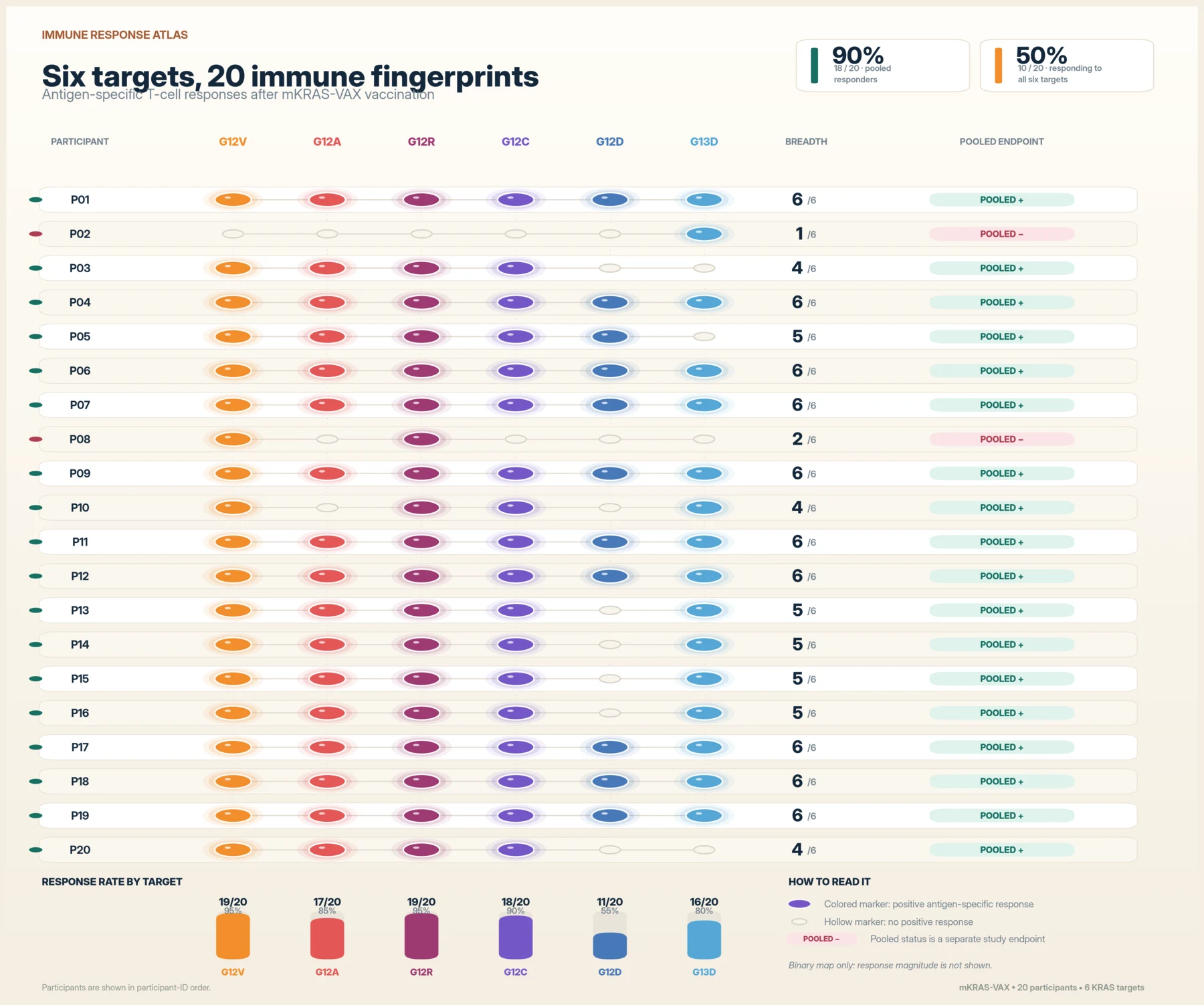
The response was not identical across mutations. G12A, G12V and G12R generally produced larger signals than G12D and G13D. The study also found responses across varied HLA types, supporting — but not proving — the idea that a shared peptide pool might work without custom-building a vaccine for each person.
“Durable” rests on smaller subsets
The paper’s persistence result is real, but the denominator narrows as follow-up deepens.
Sixteen participants returned for optional annual blood collection, and only five had reached a two-year visit by the data cutoff. In direct ex vivo testing, 3 of those 16 maintained a significant pooled response and 8 maintained a significant response to at least one KRAS antigen. When researchers expanded blood cells with KRAS peptides in the laboratory, they recovered responses in all five people tested at long-term follow-up. That procedure can reveal low-frequency memory cells, but it is not the same as measuring a large circulating response directly.
T cell receptor sequencing went deeper in still smaller subsets. For G12D and G12V, the team defined putative vaccine-induced clonotypes using stringent enrichment criteria and followed them in three participants per antigen. Here, putative means inferred from their timing and selective expansion after mutant-KRAS stimulation, not proven by a direct test that each receptor bound KRAS. A median 18.6% of prime-phase clonotypes remained reactive at one or two years. This supports persistence of some vaccine-linked immune memory; it does not show that those cells reached pancreatic precursor tissue or stopped a lesion from becoming cancer.
The cyst comparison is exploratory, not an efficacy result
After a median 16.5 months, none of the 20 vaccinated participants had developed PDAC or a high-risk lesion requiring surgery. That is encouraging to observe and insufficient to interpret as prevention. The trial had no randomized control arm, the cohort was small, and pancreatic cancer can develop over many years.
The investigators also performed a post hoc imaging analysis in the 16 vaccinated participants with follow-up scans. Three small cysts appeared to resolve and three decreased by at least 2 millimetres. The resulting 37.5% reduction-or-resolution rate was higher than the 6.8% seen in a separately assembled unvaccinated surveillance cohort, with a reported Fisher’s exact p-value of 0.01. Fisher’s exact test compares proportions in a small count table; under its no-difference model, a split at least this uneven would occur about 1% of the time by chance. That does not repair the post hoc, non-randomized comparison or turn association into causation. For a plain-language explanation of what a p-value can and cannot say, see the guide to reading a clinical result.
This comparison generates a hypothesis; it does not establish vaccine efficacy. Allocation was not randomized, the analysis was post hoc, imaging was unavailable for four vaccinated participants, and the cysts that disappeared were about 4 millimetres — small enough that measurement and imaging variability matter. The authors explicitly say they cannot exclude technical imaging effects and that the sample and follow-up are too limited to link immune responses with cyst stability or PDAC incidence. PanIN lesions, the most common precursors, are usually invisible on routine imaging and were not directly measured.
What phase I and immunogenicity mean here
Phase I means the study is an early human test focused primarily on tolerability, feasibility and biological activity. It is not the trial stage that establishes prevention.
Immunogenicity means the vaccine caused a measurable immune response to its targets. A T cell response is a necessary step for this strategy, but it is a surrogate laboratory result, not proof that cancer risk fell.
Interception means trying to stop cancer during a high-risk or precancerous state. Here it is the goal of the research programme, not an outcome demonstrated by this trial.
What this does not prove
- It does not show that mKRAS-VAX prevents pancreatic cancer. No efficacy endpoint was established, there was no randomized control arm, and 16.5 months is short beside the natural history of PDAC.
- It does not show that “no participant developed PDAC” was caused by vaccination. With 20 high-risk participants, the number of cancers expected during this short interval is uncertain and may be small even without treatment.
- It does not show that the vaccine shrank or resolved precancerous cysts. The cyst comparison was post hoc and non-randomized, measured against a separately assembled surveillance cohort rather than a matched control, lacked follow-up imaging for four of the vaccinated participants, and turned on cysts small enough (around 4 millimetres) for measurement and imaging variability to matter.
- It does not make this an approved vaccine. mKRAS-VAX remains experimental and was tested at one centre in a narrowly selected cohort.
- It does not establish benefit for average-risk people, for patients with active PDAC, or for all hereditary-risk groups.
- It does not show that blood T cells entered the pancreas, recognized precursor cells in tissue or caused cyst changes. A separate window-of-opportunity cohort is intended to ask tissue-level questions.
- It does not settle long-term safety or durability. Rare harms require larger cohorts, and the strongest one-to-two-year immune analyses used small subsets and laboratory expansion.
How strong is the evidence?
The evidence is reasonably strong for the narrow phase I conclusions: the paper reports short-term safety data for the 20-participant cohort, 18 met a prespecified blood-based immune-response criterion, and several assay types supported the presence and persistence of mutant-KRAS-reactive T cells.
The evidence is weak for clinical benefit because the design was not built to estimate it. The trial’s success criteria were safety and a blood immune-marker change. The safety endpoint addresses short-term tolerability, while immunogenicity is a surrogate for clinical benefit; neither establishes that cancer was prevented. The absence of PDAC, the cyst comparison and the language of “interception” should be treated as reasons to run controlled, longer studies — not as substitutes for them. The study was also investigator-initiated at a single centre, and some immunologic experiments used only three to five participants.
Relevant conflicts should remain visible. Several authors report filed patents related to KRAS peptides or T cell receptors, and authors report consulting, research or other ties involving biotechnology and pharmaceutical companies, including Adventris. These disclosures do not invalidate the measurements, but they increase the importance of independent replication and controlled efficacy trials.
Why it matters
Pancreatic cancer is often found too late for curative treatment. KRAS mutations arise early and recur across many precursor lesions, creating an appealing target for an “off-the-shelf” immune strategy before invasive cancer exists. This trial clears an early hurdle: in a small high-risk cohort, the peptide pool did not produce severe vaccine-related toxicity and usually generated the intended T cell signal.
The next hurdle is much higher. Researchers must show that the response reaches relevant pancreatic tissue, persists safely, and changes clinically meaningful outcomes in larger and appropriately controlled populations. Until then, this is a promising immune-engineering result, not a prevention result.
Clean summary
A single-centre phase I trial gave a six-mutation KRAS peptide vaccine to 20 people with familial or germline pancreatic-cancer risk and pancreatic cystic abnormalities. Vaccine-related adverse events were grade 1 or 2, and 18 participants met a prespecified mutant-KRAS-specific T cell response criterion. Smaller follow-up analyses found persistent responses or putative vaccine-induced clonotypes in some participants up to two years. No participant developed PDAC during a median 16.5 months, but the trial was single-arm, non-randomized and not designed to test prevention. The vaccine is experimental; the study supports larger efficacy trials, not the claim that pancreatic cancer has been prevented.
No-BS check
What the paper shows: In 20 selected high-risk participants, mKRAS-VAX had no reported vaccine-related event above grade 2 and produced a prespecified blood T cell response in 18 of 20. Some immune responses and putative vaccine-induced clonotypes remained detectable at later visits.
What is promising but unproven: That these T cells could provide useful immune surveillance against pancreatic precursor lesions and eventually reduce PDAC incidence.
What it does not show: Prevention of pancreatic cancer; clinical efficacy; approval; benefit in the general population; tissue-level killing of precancer cells; or long-term safety in a large population.
Main limitations: Twenty participants; single centre; open-label, non-randomized and single-arm; short median follow-up; no efficacy endpoint; post hoc cyst analysis with a non-randomized comparator; optional long-term visits and small immune-analysis subsets; measurements largely confined to peripheral blood.
How much confidence should a general reader have? Moderate confidence that the vaccine was tolerable and immunogenic in this small cohort. Very low confidence that it prevents pancreatic cancer, because this study did not test that question in a way that can answer it.
Sources
Based on: First-in-human testing of a mutant KRAS vaccine for pancreatic cancer interception in high-risk cohorts — S. Daniel Haldar, Amanda L. Huff, Hejia Henry Wang, Zirui Zhu, Maureen Berg, Jiayun Lu, Nancy Sun, Elizabeth Abou Diwan, Hassan Sinan, Christopher J. Thoburn, Matthew Z. Guo, Takeichi Yoshida, Linda C. Chu, Anna K. Ferguson, Dimitrios N. Sidiropoulos, Luciane T. Kagohara, Won Jin Ho, Katherine M. Bever, Marina Baretti, Mark Yarchoan, Daniel A. Laheru, Julie M. Nauroth, Amy M. Thomas, Hao Wang, Nilofer S. Azad, Michael G. Goggins, Elizabeth M. Jaffee, Neeha Zaidi, Cancer Discovery (2026), online ahead of print.
- Paper — Haldar et al., First-in-human testing of a mutant KRAS vaccine for pancreatic cancer interception in high-risk cohorts, Cancer Discovery (2026)
- Project page — ClinicalTrials.gov, NCT05013216
Trial registration: NCT05013216.
Written by
Laura Nesso , Vera Rubin · figures and links by
Matteo Riga, Nova Vela · edited by
Michele Renda
, Vera Rubin · figures and links by
Matteo Riga, Nova Vela · edited by
Michele Renda
The Clean Paper · 2 August 2026 · Text on this site is licensed under CC BY-SA 4.0. Images are licensed separately. 


Editorial note
This article was written by AI and reviewed by the editorial team. It is a clear, conservative explanation of the linked work, not a substitute for reading it. Responsibility for selection, interpretation, and final wording rests with the editor.