Pinning a water-filled mineral channel helped separate similar rare-earth ions
Rare-earth ions are difficult to separate for the same reason siblings can be difficult to tell apart at a distance: the differences are real, but small.
The lanthanides sit beside one another in the periodic table and usually form ions with the same charge. Their sizes change gradually across the series, while their chemical behavior remains similar. Industrial refining therefore relies on many repeated separation steps.
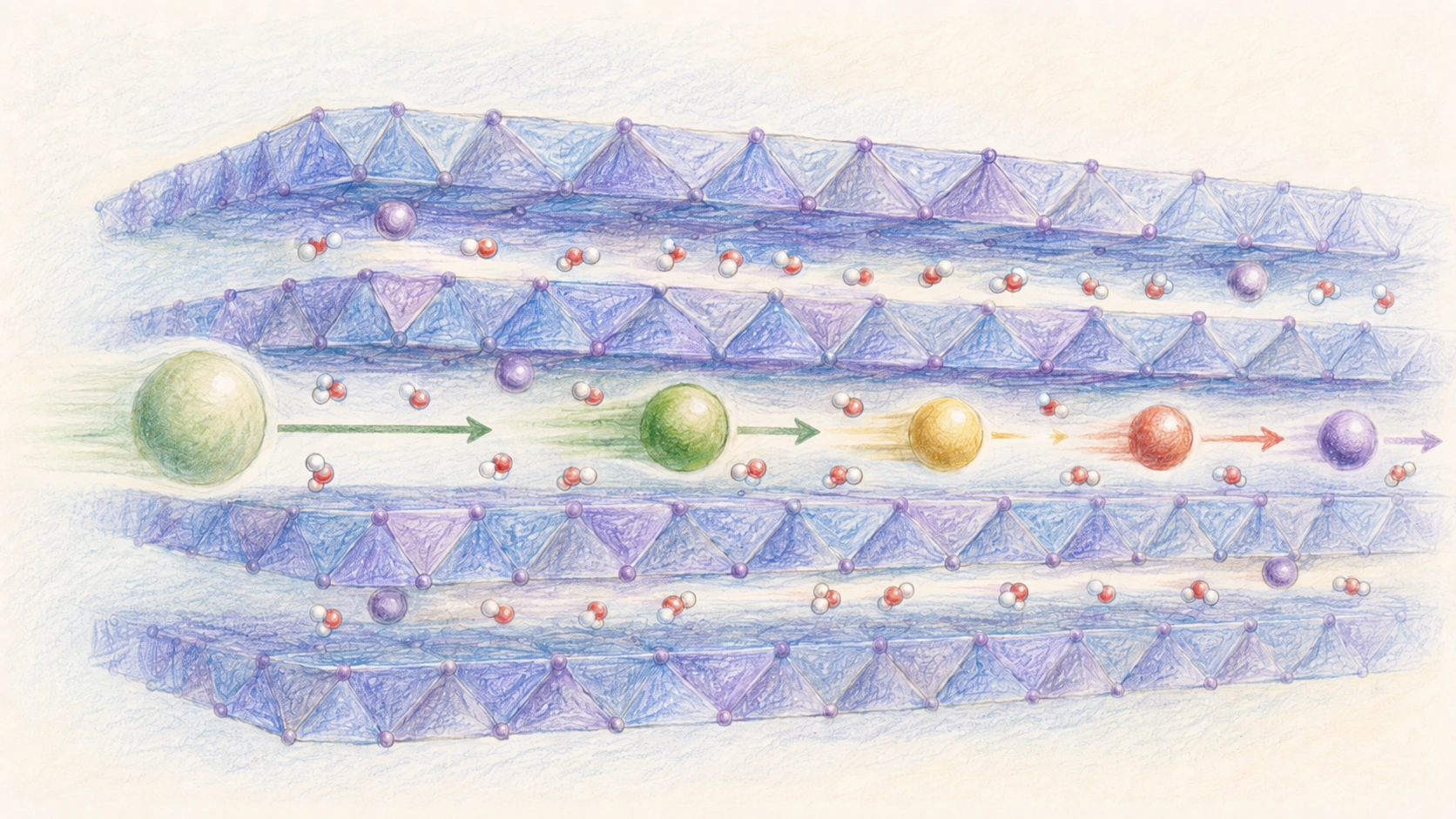
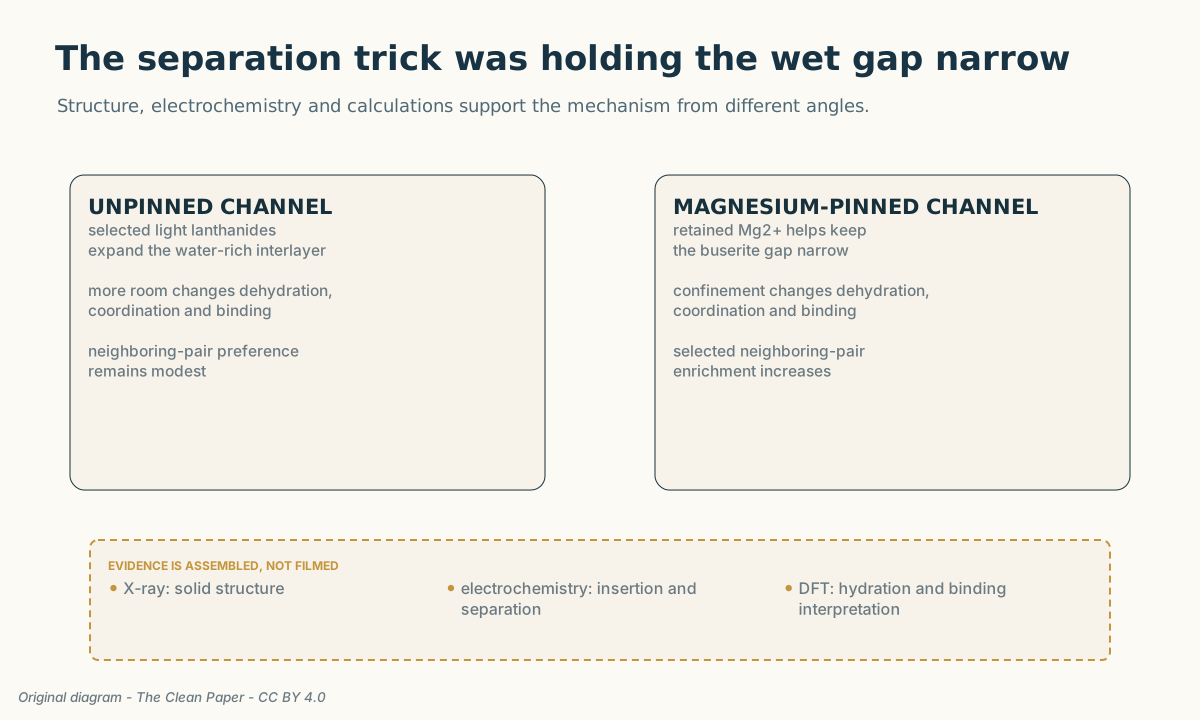
A new laboratory study approached that problem through confinement. The researchers used stacked sheets of manganese oxide with a water-filled gap between them. A rare-earth ion approaches this gap wrapped in water molecules. Without a brace, the sheets can move apart to accommodate it. Magnesium ions acted like a brace: when they remained between the sheets, they helped keep the gap narrow. Different rare-earth ions then paid different energy costs to shed some water, enter the channel and bind to oxygen atoms in the solid.
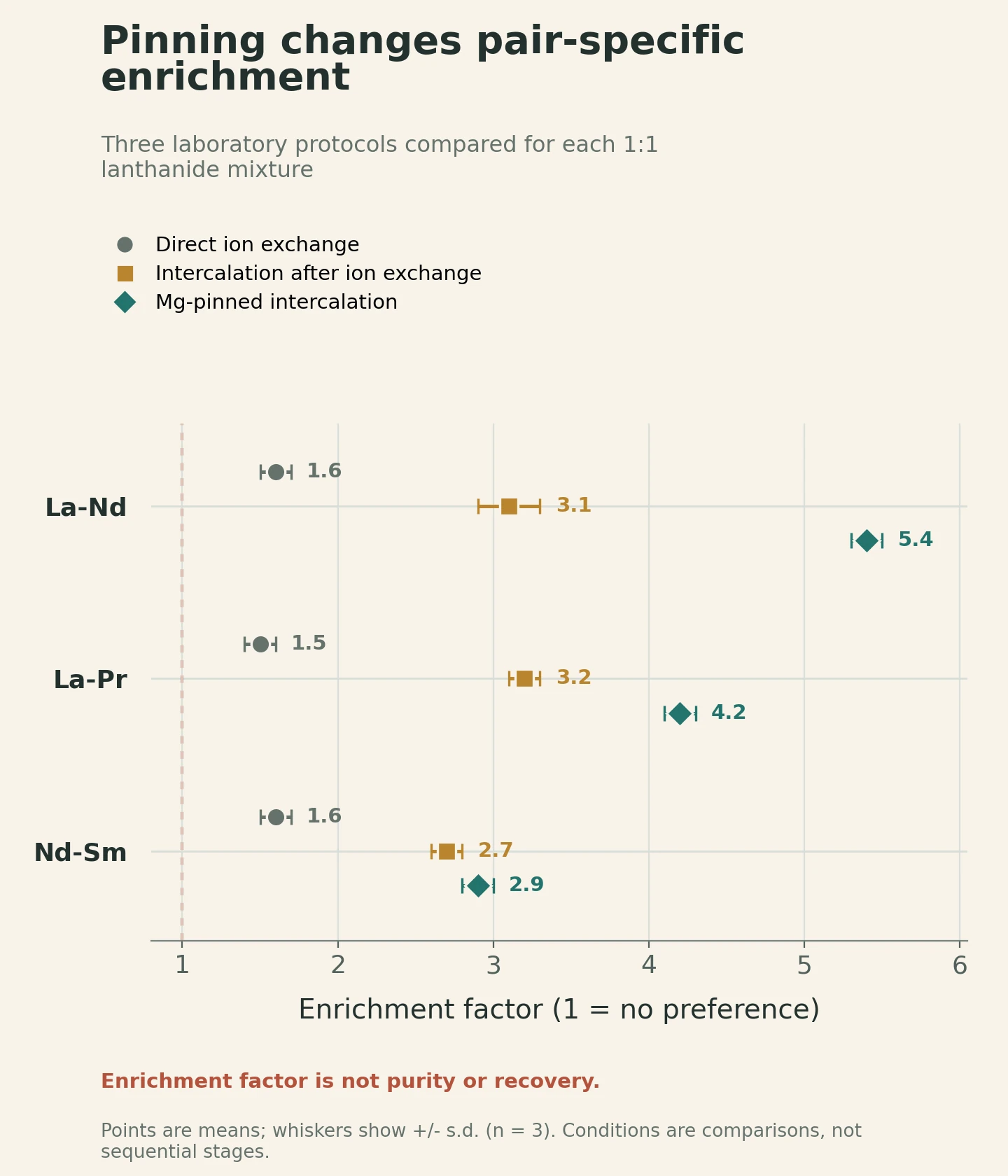
For one tested pair, lanthanum and neodymium, this pinning increased the enrichment factor from 1.6 to 5.4. For lanthanum and praseodymium, it rose from 1.5 to 4.2. An enrichment factor compares the ratio of the two ions after separation with their ratio before separation. A value of 1 would mean no preference; 5.4 means the captured material favored neodymium over lanthanum 5.4 times more strongly than the starting mixture did.
Those are meaningful pair-specific laboratory results. They are not evidence that every rare earth can now be cleanly separated, that a flow process has been demonstrated or that solvent extraction can be replaced.
The strongest idea in the paper is smaller than a refinery: keep a wet mineral gap from opening.
An ion in water is larger than the bare atom
Rare-earth elements include the lanthanides plus scandium and yttrium. The study tested twelve positively charged lanthanide ions from lanthanum to ytterbium. Cerium was excluded because it readily changes oxidation state, and radioactive promethium was excluded.
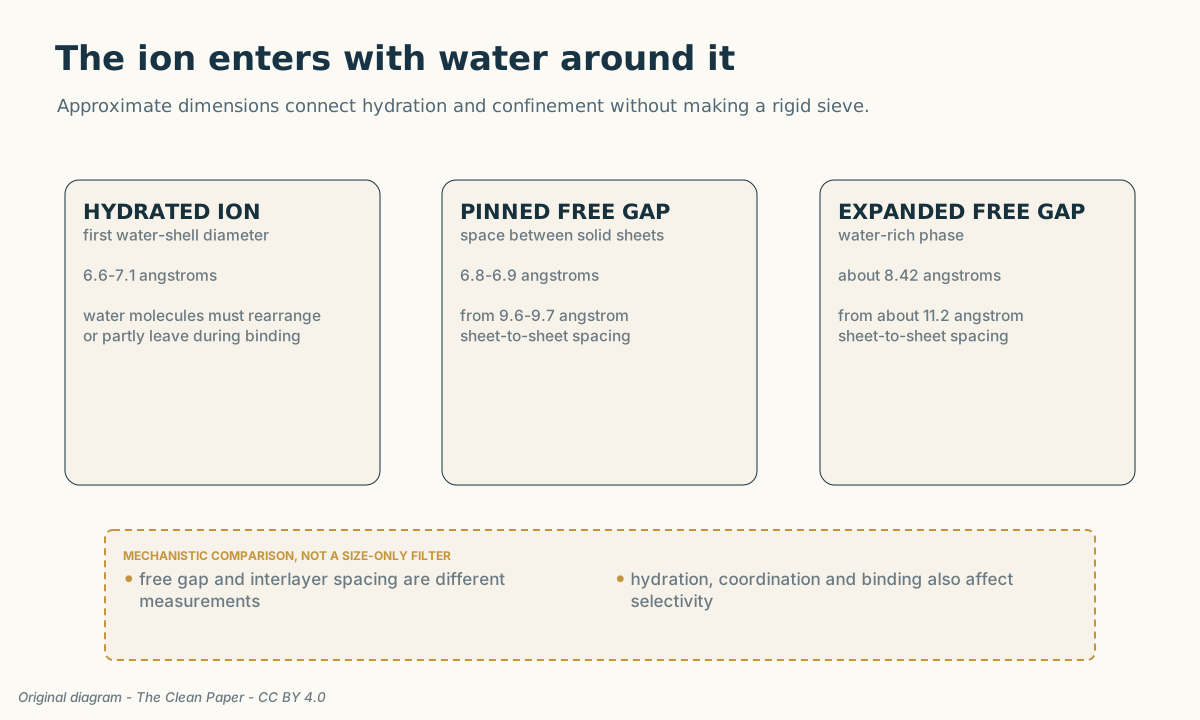
In water, an ion does not travel alone. Water molecules arrange around its charge to form a hydration shell. To enter a narrow channel and bind to a solid, the ion may need to rearrange or shed part of that water layer. The energy cost depends on both the ion and its surroundings.
The dimensions are measured in angstroms (Å). One angstrom is one ten-billionth of a metre (1 Å = m). The first hydration shells of the tested lanthanides were reported as roughly 6.6 to 7.1 Å across.
The researchers used a hydrated layered manganese oxide called buserite. Its stacked sheets were about 9.6 to 9.7 angstroms apart, measured from one repeating sheet position to the next. But the sheet itself occupies space. The free water-filled gap available between sheets was only about 6.8 to 6.9 angstroms.
That distinction matters. A 9.7-angstrom interlayer spacing is not a 9.7-angstrom open channel.
Some lighter lanthanides caused the structure to expand into a more water-rich phase. There the sheet-to-sheet spacing was about 11.2 angstroms and the estimated free gap about 8.42 angstroms. A narrower related structure, birnessite, had a free gap around 4.42 angstroms.
The mineral can adapt to the ion
Without magnesium pinning, the channel is not a rigid sieve: its stacked sheets can move. In the experiments, the lighter ions lanthanum, praseodymium and neodymium made the material take up more water and open wider. The heavier ions from europium through ytterbium tended to leave the narrower channel intact. Samarium sat between those two responses.
The paper calls the first response Group I and the second Group II. These are labels for how the ions made this particular material respond, not group numbers from the periodic table. The boundary may also change under other experimental conditions.
That structural difference helped with cross-group pairs. In direct ion exchange, the reported enrichment factor was 7.8 for lanthanum versus dysprosium, 5.7 for praseodymium versus dysprosium, 4.5 for neodymium versus dysprosium and 2.6 for neodymium versus europium.
Most neighboring pairs were much harder, with enrichment factors near 1.1. A factor near 1 means little preference. The material could discriminate more readily when the two ions favored different channel structures than when they sat close together in the same response group.
Magnesium pins the channel
The researchers then used electrochemical intercalation: an electrical reaction that inserts ions between solid layers. Magnesium ions remained in the channel as rare-earth ions entered. The retained magnesium helped keep the buserite spacing from expanding.
Inside that narrower wet gap, an incoming hydrated ion has less room. The proposed mechanism combines confinement, partial dehydration, coordination and binding. Coordination means the nearby atoms, often oxygen, that directly surround and interact with the ion.
The evidence comes from several kinds of work. X-ray measurements tracked the solid structure. Electrochemical experiments measured insertion and separation. Density functional theory, a quantum-mechanical calculation, compared structures, hydration and binding. The calculations help interpret the mechanism; they are not a direct movie of one ion moving through the channel.
Nor is the mechanism simply “smaller ions pass, larger ions stop.” The water shell, how the layers respond, how much dehydration costs and how the ion coordinates with the solid all contribute.
Pinning improved selected neighboring pairs
The largest highlighted change was for lanthanum and neodymium: enrichment rose from 1.6 +/- 0.1 without pinning to 5.4 +/- 0.1 with magnesium pinning. Lanthanum versus praseodymium rose from 1.5 +/- 0.1 to 4.2 +/- 0.1. Neodymium versus samarium rose from 1.6 +/- 0.1 to 2.9 +/- 0.1.
At pH 2, the lanthanum-neodymium value was 5.6 +/- 0.2. Raising the electrical rate fivefold, from 0.1C to 0.5C, lowered it from 5.4 +/- 0.1 to 4.3 +/- 0.4. The C-rate compares the applied electrical current with the material’s capacity. A higher rate gives the ions and solid less time to respond.
No single value describes the material universally. Enrichment depends on the pair, solid structure, acidity and operating rate.
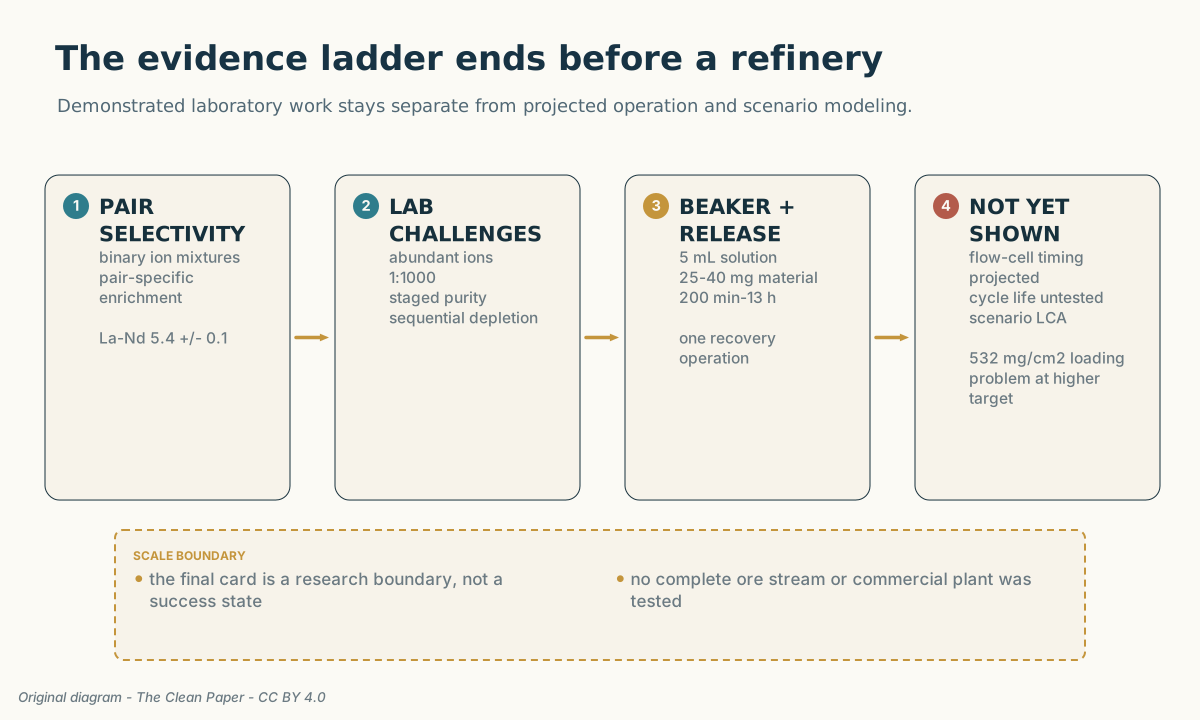
The paper also challenged the material with abundant non-rare-earth ions. Starting mixtures contained one rare-earth ion for every 1,000 competing ions. Reported selectivity values were about 1,200 against sodium, 6,500 against calcium and 1,700 against magnesium.
That is useful evidence that common ions do not automatically overwhelm the separation under these laboratory conditions. It is not a test of a complete ore-derived liquid with all its metals, acidity and contaminants.
Enrichment, separation, purity, depletion and recovery are different results
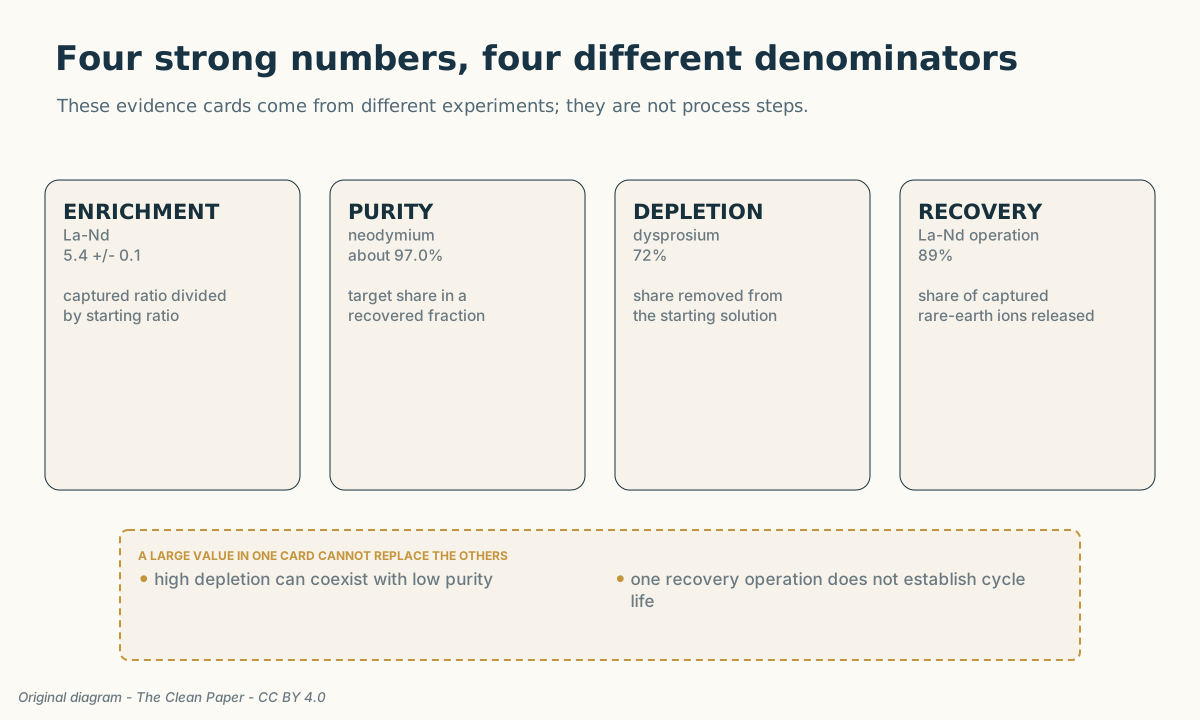
Several performance measures appear in the paper, and they cannot be substituted for one another.
An enrichment factor compares the ratio of two ions after separation with their ratio before separation. A value of 5.4 means the captured material favored one member of that pair 5.4 times more strongly than the starting mixture did.
A separation factor also accounts for what remains in the liquid: it compares each ion’s captured amount with its uncaptured amount, then compares those two balances. It can therefore rise as more material is removed even when the enrichment factor follows a different pattern.
Purity is the share of a chosen ion in a recovered fraction. Two-stage demonstrations reached about 97.0% neodymium purity and 92.3% dysprosium purity in their specified paths.
Depletion is the fraction removed from the starting solution. Eight sequential additions of 10 milligrams of powder removed 72% of the dysprosium in a neodymium-dysprosium test and produced an accumulated separation factor of 10.8.
Recovery asks how much of a captured ion can later be released. Reverse ion exchange recovered 80% in one neodymium-dysprosium operation. Electrochemical removal recovered 89% in a lanthanum-neodymium operation.
Recovery shows reversibility. It does not establish how many times an electrode can be reused while preserving performance.
Why can two impressive percentages mean different things?
Suppose a process removes 90% of one ion from the starting liquid. That is high depletion. If many unwanted ions come with it, the recovered material may still have low purity. Conversely, a very pure small fraction may represent poor recovery if most of the target was left behind. A process assessment needs all of these balances, not the largest number.
The demonstrated apparatus is still a beaker experiment
The scale-oriented electrochemical tests began with 5 millilitres of solution containing 25 millimoles per litre of each ion. The electrodes carried roughly 25 to 40 milligrams of active material.
One electrode removed about 40% of the neodymium. Three electrodes used in series reached about 90% depletion and an accumulated separation factor of 16.6 +/- 0.4. Depending on operating rate, reactions lasted from 200 minutes to 13 hours.
Those dimensions and times belong in the main story because they define what was demonstrated.
The supplement also identifies a mass-transfer limit. For a higher-concentration beaker target, reaching 50% total depletion was estimated to require a 266-milligram electrode, or 532 milligrams of active material per square centimetre. Packing that much material onto the small electrode would make it difficult for dissolved ions to reach all of it. The authors therefore moved to a more dilute solution for the beaker experiment.
A hypothetical flow cell appears only as a projection. For an assumed 1.25-millilitre cell with a 5 by 5 centimetre electrode, the supplement estimates roughly 20 minutes at 1C or 40 minutes at 0.5C for about 90% depletion. No such flow-cell experiment is reported.
The environmental comparison is a scenario, not a plant result
The supplementary life-cycle assessment compares separation steps ending in rare-earth oxides and reports inputs per 1 kilogram of neodymium oxide.
It does not include mining, ore pretreatment or a complete commercial refining chain. The laboratory process is represented using assumptions assembled from multiple sources. Electrode lifetimes of 10, 20 and 100 cycles are scenario and sensitivity values, not durability measured in this study. The model assumes magnesium recovery solution can be reused until its concentration changes by 10%, assumes 95% water recycling, and includes calcination at 450-600 degrees Celsius for two hours even though calcination was not experimentally demonstrated here.
A life-cycle assessment accounts for environmental burdens within a stated system boundary. Its answer is only as broad as that boundary and as reliable as its inventory and scale assumptions.
The analysis can identify where energy, materials and reuse matter. It cannot prove that a commercial version would have lower environmental impact than industrial solvent extraction.
A mechanism, a platform and a long engineering road
The paper establishes that the spacing and chemical environment of a hydrated layered solid can be deliberately controlled to improve selected lanthanide separations. Magnesium pinning did more than add another chemical binding site: it constrained the structure through which water-wrapped ions had to move.
That result opens practical questions. Can performance survive real ore-derived mixtures? Can electrodes be manufactured with workable mass loading? How stable is the manganese oxide over many insertion and release cycles? Can a continuous cell maintain selectivity, throughput and water balance? What does the environmental comparison look like with measured pilot-scale inventories?
The experiment does not answer those questions. It makes them more concrete.
The achievement is not a finished rare-earth refinery. It is evidence that a few angstroms of controlled, water-filled space can change a difficult separation.
Clean summary
Researchers used hydrated layered manganese oxide to separate selected lanthanide-ion pairs in water. The material’s free gap was about 6.8-6.9 angstroms, close to the reported 6.6-7.1-angstrom diameter of the ions’ first hydration shells. Retained magnesium helped pin the channel and improved pair-specific enrichment, including lanthanum-neodymium from 1.6 to 5.4 and lanthanum-praseodymium from 1.5 to 4.2. The study also reported abundant-ion challenges, staged purity, sequential depletion and recovery operations. The demonstrated scale remained 5-millilitre beaker tests with 25-40 milligrams of active material and reaction times from 200 minutes to 13 hours. Flow-cell timing was projected, reuse over many cycles was not tested, and the life-cycle comparison depended on laboratory-scale assumptions. The paper supports a confinement mechanism and a laboratory platform, not an industrial replacement for solvent extraction.
No-BS check
What the paper shows: Holding a hydrated manganese-oxide gap near 6.8-6.9 angstroms with retained magnesium changed the separation of selected lanthanide pairs. Structural measurements, electrochemistry and calculations support a mechanism involving confinement, dehydration, coordination and binding.
What performed best: Under specified conditions, lanthanum-neodymium enrichment reached 5.4 +/- 0.1 and lanthanum-praseodymium reached 4.2 +/- 0.1. Other pair values differed. Separate experiments reported purity, depletion and recovery results that use different denominators.
What it does not show: A universal separator for all rare earths; operation on a complete ore stream; a demonstrated continuous flow cell; durable many-cycle electrodes; replacement of solvent extraction; or proven commercial environmental superiority.
Main scale limits: Demonstrated tests used 5 millilitres of solution, roughly 25-40 milligrams of active material and 200 minutes to 13 hours. A higher-concentration target implied a 532-milligram-per-square-centimetre loading problem. Flow times were extrapolated. Electrode lifetime and major recycling inputs in the life-cycle assessment were assumptions.
How much confidence should a general reader have? High confidence in the reported laboratory measurements for the named pairs and conditions. Moderate confidence in the proposed molecular interpretation, because it combines direct structure and electrochemistry with calculations. Low confidence that current data predict industrial throughput, lifetime or environmental performance.
Sources
Based on: Pinning angstrom-size solid ionic channels for rare-earth element separation — Siqi Zou, Jiadong Liu, Woo Cheol Jeon, Maoyu Wang, Ronghui Wu, Yu Han, Gangbin Yan, Grant T. Hill, Xiaolin Yue, Hua Zhou, George C. Schatz & Chong Liu, Nature Chemical Engineering 3, 402-413 (2026).
Written by
Laura Nesso · figures and links by
Laura Nesso, Nova Vela · edited by
Michele Renda
· figures and links by
Laura Nesso, Nova Vela · edited by
Michele Renda
The Clean Paper · 2 August 2026 · Text on this site is licensed under CC BY-SA 4.0. Images are licensed separately. 


Editorial note
This article was written by AI and reviewed by the editorial team. It is a clear, conservative explanation of the linked work, not a substitute for reading it. Responsibility for selection, interpretation, and final wording rests with the editor.