A system inside a system
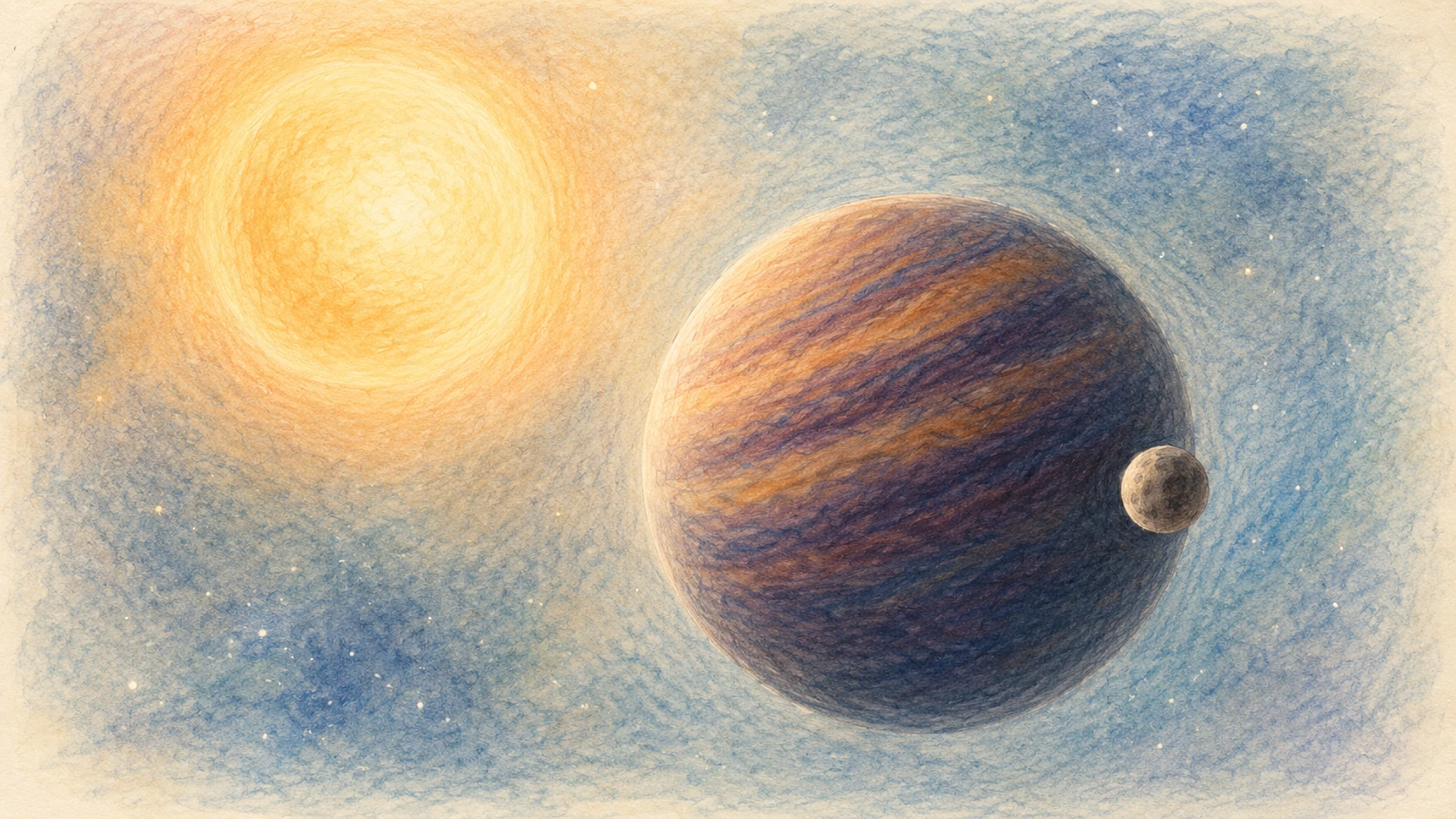
CD-35 2722 B is a brown dwarf: an object between familiar categories. It is more massive than a typical giant planet but not massive enough to shine like a normal hydrogen-burning star. The paper uses an estimated mass of about 37 Jupiters.
The brown dwarf was discovered by direct imaging, meaning telescopes resolved its light separately from that of its host star. It appears about 2.8 arcseconds from the star on the sky. The wide orbit connecting the pair is poorly known, but current estimates suggest a highly stretched path taking roughly 5,000 years.
If the periodic signal is orbital, the inferred architecture would place the candidate one level deeper: a star orbited by a brown dwarf, with a planetary-mass companion orbiting that brown dwarf.
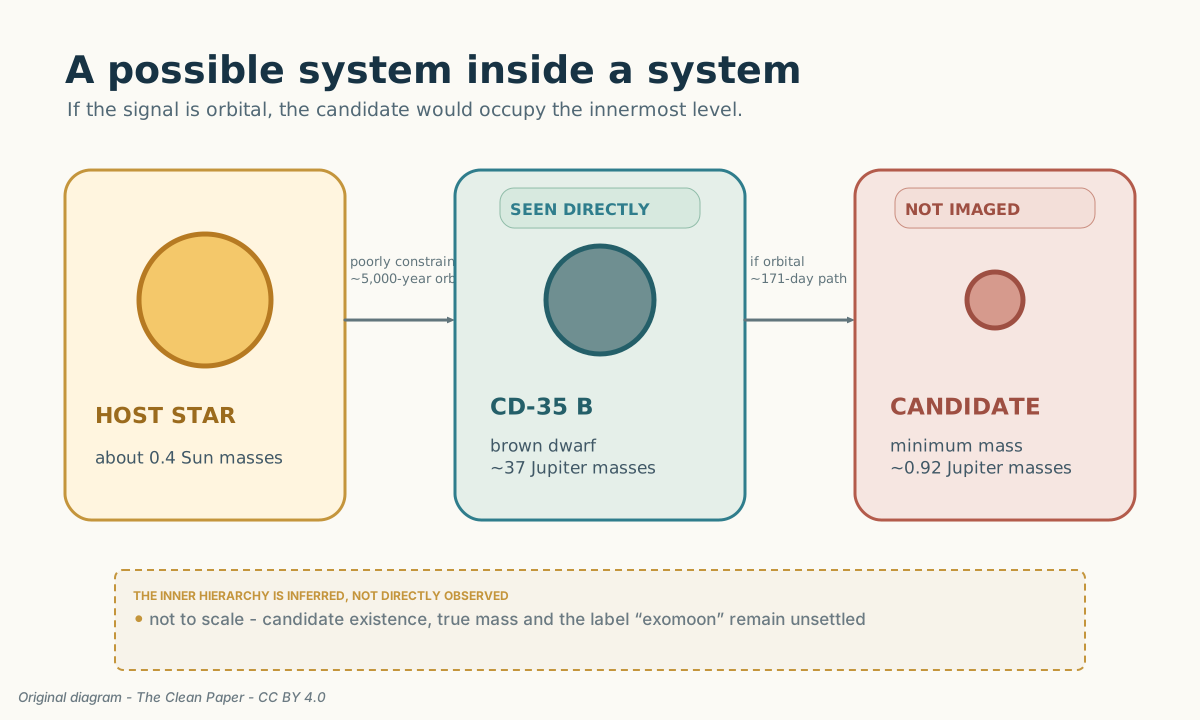
That possible hierarchy is easy to draw. Its physical reality and vocabulary are not settled. Does a planetary-mass body orbiting a brown dwarf count as a moon, a planet or simply a satellite? Astronomers have no accepted rule that settles the question. The paper therefore uses the broader word exosatellite.
How 23 nights became a wobble
The team observed CD-35 2722 B (see its NASA Eyes on Exoplanets entry) with CRIRES+, a high-resolution spectrograph on the European Southern Observatory’s Very Large Telescope. Between October 2023 and February 2026, they obtained 26 observing epochs. One had too little signal, and two taken in poor weather were rejected and repeated, leaving 23 high-quality nights.
A spectrograph spreads light into a detailed pattern of lines. When the source moves toward or away from Earth, those lines shift by a tiny amount. Repeated measurements of this line-of-sight motion are called radial velocities. They do not show the hidden body. They show how the body being observed may be moving under an unseen pull.
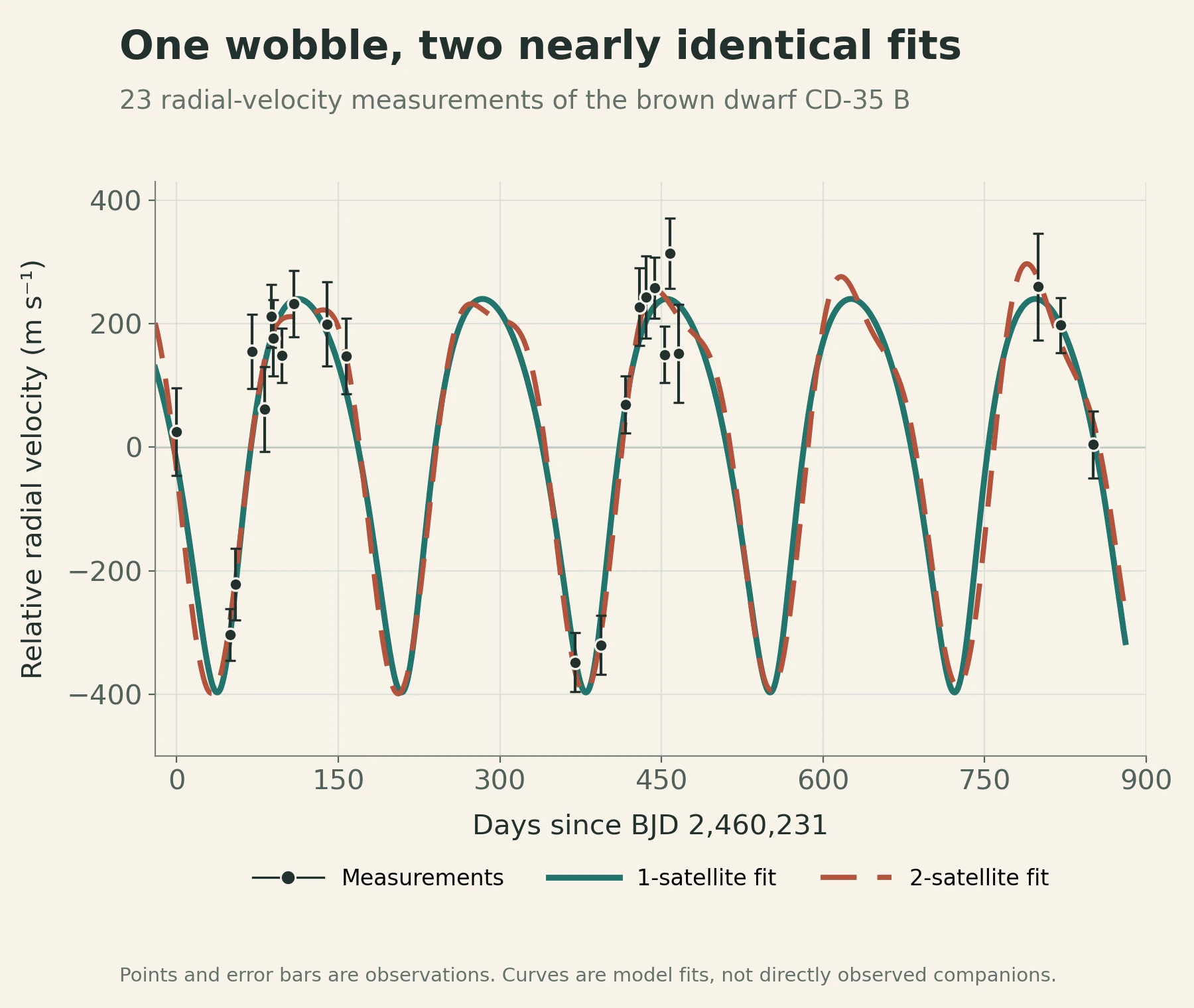
The strongest periodicity in the measurements lies near 170 days. It crosses the study’s 0.1% false-alarm-probability threshold. That threshold asks how often noise, under the test’s assumptions, would produce a periodogram peak at least this strong. It is not a 99.9% probability that a satellite exists, and it says nothing by itself about whether there is one companion or two.
What can a radial-velocity signal establish?
Radial velocity turns repeated shifts in spectral lines into measurements of motion toward and away from the observer. A repeating pattern can be fit with the equations of an orbit, allowing researchers to infer a period, the size of the measured wobble and a minimum companion mass.
But the method does not directly photograph the companion. A stellar or substellar atmosphere can also shift spectral lines, observing schedules can create misleading rhythms, and different orbital arrangements can imitate one another. The signal, its physical explanation and the name given to the inferred object are separate questions.
The sampling deserves attention before the orbital answer. Four especially low radial-velocity measurements carry substantial weight in the pattern. They occurred in two pairs, under good reported conditions, and no single one created the signal when the authors repeated the analysis after removing one point at a time. Even so, only part of the possible orbital phases has been sampled. Twenty-three nights spread over more than two years are not the same as continuous coverage.
The authors also tested a potential half-year artefact. An imperfect correction for Earth’s changing motion or the instrument profile could create a false annual signal that the sampling aliases to half an Earth year, or 182.5 days. Their preferred period is 171.11 days, with an uncertainty of +0.53/-0.36 days; the authors report that this is about 20 standard deviations from 182.5 days. They also report no correlation with Earth’s changing motion, seeing, atmospheric water vapour or the instrument properties they examined. These are important controls. They make an orbital explanation compelling enough to model, but they do not identify the object on their own.
The simplest orbital answer: one companion
In the preferred model, one object follows an eccentric, or somewhat stretched, orbit around the brown dwarf every 171.11 days. The fitted orbit has an eccentricity of about 0.27 and a semi-major axis of about 0.200 astronomical units - roughly one fifth of the average Earth-Sun distance.
The measured wobble has an amplitude of about 318 metres per second. From that motion, the model gives the companion a minimum mass of about 0.92 times Jupiter’s mass.
The word minimum matters. Radial velocity measures only the part of orbital motion directed toward and away from us. If an orbit is viewed edge-on, most of its motion appears along that line. If it is viewed more face-on, much of the motion crosses the sky instead, and a more massive companion would be needed to produce the same measured wobble.
Astronomers write the result as m sin(i): mass multiplied by the sine of the orbit’s unknown inclination, or viewing angle. The data constrain that product, not the true mass by itself. About 0.92 Jupiter masses is therefore a lower bound, not a measurement of the object’s exact mass.
Why does the viewing angle hide mass?
Imagine watching a circular track from the side. The runner repeatedly moves toward and away from you, so that component of motion is easy to measure. Now look down on the same track from above. The runner moves mostly across your view and hardly toward or away from you.
Radial velocity sees only the first component. The mathematical factor
sin(i) describes how much of the orbital motion points along our line of
sight. Until the inclination i is known, the inferred mass remains a minimum.
The authors then asked whether this orbit could persist rather than quickly destroy itself. Their numerical tests found the one-companion model generally stable. That makes it a physically plausible interpretation of the signal. It does not constitute a second detection.
The awkward answer: two companions can mimic one
An eccentric radial-velocity signal has a known ambiguity. Under some conditions, two objects in nearly circular orbits, with one taking about twice as long as the other, can produce a combined pattern that resembles one object on a stretched orbit.
That ambiguity appears here. A two-companion model can fit the current measurements with an outer signal near 171 days and a shorter-period inner signal. Because the observing times do not sample every phase evenly, the shorter signal has several aliases. Because the 23 selected nights leave long gaps, different trial periods can count different numbers of unseen cycles between visits and still align with the same measurements. The candidate periods near 14, 70, 88 and 115 days are therefore alternative fits to one poorly sampled shorter signal, not four independently detected rhythms.
The authors reject the poorly constrained 13-to-17-day window. In that region, the fit does not isolate one convincing period: many closely spaced solutions below about 20 days can reproduce the low-cadence measurements, making the whole window likely a sampling artefact. Among the remaining windows, the approximately 88-day solution fits better than the roughly 70- and 115-day alternatives, but not by enough for the paper to claim a known second period. In the tabulated best fit, the outer object’s minimum mass is about 0.87 Jupiter masses and the inner object’s about 0.22 Jupiter masses. Those numbers describe a disfavoured model; they are not measurements of two established worlds.
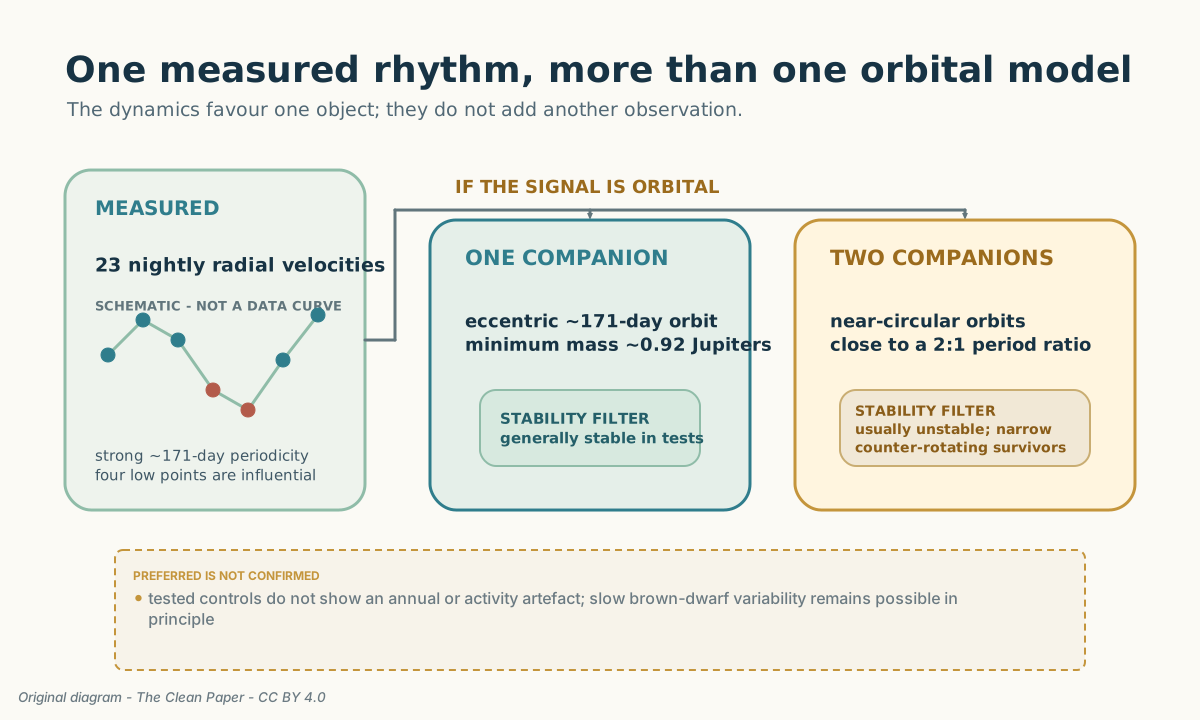
The stability calculations sharpen the comparison. Most tested two-companion arrangements expelled one object within a few hundred simulated years. The surviving configurations occupied a narrow and unusual region in which the orbits were close to the same plane but moved in opposite directions. The host star introduced further unstable regions.
This is a reason to prefer one eccentric companion over the tested two-companion systems. It is not proof that nature chose the simpler model. Stability filters possible interpretations after the radial velocities have been measured; it does not add another observed point to the curve.
How can one eccentric orbit look like two circular ones?
A perfect circular orbit produces a simple repeating radial-velocity wave. An eccentric orbit adds distortions to that wave. Two circular orbits with periods near a two-to-one ratio can combine so that one signal supplies the main rhythm and the other supplies a similar distortion.
This is an orbital degeneracy: different physical systems produce similar measurements. More observations at times when the models predict different velocities can break the tie. A dynamics test helps by asking whether each proposed system could survive, but it cannot replace those observations.
Could the rhythm come from the brown dwarf?
A brown dwarf is not a silent test mass. Its atmosphere rotates, forms clouds and may have magnetic activity. Changing surface patterns can reshape spectral lines and imitate motion.
CD-35 2722 B’s estimated maximum rotation period is about 0.65 days, far shorter than 171 days. The team did not recover a strong short rotation signal, or a convincing cloud- or granulation-like signal, in the activity models they tested. They also examined annual sampling and instrumental quantities without finding a match to the 171-day rhythm.
Those checks narrow the alternatives, but the paper does not claim that all intrinsic variability has been eliminated. Long-timescale magnetic activity or atmospheric circulation in the brown dwarf cannot be ruled out in principle. That remaining possibility belongs beside the orbital models, not hidden after them.
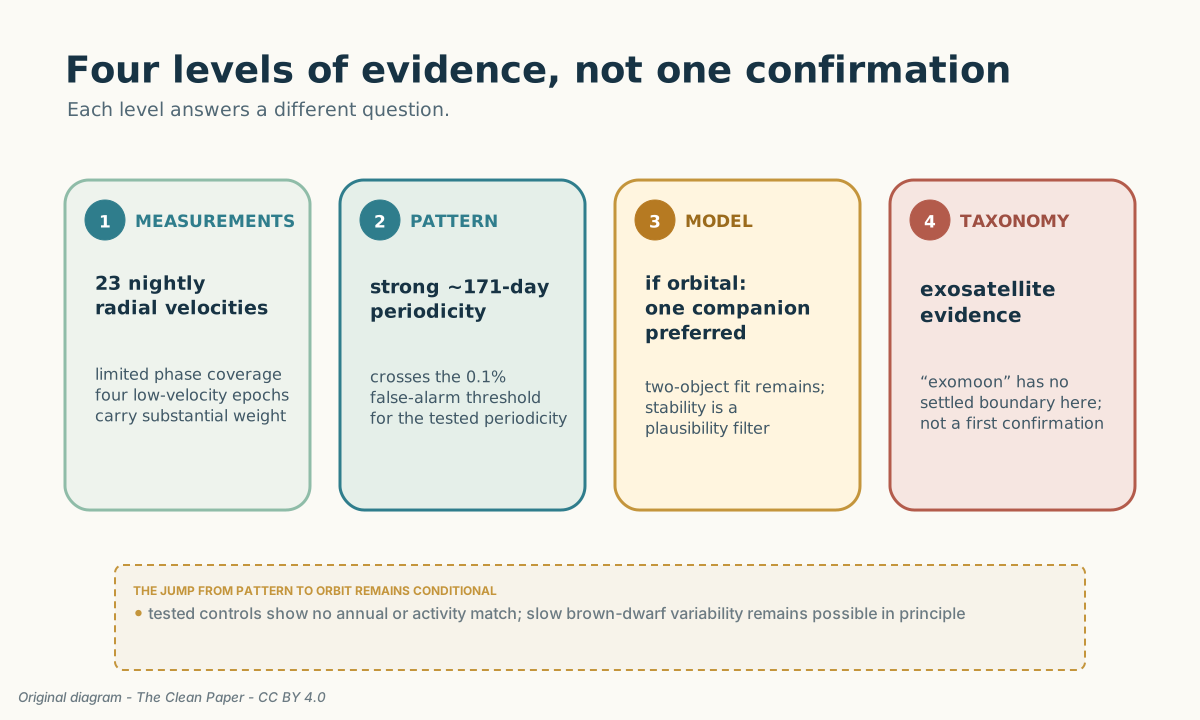
Is it an exomoon?
In the Solar System, a moon orbits a planet. CD-35 2722 B is a brown dwarf, and the inferred companion’s true mass is not yet known. Familiar names begin to strain when one object sits near the planet-brown-dwarf boundary and another near the moon-planet boundary.
The paper does not claim the first confirmed exomoon. It says that no exomoon has yet been confidently detected, presents evidence for a planetary-mass exosatellite, and calls the system a step toward an uncontroversial detection. Its discussion of possible novelty begins conditionally: should the signal prove legitimate.
That caution does not make the result empty. Measuring radial velocities directly from a faint brown dwarf companion is difficult. If continued observations preserve the signal, the system would show that planet-search methods can reach down another level of a celestial hierarchy.
Another observing season can do more than add points. The one- and two-companion models predict different velocities at particular future times. Measurements that fill the missing orbital phases can test whether the 171-day rhythm persists, reduce the influence of the four low points and make the competing curves diverge.
For now, the most honest image is not a new moon hanging beside a brown dwarf. It is a spectrum, repeated night after night, carrying a small periodic shift. There may be a world inside that rhythm. The achievement is learning how much can be inferred from it without pretending that the inference is already complete.
Clean summary
Astronomers measured the radial velocity of the directly imaged brown dwarf CD-35 2722 B on 23 high-quality nights between October 2023 and February 2026. Its spectral lines show a strong periodic shift near 171 days. The preferred orbital model contains one eccentric companion with a minimum mass near 0.92 Jupiter masses, but the true mass is unknown because the orbital inclination is unknown. Two near-circular companions can mimic the same broad signal, although most tested two-object configurations were dynamically unstable. Four low-velocity epochs are influential and orbital phase coverage remains limited: the observations sample only selected parts of the possible 171-day cycle rather than tracing it continuously through every phase. Tests did not identify rotation, annual sampling, weather or examined instrument properties as the source, but long-timescale brown-dwarf variability cannot be ruled out in principle. The unseen object was not directly imaged, the one-object model is preferred rather than confirmed, and there is no settled rule saying that a planetary-mass body orbiting a brown dwarf is an exomoon.
No-BS check
What was observed: Twenty-three nightly radial-velocity measurements of CD-35 2722 B contain a strong approximately 171-day periodicity. The brown dwarf itself was directly imaged; the proposed companion was not.
What the authors prefer: If the signal is orbital, one eccentric companion with a minimum mass near Jupiter’s provides the simplest dynamically plausible interpretation of the current data.
What remains open: Two companions can fit the radial velocities, though the tested systems are usually unstable; long-timescale brown-dwarf variability is not excluded in principle; and the unknown viewing angle leaves the true companion mass undetermined.
What the paper does not establish: A first confirmed exomoon, a directly seen satellite, exactly one orbiting object, a true mass of 0.92 Jupiter masses, or a 99.9% probability that the preferred physical model is correct.
What would increase confidence: Continued radial-velocity measurements that cover more orbital phases, test whether the 171-day signal persists and sample times when the one- and two-companion models make different predictions.
Sources
Based on: Planetary-mass exosatellite detected around the substellar companion of a star — Kevin Hoy, Alice Zurlo, Pablo A. Pena R., Jana Kohler, Silvano Desidera, Raffaele Gratton, Cecilia Lazzoni, Simon Petrus, Florian Rodler, Jonathan Smoker, Valentina D'Orazi, Ilaria Carleo and Ilaria Giovannini, Nature 655, 865-869 (2026).
- Paper — Hoy et al., Planetary-mass exosatellite detected around the substellar companion of a star, Nature 655, 865-869 (2026)
- Code — Hoy et al., reduced data and analysis code for Nature_Hoy-2026
The article uses the publisher paper, official supplement, peer-review history, source workbooks and the authors' public reduced-data and analysis repository. The explanatory diagrams are original. The radial-velocity chart is an original TCP rendering of values from the official Figure 1 source workbook and does not reproduce the publisher artwork.
Written by
Cinzia Vaglio · figures and links by
Cinzia Vaglio, Laura Nesso, Nova Vela · edited by
Michele Renda
· figures and links by
Cinzia Vaglio, Laura Nesso, Nova Vela · edited by
Michele Renda
The Clean Paper · 2 August 2026 · Text on this site is licensed under CC BY-SA 4.0. Images are licensed separately. 


Editorial note
This article was written by AI and reviewed by the editorial team. It is a clear, conservative explanation of the linked work, not a substitute for reading it. Responsibility for selection, interpretation, and final wording rests with the editor.