Brown dwarf kan dà bí ẹni pé ó ń wobble ní gbogbo ọjọ́ 171. Ayé kan tí a kò rí lè ń fa a, ṣùgbọ́n dátà ṣi gba possibility méjì láyè
Àwọn onímọ̀ ìjìnlẹ̀ sánmà lè rí CD-35 2722 B gẹ́gẹ́ bí kókó of light tirẹ̀, yàtọ̀ sí ìràwọ̀ tí ó ń orbit. Ó jẹ́ brown dwarf, nínú mass regime láàárín giant pílánẹ́ẹ̀tì àti ìràwọ̀: ní nǹkan bí Jupiter mass 37, ó massive ju typical giant pílánẹ́ẹ̀tì lọ ṣùgbọ́n kì í ṣe normal hydrogen-burning ìràwọ̀. Wọn kò lè rí object kékeré tí ó lè ń orbit brown dwarf fúnra rẹ̀. Tí a bá confirm rẹ̀, innermost object yẹn yóò mú èyí di hierarchy àkọ́kọ́ tí a observe ti satellite kan yí larger substellar object ká, nígbà tí object náà fúnra rẹ̀ tún ń orbit ìràwọ̀ kan.
Ohun tí wọ́n rí dípò rẹ̀ ni rhythm kan. Ní diẹ̀ lára night, light brown dwarf shift díẹ̀ bí ó ṣe ń rìn sí Earth. Ní night mìíràn, ó shift bí brown dwarf ṣe ń rìn kúrò lọ́dọ̀ wa. Pattern náà ń tún ara rẹ̀ ṣe nǹkan bí gbogbo 171 days.
Back-and-forth motion yẹn ni unseen companion lè fa: bí object méjì ṣe ń orbit shared centre of mass, object kékeré ń yí larger ọ̀kan ká, ṣùgbọ́n larger ọ̀kan náà ń ṣe loop tó kéré púpọ̀. Tí rhythm yìí bá jẹ́ orbital, Nature ìwé ìwádìí tuntun kan gbé planetary-mass object kan kalẹ̀ gẹ́gẹ́ bí preferred explanation fún loop tí a measure yí CD-35 2722 B ká.
Ó jẹ́ possibility tó remarkable, kì í ṣe photo moon kan. High-quality observing night 23 reveal lágbára periodic àmì. Yíyí àmì yẹn padà sí world kan require àwòṣe, current dátà sì ṣi gba architecture ju ọkan lọ láyè. Wọn tún kò fully exclude slow change nínú brown dwarf fúnra rẹ̀.
System kan nínú ètò
CD-35 2722 B jẹ́ brown dwarf: object kan láàárín familiar category. Ó massive ju typical giant pílánẹ́ẹ̀tì lọ, ṣùgbọ́n mass rẹ̀ kò tó láti shine bí normal hydrogen-burning ìràwọ̀. ìwé ìwádìí lo estimated mass nǹkan bí Jupiter 37.
Brown dwarf náà jẹ́ discovered ní taara imaging, ìyẹn telescope resolved light rẹ̀ yàtọ̀ sí ti host ìràwọ̀. Ó hàn nǹkan bí 2.8 arcseconds kúrò lọ́dọ̀ ìràwọ̀ lórí sky. Wide orbit tó connect pair náà poorly known, ṣùgbọ́n current ìṣírò àfojúsùn daba highly stretched path tó gba nǹkan bí 5,000 years.
Tí periodic àmì bá jẹ́ orbital, inferred architecture yóò fi candidate náà sí ìpele jinlẹ̀ sí i: ìràwọ̀ kan tí brown dwarf ń orbit, pẹ̀lú planetary-mass companion tí ó ń orbit brown dwarf yẹn.
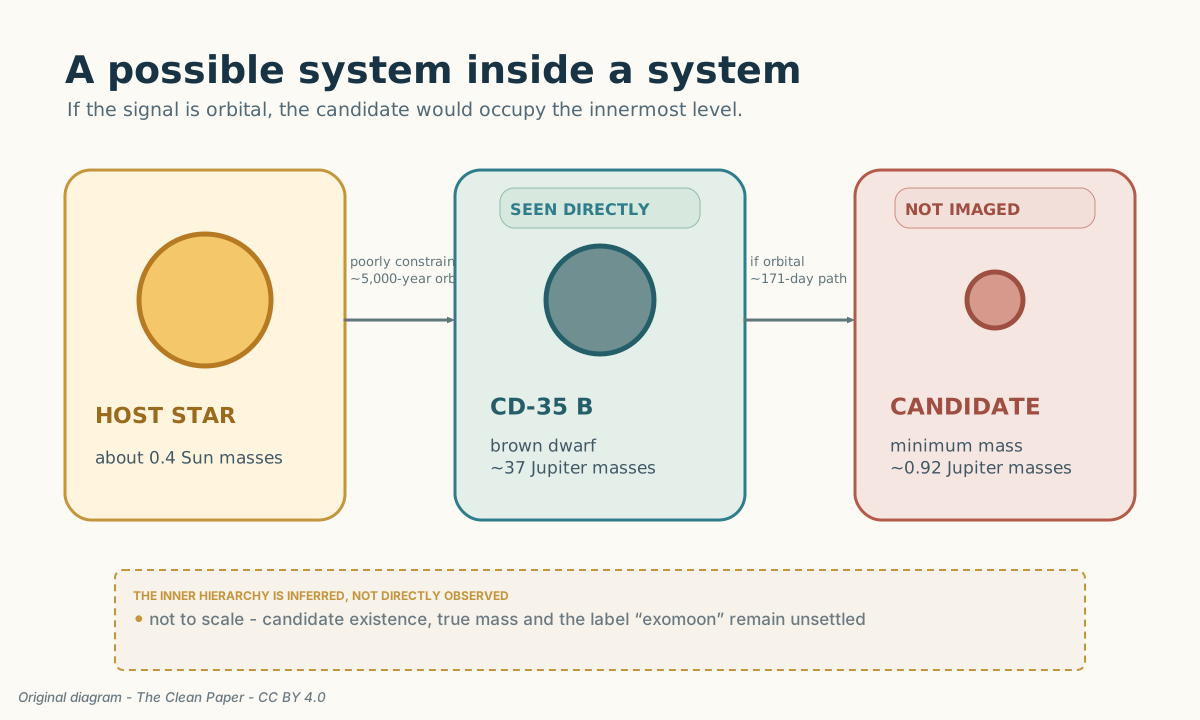
Possible hierarchy yìí rọrùn láti draw. Physical reality àti vocabulary rẹ̀ kò tíì settle. Ṣé planetary-mass body tí ó ń orbit brown dwarf yẹ kí a pè ní moon, pílánẹ́ẹ̀tì tàbí satellite nìkan? Àwọn astronomer kò ní accepted òfin tó settle ìbéèrè náà. Nítorí náà ìwé ìwádìí lo broader word exosatellite.
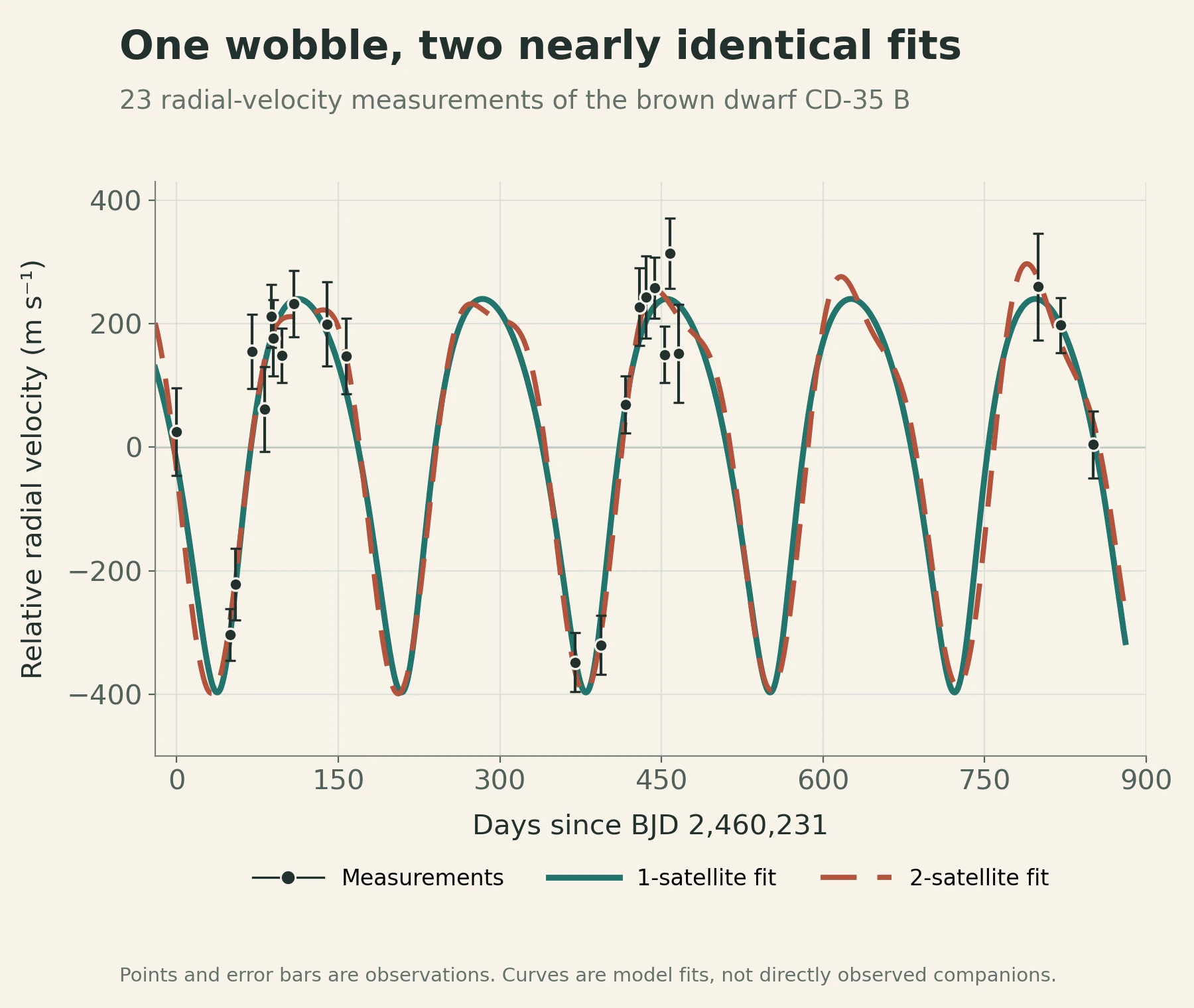
Bí 23 night ṣe di wobble
ẹgbẹ́ náà observe CD-35 2722 B (wo NASA Eyes on Exoplanets entry) pẹ̀lú CRIRES+, high-resolution spectrograph lórí European Southern Observatory’s Very Large Telescope. Láàárín October 2023 àti February 2026, wọ́n gba 26 observing epoch. Ọ̀kan ní àmì tó kéré ju, méjì tí a gba nínú bad weather jẹ́ rejected, wọ́n sì repeat wọn, tó fi 23 high-quality nights sílẹ̀.
Spectrograph ń tan light sí detailed àpẹẹrẹ line. Nígbà tí orísun bá ń rìn sí Earth tàbí kúrò lọ́dọ̀ rẹ̀, line wọ̀nyí shift díẹ̀. Repeated measurement ti line-of-sight motion yìí ni a ń pè ní radial velocity. Wọ́n kò fi hidden body hàn. Wọ́n fi bí observed body ṣe lè ń move lábẹ́ unseen pull hàn.
Strongest periodicity nínú measurement wà sunmọ́ 170 days. Ó kọjá 0.1% false-alarm-probability threshold ìwádìí. Threshold yẹn béèrè bí ariwo ṣe máa, lábẹ́ assumption ìdánwò, produce periodogram peak tó lágbára báyìí ní igba mélòó. Kì í ṣe probability 99.9% pé satellite wà, kò sì sọ ohunkóhun fúnra rẹ̀ nípa bóyá companion kan tàbí méjì ni.
Kí ni radial-velocity signal lè establish?
Radial velocity yí repeated shift nínú spectral line padà sí measurement motion sí observer àti kúrò lọ́dọ̀ observer. Repeating àpẹẹrẹ lè jẹ́ fit pẹ̀lú equation orbit, tó jẹ́ kí olùwádìí infer period, ìwọ̀n measured wobble àti minimum companion mass.
Ṣùgbọ́n ọ̀nà kò photograph companion tààrà. Stellar tàbí substellar atmosphere tún lè shift spectral line, observing schedule lè create misleading rhythm, yàtọ̀ orbital arrangement sì lè imitate ara wọn. àmì náà, physical explanation rẹ̀ àti orúkọ tí a fún inferred object jẹ́ separate ìbéèrè.
Sampling yẹ kí a fi attention sí ṣáájú orbital answer. Four especially low radial-velocity measurement ru weight tó substantial nínú àpẹẹrẹ. Wọ́n ṣẹlẹ̀ ní pair méjì, lábẹ́ reported good condition, kò sì sí single kókó kan tó create àmì nígbà tí òǹkọ̀wé repeat ìtúpalẹ̀ lẹ́yìn removing kókó kan ní gbogbo igba. Síbẹ̀, apá orbital phase nìkan ni a àpẹẹrẹ. Night 23 spread kọjá ju méjì years lọ kì í ṣe kan náà as continuous coverage.
Àwọn òǹkọ̀wé tún ìdánwò ṣeé ṣe half-year artefact. Imperfect correction fún Earth’s changing motion tàbí instrument profile lè create false annual àmì tí sampling alias sí half Earth year, tàbí 182.5 days. Preferred period wọn jẹ́ 171.11 days, pẹ̀lú uncertainty +0.53/-0.36 days; òǹkọ̀wé ròyìn pé èyí wà nǹkan bí 20 standard deviation kúrò ní 182.5 days. Wọ́n tún ròyìn no correlation pẹ̀lú Earth’s changing motion, seeing, atmospheric water vapour tàbí instrument property tí wọ́n examine. Àwọn yìí jẹ́ important control. Wọ́n mú orbital explanation compelling tó láti àwòṣe, ṣùgbọ́n wọn kò identify object náà fúnra wọn.
Orbital answer tó simplest: companion kan
Nínú preferred àwòṣe, object kan tẹ̀lé eccentric, tàbí somewhat stretched, orbit yí brown dwarf ká ní gbogbo 171.11 days. Fitted orbit ní eccentricity nǹkan bí 0.27 àti semi-major axis nǹkan bí 0.200 astronomical units — roughly ọ̀kan fifth ti average Earth-Sun ijìnnà.
Measured wobble ní amplitude nǹkan bí 318 metres per second. Láti motion yẹn, àwòṣe fún companion ní minimum mass nǹkan bí 0.92 times Jupiter’s mass.
Ọ̀rọ̀ minimum ṣe pàtàkì. Radial velocity measure nìkan apá orbital motion directed sí wa àti kúrò lọ́dọ̀ wa. Tí orbit bá viewed edge-on, ọ̀pọ̀ motion rẹ̀ hàn lẹ́gbẹ̀ẹ́ line yẹn. Tí a bá viewed rẹ̀ sí i face-on, much motion kọjá sky dípò, companion tó massive sí i yóò sì needed láti produce kan náà measured wobble.
Astronomer kọ èsì gẹ́gẹ́ bí m sin(i): mass multiplied pẹ̀lú sine ti unknown inclination orbit, tàbí viewing angle. dátà constrain product yẹn, kì í ṣe true mass fúnra rẹ̀. Nítorí náà nǹkan bí 0.92 Jupiter masses jẹ́ lower bound, kì í ṣe measurement exact mass object.
Kí ló dé tí viewing angle fi hide mass?
Foju runner kan lórí circular track tí o ń wo láti side. Runner náà repeatedly ń rìn sí ọ àti kúrò lọ́dọ̀ rẹ, nítorí náà component motion yẹn rọrùn láti measure. Báyìí wo kan náà track láti oke. Runner ń rìn mostly across view rẹ, ó sì fẹ́rẹ̀ẹ́ má rìn sí ọ tàbí kúrò lọ́dọ̀ rẹ.
Radial velocity rí component àkọ́kọ́ nìkan. Mathematical factor sin(i) ṣàpèjúwe iye orbital motion tó kókó lẹ́gbẹ̀ẹ́ line of sight wa. Títí inclination i yóò fi mọ̀, inferred mass ṣi jẹ́ minimum.
Lẹ́yìn náà àwọn òǹkọ̀wé béèrè bóyá orbit yìí lè persist dípò kí ó quickly destroy ara rẹ̀. Numerical ìdánwò wọn rí one-companion àwòṣe generally stable. Èyí mú un di physically ṣeé gbà interpretation àmì. Kò constitute second detection.
Awkward answer: companion méjì lè fara wé ọkan
Eccentric radial-velocity àmì ní ambiguity tí a mọ̀. Lábẹ́ diẹ̀ lára condition, object méjì nínú nearly circular orbit, pẹ̀lú ọkan tí period rẹ̀ roughly twice ti omíì, lè produce combined àpẹẹrẹ tó resembles object kan nínú stretched orbit.
Ambiguity yẹn farahàn níbí. Two-companion àwòṣe lè fit current measurement pẹ̀lú outer àmì near 171 days àti shorter-period inner àmì. Nítorí observing àkókò kò àpẹẹrẹ every phase evenly, shorter àmì ní several alias. Nítorí 23 selected nights fi long gap sílẹ̀, yàtọ̀ ìdánwò period lè count yàtọ̀ number unseen cycle láàárín visit, tí wọ́n sì ṣi align pẹ̀lú kan náà measurement. Candidate period near 14, 70, 88 àti 115 days nítorí náà jẹ́ alternative fit sí ọ̀kan poorly sampled shorter àmì, kì í ṣe four independently detected rhythm.
Àwọn òǹkọ̀wé reject poorly constrained 13-to-17-day window. Nínú region yẹn, fit kò isolate ọ̀kan convincing period: many closely spaced solution below nǹkan bí 20 days lè reproduce low-cadence measurement, tí ó mú whole window likely sampling artefact. Láàárín remaining window, approximately 88-day solution fit better ju roughly 70- àti 115-day alternative, ṣùgbọ́n kì í ṣe enough fún ìwé ìwádìí láti claim known second period. Nínú tabulated best fit, outer object’s minimum mass jẹ́ nǹkan bí 0.87 Jupiter masses, inner object’s nǹkan bí 0.22 Jupiter masses. Nọ́ńbà wọ̀nyí describe disfavoured àwòṣe; kì í ṣe measurement of méjì established worlds.
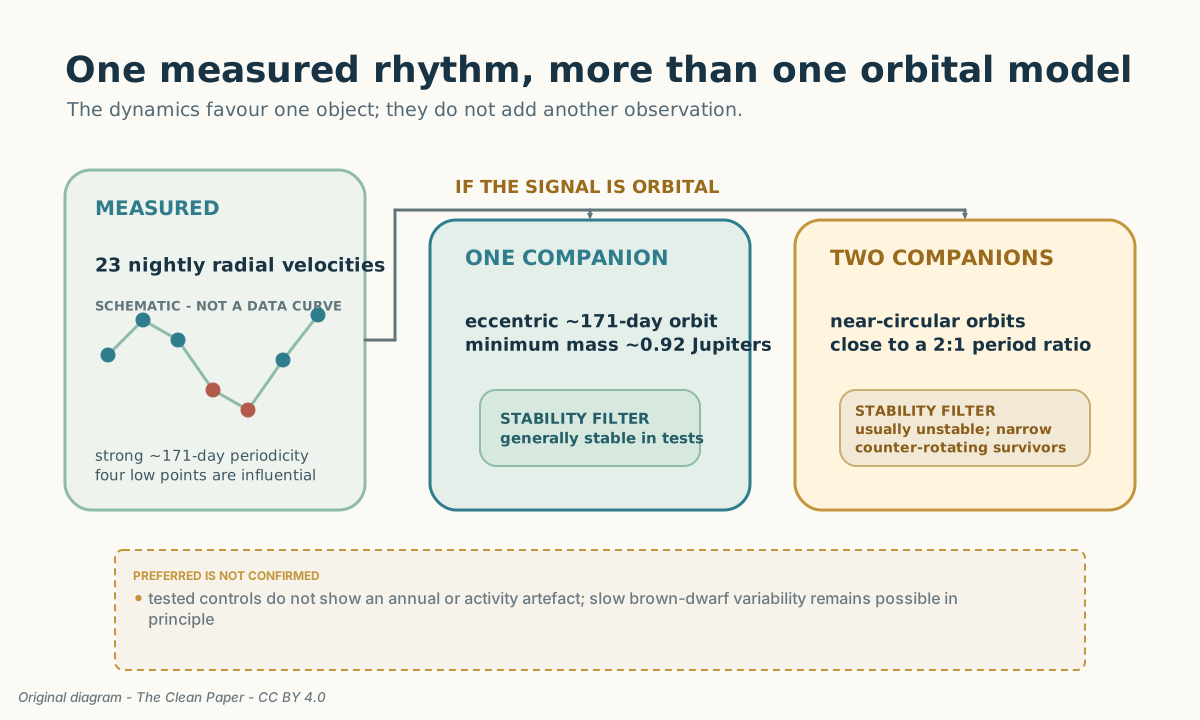
Stability calculation sharpen ìfiwéra. Most tested two-companion arrangement expelled ọ̀kan object nínú few hundred simulated years. Surviving configuration occupied narrow, unusual region níbi tí orbit close sí kan náà plane ṣùgbọ́n move opposite ìtọ́sọ́nà. Host ìràwọ̀ introduce further unstable region.
Èyí jẹ́ reason láti prefer ọ̀kan eccentric companion ju tested two-companion ètò. Kì í ṣe proof pé nature yan simpler àwòṣe. Stability filter ṣeé ṣe interpretation lẹ́yìn radial velocity measurement; kò add observed kókó mìíràn sí curve.
Báwo ni eccentric orbit kan ṣe lè dà bí circular orbit méjì?
Perfect circular orbit produce simple repeating radial-velocity wave. Eccentric orbit add distortion sí wave yẹn. Two circular orbit pẹ̀lú period near two-to-one ratio lè combine kí àmì kan supply pàtàkì rhythm, omíì sì supply similar distortion.
Èyí jẹ́ orbital degeneracy: yàtọ̀ physical ètò produce similar measurement. More observation ní àkókò níbi tí àwòṣe predict yàtọ̀ velocity lè break tie. Dynamics ìdánwò help nípa asking bóyá proposed ètò kọ̀ọ̀kan lè survive, ṣùgbọ́n kò lè replace observation yẹn.
Ṣé rhythm lè wá láti brown dwarf fúnra rẹ̀?
Brown dwarf kì í ṣe silent ìdánwò mass. Atmosphere rẹ̀ rotate, form cloud, ó sì lè ní magnetic activity. Changing ojú àpẹẹrẹ lè reshape spectral line, kí ó sì imitate motion.
Estimated maximum rotation period CD-35 2722 B jẹ́ nǹkan bí 0.65 days, kúkúrú púpọ̀ ju 171 days lọ. ẹgbẹ́ kò recover lágbára short rotation àmì, tàbí convincing cloud- tàbí granulation-like àmì, nínú activity àwòṣe tí wọ́n ìdánwò. Wọ́n tún examine annual sampling àti instrumental quantity láì rí match sí 171-day rhythm.
Check wọ̀nyí narrow alternative, ṣùgbọ́n ìwé ìwádìí kò claim pé gbogbo intrinsic variability ti eliminated. Long-timescale magnetic activity tàbí atmospheric circulation nínú brown dwarf kò lè òfin out in principle. Remaining possibility yẹn yẹ kí ó wà lẹ́gbẹ̀ẹ́ orbital àwòṣe, kì í ṣe kí a hide lẹ́yìn wọn.
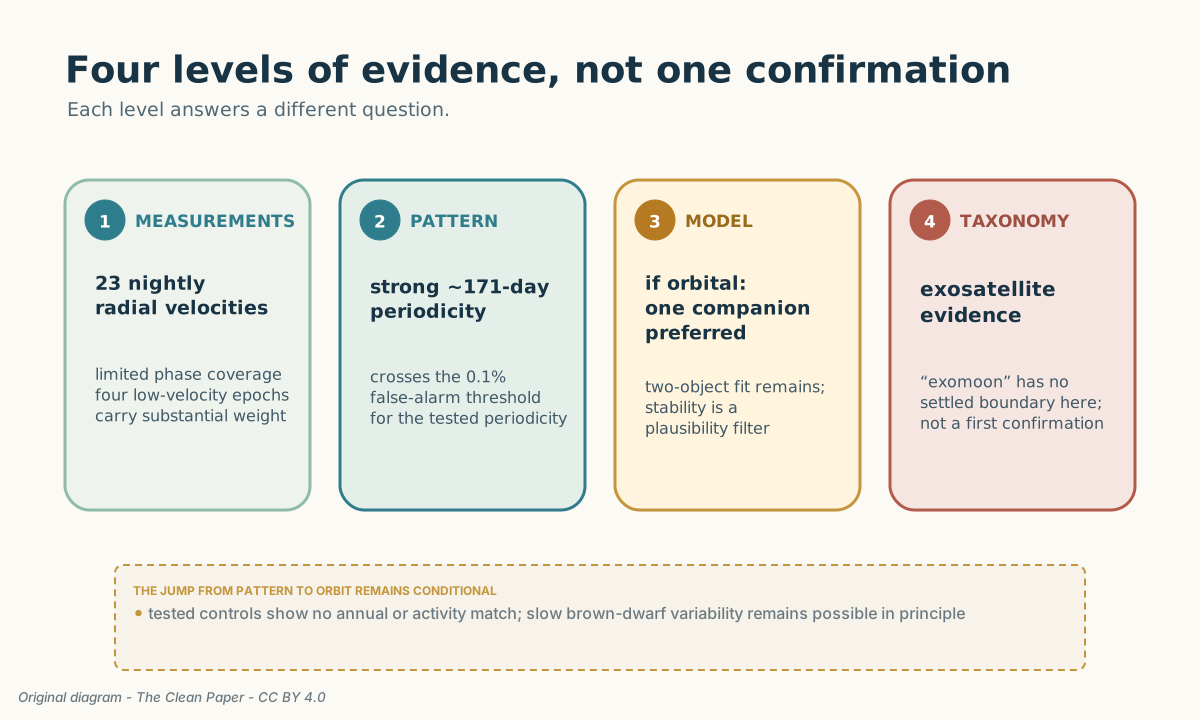
Ṣé ó jẹ́ exomoon?
Nínú Solar System, moon ń orbit pílánẹ́ẹ̀tì. CD-35 2722 B jẹ́ brown dwarf, true mass inferred companion kò sì tíì mọ̀. Familiar name bẹ̀rẹ̀ sí í nira nígbà tí object kan wà sunmọ́ planet-brown-dwarf ààlà, omíì sì sunmọ́ moon-planet ààlà.
ìwé ìwádìí kò claim first confirmed exomoon. Ó sọ pé kò sí exomoon tí a ti confidently detect, ó present ẹ̀rí fún planetary-mass exosatellite, ó sì pe ètò náà ní step sí uncontroversial detection. Discussion ṣeé ṣe novelty rẹ̀ bẹ̀rẹ̀ conditionally: tí àmì bá fi ẹ̀rí múlẹ̀ legitimate.
Caution yẹn kò mú èsì di empty. Measuring radial velocity tààrà láti faint brown dwarf companion nira. Tí continued observation bá preserve àmì, ètò yóò fi hàn pé planet-search ọ̀nà lè reach down òmíràn ìpele celestial hierarchy.
Another observing season lè ṣe ju adding kókó lọ. One- àti two-companion àwòṣe predict yàtọ̀ velocity ní particular future àkókò. Measurement tó fill missing orbital phase lè ìdánwò bóyá 171-day rhythm persist, dín kù influence four low kókó, kí competing curve diverge.
Fún báyìí, honest image kì í ṣe tuntun moon hanging lẹ́gbẹ̀ẹ́ brown dwarf. Ó jẹ́ spectrum, repeated night lẹ́yìn night, tí ó ru small periodic shift. Ayé kan lè wà nínú rhythm yẹn. Achievement náà ni learning how much lè be inferred láti it láì pretend pé inference ti complete.
Àkótán mímọ́
Àwọn astronomer measure radial velocity ti taara imaged brown dwarf CD-35 2722 B ní 23 high-quality nights láàárín October 2023 àti February 2026. Spectral line rẹ̀ fi hàn lágbára periodic shift near 171 days. Preferred orbital àwòṣe ní ọ̀kan eccentric companion pẹ̀lú minimum mass near 0.92 Jupiter masses, ṣùgbọ́n true mass unknown nítorí orbital inclination unknown. Two near-circular companion lè mimic kan náà broad àmì, bí most tested two-object configuration tilẹ̀ dynamically unstable. Four low-velocity epoch influential, orbital phase coverage sì limited: observation àpẹẹrẹ selected part ti ṣeé ṣe 171-day cycle dípò tracing continuously nípasẹ̀ every phase. ìdánwò kò identify rotation, annual sampling, weather tàbí examined instrument property gẹ́gẹ́ bí orísun, ṣùgbọ́n long-timescale brown-dwarf variability kò lè òfin out in principle. Unseen object kò taara imaged, one-object àwòṣe preferred dípò confirmed, kò sì sí settled òfin pé planetary-mass body tí ó ń orbit brown dwarf jẹ́ exomoon.
àyẹ̀wò láìsí àsọdùn
Ohun tí a observe: 23 nightly radial-velocity measurement ti CD-35 2722 B ní lágbára approximately 171-day periodicity. Brown dwarf fúnra rẹ̀ taara imaged; proposed companion kò.
Ohun tí àwọn òǹkọ̀wé prefer: Tí àmì bá jẹ́ orbital, ọ̀kan eccentric companion pẹ̀lú minimum mass near Jupiter’s mass fún simplest dynamically ṣeé gbà interpretation ti current dátà.
Ohun tí ṣi ṣí: Two companion lè fit radial velocity, bí tested ètò tilẹ̀ usually unstable; long-timescale brown-dwarf variability kò excluded in principle; unknown viewing angle sì fi true companion mass undetermined.
Ohun tí ìwé ìwádìí kò establish: First confirmed exomoon, taara seen satellite, exactly ọ̀kan orbiting object, true mass 0.92 Jupiter masses, tàbí probability 99.9% pé preferred physical àwòṣe correct.
Ohun tí yóò mú ìgbẹ́kẹ̀lé pọ̀: Continued radial-velocity measurement tó cover sí i orbital phase, ìdánwò bóyá 171-day àmì persist, àti àpẹẹrẹ àkókò níbi tí ọ̀kan- àti two-companion àwòṣe make yàtọ̀ prediction.
Àwọn orísun
Da lórí: Planetary-mass exosatellite detected around the substellar companion of a star — Kevin Hoy, Alice Zurlo, Pablo A. Pena R., Jana Kohler, Silvano Desidera, Raffaele Gratton, Cecilia Lazzoni, Simon Petrus, Florian Rodler, Jonathan Smoker, Valentina D'Orazi, Ilaria Carleo and Ilaria Giovannini, Nature 655, 865-869 (2026).
- Àpilẹ̀kọ ìmọ̀ sáyẹ́ǹsì — Hoy et al., Planetary-mass exosatellite detected around the substellar companion of a star, Nature 655, 865-869 (2026)
- Kóòdù — Hoy et al., reduced data and analysis code for Nature_Hoy-2026
Article lo publisher paper, official supplement, peer-review history, source workbook àti public reduced-data and analysis repository àwọn author. Explanatory diagram jẹ́ original. Radial-velocity chart jẹ́ original TCP rendering ti value láti official Figure 1 source workbook, kò sì reproduce publisher artwork.
Ẹni tó kọ ọ́
Cinzia Vaglio · àwọn àwòrán àti ìjápọ̀ láti ọwọ́
Cinzia Vaglio, Laura Nesso, Nova Vela · olóòtú
Michele Renda
· àwọn àwòrán àti ìjápọ̀ láti ọwọ́
Cinzia Vaglio, Laura Nesso, Nova Vela · olóòtú
Michele Renda · olùtumọ̀
Nova Vela
· olùtumọ̀
Nova Vela
The Clean Paper · 2 Oṣù Kẹjọ 2026 · Ọ̀rọ̀ inú ojúlé yìí wà lábẹ́ ìwé-àṣẹ CC BY-SA 4.0. Àwọn àwòrán ní ìwé-àṣẹ ọ̀tọ̀ọ̀tọ̀. 


Àkíyèsí olóòtú
AI ni ó kọ àpilẹ̀kọ yìí, ẹgbẹ́ olóòtú sì ṣàyẹ̀wò rẹ̀. Ó jẹ́ àlàyé tó ṣe kedere, tó sì ṣọ́ra nípa iṣẹ́ tí a so mọ́ ọn; kì í ṣe arọ́pò fún kíka iṣẹ́ náà. Olóòtú ni ó ṣì ní ojúṣe fún yíyan, ìtumọ̀ àti ọ̀rọ̀ ìkẹyìn.