The double life of a neuron’s tau delivery van
In Alzheimer’s disease, the protein tau does not stay put. Inside a sick neuron it misfolds and clumps into tangles; then, somehow, the damage jumps to the next neuron, and the next, spreading through the brain in a pattern that tracks the decline of memory and thought. For years the spread itself has been clear and the mechanism murky: how does tau get out of one cell and into another?
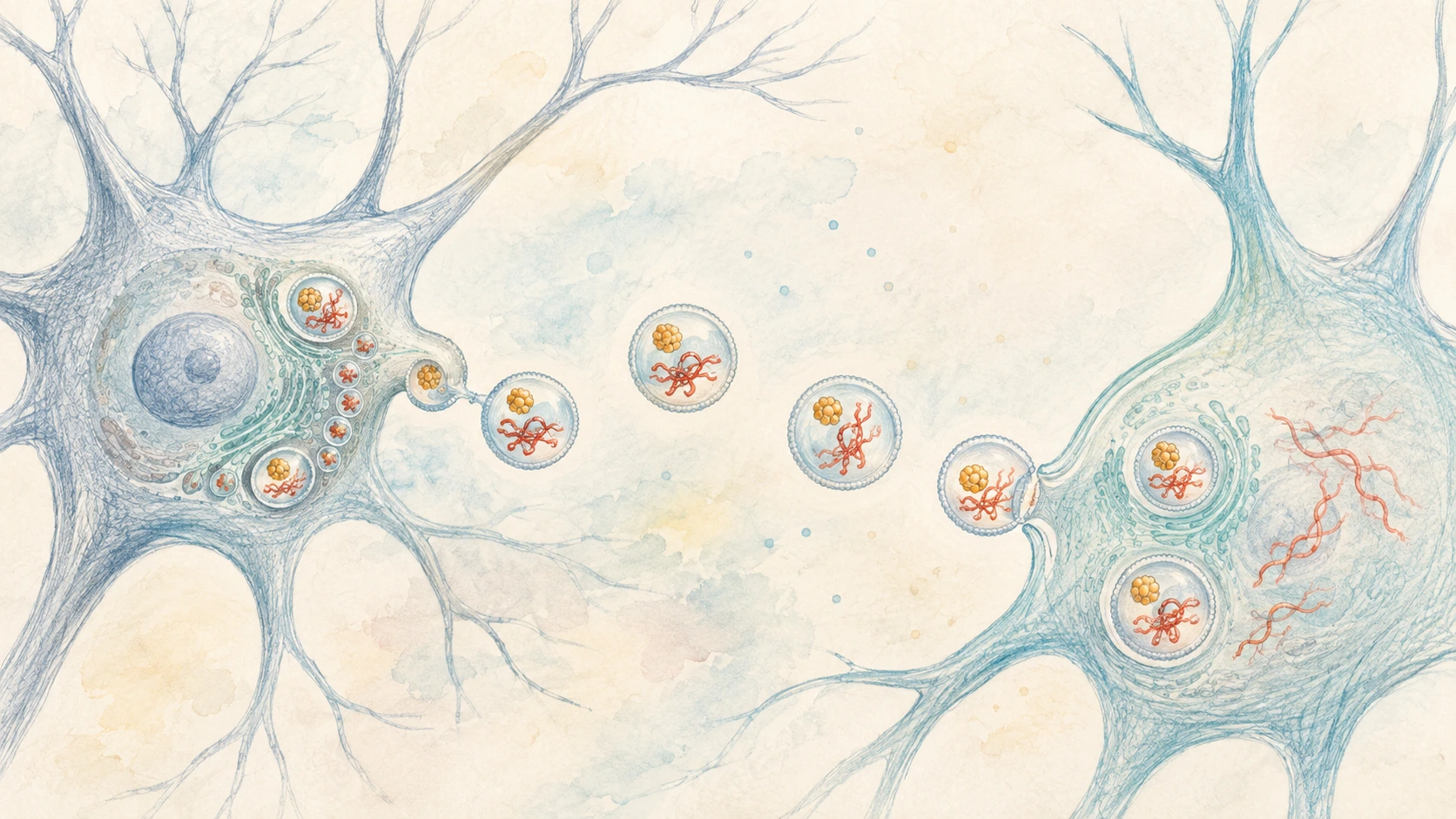
A study in Cell offers a striking piece of the answer, and a genuinely surprising twist. The escort that carries tau out of neurons turns out to be Arc - a gene that behaves less like an ordinary protein and more like a domesticated virus, forming hollow capsids that shuttle cargo between brain cells. The researchers, led by Jason Shepherd’s group at the University of Utah, find that Arc grabs tau and packs it into extracellular vesicles, the tiny membrane bubbles neurons release, and that without Arc, tau’s cell-to-cell spread nearly stops.
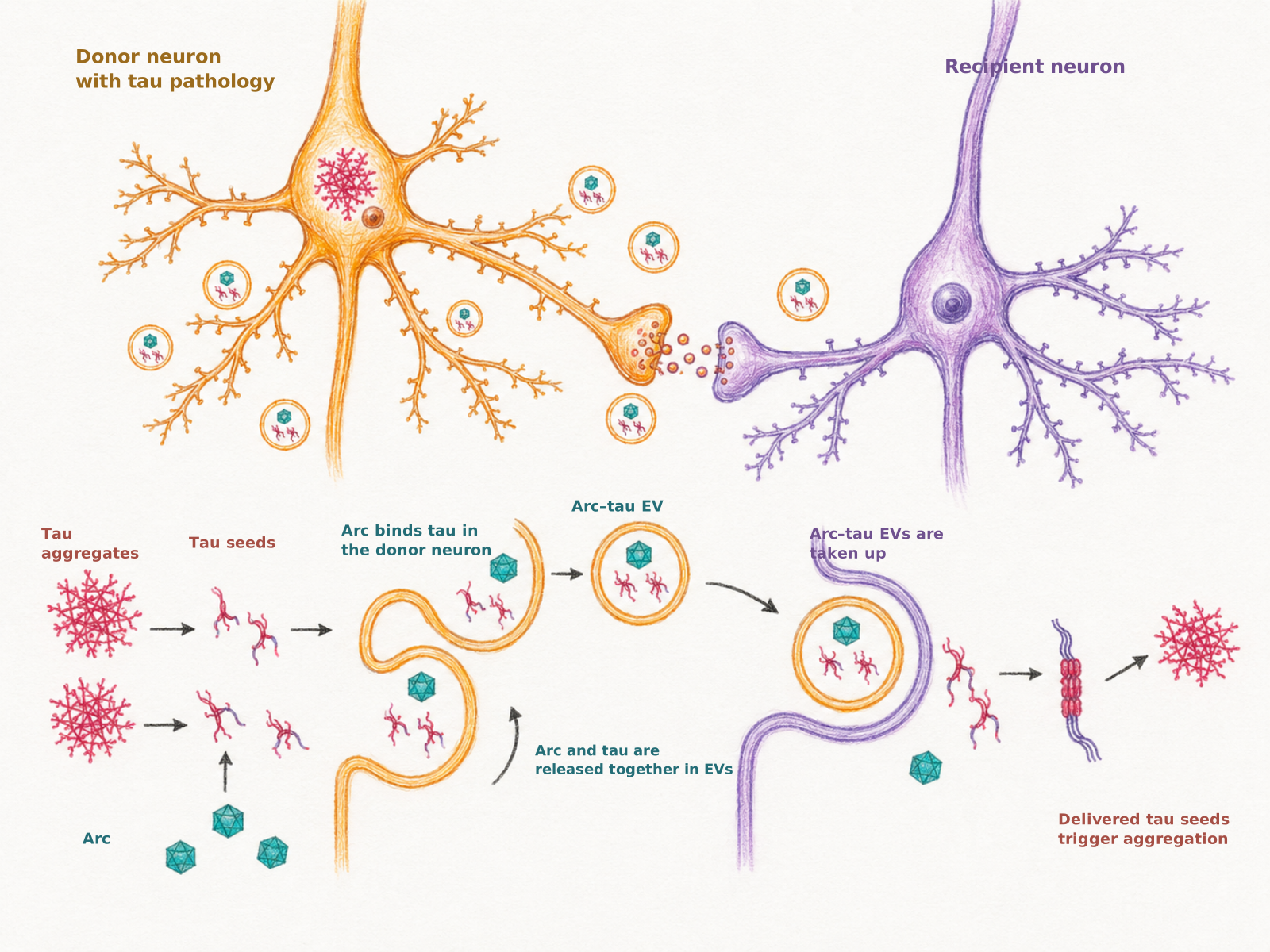
The twist is what keeps this from being a simple villain story. The very same packaging that spreads tau to healthy neighbours also clears toxic tau out of the neuron doing the packing. Arc is not simply a saboteur; it is a delivery van whose route helps one cell and harms the next.
What the researchers did
The work stacks several kinds of evidence, each with its own caveat about how far it reaches.
-
In cultured neurons. They compared normal neurons with neurons lacking Arc (Arc knockout) and measured how much tau came out in extracellular vesicles. They also tested whether adding back Arc, alone or with a partner protein, changed tau’s release.
-
In mice. They used a well-known model of tauopathy - the family of diseases, Alzheimer’s among them, in which the tau protein misfolds and accumulates in the brain - namely the rTg4510 mice, which are engineered to over-produce a mutant (P301L) form of human tau, and crossed it with Arc-knockout mice. Then they purified vesicles from brain tissue and asked how much tau they carried, and whether that tau could still “seed” new aggregation.
-
In a seeding assay. Vesicles were dropped onto reporter cells (engineered “biosensor” cells) that light up (via a fluorescence signal) when tau starts to clump, giving a readout of how strongly the vesicle-borne tau seeded new aggregation.
-
In human brain tissue. They examined post-mortem prefrontal cortex from six people without Alzheimer’s and six with advanced (Braak stage six) disease, looking at whether Arc and phosphorylated tau travel together in brain vesicles. That comparison was possible because donors and their families made brain tissue available for research, including people without Alzheimer’s whose tissue provided the essential comparison group.
-
In molecular detail. Using purified proteins and all-atom simulations, they tested whether Arc physically binds tau, and how.
What they found
-
Arc is critical for loading tau into vesicles. Knock out Arc in neurons and the tau content of their vesicles drops sharply, even though the neurons still make vesicles normally. In the mice, brain vesicles from Arc-lacking animals carried dramatically less human tau - and Arc’s absence did not reduce overall vesicle production, so this is about packaging, not plumbing.
-
The tau Arc packages is seed-competent - and Arc’s absence blunts it. Vesicles from the tau mice triggered tau clumping in the reporter cells; vesicles from the Arc-knockout tau mice triggered very little. Intercellular tau transmission was, in the authors’ word, “almost absent” without Arc.
-
Arc binds tau directly, preferring the phosphorylated form. Purified Arc stuck to tau in a direct, specific interaction - more tightly when the tau was phosphorylated, that is, carrying the extra phosphate chemical tags that build up abnormally on tau in disease - and the simulations describe a loose, shifting (“fuzzy”) complex rather than a rigid lock.
-
In human Alzheimer’s brain vesicles, Arc tracks with diseased tau. Arc levels and phosphorylated-tau levels rose and fell together across the Alzheimer’s samples (a correlation coefficient of 0.89, at a p-value of 0.01). In immunogold electron-microscopy imaging of vesicles from a single advanced-Alzheimer’s (Braak stage six) brain, only a few percent carried both Arc and tau - likely an underestimate, since the larger tau labels penetrate vesicles poorly.
-
The surprise: losing Arc made neurons worse, not better. Because Arc ships tau out, removing it left more tau trapped inside. The Arc-knockout tau mice accumulated more tau within neurons and showed a modest early increase in cell death. Deleting Arc on its own, in mice without the tau transgene, caused no such loss - so the harm depended on tau being there to pile up.
What Arc, vesicles, and “seeding” are here
Arc is a neuronal gene best known for its role in learning and memory. Unusually, it descends from an ancient retrotransposon - a virus-like genetic element - and its protein still assembles into capsids that can carry cargo between neurons. That viral heritage is why it is well suited to packaging and ferrying molecules like tau.
Extracellular vesicles (EVs) are small membrane-wrapped packets (here, tens to ~150 nanometres) that cells release and neighbours take up. They are a normal cell-to-cell communication channel; the concern is that in disease they can carry harmful cargo.
“Seeding” means a small amount of misfolded tau can template healthy tau into the same misshapen form, propagating the aggregation. Seed-competent tau is therefore the dangerous kind: not just present, but able to corrupt.
The double edge. The same act - Arc bundling tau into a vesicle and sending it out - is protective for the sending neuron (it exports toxic tau) and dangerous for the receiving one (it delivers a seed). That is why “just block Arc” does not follow from this paper: in these mice, blocking Arc trapped more tau inside neurons and modestly worsened early damage.
What this does not prove
Alzheimer’s headlines run ahead of Alzheimer’s evidence more reliably than almost any other field, so the boundaries here matter.
-
This is not the cause of Alzheimer’s. It is a mechanism for one step - how tau exits neurons in vesicles - within the much larger, still-unsettled story of the disease. Tau spread is one feature of Alzheimer’s, not its origin, and tau itself shares the stage with amyloid, inflammation, and more.
-
It is not a treatment, and does not point cleanly at one. The obvious “drug the mechanism” move - block Arc - is exactly what the double-edged result warns against: in these mice it left neurons holding more toxic tau. Any therapeutic idea here is far more delicate than “switch Arc off,” and none was tested in the paper.
-
The mouse results come from a tau-overexpression model, not natural disease. rTg4510 mice are built to flood neurons with a mutant human tau. They are a powerful, standard tool for studying tau spread, but they model a tauopathy driven by an engineered gene, not the sporadic Alzheimer’s that most patients have.
-
The human evidence is a correlation, in a small sample. Arc and diseased tau riding together in brain vesicles from twelve donors is consistent with the mouse mechanism; it does not, by itself, show that Arc drives tau spread in people. The comparable correlation in the non-Alzheimer’s samples did not reach statistical significance, and correlation across a dozen brains is a starting point, not a verdict.
-
Vesicles are not the whole story of tau release. Tau also leaves neurons as free protein and by other routes; this paper makes a strong case that the Arc-vesicle pathway is important, not that it is the only one.
How strong is the evidence
For its central claim - that Arc packages tau into vesicles and that this is important for cell-to-cell tau transmission - the evidence is layered and mutually reinforcing: a direct physical interaction, a loss-of-function effect in cultured neurons, a matching loss in mouse brain vesicles, a functional seeding readout, and a corroborating human correlation. The mechanism does not rest on any single experiment, and the “packaging, not vesicle production” control is the kind of check that makes the interpretation cleaner.
The reach is the weaker part, and the authors are more measured than a headline would be. The strongest links are in engineered mice and cultures; the human data are correlational and thin; the therapeutic implication is genuinely ambiguous because the mechanism cuts both ways. The honest confidence is high that Arc matters for vesicle-borne tau release in these systems, and low for any leap to “the cause of Alzheimer’s” or “a way to treat it.”
One disclosure belongs on the record: the paper’s corresponding author declares commercial interests relevant to this mechanism - co-founder of one company, and a stockholder in and consultant for another that licenses intellectual property and patents covering Arc capsids.
Why it matters
If tau’s spread is a key driver of how Alzheimer’s progresses, then understanding the doors tau uses to leave neurons is a prerequisite for ever slowing it. Naming Arc as one of those doors - and, unexpectedly, one that also helps neurons dump toxic tau - reframes a piece of the problem. It suggests that anti-tau strategies aimed at vesicle release will have to reckon with a trade-off, not a clean target: stop the export and you may spare the neighbours but poison the source.
It also deepens a strange and growing theme in neuroscience: that a gene our brains repurposed from an ancient virus sits in the middle of both memory and neurodegeneration, moving cargo between neurons for better and for worse. That is a real advance in understanding - and, precisely because it is early and double-edged, a poor basis for promising anyone a cure.
Clean summary
Researchers found that Arc, a neuronal gene descended from a virus-like genetic element, directly binds tau and packages it into the extracellular vesicles that neurons release. In cultured cells and in tau-model mice, removing Arc sharply reduced the amount of seed-competent tau in brain vesicles and nearly abolished tau’s transmission from cell to cell; in post-mortem Alzheimer’s brains, Arc levels correlated with phosphorylated tau in vesicles. The unexpected finding is that this packaging is double-edged: it exports toxic tau out of a neuron even as it spreads seeds to others, so Arc-lacking mice actually accumulated more tau inside neurons and showed a modest early increase in cell death. The work identifies a mechanism for how tau leaves neurons, demonstrated mainly in engineered mice and cells with a supporting human correlation. It is not the cause of Alzheimer’s, not a therapy, and - because blocking Arc made mouse neurons worse - not a simple drug target.
No-BS check
What the paper shows: In cultured neurons and tau-model mice, the gene Arc is critical for packaging seed-competent tau into extracellular vesicles and for transmitting tau between cells; Arc binds tau directly; and in human Alzheimer’s brain vesicles Arc levels correlate with phosphorylated tau.
What is plausible but not proven: That the Arc-vesicle pathway is a major route of tau spread in actual human Alzheimer’s disease. The human data are consistent with this but correlational and limited.
What it does not show: That Arc causes Alzheimer’s; that blocking Arc would treat it (the opposite, if anything, in these mice); that vesicles are the only way tau spreads; or that findings in tau-overexpressing mice transfer directly to sporadic human disease.
Main limitations: Mouse models over-produce a mutant human tau; the human sample is twelve post-mortem brains with a correlational readout (and a non-significant correlation in controls); no therapy was tested; and the mechanism’s double-edged nature complicates any intervention.
How much confidence should a general reader have? High that Arc packages tau into vesicles and matters for tau release in these systems. Low for any claim about curing, or explaining the cause of, Alzheimer’s disease.
Sources
Based on: Arc mediates intercellular tau transmission via extracellular vesicles — Mitali Tyagi, Eric de Hoog, Matthew Grega, Kaelan R. Sullivan, Alicia C. Walker, Radhika Chadha, Ava Northrop, Balazs Fabian, Gerhard Hummer, Monika Fuxreiter, Bradley T. Hyman, Jason D. Shepherd, Cell 189, 1-18 (2026).
The source paper is open access under CC BY 4.0. The Clean Paper does not reuse or adapt its figures; any figure is an original TCP schematic.
Written by
Vera Rubin · figures and links by
Laura Nesso, Nova Vela · edited by
Michele Renda
· figures and links by
Laura Nesso, Nova Vela · edited by
Michele Renda
The Clean Paper · 2 August 2026 · Text on this site is licensed under CC BY-SA 4.0. Images are licensed separately. 


Editorial note
This article was written by AI and reviewed by the editorial team. It is a clear, conservative explanation of the linked work, not a substitute for reading it. Responsibility for selection, interpretation, and final wording rests with the editor.