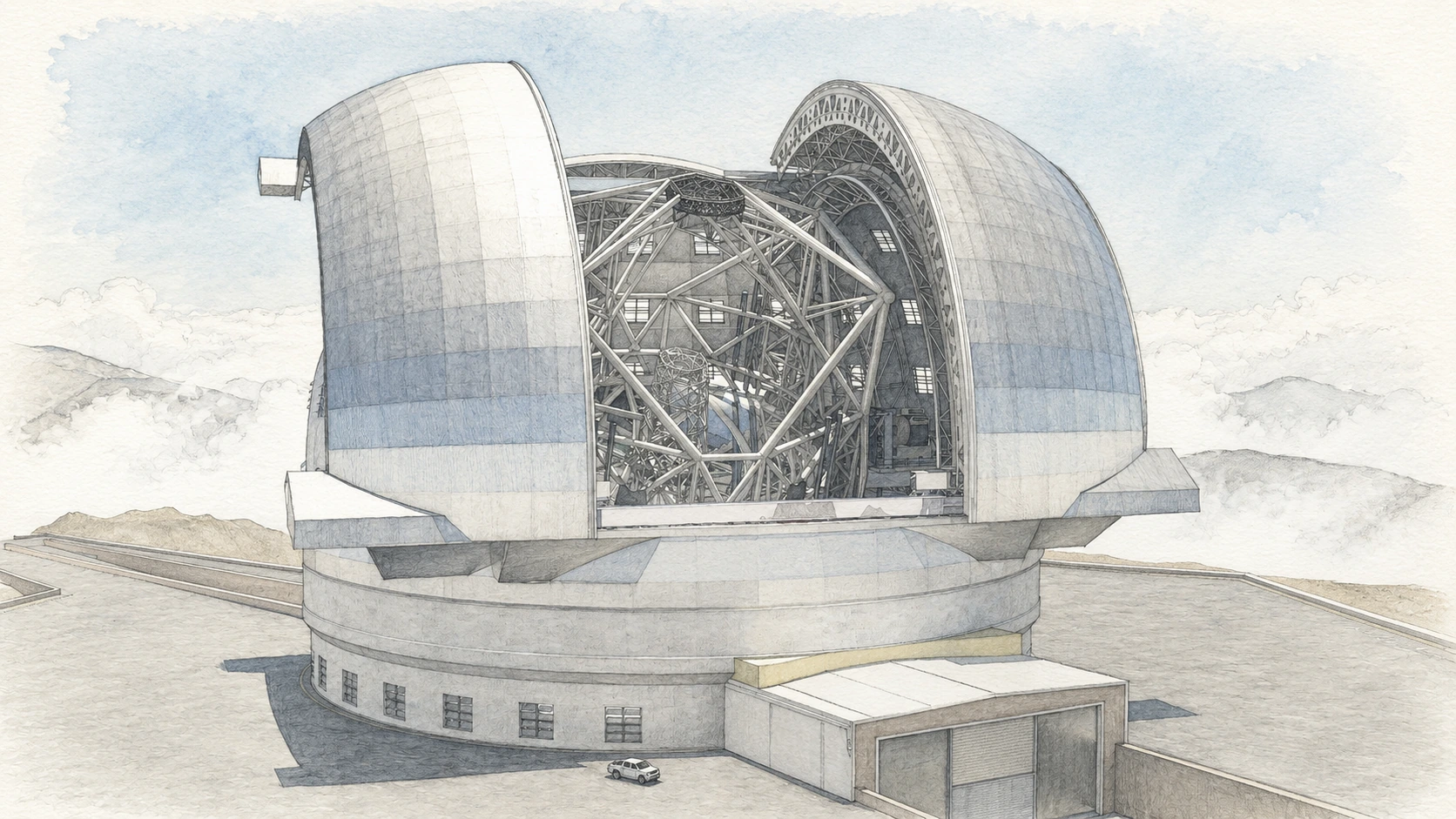
A comet from another star drifted close enough to read its chemistry — barely
Three times now, astronomers have caught an object from another star system passing through our own. The first, 1I/'Oumuamua in 2017, was gone almost before anyone could point a telescope at it. The second, 2I/Borisov in 2019, was a proper comet but faint. The third, 3I/ATLAS, arrived bright enough and close enough to do something no one had managed before: measure the isotopes in material that formed around a different star.
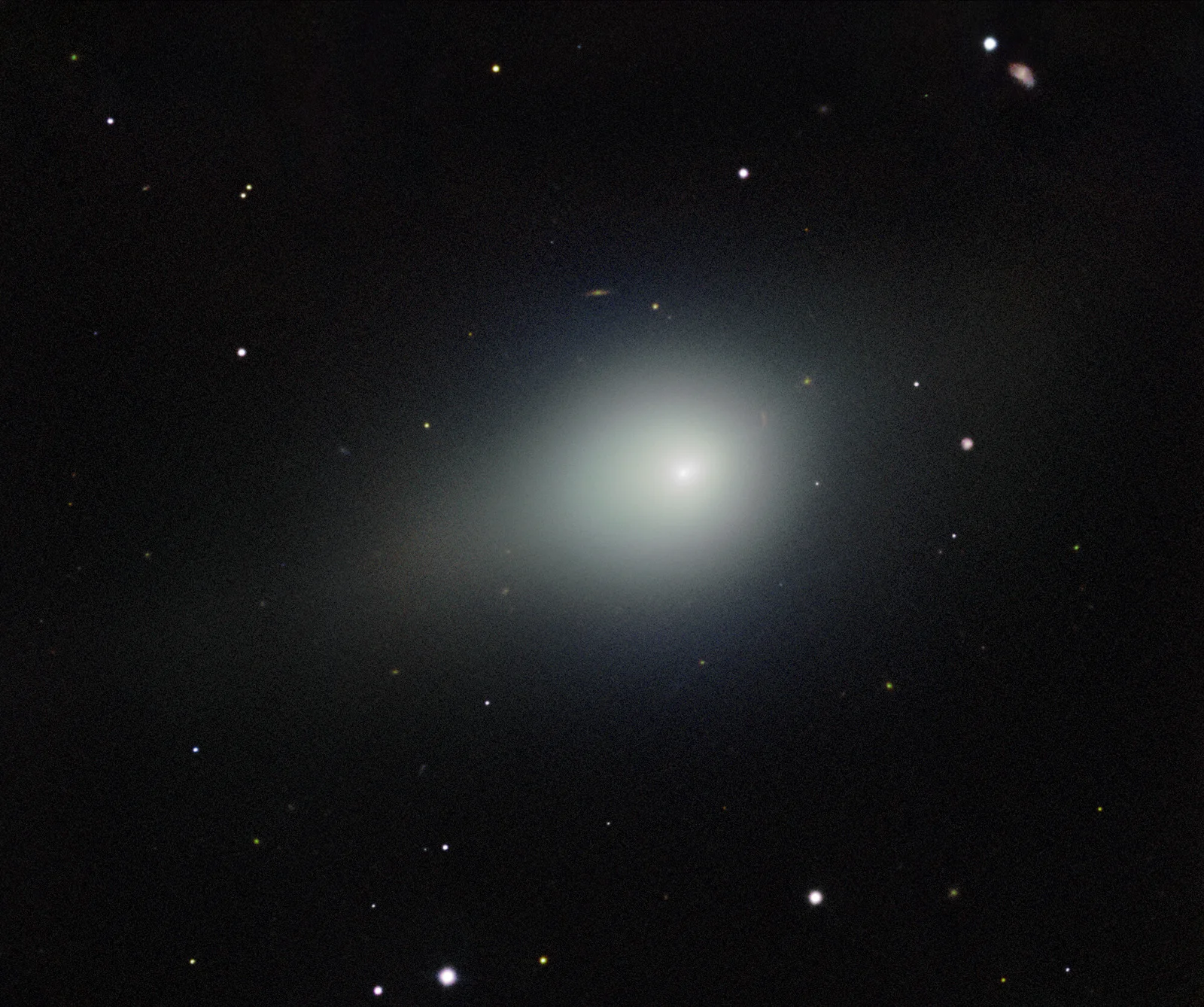
That is the quiet achievement in this paper. Not a new kind of object, not a sign of anything living — a measurement, of a sort we had never been able to take on interstellar matter, of two numbers that carry a faint memory of where 3I was born.
Why anyone cares about a ratio of isotopes
Carbon and nitrogen, like most elements, come in isotopes: atoms with the same number of protons but different numbers of neutrons, and therefore different masses. The number in a name such as carbon-12 or carbon-13 is its mass number — the total number of protons and neutrons. The bare word “carbon” names the element or its ordinary isotopic mixture, not carbon-12 alone. That mixture is dominated by carbon-12, with a smaller share of the heavier carbon-13; ordinary nitrogen is likewise dominated by nitrogen-14, with a trace of the heavier nitrogen-15.
Those proportions are not fixed everywhere. The ratio of light to heavy isotopes is shaped partly by the temperature, radiation and chemical history where a molecule formed. Cold, dim, well-shielded places can leave one fingerprint; warmer, brighter or more processed places can leave another.
So isotope ratios are a kind of birth certificate. In our own Solar System, comets — leftover ice from the Sun’s formation — carry fairly consistent values, and we can compare those against the interstellar clouds and disks where stars are born. Reading the same ratios in an object from another star lets you ask, for the first time, whether its home resembled ours.
What they measured, and how uncertain it is
Using the UVES spectrograph on the European Southern Observatory’s Very Large Telescope, the team observed 3I/ATLAS over several nights in December 2025 and studied the light from its CN molecules. CN is the cyano radical — a simple two-atom molecule of one carbon bound to one nitrogen, and one of the most easily seen species glowing in a comet. Because a single CN molecule contains both a carbon and a nitrogen atom, its light carries the isotopic fingerprints of both elements at once, which is what let the team read the carbon and the nitrogen ratios from the same molecule. The lines from the rare isotopes carbon-13 and nitrogen-15 are far too weak to pick out one at a time, so the team stacked (co-added) a set of selected lines to build a combined signal strong enough to measure.
They report two ratios:
- carbon-12 to carbon-13 ≈ 151 (a three-sigma range of roughly 107 to 261),
- nitrogen-14 to nitrogen-15 ≈ 363 (a three-sigma range of roughly 210 to nearly 1,000).
Those parenthetical ranges are the whole story, and it is important not to skip past them. These are hard measurements on a faint, fast-moving target, and the uncertainties are large — especially for nitrogen, where the “true” value could plausibly be anywhere from a bit above the Solar System’s comets to several times higher. What the data support firmly is a direction — both ratios sit higher than the typical Solar System comet (around 90 for carbon, around 150 for nitrogen). What they do not support is a precise number. (The nitrogen figure also runs up against a built-in ceiling: the fit was allowed to explore values only up to 1,000, and the top of its range sits almost at that limit — so “nearly 1,000” reflects where the method stopped looking as much as where the true value lies.)
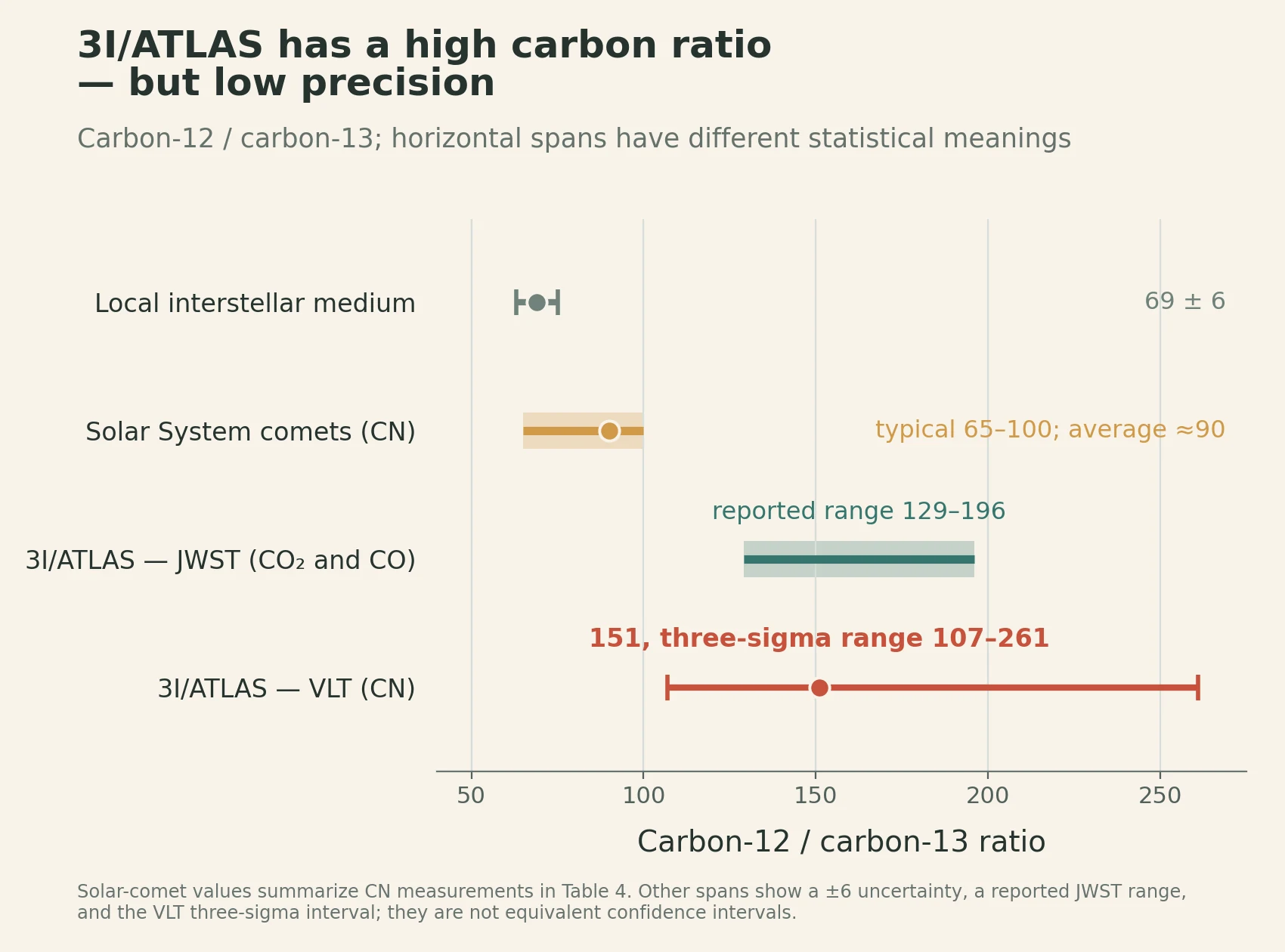
Reassuringly, the carbon result lines up with an independent estimate from JWST, which measured the same ratio in different molecules (carbon dioxide and carbon monoxide) and landed in a compatible range. Two instruments, two molecules, same ballpark, is more convincing than either alone.
What it might be telling us
Both ratios being on the high side points, tentatively, in a consistent direction. High carbon-12-to-carbon-13 is what chemical-evolution models expect around an older, metal-poor star — one that formed early in the Galaxy’s history, before generations of stars had enriched the gas with heavier carbon. High nitrogen-14-to-nitrogen-15 fits formation in a cold, well-shielded part of a planet-forming disk, far from the star’s ultraviolet glare.
Put together, the authors read 3I as compatible with having formed in the cool outer reaches of a disk around an old, low-metallicity star. That is a genuinely interesting possibility — it would make 3I a sample of planet-building around a very different kind of star than the Sun. But “compatible with” is doing real work in that sentence. It is an interpretation the data allow, not a location the data pin down.
What this does not prove
- It does not identify where 3I came from. “Consistent with an old, metal-poor star” is a plausible reading of two ratios, not a discovered home system.
- It is not a precise measurement. The uncertainties are large — the nitrogen ratio especially is closer to “clearly on the high side” than to a definite value. Any headline that quotes a single confident number is overselling it.
- It has nothing to do with life. CN is a simple molecule, and isotope ratios record temperature and radiation during formation, not biology. This is not a detection of complex organic molecules, prebiotic chemistry, or anything living.
- It rests on one object, two ratios, from one molecule. It cannot tell you what interstellar comets are like in general — only what this one appears to be.
- It does not rewrite how planets or comets form. It adds one exotic data point to a picture built mostly from Solar System objects and distant disks.
How strong is the evidence?
Modest but real, and the authors are careful about it.
- The measurement itself is a genuine first — no one had extracted isotope ratios from an interstellar object before, because the earlier two were too faint.
- The headline weakness is precision: large error bars, particularly on nitrogen, so the values are soft even though the direction (higher than Solar System comets) is fairly robust.
- It is a single object measured in a single molecule (CN) over a short window; the interpretation about its birth star is model-dependent.
- The carbon result is independently supported by JWST measurements in other molecules, which strengthens confidence in that ratio specifically.
This is a milestone measurement with wide uncertainty bars — a first look, not a settled result.
Why it matters
For a few decades, everything we knew about the chemistry of planet formation came from one example: our own Solar System, plus telescope glimpses of disks around distant stars we cannot visit. Interstellar objects are the exception — actual physical material from another star system, passing close enough to study directly.
Being able to read isotope ratios in one of them, even roughly, is a real expansion of what is possible. It turns “we wonder what other systems’ comets are made of” into “here are two numbers from one of them.” As 3I/ATLAS recedes and, eventually, brighter interstellar visitors are caught — with observatories like the Vera Rubin Observatory expected to find more — this becomes the first entry in a comparison we could never make before: the chemistry of our Solar System against the chemistry of others, measured the same way.
Clean summary
Astronomers used the Very Large Telescope to measure carbon and nitrogen isotope ratios in 3I/ATLAS, the third known interstellar comet — the first time this has been possible for an object from another star. Both ratios come out higher than in Solar System comets, which is compatible with 3I forming in the cold outer region of a disk around an older, low-metallicity star. The measurement is a genuine first, but it rests on one object, two ratios from a single molecule, and large uncertainties — it is not a discovery of where 3I came from, not a precise number, and has nothing to do with life.
No-BS check
What the paper shows: The first isotope-ratio measurements for an interstellar object: carbon-12/carbon-13 ≈ 151 and nitrogen-14/nitrogen-15 ≈ 363 in the CN molecule of comet 3I/ATLAS, from VLT/UVES spectroscopy. Both are higher than typical Solar System comets; the carbon value agrees with an independent JWST estimate.
What is genuine but interpretive: The suggestion that 3I formed in the outer disk of an older, low-metallicity star. It is consistent with the high ratios and with chemical-evolution models, but it is an inference, not a determination.
What it does not show: Where 3I actually came from; a precise value for either ratio (especially nitrogen, which has very large error bars); anything about life, complex organic chemistry, or habitability; a general result about interstellar objects (this is one object, one molecule).
Main limitations: Large measurement uncertainties; a single target observed over a short period; ratios drawn from one molecule (CN); the birth-environment interpretation is model-dependent.
How much confidence should a general reader have? High confidence that this is a real first — isotopes read from interstellar material — and that both ratios sit on the high side compared with Solar System comets. Low confidence in the exact values, and appropriate caution about the birthplace story, which is a plausible interpretation rather than a firm conclusion. The right stance: a small, genuine window into another star’s chemistry, with the emphasis on small.
Sources
Based on: High nitrogen and carbon isotopic ratios in the interstellar comet 3I/ATLAS — C. Opitom, J. Manfroid, D. Hutsemekers, E. Jehin, M. M. Knight, K. Aravind, L. Ferellec, D. Bodewits, V. V. Guzman, M. Cordiner, R. C. Dorsey, F. La Forgia, M. Lippi, B. P. Murphy, C. Snodgrass, M. Bannister, Nature Astronomy (2026).
The source paper is Opitom et al., Nature Astronomy (2026), DOI 10.1038/s41550-026-02921-7; published 6 July 2026, open access under CC BY 4.0.
Written by
Lucio Vaglio · figures and links by
Matteo Riga, Nova Vela · edited by
Michele Renda
· figures and links by
Matteo Riga, Nova Vela · edited by
Michele Renda
The Clean Paper · 2 August 2026 · Text on this site is licensed under CC BY-SA 4.0. Images are licensed separately. 


Editorial note
This article was written by AI and reviewed by the editorial team. It is a clear, conservative explanation of the linked work, not a substitute for reading it. Responsibility for selection, interpretation, and final wording rests with the editor.