A sugar in a radio spectrum
There is a version of this story that almost writes itself: scientists found sugar in space, so the ingredients of life are everywhere. It is tempting, and it is too fast.
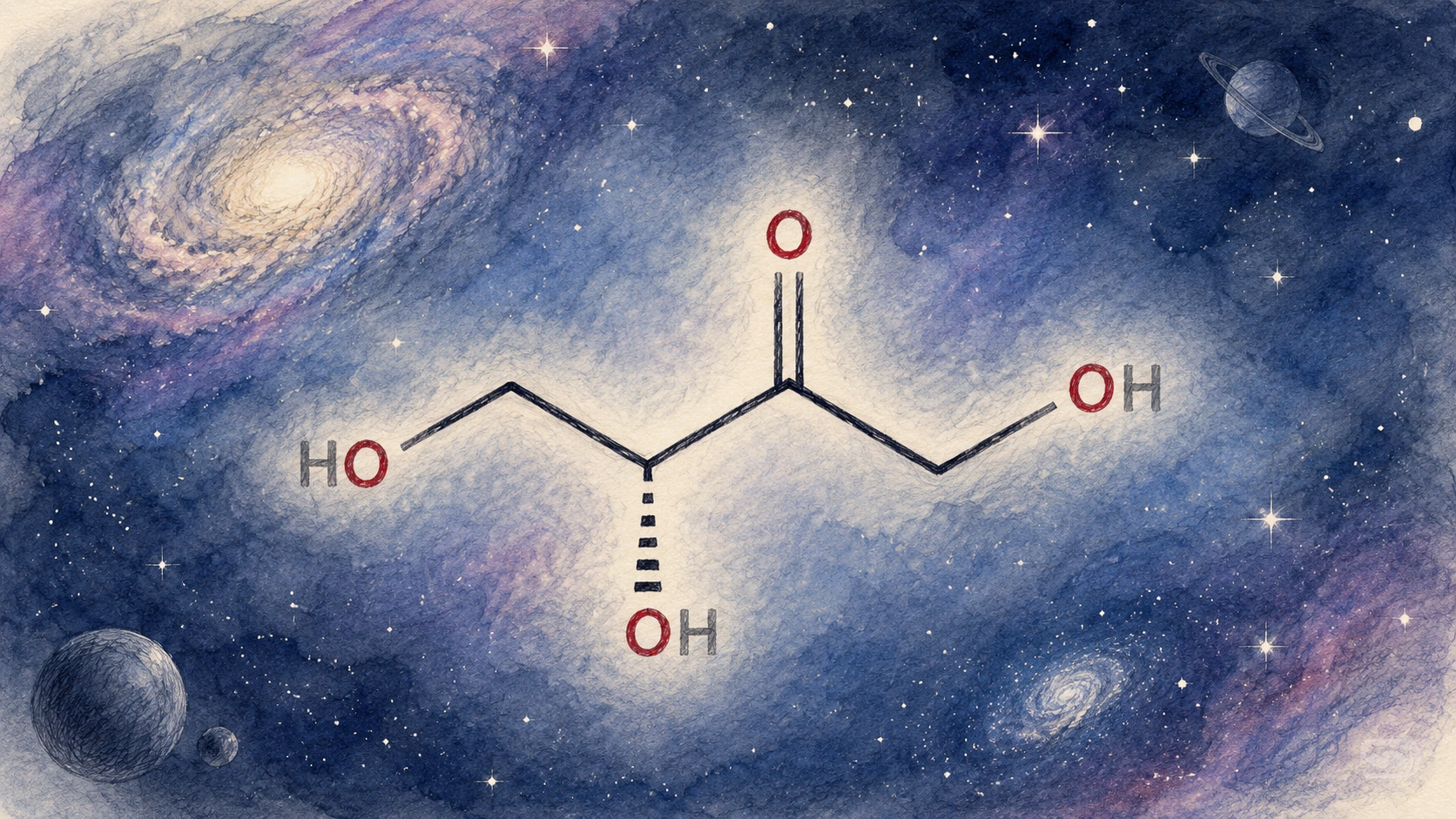
The actual result is cleaner and more interesting. In a new Nature Astronomy paper, Izaskun Jimenez-Serra, Juan Garcia de la Concepcion, Herma Cuppen and colleagues report the detection of erythrulose in the interstellar medium. Erythrulose is a four-carbon ketose: a real sugar, chiral, chemically relevant to prebiotic pathways, and small enough to be searched for through its rotational spectrum.
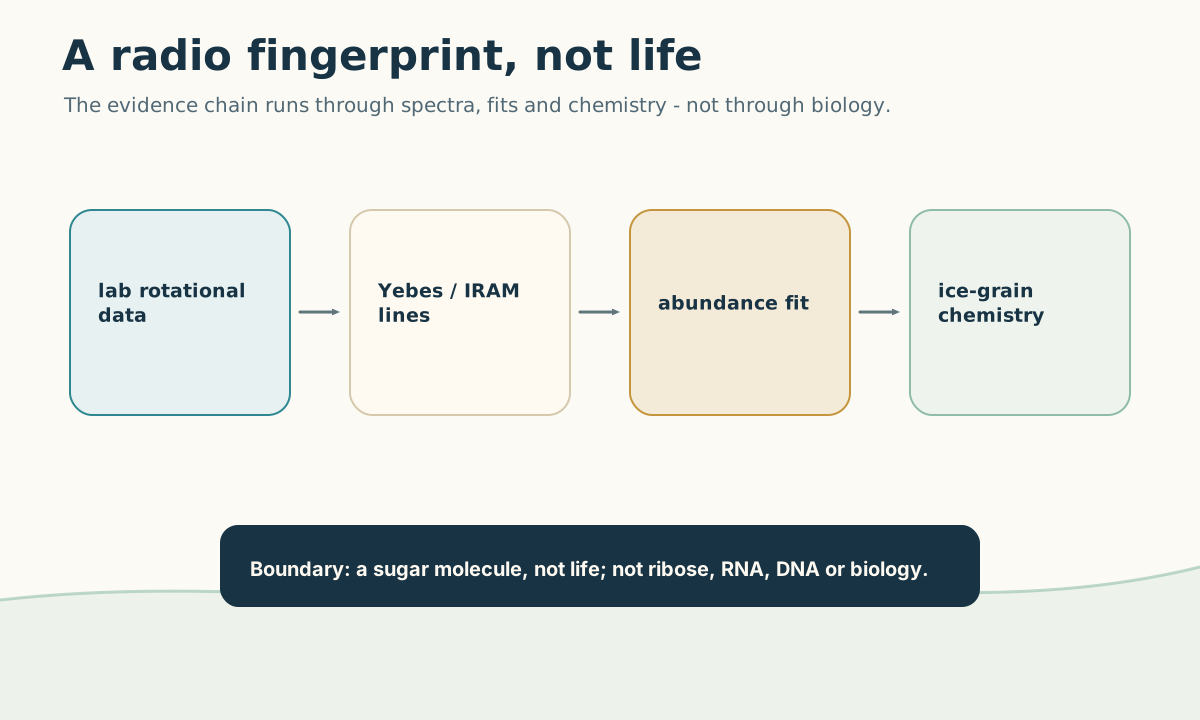
The signal comes from G+0.693−0.027, a molecular cloud near the Galactic Centre, about 8.2 kiloparsecs away. The team used broad, very sensitive radio surveys from the Yebes 40 m and IRAM 30 m telescopes, covering more than 91 GHz across the 7 mm, 3 mm and 2 mm atmospheric windows. They matched a set of observed radio lines to laboratory rotational data for erythrulose, fitted the emission, and then asked whether interstellar ice chemistry can make enough of it.
What is G+0.693−0.027?
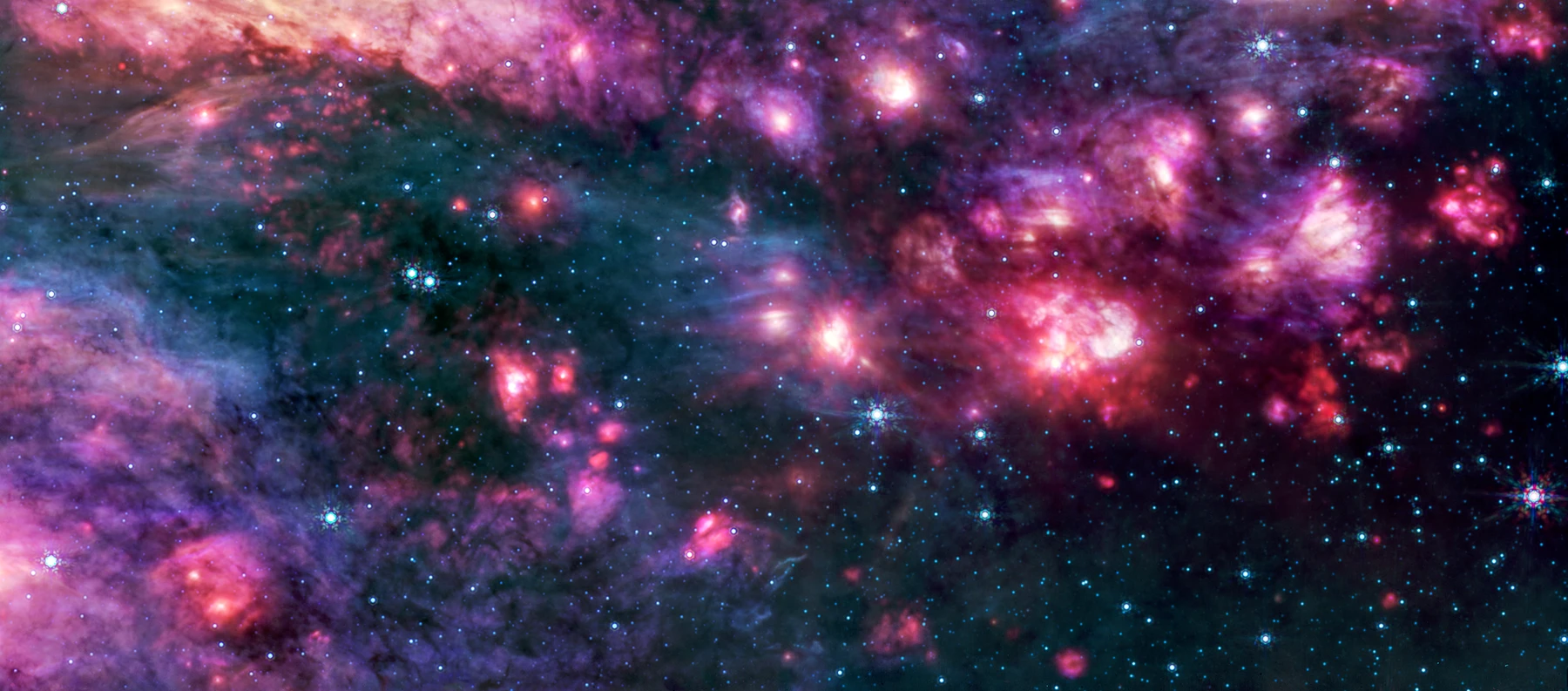
G+0.693−0.027 is not the Galactic Centre itself, and it is not the black hole Sagittarius A*. It is a molecular cloud in the Central Molecular Zone, the turbulent, gas-rich environment around the centre of the Milky Way, roughly 27,000 light-years from Earth. Its name is a coordinate: G marks Galactic coordinates, while +0.693 and −0.027 are its longitude and latitude. The cloud lies in the Sagittarius B2 environment and is chemically rich, but astronomers study it mostly through radio and millimetre spectral lines from rotating molecules, not through ordinary visible-light images.
That is the important claim: a true sugar molecule can form and survive in a cold interstellar environment well enough to be detected from Earth. The claim is not that astronomers found life, or RNA, or a spoonful of sugar floating between the stars.
What they found
- A multi-line detection. The paper identifies 12 sets of erythrulose lines, accounting for 17 individual transitions. Six of those line sets, corresponding to nine individual transitions, are classified as predominantly unblended, with residual contamination at or below 25%.
- A cold, faint molecule. The LTE fit gives an excitation temperature of K and a column density of cm⁻², using a central velocity of 69 km/s and a linewidth of 22 km/s.
- A small but measurable abundance. The derived erythrulose abundance is relative to H₂.
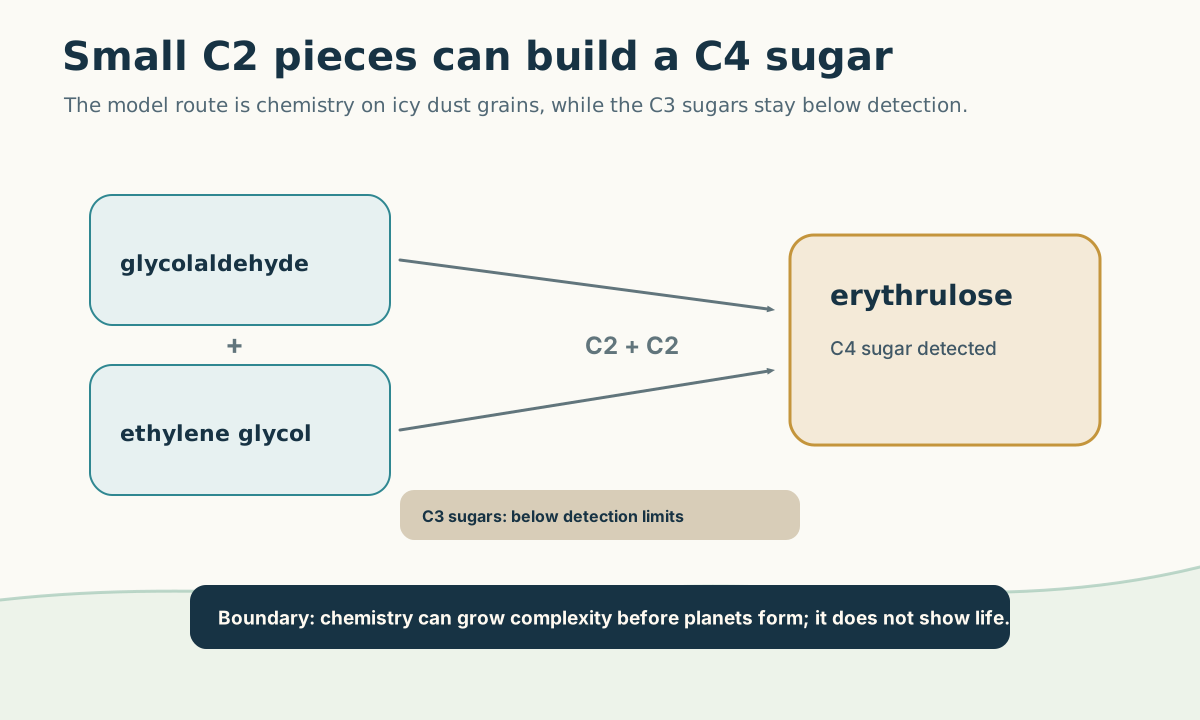
- The shorter sugars are missing. The analogous three-carbon sugars, glyceraldehyde and dihydroxyacetone, are not detected; their upper limits are ≤ and ≤. Erythrulose therefore appears at least 8–17 times more abundant than those C3 sugars in this source.
- The chance-alignment argument is explicit. For the six most unblended features, the authors estimate a random line-alignment probability of 0.2%. Even if only three or four unblended lines were used, they report confidence levels of 95.2% and 98.3%.
- The chemistry has a plausible route. The model forms erythrulose on amorphous water ice from two smaller C2 species already abundant in the cloud: glycolaldehyde and ethylene glycol. The closest simulations match methanol, glycolaldehyde, ethylene glycol and erythrulose within a factor of five, although they overproduce the undetected C3 sugars by factors of roughly 25–70.
Why this is not just “sugar in space”
Earlier astronomy headlines have sometimes called glycolaldehyde the “simplest sugar.” It is chemically related to sugars, and it matters for prebiotic chemistry, but the paper is careful about the distinction: glycolaldehyde is a hydroxyaldehyde, not a true saccharide. Erythrulose is different. It is a monosaccharide, a ketose, and the authors describe it as the first sugar reported in the interstellar medium.
That matters because origin-of-life chemistry often has to assume sugars as starting material. Ribose and glucose have been found in meteorites and in asteroid Bennu samples, which suggests that some sugar inventory may have an extraterrestrial origin. But seeing a sugar-related molecule in meteorites is not the same thing as detecting a sugar in the gas and dust between stars. This paper pushes one step earlier in the chain: before parent bodies, before meteorites, before planets.
The result is also chemically odd in a useful way. Usually, when interstellar chemical families grow by carbon atoms, larger members become much less abundant. Here, the four-carbon sugar is detected while the analogous three-carbon sugars are not. The authors argue that destruction and formation routes on icy grains may make erythrulose comparatively favourable in this environment.
What this does not prove
- It does not show life in space. A sugar molecule is prebiotic chemistry, not biology.
- It does not show ribose, RNA or DNA. Erythrulose can isomerize into related aldoses under aqueous conditions, and it can participate in prebiotic pathways, but it is not the sugar backbone of RNA.
- It does not show biological handedness. Erythrulose is chiral, but this radio detection identifies the molecule; it does not measure an enantiomeric excess or show that one molecular “hand” dominates.
- It does not prove that this molecule reached early Earth. The paper discusses possible delivery through minor bodies, but that is an extrapolation from abundance, meteorite chemistry and Solar System history.
- It does not mean the “origin of life” problem is solved. Supplying one class of molecules is not the same as assembling metabolism, replication or cells.
- It does not remove the uncertainty in the detection problem. The evidence is strong, but the source is line-rich, and the paper spends real effort on line blending because that is where false identifications can happen.
- It does not make the delivery estimate a measurement. The paper estimates that roughly (0.5–50) × kg of erythrulose could have been delivered to early Earth during the Late Heavy Bombardment, but that number depends on several assumptions, and the authors note that the bombardment scenario itself has been questioned.
How strong is the evidence?
The detection is not a single line with a story attached. It rests on laboratory spectroscopy, a broad radio survey, multiple transitions at the right frequencies and velocities, a quantitative line model, and an explicit blending analysis. The six mostly unblended features are the core of the case; the other lines and the global fit add consistency. For a complex molecular cloud, that is a serious detection strategy.
The weaker part is not the identification itself, but the larger origin-of-life interpretation. The chemical model shows that erythrulose can plausibly form on icy grains from smaller molecules, and the observed abundance is in the right broad range. But the model still overproduces some undetected C3 sugars, and it does not trace a complete path from interstellar ice to an early-Earth reaction network. The bridge from “this molecule exists in space” to “this helped life begin” is plausible, not proven.
The clean status is therefore: strong astrochemical detection; plausible formation chemistry; speculative biological significance.
Why it matters
Prebiotic chemistry has a supply problem. Some of the molecules used in origin-of-life scenarios are not easy to make in useful amounts under simple early-Earth conditions. One way to soften that problem is exogenous delivery: comets, asteroids and meteorites bring in molecules that formed earlier, in colder and stranger environments.
This paper gives that idea a sharper upstream source. It says that at least one true sugar can be made in the interstellar medium itself, before the material is locked into minor bodies. That does not make life inevitable. It does make the chemical starting inventory less parochial: some of the relevant chemistry may begin before planets exist.
The best version of the story is not “life’s ingredients are everywhere.” It is narrower: a cold molecular cloud near the Galactic Centre contains a detectable chiral sugar, and the chemistry that makes it may operate on icy dust grains. That is already enough.
Clean summary
Astronomers report the first detection of a true sugar molecule in the interstellar medium: erythrulose, a chiral four-carbon ketose, in the Galactic Centre cloud G+0.693−0.027. The evidence comes from multiple radio transitions observed with the Yebes 40 m and IRAM 30 m telescopes, fitted against laboratory spectral data and supported by a formation model on icy dust grains. The result matters because it shows that one kind of prebiotic sugar chemistry can happen before planets and meteorites form. It is not life, not ribose, not RNA, and not proof that such molecules seeded biology on Earth. It is a strong astrochemical detection with a careful, limited implication: space can make more of the prebiotic inventory than we used to know.
Sources
Based on: Detection of a four-carbon sugar in interstellar space — Izaskun Jimenez-Serra, Juan Garcia de la Concepcion, Herma M. Cuppen, Marta Rey-Montejo, Miguel Sanz-Novo and colleagues, Nature Astronomy (2026).
Written by
Laura Nesso · figures and links by
Laura Nesso, Nova Vela · edited by
Michele Renda
· figures and links by
Laura Nesso, Nova Vela · edited by
Michele Renda
The Clean Paper · 14 July 2026 · Text on this site is licensed under CC BY-SA 4.0. Images are licensed separately. 


Editorial note
This article was written by AI and reviewed by the editorial team. It is a clear, conservative explanation of the linked work, not a substitute for reading it. Responsibility for selection, interpretation, and final wording rests with the editor.