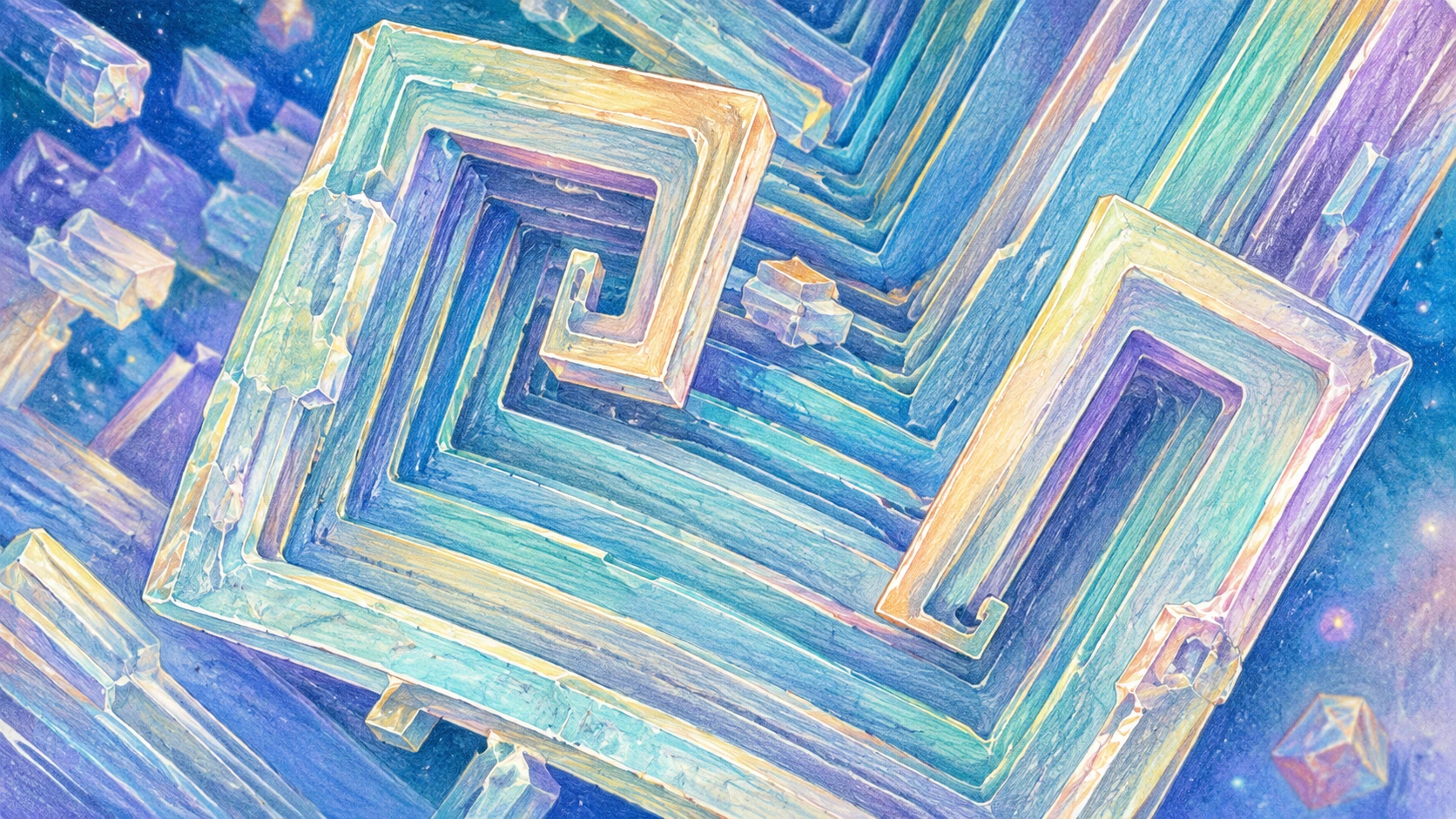
In orbit, ordinary table salt grew into hollow stepped cubes
The crystals looked architectural: square frames nested inside square frames, their faces hollowed into staircases.
They were made of ordinary sodium chloride, the same compound as table salt. The unusual part was not the material. It was the brine around it.
On Earth, a growing crystal in a centimetre-scale volume of liquid can sink, touch a wall or surface, and help create density differences that circulate the solution. On the International Space Station, ordinary settling and buoyancy-driven flow were strongly suppressed. Some salt crystals remained suspended long enough to grow slowly and more symmetrically into hopper cubes with edges between 2 and 8 millimetres.
Three papers, published in 2011, 2015 and 2019, describe these experiments. Together they offer a clean lesson in transport physics: changing how dissolved material reaches a crystal can change its visible form without changing its atomic structure.
They do not show that space makes perfect crystals, establish an industrial process or reveal a new kind of salt.
What makes a cube into a hopper
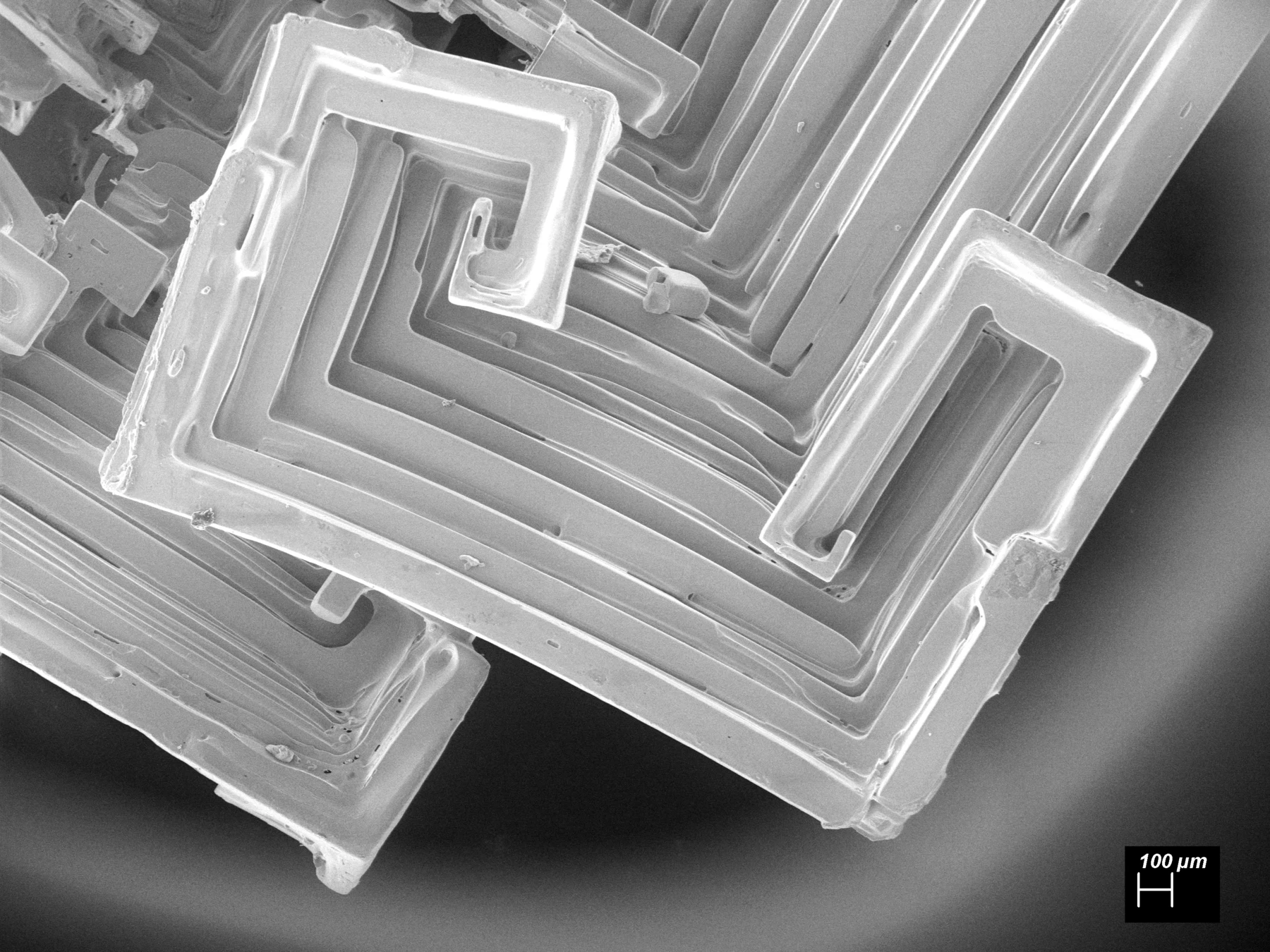
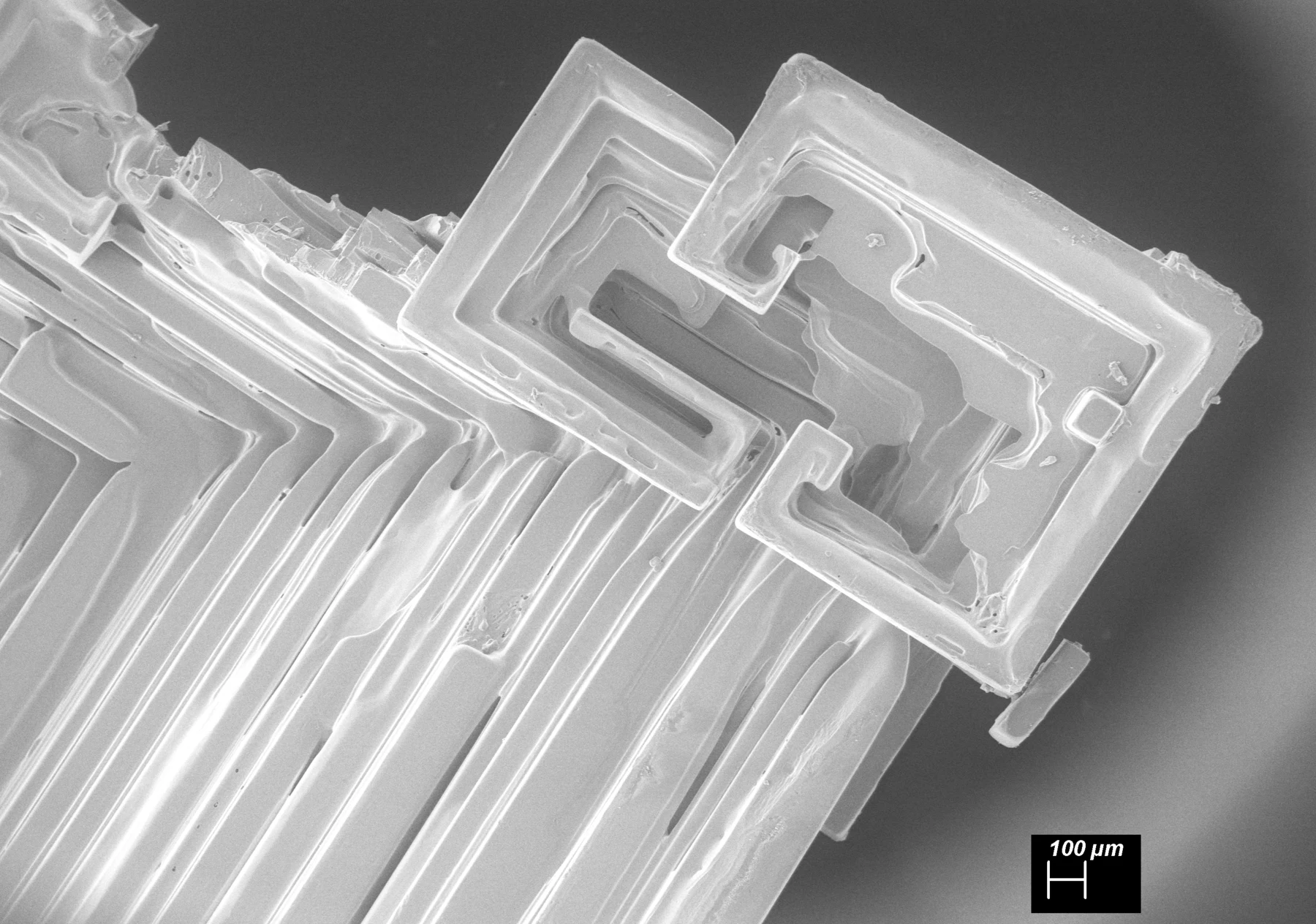
A normal sodium chloride crystal has a cubic atomic arrangement. A hopper crystal is still cubic, but its corners and edges grow ahead of the centres of its faces. The result is a hollow, stepped depression on each face, as though the cube tried to build its frame before filling in the walls.
A later ISS example makes that growth pattern visible, but it is context rather than evidence from the three sodium-chloride papers. Donald Pettit’s image and time-lapse below show potassium chloride, a different salt, forming stepped hopper and scroll morphologies in microgravity.
Crystals grow from supersaturated brine: salt water containing more dissolved sodium chloride than it would hold at equilibrium under those conditions. Sodium and chloride ions must travel through the liquid and join the crystal surface.
There are two broad ways to move them. Diffusion is the random molecular motion that carries dissolved material down a concentration difference without bulk liquid circulation. Convection is the movement of the liquid itself. Under ordinary gravity, small differences in temperature or concentration can change density and drive buoyancy circulation. Crystals can also sediment, or settle through the liquid.
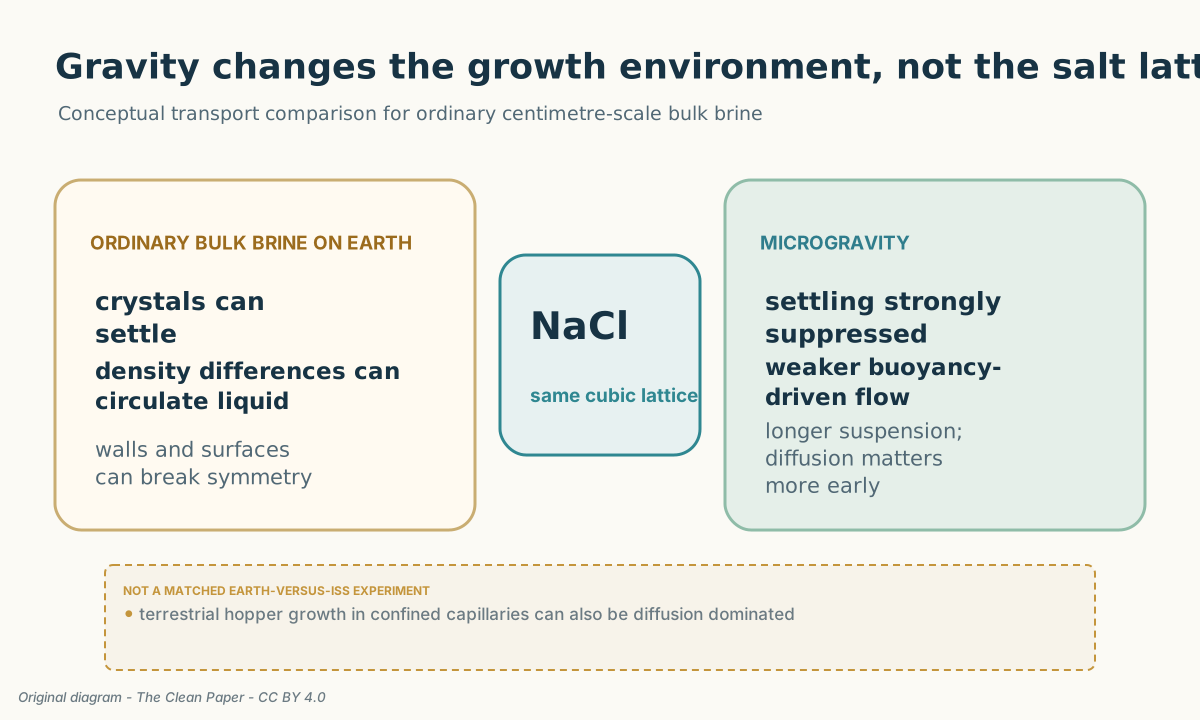
This experiment was conducted aboard the International Space Station, an orbiting microgravity laboratory. The phrase microgravity does not mean no gravity. The 2019 paper reported residual acceleration of about 1.2 millionths of Earth’s surface gravity, or 1.2 micro-g, along with slow cyclic liquid motion. The environment changed the balance of transport; it did not make the brine perfectly still.
A slow route to millimetre-scale cubes
The 2019 study focused on hopper cubes grown as water evaporated from brine on the ISS. Reported cube edges ranged from 2 to 8 millimetres. Growth rates ranged from 0.34 to 1.0 micrometres per minute (about 0.49 to 1.44 millimetres per day), with a mean of 0.68 micrometres per minute and a standard deviation of 0.23.
At that average rate, an 8-millimetre edge would take roughly a week to develop. The calculation is an estimate, not a time-lapse measurement of every stage of one crystal.
The authors estimated supersaturation below 1.002. Their terrestrial comparison literature described hopper growth under much higher supersaturation, above 1.45, at rates of 10 to 110 micrometres per second for seconds or minutes, typically producing cubes smaller than 250 micrometres.
That comparison is informative but not matched. The ISS crystals and terrestrial literature did not come from simultaneous, identical Earth and orbit arms run by the same team. Different containers, interfaces and methods can matter alongside gravity.
The strongest contrast is therefore descriptive: in these ISS observations, hopper cubes grew slowly, at low supersaturation, over days to weeks and reached millimetre scale.
Diffusion dominated early; later flow remained possible
The 2019 paper used the Peclet number to compare transport by liquid motion with transport by diffusion. A value below one means diffusion is more important; a value above one means bulk motion may dominate.
A ratio, not a switch
The Peclet number is a comparison between two transport rates. It does not divide the world into perfectly still liquid below one and pure convection above one. Here the value changed with crystal size and with the velocity estimate used for the surrounding brine. The smallest crystals were clearly in a diffusion-dominated regime; the largest crystal in the larger vessel could have entered a regime where slow liquid motion mattered.
In the smaller, roughly 0.8-centimetre drops, estimated Peclet values rose from about 0.0004 near nucleation to about 0.03 at the final measured size. Diffusion remained dominant.
In 2- to 3-centimetre crystallizers, the estimate rose from about 0.05 for a 50-micrometre nucleus to about 4 for a 4-millimetre edge. Early growth was still diffusion dominated, but slow cyclic motion could have contributed later.
This is why “microgravity removed convection” would be wrong. Ordinary buoyancy-driven circulation and settling were strongly reduced. Residual acceleration and measurable motion remained.
The liquid’s shape mattered too
The 2011 paper and 2015 paper broadened the picture. They reported salt crystallization in thin films, thicker liquid layers, roughly spherical brine volumes and drops attached to a surface.
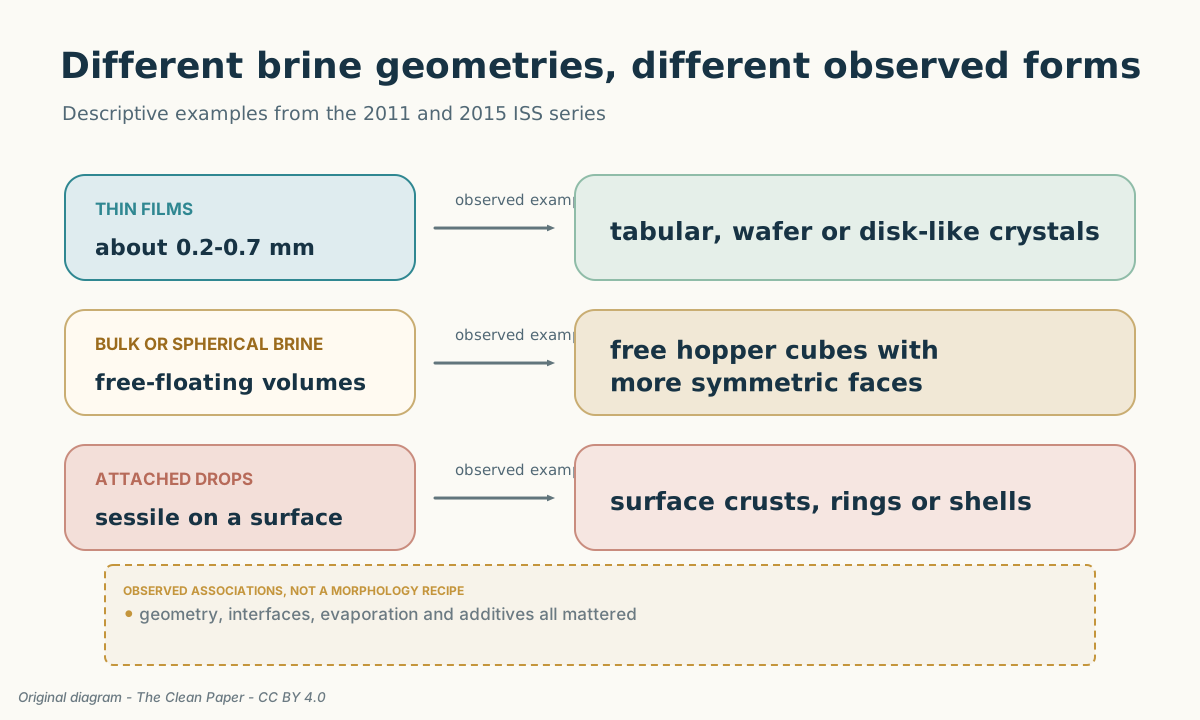
In the 2011 study, thin films approximately 0.2 to 0.7 millimetres thick produced thin wafers and tabular crystals. Free-floating brine volumes allowed more symmetric lateral faces and hopper cubes.
The 2015 observations included thin sheets 0.2 to 0.7 millimetres thick, thicker layers around 4 to 6 millimetres and attached hemispherical drops roughly 20 to 32 millimetres across. Reported forms included tabular hoppers, cubes, disk-like crystals, dendrites, rings and shells. Adding polyethylene glycol suppressed hopper growth in one set of observations.
The authors described the 2015 work as observations made with non-inventoried supplies during crew off-duty time, not a rigorous programmatic investigation. The examples show that liquid geometry, interfaces, evaporation and additives all mattered. They do not define a deterministic recipe in which one container shape guarantees one crystal shape.
The lattice did not become a new form of salt
The distinction between crystal structure and morphology is essential.
Structure is the repeating atomic arrangement. Morphology is the visible external form. Neutron diffraction in the 2011 paper did not identify a changed sodium chloride structure or changed lattice-cell parameters compared with terrestrial samples. The orbital samples also contained brine inclusions, small pockets of solution trapped within a crystal.
So the large, symmetric appearance is not evidence of a purer or defect-free material. No paper in the dossier reports higher chemical purity, better mechanical performance or suitability for a specific device.
Gravity acted indirectly. It changed settling, liquid circulation, orientation and contact with surfaces. It did not alter the strength of sodium-chloride bonds or create a new atomic phase.
What these experiments can and cannot teach
The papers support a transport explanation: strongly suppressing ordinary settling and buoyancy-driven flow let some crystals remain suspended and grow slowly under more symmetric conditions. The measured sizes, rates and forms are direct observations; supersaturation, growth history and Peclet values include estimates; the comparison with Earth draws partly on other published experiments.
There is no single clean denominator for the dossier. It combines individual crystals, crystallizers and selected examples across three papers. Adding them into one total would imply a uniform experiment that did not exist.
The studies also report none of the evidence needed for a manufacturing claim. They do not measure throughput, production cost, energy use, yield, reliability or useful material performance. The 2015 series was exploratory. The terrestrial comparisons were not matched controls. And large or visually striking is not the same as better for an application.
Natural salt deposits can contain hopper cubes measured in centimetres, sometimes suspended in brine-soaked mud. The 2019 paper suggests a possible analogy with slow, diffusion-dominated growth. It is an interesting comparison, not proof that natural and orbital hoppers share one mechanism.
Clean summary
Salt crystals grown from evaporating brine on the International Space Station included hollow, stepped hopper cubes 2 to 8 millimetres across. The papers support an explanation based on transport: microgravity strongly suppressed ordinary settling and buoyancy-driven flow, allowing slow growth and longer suspension while diffusion dominated early. Liquid geometry, interfaces, evaporation and additives also affected morphology. Neutron diffraction did not show a new sodium chloride structure, and brine inclusions remained. The work is a bounded materials-science case study, not proof that space makes perfect crystals or enables an industrial process.
No-BS check
What the papers show: Millimetre-scale sodium chloride hopper cubes and other morphologies grew in several ISS brine geometries. The 2019 hopper cubes grew slowly at low estimated supersaturation, with diffusion dominant early.
What is interpreted: Strongly reduced settling and buoyancy-driven flow allowed longer suspension and more symmetric growth. Slow liquid motion may have mattered late in the larger crystallizer.
What they do not show: A new atomic form of salt, purer or defect-free crystals, a matched Earth-versus-ISS trial, a universal advantage of microgravity or a commercial manufacturing route.
Main limitations: Three distinct studies with different geometries and selected examples; cross-study terrestrial comparisons; estimated transport quantities; exploratory, non-programmatic parts of the dossier; and no process economics or performance tests.
How much confidence should a general reader have? High confidence that the reported orbital morphologies and slow growth are real. Moderate confidence in the transport explanation as the best account across the observations. Very low confidence in any claim that turns these salt experiments into a general promise about space manufacturing.
Sources
Based on: Comparison of sodium chloride hopper cubes grown under microgravity and terrestrial conditions — Donald Pettit and Pietro Fontana, npj Microgravity 5, 25 (2019).
- Paper — Pettit and Fontana, Comparison of sodium chloride hopper cubes grown under microgravity and terrestrial conditions, npj Microgravity 5, 25 (2019)
- Paper — Fontana, Schefer and Pettit, Characterization of sodium chloride crystals grown in microgravity, Journal of Crystal Growth 324, 207-211 (2011)
- Paper — Fontana, Pettit and Cristoforetti, Sodium chloride crystallization from thin liquid sheets, thick layers, and sessile drops in microgravity, Journal of Crystal Growth 428, 80-85 (2015)
This article treats the 2011, 2015 and 2019 papers as three distinct sources in one dossier.
Written by
Matteo Riga · figures and links by
Matteo Riga, Nova Vela · edited by
Michele Renda
· figures and links by
Matteo Riga, Nova Vela · edited by
Michele Renda
The Clean Paper · 2 August 2026 · Text on this site is licensed under CC BY-SA 4.0. Images are licensed separately. 


Editorial note
This article was written by AI and reviewed by the editorial team. It is a clear, conservative explanation of the linked work, not a substitute for reading it. Responsibility for selection, interpretation, and final wording rests with the editor.