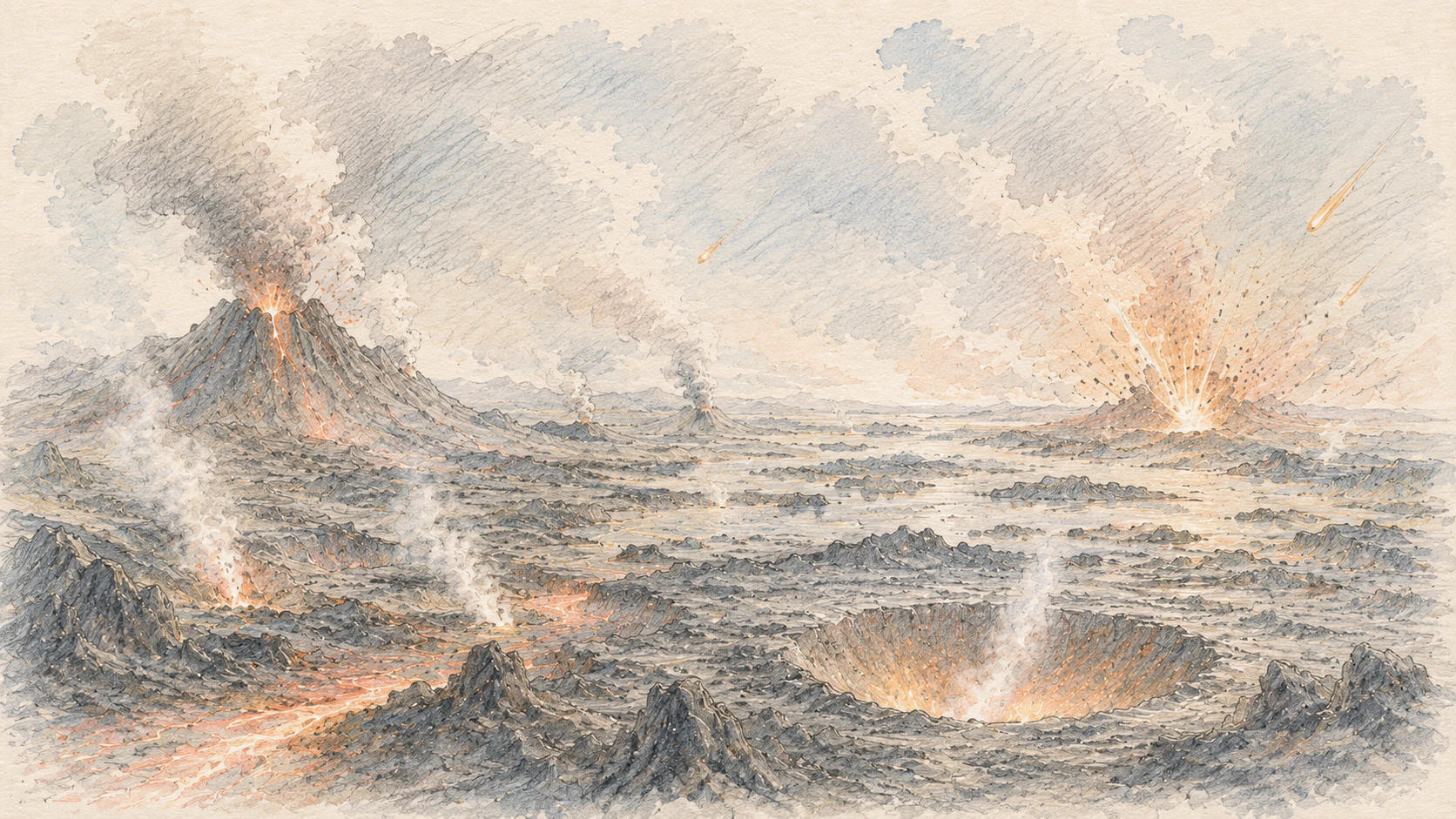
Chapter kan nínú ìtàn Earth tí fẹrẹ̀ kò ní page kankan tó kù
Earth ni nìkan pílánẹ́ẹ̀tì tí a mọ̀ pẹ̀lú continents — buoyant, silica-rich land tí gbogbo wa ń gbé lórí. Ṣùgbọ́n bí first continents ṣe form jẹ́ ọ̀kan lára oldest unsolved ìṣòro nínú geology, fún brutal reason kan: ẹ̀rí fẹrẹ̀ parẹ́ patapata.
First eon Earth, Hadean, lọ láti birth pílánẹ́ẹ̀tì dé nípa 4.03 billion years ago (Ga). Láti first half-billion years yẹn, fẹrẹ̀ kò sí nǹkan tó survive. Oldest intact felsic (continental-type) àpáta jẹ́ around 4.03 Ga. Few rare basaltic àpáta reach ~4.2 Ga. Oldest ohun èlò of any kind jẹ́ scatter of zircon crystals — famously láti Jack Hills, Western Australia — dated to 4.4 Ga. Èyí ni entire archive ti Earth infancy: handful localities àti minerals tó ìwọ̀n bí sand grain.
ìwádìí yìí kò fi tuntun àpáta kún archive. Ó ṣe nǹkan mìíràn: build physical àwòṣe ti ohun tí Hadean crust yẹ kí look like labẹ physics yẹn, ó sì béèrè ìbéèrè tí most early-Earth àwòṣe leave out. Kí ló ṣẹlẹ̀ tí o bá stop ignoring fact pé early Earth ń gba bombardment?
Answer àwọn olùkọ̀wé striking. Fún most of Hadean, heat delivered by impacts yóò have swamped gbogbo Earth internal heat, leaving crust thin àti half-molten — weak ju, gẹ́gẹ́ bí wọn argue, fún anything like modern plate tectonics. àwòṣe ni, kì í ṣe ìrántí. Ṣùgbọ́n àwòṣe kan tí, fún once, ń try account fún violence of era tí ó describes.
Ohun tí àwọn olùkọ̀wé ṣe
ẹgbẹ́ combine ingredients mẹ́ta tí a sábà keep separate.
Àkọ́kọ́, stochastic àwòṣe of impact flux — rain of asteroids àti larger bodies hitting inner Solar System nípasẹ̀ Hadean àti early Archean. Crucially, kì í ṣe old idea of single “Late Heavy Bombardment” spike. Ó jẹ́ flux intense early, declines over àkókò, large impacts arrive randomly (stochastically), kì í ṣe on schedule. àwòṣe rescaled láti lunar àti inner-Solar-System impact statistics, chosen to be consistent pẹ̀lú zircon age spectra àti available paleomagnetic ẹ̀rí.
Ẹlẹ́ẹ̀kejì, geodynamic simulations ti how heat moves nípasẹ̀ crust àti upper mantle. Wọ́n lo benchmarked lattice-Boltzmann code (Planet_LB), run simple 1D temperature-versus-depth calculations àti full 2D convection snapshots of mantle at 4.1 Ga. Wọ́n include ordinary internal heat orísun — radioactive decay àti core heat — àti importantly, magmatic advection: heat carried upward by rising melt, which most crustal thermal àwòṣe omit.
Ẹlẹ́ẹ̀kẹta, phase-equilibrium modelling ti realistic early crust — hydrated Hadean metabasalt láti Nuvvuagittuq greenstone belt — láti iṣẹ́ out at what temperature àti depth àpáta like that starts to melt.
One methodological choice matter fún reading whole ìwé ìwádìí: òǹkọ̀wé deliberately stacked deck against own conclusion. Wọ́n assume “nonchondritic” mantle (less heat-producing radioactive ohun èlò than chondritic reference), pẹ̀lú less than half internal heating of standard àwòṣe, conservative heating rates, ignore tidal heating láti young close Moon. Nítorí náà calculated crustal temperatures jẹ́ minima — lower bounds. Tí anything, gidi Hadean hotter than modeled.
Ohun tí wọ́n rí
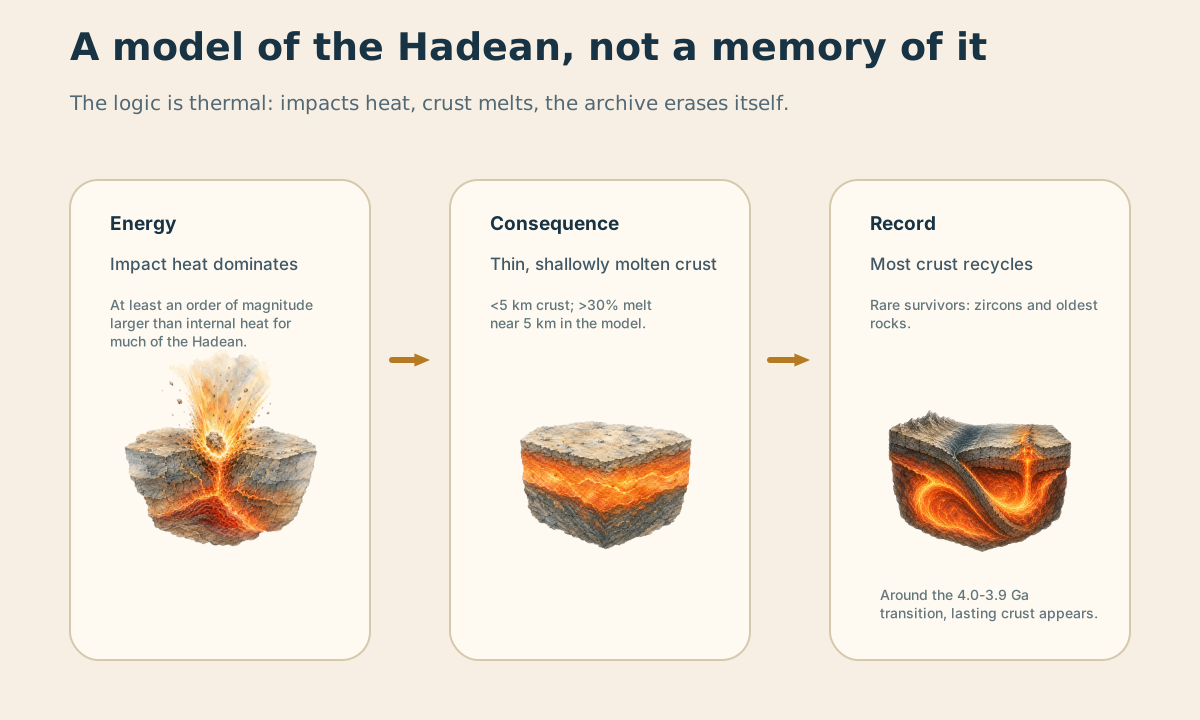
Impacts, kì í ṣe internal heat, dominate Hadean agbára budget. Tí impact heat integrate over àkókò, ó dwarfs internal contribution — by at least order of magnitude fún most Hadean. Nínú picture yìí, impact heating, kì í ṣe radioactive decay, is pàtàkì engine driving early tectonism, fades to minor role nìkan lẹ́yìn nípa 3.9 Ga.
Heat yẹn keep crust thin àti shallowly molten. Without impacts àti melt advection, àwòṣe gives Hadean crust partially molten nìkan below ~10–15 km. Add impact heat, melt zone rises dramatically: crust partially molten just few kilometres down (below roughly 2–5 km). Around 5 km depth, àwòṣe predict >30% melt — ipò where àpáta too weak to hold as rigid plate. At 5–10 km, temperatures ~1000–1100°C mean crust extensively molten almost regardless composition. Surviving solid crust yóò have been thin, lábẹ́ nípa 5 km.
Half-molten crust erases itself. Extensive melting lets dense iron- àti magnesium-rich ohun èlò sink àti separate, lighter silica-rich melts rise. Over àkókò this drives average crust toward sí i evolved, silica-rich compositions — produces felsic melt that lè crystallize zircon. Almost gbogbo thin crust yóò then recycle back sínú convecting mantle, consistent pẹ̀lú isotopic àkọsílẹ̀. Nínú àwòṣe yìí, near-total absence of Hadean àpáta kì í ṣe gap — ó jẹ́ prediction. 4.2 Ga àpáta àti 4.4 Ga zircons are rare survivors of crust mostly destroyed as fast as it formed.
End of bombardment lines up pẹ̀lú first lasting continents. As bombardment waned across 4.0–3.9 Ga transition, crust lè finally thicken àti endure. Oldest surviving continental àpáta appear around kan náà transition. òǹkọ̀wé ipò carefully: that enduring continental crust appeared around this àkókò is “likely not a coincidence.”
àkọlé inference wọn: labẹ conditions wọ̀nyí — thin crust, molten few kilometres down — Hadean plate tectonics implausible.
Wọ́n tún fi hàn why earlier iṣẹ́ reached opposite conclusion. Previous stochastic impact ìwádìí rí nìkan minor ipa, <2.5% crust molten at any àkókò. Those ìwádìí left out méjì things this ọ̀kan includes: global ipa of large impacts on melting deep mantle, àti upward transport of heat by rising magma. Put them back in, thermal picture changes drastically.
Kí ló dé tí àwòṣe kì í ṣe ìrántí?
Gbogbo ohun lókè output of simulations, kì í ṣe reading láti Hadean àpáta — nítorí àpáta yẹn fẹrẹ̀ gbogbo gone. Èyí kò make èsì weak, ṣùgbọ́n ó define type èsì.
Chain: àwòṣe of impact flux feeds àwòṣe of mantle/crust heat flow, checked against àwòṣe of how particular àpáta melts. Each link physically motivated, benchmarked where ṣeé ṣe — ṣùgbọ́n whole thing coherent argument nípa what Hadean gbọ́dọ̀ have looked like given ṣeé gbà physics, kì í ṣe measurement of what it did look like.
Ìdí nìyẹn tí conservative assumptions matter. Nítorí òǹkọ̀wé choose lower-bound heating, still get pervasively molten shallow crust, qualitative conclusion — Hadean crust hot àti weak — robust to choices. What not pinned down: precise numbers — exact geotherms, melt fractions, crustal thickness. Read ìtọ́sọ́nà lágbára, decimal places provisional.
Ohun tí èyí kò fi ẹ̀rí múlẹ̀
- Kò taara observe Hadean crust. Almost no àpáta láti era; modelling èsì nípa physics implies, kì í ṣe measurement.
- Kò rest on “Late Heavy Bombardment.” Impact flux is declining stochastic ọ̀kan — no sudden spike required.
- Kò settle plate-tectonics debate. “Implausible” is lágbára physically grounded inference favoring hot stagnant- tàbí squishy-lid early Earth — tectonic mode genuinely contested.
- Kò fi ẹ̀rí múlẹ̀ impacts caused continents to appear around 4.0–3.9 Ga. Timing match lágbára association òǹkọ̀wé call “likely not a coincidence” — careful èdè fún compelling correlation, not demonstrated cause.
- Jack Hills zircons are not preserved continents. Rare grains fi hàn felsic ohun èlò àti water existed early; kókó àwòṣe is crust that made them mostly recycled.
- Kò reconstruct full early Earth history. Simulations idealized — 1D profiles, 2D equatorial slices, impacts near equator, snapshots — not complete four-dimensional pílánẹ́ẹ̀tì àwòṣe.
Báwo ni ẹ̀rí ṣe lágbára tó?
Fún central claim — impact heating first-order control on Hadean crust, keeping it thin àti shallowly molten — argument coherent, importantly conservative. Uses benchmarked geodynamics code, physically reasonable inputs, lower-bound assumptions, integrates heat orísun most previous àwòṣe ignored. It also explains méjì stubborn facts at once: why almost no àpáta >~4 Ga survives (near-total recycling), why lasting crust appears as bombardment fades.
Limits equally clear: àwòṣe built on àwòṣe, anchored to sparse àpáta àkọsílẹ̀, most quotable conclusion “plate tectonics is implausible” is inference not observation. Right posture: lágbára, well-reasoned hypothesis that reframes Hadean, invites ìdánwò of assumptions — especially impact-flux àwòṣe — not closed ọ̀ràn.
Most useful summary kì í ṣe “this is what Hadean was like” tàbí “it’s just simulation.” Ó jẹ́: given ṣeé gbà conservative physics, early Earth lábẹ́ heavy bombardment yóò have thin, half-molten, self-recycling crust — ọ̀kan idea accounts fún surprising amount of little we lè actually see.
Kí nìdí tí ó fi ṣe pàtàkì?
Popular image early Earth swings láàárín serene plate-tectonic water world like today, tàbí hellish lava pílánẹ́ẹ̀tì. Work yìí sketches physically motivated middle: thin crust repeatedly remelted láti few kilometres down, continually destroyed àti remade, impacts — not internal heat — setting terms.
Reframing yìí does gidi iṣẹ́. It offers ọ̀nà iṣẹ́ fún méjì biggest facts of Earth infancy — near-total absence of àpáta àkọsílẹ̀, timing first enduring continents — àti puts neglected ìlànà, impact heating, at centre. If holds, changes how we reason nípa when Earth became pílánẹ́ẹ̀tì of stable continents, carries to other rocky worlds formed lábẹ́ bombardments.
None requires àwòṣe to be last word. It needs be good hypothesis to ìdánwò — àti by tying to surviving zircon/isotope àkọsílẹ̀, it is. “Hidden Hadean” of title is kókó: era we lè mostly reach nìkan by modelling, nítorí era erased own ẹ̀rí.
Àkótán kedere
Earth first eon, Hadean (ṣáájú ~4.03 Ga), left almost no àpáta àkọsílẹ̀. Modelling ìwádìí asks crust ìhùwàsí once impact heating included. Using stochastic declining impact-flux àwòṣe pẹ̀lú benchmarked 1D/2D crust/mantle heat-flow simulations including rising-melt heat, òǹkọ̀wé rí time-integrated impact heat exceeded Earth entire internal heat by at least order of magnitude fún most Hadean. Consequence: thin crust (<~5 km), partially molten nìkan few kilometres down, >30% melt at ~5 km — too weak fún plate tectonics, which òǹkọ̀wé call implausible. Such crust mostly recycle sínú mantle, explaining little surviving Hadean ohun èlò; as impacts waned across 4.0–3.9 Ga, lasting continental crust lè form around when oldest surviving felsic àpáta appear — “likely not a coincidence.” Because òǹkọ̀wé deliberately lò conservative lower-bound heating, qualitative èsì robust though exact numbers not fixed. Strong coherent àwòṣe, not taara observation.
Àyẹ̀wò láìsí àṣejù
Ohun tí ìwé ìwádìí fi hàn: Nínú physically grounded simulations including impact heating àti magmatic heat transport, Hadean crust comes out thin àti partially molten few kilometres down, dominated by impact heat rather than internal heat, mostly recycled sínú mantle, àti — on àwòṣe — unable to ṣe àtìlẹ́yìn fún plate tectonics.
Ohun tó ṣeé gbà ṣùgbọ́n tí a kò fi ẹ̀rí múlẹ̀: Impacts are reason enduring continents appear around 3.9 Ga; Hadean stagnant/squishy-lid world rather than early plate tectonic; missing Hadean àpáta specifically nítorí molten crust recycled itself.
Ohun tí kò fi hàn: Direct measurement Hadean crust; settled plate-tectonics answer; demonstrated causal link bombardment fade → continents; Jack Hills zircons as preserved continents; complete àwòṣe early pílánẹ́ẹ̀tì.
Main limitations: Almost nonexistent àpáta àkọsílẹ̀; àwòṣe stacked on àwòṣe (impact flux → geodynamics → phase equilibria); impact flux representative uncertain choice; simulations idealized (1D/2D equatorial slices, snapshots). Conservative lower-bound assumptions strengthen qualitative conclusion, not specific precision.
Confidence wo ni gbogbogbò reader yẹ kí ó ní? High that lábẹ́ ṣeé gbà physics, heavily bombarded early Earth yóò have hot, thin, shallowly molten crust. Moderate that this makes Hadean plate tectonics unlikely àti explains missing àpáta àkọsílẹ̀. Low fún claim that it proves exactly how continents formed tàbí when — lágbára conservative àwòṣe, not taara look.
Àwọn orísun
Da lórí: Impact heating and the hidden Hadean — Tim E. Johnson, Craig O'Neill, Simon Turner, Christopher L. Kirkland, Science (2026), 392:1408-1412.
Ẹni tó kọ ọ́
Lucio Vaglio · àwọn àwòrán àti ìjápọ̀ láti ọwọ́
Laura Nesso, Nova Vela · olóòtú
Michele Renda
· àwọn àwòrán àti ìjápọ̀ láti ọwọ́
Laura Nesso, Nova Vela · olóòtú
Michele Renda · olùtumọ̀
Nova Vela
· olùtumọ̀
Nova Vela
The Clean Paper · 3 Oṣù Keje 2026 · Ọ̀rọ̀ inú ojúlé yìí wà lábẹ́ ìwé-àṣẹ CC BY-SA 4.0. Àwọn àwòrán ní ìwé-àṣẹ ọ̀tọ̀ọ̀tọ̀. 


Àkíyèsí olóòtú
AI ni ó kọ àpilẹ̀kọ yìí, ẹgbẹ́ olóòtú sì ṣàyẹ̀wò rẹ̀. Ó jẹ́ àlàyé tó ṣe kedere, tó sì ṣọ́ra nípa iṣẹ́ tí a so mọ́ ọn; kì í ṣe arọ́pò fún kíka iṣẹ́ náà. Olóòtú ni ó ṣì ní ojúṣe fún yíyan, ìtumọ̀ àti ọ̀rọ̀ ìkẹyìn.