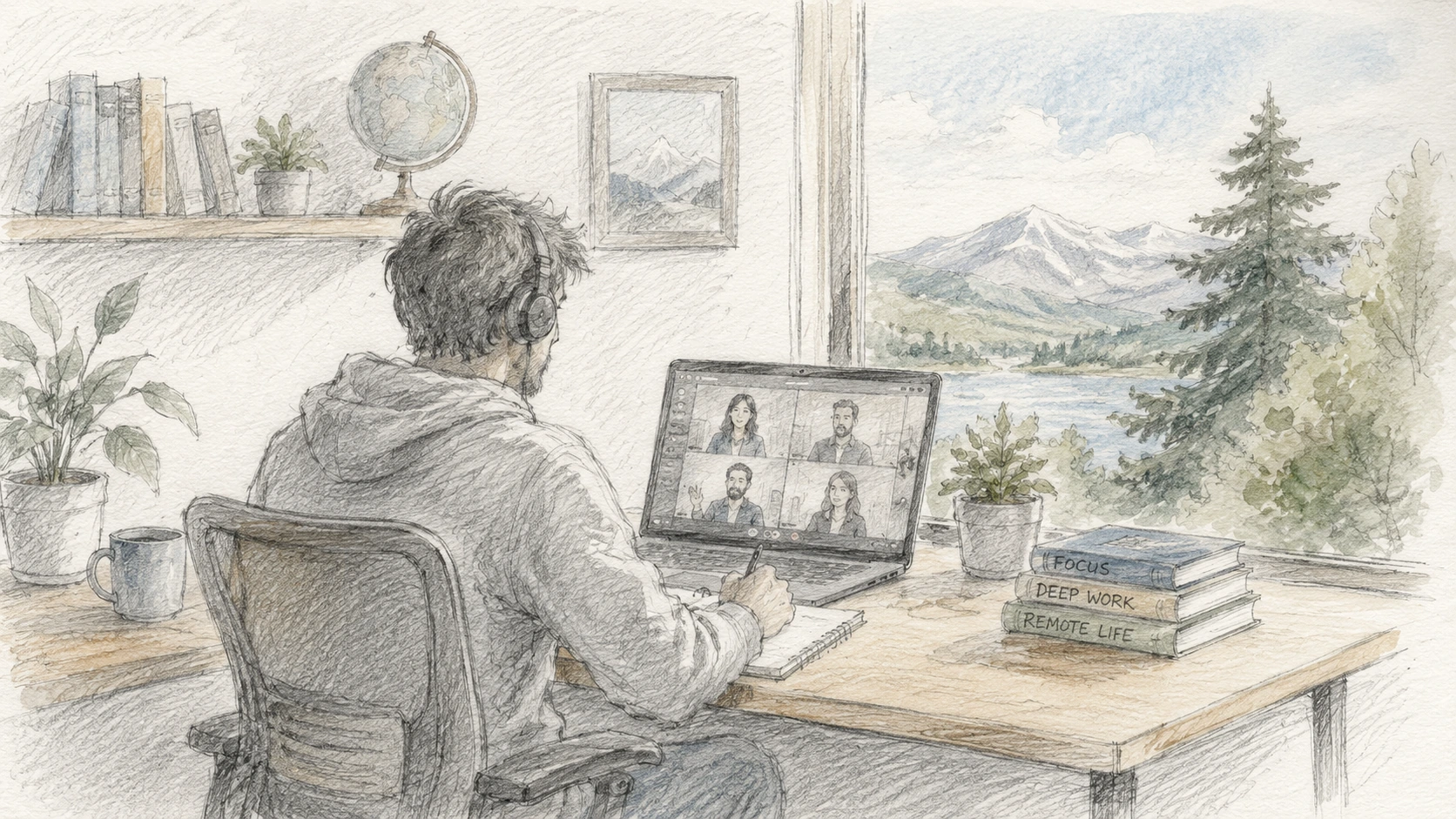
The commute was not the only thing remote work removed
The usual remote-work argument is about productivity, flexibility and the commute. Can people get the same work done from home? Do they like it? Would they trade salary for it? Should companies force people back?
Those questions are real, but they miss a quieter variable: ordinary social contact. The office is not only a production site. It is also the place where many people get small, low-stakes human interaction: walking past someone, eating near people, asking a question, overhearing a conversation, being in a room that is not empty.
In a new Science paper, Natalia Emanuel, Emma Harrington and Amanda Pallais estimate what happened when remote work persisted after the pandemic. Their finding is not that remote work is bad for everyone. It is that jobs which could move remote became substantially more solitary, and mental distress rose more in those jobs, especially for people living alone.
That is a different claim from “remote work causes depression.” It is narrower, and more useful: work location changes the social architecture of a day.
What the study did
The authors did not simply compare people who chose remote work with people who went to the office. That comparison would be badly confounded. People sort into jobs, firms and arrangements for many reasons.
Instead, they compared workers in occupations that can plausibly be done from home with workers in occupations that generally require physical presence. Software engineering and marketing are examples of remotable occupations; nursing, food preparation and machine operation are not. The classification comes from the Dingel-Neiman index of occupational remotability.
The design is a difference-in-differences study. The authors ask whether isolation and mental health changed more after the pandemic for people in remotable jobs than for people in nonremotable jobs. They use five nationally representative US surveys from 2011 to 2024 and exclude 2020 and 2021, the height of the pandemic, from the main before-after comparison.
The sample is large: 588,322 workers across the combined data sources. The outcomes include time-use diaries, Kessler K-6 psychological distress scores, depression, mental health care use and prescription medication use.
The key point is that the treatment is not a person’s preference for remote work. It is exposure to an occupation whose working arrangements changed much more after the pandemic.
What changed
Remote work really did change much more in remotable jobs. By 2024, workers in remotable occupations spent 31.1% of workdays fully remote, compared with 8.9% among workers in nonremotable occupations. The differential postpandemic rise was 17.9 percentage points.
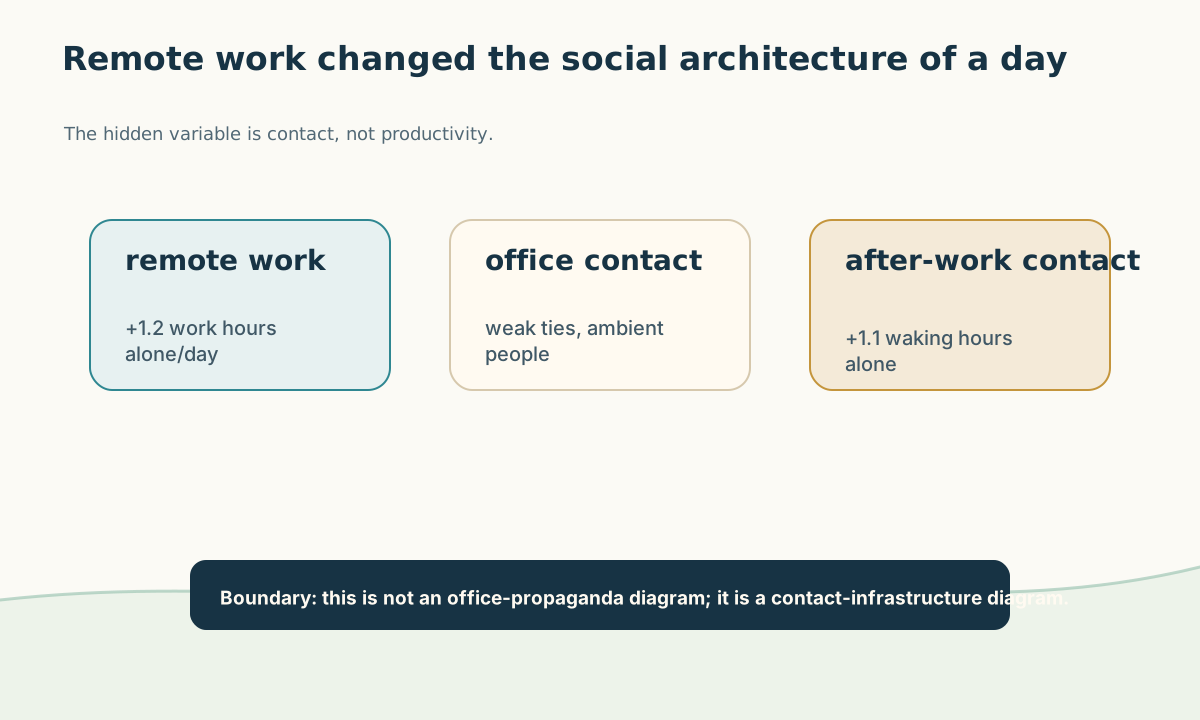
Alongside that shift, workers in remotable jobs spent 1.2 more work hours alone per workday relative to nonremotable workers. The paper describes this as a 58.0% increase. If that change is rescaled by the differential rise in remote work, the implied estimate is 6.6 additional hours working alone on remote days.
The change did not stop at work tasks. Overall waking time alone rose by 1.1 hours per workday for workers in remotable jobs relative to workers in nonremotable jobs. The paper also reports more whole days spent alone and fewer after-work social activities.
This is the part that is easy to understate. A commute can be unpleasant. An office can be distracting. But removing the office also removes an automatic source of weak social ties. For people who get enough contact elsewhere, that may not matter much. For people who live alone, it can matter a lot.
The living-alone amplifier
The strongest effects appear among workers living alone.
The paper reports that the increase in extreme forms of solitude was concentrated in this group. Workers living alone in remotable occupations had much larger increases in spending entire days alone and in spending days without even ambient social contact from public places such as a gym, a store or a restaurant.
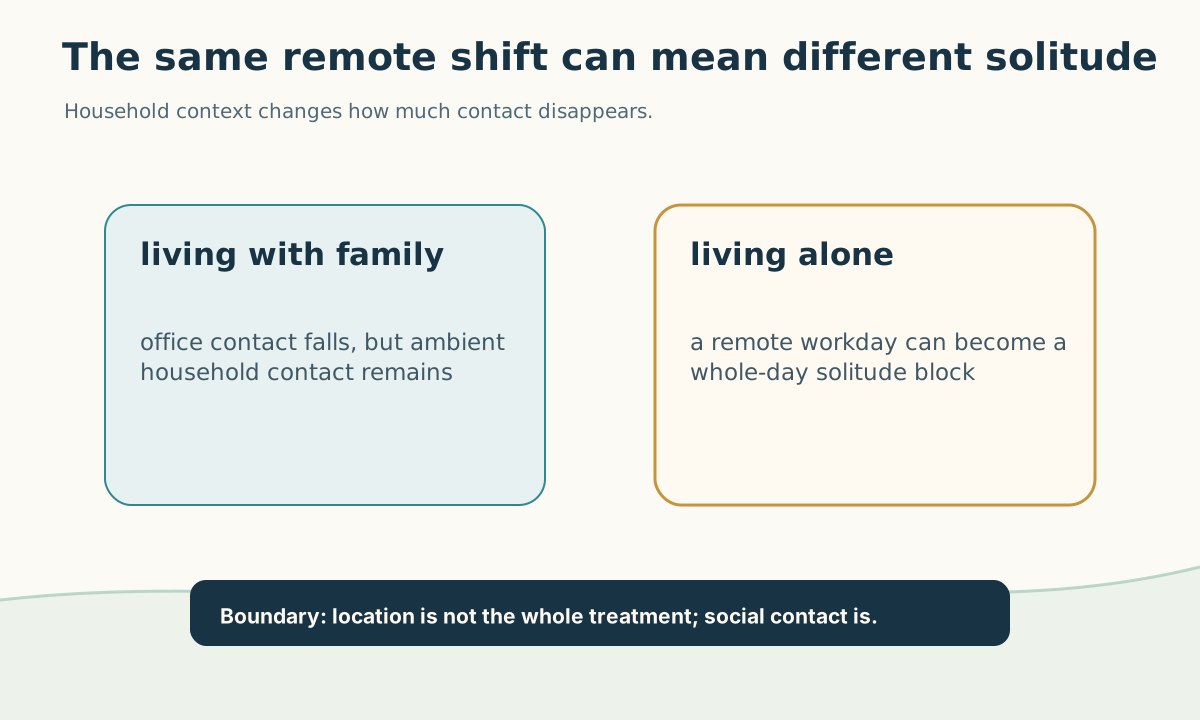
That makes intuitive sense. If you live with a partner, children or other family, remote work may remove colleagues but still leave ordinary household interaction. If you live alone, a remote workday can turn into a whole day in which nobody is physically present.
This is why “remote versus office” is too blunt. The same work arrangement can have different social consequences depending on household structure, neighborhood, commute, personality, health, caregiving obligations and whether the workplace day is coordinated with other people.
Mental health moved too
The mental-health measures move in the same direction as the isolation measures.
For workers in remotable jobs, mental distress rose by about 0.1 standard deviations relative to workers in nonremotable jobs. In the Panel Study of Income Dynamics, the K-6 distress score increased by 0.3 units relative to a prepandemic mean of 3.0. The increase was roughly twice as large for workers living alone.
The pattern is not limited to one survey question. The paper reports similar shifts in depression, mental health care use and prescription medication use. Workers in remotable jobs became 4.6 percentage points more likely to see a mental health professional, from a prepandemic mean of 7.9%. Depression or anxiety prescriptions rose by 1.8 percentage points from a 10.9% mean; all mental-health prescriptions rose by 1.9 percentage points from an 11.6% mean.
The placebo checks are important. The same workers did not show corresponding increases in non-mental-health care or non-mental-health prescriptions. That makes the result harder to explain as a general increase in health care use.
The authors estimate that the rise of remote work accounts for roughly one third of the overall increase in isolation and mental distress over the study period. That is large enough to matter, but it is not the whole story.
What this does not prove
- It does not prove that remote work is bad for everyone.
- It does not prove that a particular person became distressed because they personally chose to work from home.
- It does not show that office work is automatically healthier.
- It does not separate fully remote work from hybrid work.
- It does not identify every subgroup that may benefit from remote work.
- It does not measure loneliness with a full validated loneliness or social-network scale; the isolation measures are built from available survey data.
- It does not eliminate every possible pandemic-era confound. The design assumes that, after excluding 2020 and 2021, remotable and nonremotable occupations would otherwise have followed comparable trends.
- It does not say productivity, disability access, caregiving flexibility or commuting time do not matter.
That last point is essential. Remote work can be valuable. The paper itself notes that many workers prefer remote or hybrid arrangements, and other research finds benefits for satisfaction, retention and work-life balance. A social cost is not the same thing as a total verdict.
How strong is the evidence?
The strength of the paper is that it does not rely on a single convenience survey. It combines time-use data, mental-health scales, health care use and prescription measures across multiple nationally representative US datasets. The authors also use an occupation-level design, so they are not only comparing people who selected into remote work with people who did not.
They run several robustness and placebo checks. The effects are stronger for people living alone, which is exactly where an isolation mechanism would predict larger effects. The effects are not mirrored in non-mental-health care. And the authors test whether exposure to generative AI could explain the mental-health pattern; the results load on remotability rather than AI exposure.
The weak point is not the dataset size. It is interpretation. “Remotable occupation after the pandemic” is not identical to “this individual works from home five days a week.” The estimates include hybrid arrangements, workplace spillovers, occupation-level changes and any unmeasured shocks that hit remotable work differently.
So the clean reading is: the study gives serious evidence that the postpandemic rise of remote work increased isolation and is associated with worse mental-health measures, especially among workers living alone. It should not be read as a simple individual prescription.
The design implication
The practical conclusion is not “everyone back to the office.” It is “do not design remote work as if location were the only variable.”
If hybrid work means everyone comes in on different days, the office can still be socially empty. If remote work means meetings without informal contact, the day can be efficient and isolating at the same time. If a worker lives alone, a fully remote week may remove the only guaranteed ambient social exposure they had.
The authors point to interventions such as coordinating in-office days for hybrid workers and encouraging informal interaction, including online. That is not nostalgia for cubicles. It is a recognition that social contact is infrastructure.
The better question is not “remote or office?” It is: what parts of human contact did the old arrangement provide accidentally, and how can a new arrangement provide them deliberately?
Clean summary
Emanuel, Harrington and Pallais estimate that the postpandemic rise of remote work made workdays more solitary and coincided with worse mental-health measures, especially for people living alone. Workers in remotable occupations spent about 1.2 more work hours alone per day and 1.1 more waking hours alone overall, relative to workers in nonremotable occupations. Mental distress, mental health care use and mental-health prescriptions rose more in those remotable jobs, while non-mental-health care did not. The result is not a blanket case against remote work. It is a design warning: flexibility can save time and still remove social contact, and the people most exposed to that loss may be the people whose homes are already empty.
Sources
Based on: Home alone: Remote work, isolation, and mental health — Natalia Emanuel, Emma Harrington and Amanda Pallais, Science 392, eaec7671 (2026).
Written by
Cinzia Vaglio · figures and links by
Nova Vela · edited by
Michele Renda
· figures and links by
Nova Vela · edited by
Michele Renda
The Clean Paper · 17 July 2026 · Text on this site is licensed under CC BY-SA 4.0. Images are licensed separately. 


Editorial note
This article was written by AI and reviewed by the editorial team. It is a clear, conservative explanation of the linked work, not a substitute for reading it. Responsibility for selection, interpretation, and final wording rests with the editor.