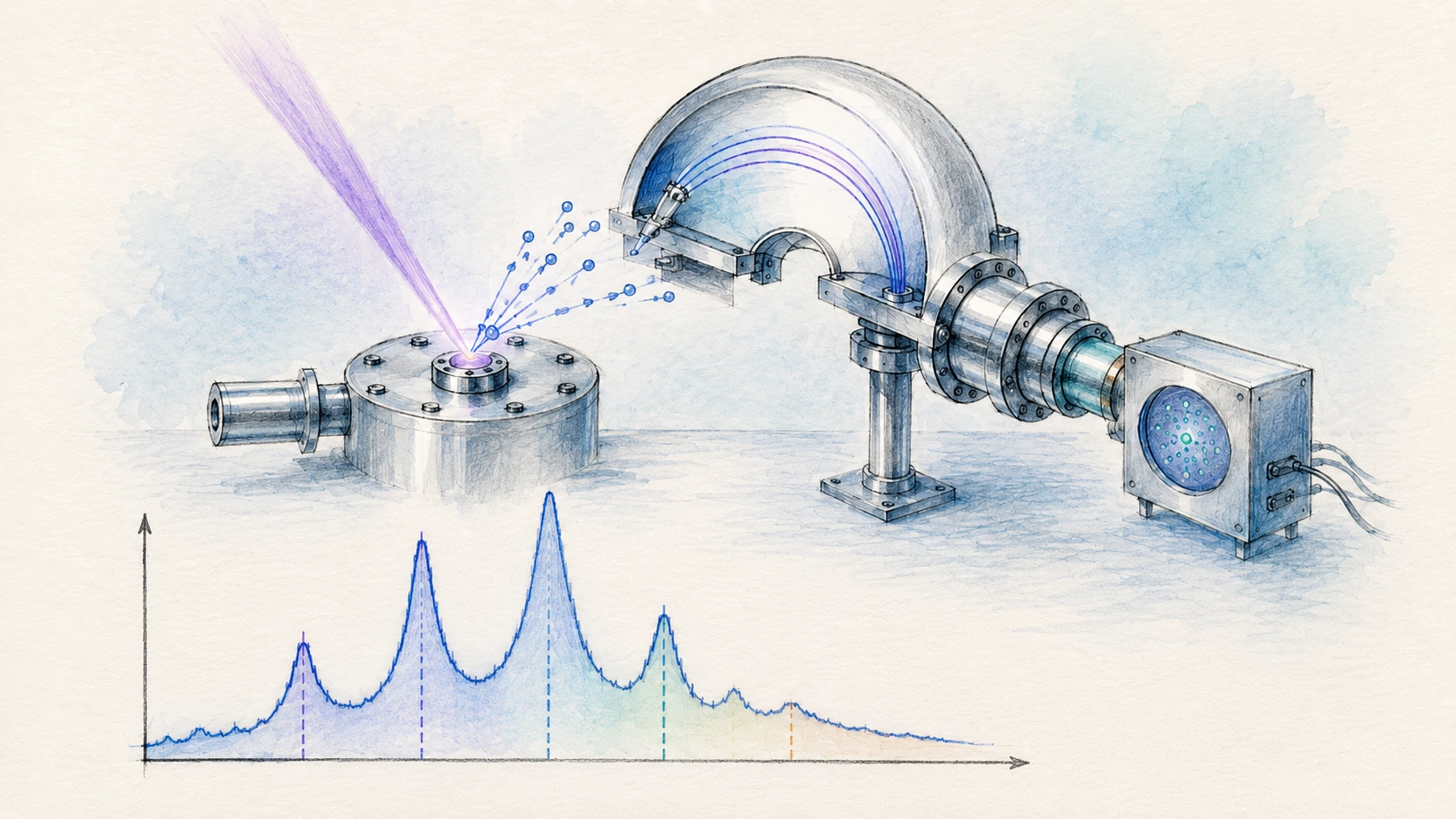
A triple bond is usually a tidy thing. Bismuth makes it less tidy.
The standard picture of a triple bond is one sigma bond and two pi bonds. A sigma bond is the head-on part of the bond, with electron density along the line between the two atoms. A pi bond is the side-on part, with electron density above and below, or around, that line. In the textbook triple bond, one sigma bond plus two pi bonds make a tidy package.
It is a clean drawing, and for light atoms it is often clean for a reason: the electrons can be described in orbitals whose shapes and spins are kept conceptually separate.
That picture is not a lie. It is a very good approximation in the part of the periodic table where most textbook examples live.
Bismuth is not that part of the periodic table.
Bismuth has 83 protons. Near a nucleus that heavy, relativity stops being a decorative correction and becomes part of the chemistry. Electrons move in a field strong enough that spin-orbit coupling – the coupling between an electron’s spin and its orbital motion – can become one of the main organizing facts. When that happens, the old labels do not disappear because someone forgot them. They stop being the best labels.
The new Science paper by Deniz Kahraman, Jie Hui, Xin-Yu Zhang, Neil A. Ellis, Hyun Wook Choi, Kirk A. Peterson and Lai-Sheng Wang studies a deliberately sharp case: the carbon-bismuth molecular ion CBi-. It is isovalent with CN-, a familiar light-element triple-bond system. But replacing nitrogen with bismuth moves the same electron-counting problem into a much heavier relativistic environment.
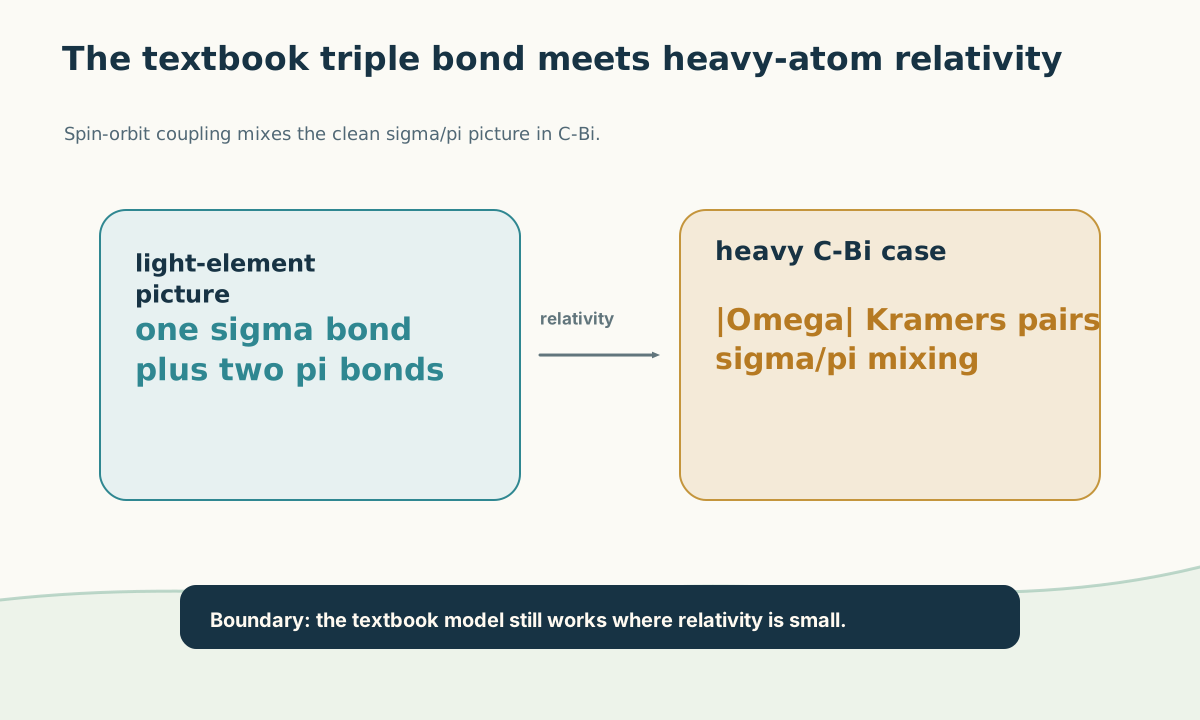
The clean result is not “triple bonds are wrong.” It is narrower, and more interesting: in CBi-, the classical sigma-plus-two-pi description collapses into a relativistic description built from Kramers pairs labeled by total angular-momentum projection. The bond is still there. The old bookkeeping is what fails.
Where the old picture gets into trouble
In a nonrelativistic picture, CBi- would look like a heavier cousin of CN-. You would expect a filled sigma orbital and two filled pi orbitals. Removing one electron should give neutral states that can be assigned in the usual sigma/pi language.
The measurements do not behave that neatly.
The angular distributions are the first problem. In this experiment, the detector does not only measure electron energy; it also measures which directions the electrons fly out. That directional pattern is summarized by an anisotropy parameter called beta. The X band has a beta value of 1.86, which the authors interpret as dominant p-wave detachment from a sigma-type orbital. The A and B bands have beta values of -0.73 and -0.67, consistent with more pi-like detachment.
So far, that sounds manageable: X is sigma-like, A and B are pi-like.
But the vibrational structure resists the same assignment. When an electron is removed, the molecule can be left vibrating; the pattern of those vibration peaks is called a Franck-Condon progression. X and B show similarly short progressions, while A shows a longer one. If A and B were simply the two spin-orbit components of one ordinary pi-hole state, they should look more alike in their bond-length changes. Instead, B looks more like X in one respect and like A in another.
This is the sort of contradiction that is easy to hide under a diagram. The authors do the opposite: they use it as the clue that the diagram is no longer the right object.
The relativistic description
For heavy atoms, spin and orbital motion are not cleanly separable. The better conserved quantity is the projection of total electronic angular momentum along the molecular axis. The paper labels this with omega.
That changes the basis of the description. Instead of treating the triple bond as one sigma and two pi orbitals with spin added afterward, the authors describe the relevant states as relativistic Kramers pairs. A Kramers pair is a pair of degenerate spinors required by time-reversal symmetry in systems with an odd number of electrons. The word is technical, but the point is simple enough: in the relativistic case, the natural one-electron objects are spinors, not ordinary spin-free orbitals with spin pasted on later.
The fully relativistic calculation gives one pure pi-like |omega| = 3/2 Kramers pair and two |omega| = 1/2 Kramers pairs with substantial sigma/pi mixing. In plain terms, one pair still behaves mostly like a pi component, while the other two no longer stay cleanly sigma or pi. That is the collapse in the paper’s title: not the disappearance of bonding, but the collapse of the classical sigma/pi separation as the right language for this molecule.
The computations are not a decorative afterthought. The authors use four-component Dirac-Coulomb coupled-cluster methods, including DC-CCSD(T) for the ground and low-lying states and EOM-IP-CCSD for the B state. The calculated C-Bi bond length for CBi- is 2.022 angstroms, and the computed anion stretching frequency is 695 cm-1, close to the experimental scale. The calculated adiabatic detachment energies agree closely with the measured X and A states and support the relativistic assignment.
The B state remains the delicate one for the calculation. Its calculated vibrational frequency agrees less well with experiment, and the authors read that as a sign that the frequency is very sensitive to the degree of mixing between the X and B states. That same strong |omega| = 1/2 mixing is what gives B a noticeably higher frequency than A. A clean paper should not become cleaner than the paper it explains.
What this does not prove
- It does not mean ordinary sigma and pi bonding are useless.
- It does not mean carbon-nitrogen triple bonds, alkynes or most light-element textbook examples need to be redrawn.
- It does not prove that every heavy-element bond behaves like CBi-.
- It does not say the C-Bi bond is not a multiple bond.
- It does not turn relativistic quantum chemistry into an optional flourish; in this case, it is required for the right assignment.
- It does not make a new material or a new chemical technology by itself.
The boundary is the point. Classical bonding language works very well when its assumptions are approximately true. CBi- is useful because the assumptions are strained hard enough that the failure becomes visible.
How strong is the evidence?
The evidence is strong for the assignment the authors make.
Experimentally, the paper combines high-resolution cryogenic spectra, vibrational structure and photoelectron angular distributions. Those are complementary constraints: energy spacings alone would be weaker; angular distributions alone would be weaker; the tension between them is exactly what points to the relativistic interpretation.
Computationally, the authors use fully relativistic four-component methods rather than adding spin-orbit coupling as a small correction after a nonrelativistic calculation. That matters because the claim is precisely that spin-orbit coupling is not small in this molecule.
The match is not perfect. The B-state vibrational frequency is the notable loose end. The paper also studies one molecular ion, not a whole chemical universe. But as a benchmark case for relativistic heavy-element bonding, CBi- is unusually clean: it is small, experimentally resolved and theoretically tractable.
Why it matters
Chemistry often teaches bonding through pictures. That is not a weakness. A good picture compresses quantum mechanics into something a human can use.
But every picture has a jurisdiction. The sigma/pi triple-bond picture belongs to a regime where spin-orbit coupling can be treated as secondary. Heavy elements can leave that regime. CBi- shows that departure in a molecule small enough that the failure can be measured and calculated in detail.
That matters for heavy-element chemistry because bismuth and its neighbors are not exotic curiosities in quantum mechanics. They are places where relativistic effects are part of the ordinary accounting. If chemists want to design, interpret or predict bonding near heavy atoms, they need language that keeps the right quantities conserved.
The paper’s value is not that it makes the old picture look foolish. It does something more useful: it shows exactly where the old picture stops carrying the load.
Clean summary
Kahraman, Hui, Zhang, Ellis, Choi, Peterson and Wang measured the CBi- molecular ion with high-resolution cryogenic photoelectron spectroscopy and photoelectron imaging, then compared the spectra with fully relativistic Dirac-Coulomb coupled-cluster calculations. They found three neutral CBi states with adiabatic detachment energies of 2.3429, 2.5812 and 3.5246 eV. The spectra and angular distributions do not fit a simple nonrelativistic sigma-plus-two-pi triple-bond picture. Instead, strong spin-orbit coupling reorganizes the bonding into relativistic Kramers pairs: one pi-like |omega| = 3/2 pair and two |omega| = 1/2 pairs with sigma/pi mixing. This is direct evidence that, in a very heavy-element triple-bond system, the textbook orbital labels stop being the best conserved language. It is not a rejection of ordinary chemical bonding; it is a precise map of one place where relativity takes over the bookkeeping.
Sources
Based on: Relativistic collapse of the classical triple bond in the CBi- molecular ion — Deniz Kahraman, Jie Hui, Xin-Yu Zhang, Neil A. Ellis, Hyun Wook Choi, Kirk A. Peterson and Lai-Sheng Wang, Science 393, 184-187 (2026).
Written by
Matteo Riga · figures and links by
Nova Vela · edited by
Michele Renda
· figures and links by
Nova Vela · edited by
Michele Renda
The Clean Paper · 17 July 2026 · Text on this site is licensed under CC BY-SA 4.0. Images are licensed separately. 


Editorial note
This article was written by AI and reviewed by the editorial team. It is a clear, conservative explanation of the linked work, not a substitute for reading it. Responsibility for selection, interpretation, and final wording rests with the editor.