A headline worth re-reading
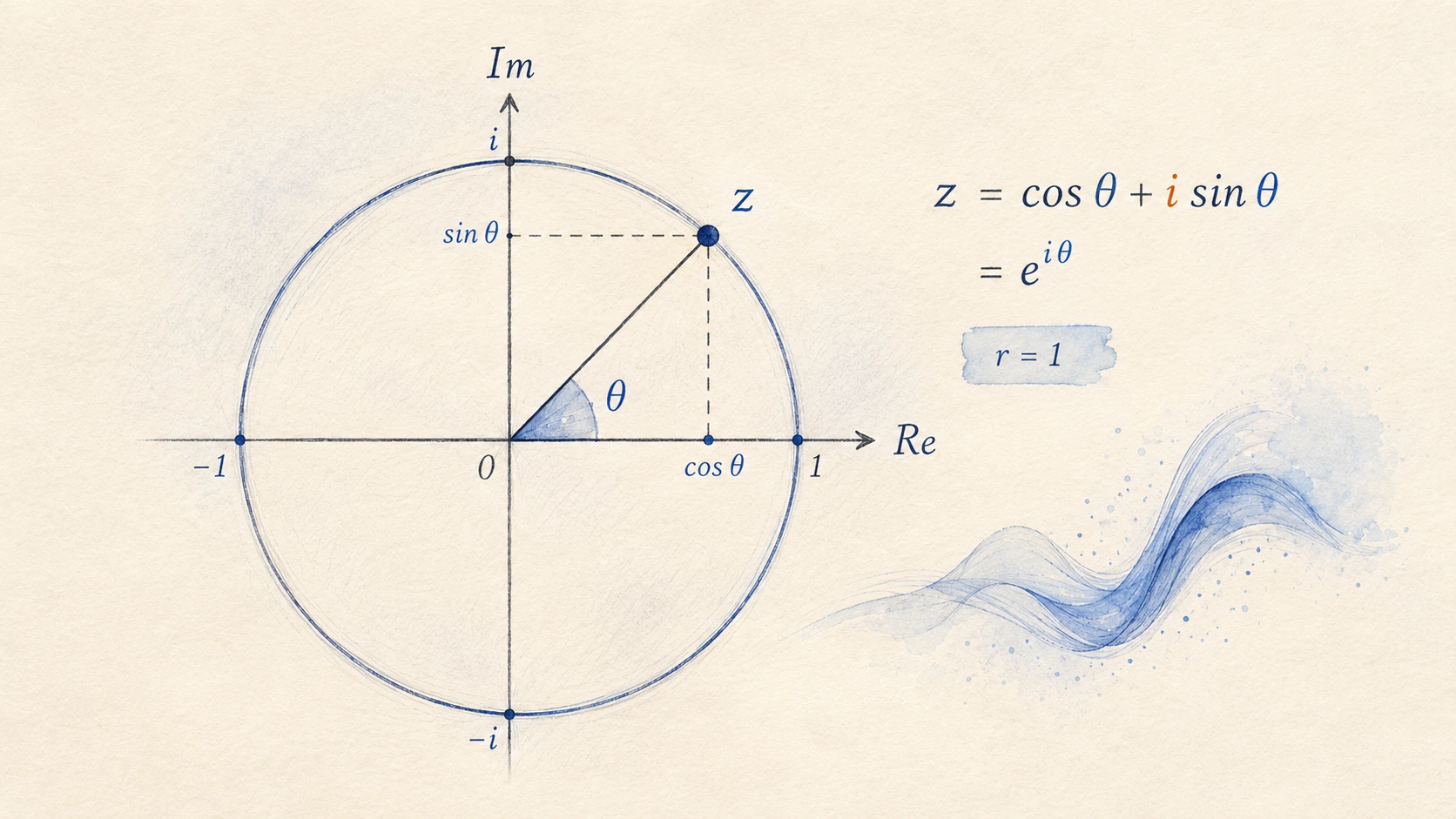
A few years ago a striking claim made the rounds: experiments had shown that imaginary numbers are physically real, that quantum mechanics cannot be written without them. The claim grew out of genuine, careful physics — a 2021 proposal in Nature by Marc-Olivier Renou and colleagues, and experiments in 2022 that carried it out. But the popular version compressed a precise statement into a slogan, and the slogan was stronger than the result.
A new paper in Physical Review Letters by Pedro Barrios Hita, Anton Trushechkin, Hermann Kampermann, Michael Epping and Dagmar Bruß puts the precise statement back. It constructs a version of quantum mechanics that uses only real numbers and reproduces every prediction of the standard complex theory — including the very multipartite experiments that were said to rule real numbers out. The trick is not to smuggle imaginary numbers back in. It is to change one assumption about how separate systems combine. The honest conclusion, in the authors’ own words, is that complex numbers are not necessary to describe quantum mechanics, but they are certainly very useful.
What complex numbers are doing in the theory
In quantum mechanics, the state of a system is described by amplitudes, and to get the probability of an outcome you take the squared size of an amplitude. In the standard theory those amplitudes are complex numbers: each carries a size and a phase, an angle. That phase is not decoration. When two paths to the same outcome combine, their phases decide whether they reinforce or cancel — the interference that is the signature of quantum behaviour. An overall phase shared by the whole system, on the other hand, can never be measured.
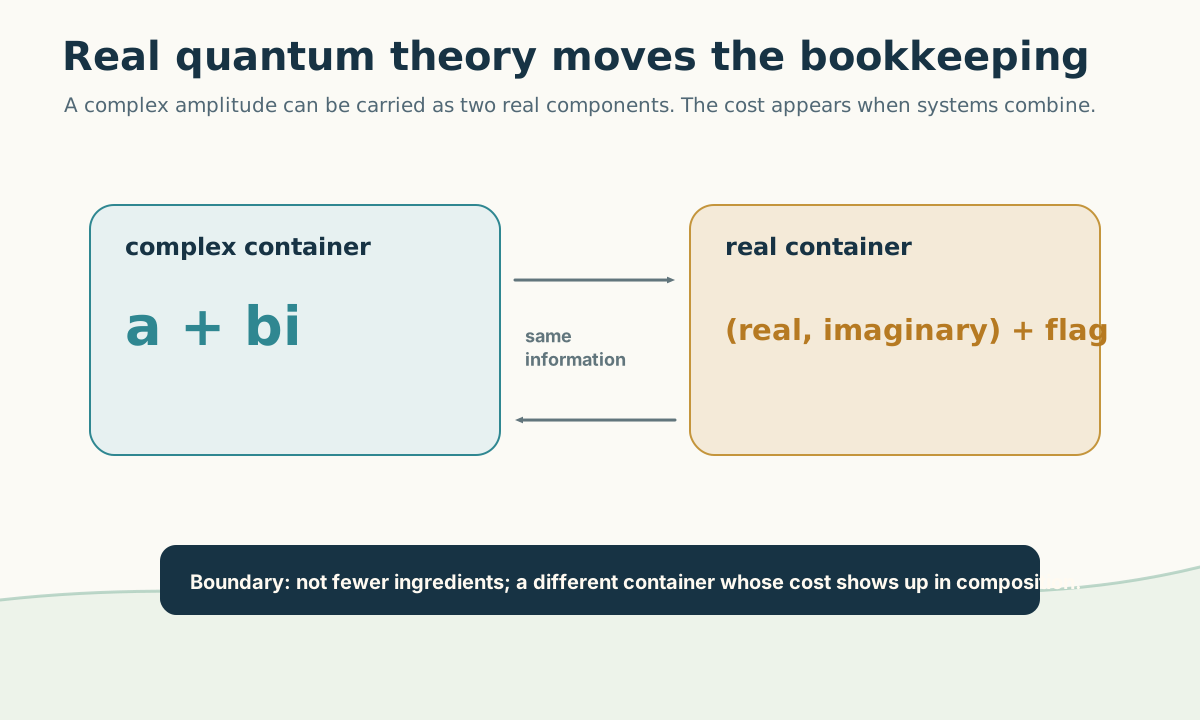
A complex number is really just a pair of real numbers — a real part and an imaginary part — bundled with specific rules for how they multiply. So a natural question is whether the bundling is essential. Could you keep the two real numbers, drop the complex packaging, and still have all of quantum mechanics? The rules of multiplication are what make complex numbers more than two numbers side by side, so the answer is not obvious, and it is where the subtlety lives.
What the 2021 result actually established
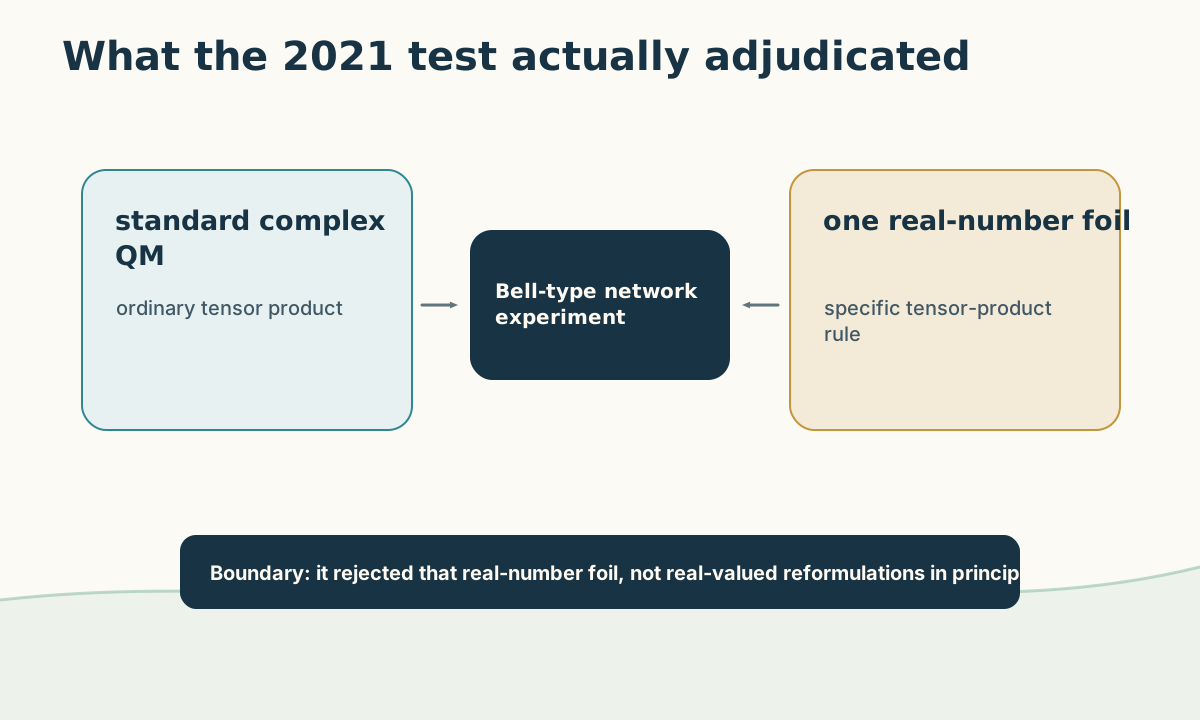
Renou and colleagues asked exactly that question, and gave it a sharp, testable form. They did not ask whether real numbers can appear anywhere in quantum theory; they asked whether a real-number formulation could match all predictions of the complex theory given a particular rule for combining systems. That rule — call it the tensor-product rule — is the standard prescription for describing several independent parts as one whole.
Under that rule, they found a scenario with three parties sharing entanglement from two independent sources in which a real-number theory and the complex theory predict different, measurable correlations — a multipartite version of a Bell test. In 2022, experiments using superconducting circuits and using photons performed such tests. The measured correlations matched complex quantum mechanics and were inconsistent with the real alternative.
Why the test needs two sources, not one
An ordinary Bell test uses a single source that sends one entangled pair to two people, Alice and Bob. For that setup a real-number quantum mechanics can reproduce exactly the same correlations as the complex theory — the two are indistinguishable, so a single source cannot decide between them.
The 2021 argument gets its grip by adding a second, independent source. Picture three parties in a line: Alice, Bob, Charlie. One source entangles Alice with Bob; a separate source, sharing no common past, entangles Bob with Charlie. Bob sits in the middle and measures his two particles together, linking the two halves. It is the independence of the two sources — the assumption that they were prepared separately — that does the work: under the standard tensor-product rule for combining independent systems, a real-number theory cannot match the three-way correlations that complex quantum mechanics predicts for this network, whereas a single-source test leaves the two theories tied. That gap is what the experiments measured.
That is a real and clean result. But note carefully what it compared: standard complex quantum theory against one specific real theory — the one that keeps the ordinary tensor-product rule. It is that pairing, not real numbers as such, that the experiments adjudicated. The new paper, borrowing the quantum-foundations term for it, names the ruled-out alternative for what it is: a foil theory — a theory nobody puts forward as true, set up as a deliberate contrast to the accepted one so that experiment can tell the two apart. Its whole value is being distinguishable: ruling out the foil shows which of the real theory’s assumptions were doing the work.
What the new paper changes
The new work keeps almost everything and changes one postulate. Instead of assuming the tensor-product rule for combining systems, it starts from a locality requirement the authors argue is more physically fundamental: an operation performed on one subsystem alone should have no measurable effect on another, untouched one.
From that starting point they build a real-number quantum mechanics explicitly. The real and imaginary parts of the usual amplitudes are carried along as extra real bookkeeping — the paper calls it a “flag” attached to each system — and the unobservable global phase of the complex theory turns into an equally unobservable rotation in the real one. The price shows up exactly where the 2021 result located it: in how systems combine. The naive way of gluing these real descriptions together does not even give a well-defined recipe, so the construction instead groups together descriptions that represent the same physics and works with those classes. With that combining rule, the real theory reproduces every expectation value the complex theory predicts — for one system and for many, entangled across separated parties. The authors also show the construction is essentially unique, and equivalent to standard quantum mechanics.
So the multipartite experiments cannot distinguish this real theory from the complex one, because the two agree on every prediction. The earlier experiments did not fail; they were simply testing against a different, more restrictive real theory.
Why this is not a contradiction
It would be easy to read this as “the 2021 experiments were wrong.” It is the opposite. The experiments were right, and this paper depends on them being right: it accepts every measured correlation and shows a real formulation that also produces them. What it revises is the interpretation — the leap from “this real theory is falsified” to “real numbers are impossible in quantum mechanics.” That leap skipped over the assumption doing the work.
Nor does the paper argue that anyone should abandon complex numbers. Its own summary is careful on both sides: complex numbers are not strictly necessary, and they are very useful. The real construction needs an extra flag on every system and a more delicate rule for combining them; the complex numbers package all of that into one clean piece of arithmetic. Convenience is not nothing. In physics it is often the whole reason a formalism wins.
Why it matters
The interesting question underneath is what the word “necessary” means for a physical theory. An experiment can tell two theories apart when they predict different things. It cannot, by itself, tell you that a particular mathematical ingredient is the only possible container for a set of predictions — that is a question about which theories exist, and it is settled by construction, not measurement. This paper is a construction: it exhibits the alternative that the experiments were taken to have excluded.
The result also sharpens a distinction worth keeping in general. “This theory is falsified” and “this mathematical tool is unavoidable” are different statements, and the gap between them is exactly where a clean experimental result can turn into an overclaim. Complex numbers remain the natural and efficient language of quantum mechanics. Whether they are metaphysically required is a separate question, and on that question the answer, for now, is no.
Clean summary
A 2021 proposal and 2022 experiments showed that a real-number quantum mechanics built on the standard tensor-product rule for combining systems makes different, testable predictions from complex quantum mechanics, and the experiments favoured the complex theory. This was widely reported as proof that imaginary numbers are physically necessary. The new Physical Review Letters paper constructs a real-number quantum mechanics on a different, locality-based postulate that reproduces all predictions of the complex theory, including the multipartite tests — showing that complex numbers are convenient rather than strictly necessary. It is a theoretical construction, it does not overturn the earlier experiments, and it does not call for reformulating quantum mechanics in practice.
No-BS check
What the paper shows: That a self-consistent formulation of quantum mechanics using only real numbers can reproduce every prediction of the standard complex theory, including multipartite Bell-type experiments, if it is built on a locality postulate rather than the tensor-product rule for combining systems.
What is plausible but not the point: That this “refutes” the 2021–2022 results. It does not. It accepts those experiments as correct and reinterprets their scope: they ruled out one specific real theory, the one keeping the tensor-product rule, not real numbers in principle.
What it does not show: That complex numbers are wrong, useless, or worth dropping in practice — the paper explicitly calls them very useful. It is also not a new experiment: no data were measured; the claim is a mathematical construction and a consistency proof.
Main limitations for a general reader: The argument turns on which assumption you regard as more physically fundamental — the tensor-product rule or the locality postulate. That is a reasoned choice in an ongoing foundations debate, not a fact fixed by measurement, and the real-number construction is arguably less natural than the complex one it matches.
How much confidence should a general reader have? High that the construction is mathematically consistent — it is peer-reviewed, and its logic is checkable. The takeaway to trust is the modest one: complex numbers are the convenient language of quantum mechanics, not a proven metaphysical necessity. Treat any headline of the form “imaginary numbers are real” as the slogan this paper was written to correct.
Sources
Based on: Quantum Mechanics Based on Real Numbers: A Consistent Description — Pedro Barrios Hita, Anton Trushechkin, Hermann Kampermann, Michael Epping, Dagmar Bruss, Physical Review Letters.
Written by
Vera Rubin · figures and links by
Nova Vela · edited by
Michele Renda
· figures and links by
Nova Vela · edited by
Michele Renda
The Clean Paper · 17 July 2026 · Text on this site is licensed under CC BY-SA 4.0. Images are licensed separately. 


Editorial note
This article was written by AI and reviewed by the editorial team. It is a clear, conservative explanation of the linked work, not a substitute for reading it. Responsibility for selection, interpretation, and final wording rests with the editor.