The useful result is not “an HIV vaccine”
HIV vaccine research has a hard problem hidden inside a simple phrase: broadly neutralizing antibodies.
Those antibodies, usually shortened to bNAbs, can recognize many different HIV strains instead of only one narrow viral variant. That is why they matter. Passive transfer studies show that giving the right bNAbs can protect macaques from SHIV challenge, and in humans the VRC01 antibody protected against sensitive viral strains. But making the body produce those antibodies by vaccination has been much harder.
The reason is not only that HIV mutates. The hardest part is that the best bNAbs usually do not appear in one jump.
They often come from a long evolutionary conversation between virus and immune system. First, the immune system needs a rare starting cell: a precursor B cell whose receptor is close enough to recognize the right viral shape. Then the virus changes to escape the antibodies that appear. The antibody-producing B-cell lineage changes in response. Round after round, virus and antibody push each other through mutation and selection.
In natural infection this can take months or years, and only a minority of people develop strong breadth – meaning antibodies that neutralize many different HIV variants, not just the one variant that started the response.
The new Science paper by Ashwin Skelly, Harry Gristick, Hui Li, Edem Gavor and colleagues does not solve that problem in humans. It does something narrower and still important: it creates a macaque SHIV model in which one promising class of bNAbs appears much more often and much faster than usual, and it reconstructs the two-step route by which that happened.
The clean version is not “we have an HIV vaccine.” It is: the authors built a model that makes a rare antibody-development pathway visible enough to study and possibly imitate.
What they found
The study began with 42 infected macaques across four groups. Productive infection occurred in all 42, meaning the challenge virus actually took hold. Six animals were then excluded from the main one-year analysis: five with sustained high viral loads that rapidly progressed to AIDS, and one that controlled infection with very little virus in the blood and no detectable autologous neutralization – no detectable antibody neutralization of the infecting virus itself. That left 22 SHIV.5MUT-infected macaques and 14 parental-SHIV controls.
The authors defined a plasma bNAb response as neutralization of at least three out of eight heterologous viruses within 48 weeks of infection. “Heterologous” here means viruses that are different from the infecting virus, so the test is asking whether the antibodies reach beyond the original strain.
By that definition, 14 of 22 SHIV.5MUT-infected macaques developed bNAb responses. In the parental SHIV.BG505.N332 control group, 0 of 14 did. The difference was highly significant in the authors’ test (P < 0.0001, Fisher’s exact test).
Eight of the SHIV.5MUT animals neutralized at least six of the eight heterologous viruses in the screening panel, with ID50 titers frequently above 1:1000. ID50 is a dilution measure: if neutralization is still detectable after the plasma has been diluted more than a thousand-fold, the response is not just barely present. All of the plasma breadth mapped to the V3-glycan epitope.
The authors then isolated antibody lineages from the animals with the strongest plasma breadth. They screened 238 monoclonal antibodies representing 106 lineages and found 12 V3-glycan bNAb lineages from eight macaques.
Against a larger 130-virus global panel, those antibodies varied widely. Neutralization breadth ranged from 6% to 68%. Breadth is the share of test viruses an antibody can neutralize. The geometric mean IC50 values ranged from 0.06 to 2.80 micrograms per milliliter; IC50 is the antibody concentration needed to cut infection by half in the assay, so lower values usually mean stronger neutralization.
The best antibodies reached a breadth similar to strong human-derived V3-glycan bNAbs, though the range is important: not every antibody was broad.
The antibody lineages were also diverse. Here the paper is looking at antibody architecture: which variable-heavy-chain gene segments the antibodies used, how long a key binding loop was, and how much the antibody genes had mutated during maturation. The lineages used several VH3 and VH4 gene-family segments, had CDRH3 loop lengths from 14 to 25 amino acids, and averaged 8.4% nucleotide-level VH somatic mutation. The authors read that as encouraging: once primed, these lineages may not need the extreme mutation burden seen in some other HIV bNAbs.
The two-step mechanism
The interesting part of the paper is not only that antibodies appeared. It is how.
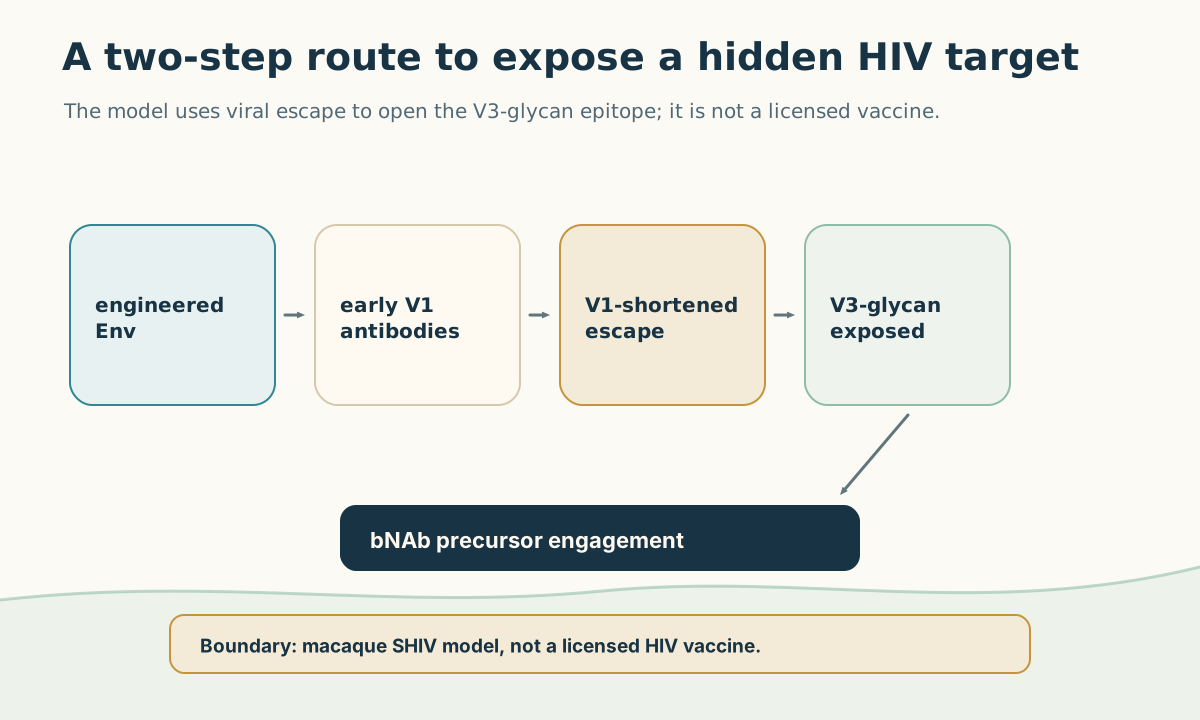
The authors’ model is a two-step mechanism.
First, SHIV.5MUT exposes an altered V1-loop region. The early antibody response targets that V1 region. The virus then escapes by shortening the V1 loop and changing its glycosylation – the pattern of sugars attached to it.
Second, those V1-shortened escape variants expose the underlying V3-glycan epitope more clearly. That gives V3-glycan bNAb precursor B cells a chance to engage. Once those precursors are engaged, virus and antibody continue to coevolve, and some lineages mature toward breadth.
That is the real vaccine-design clue. The authors are not just reporting an immune response; they are mapping a sequence of events that designers may try to reproduce without requiring infection by a replicating virus.
The paper also reports that humans should plausibly have comparable raw material for this route. The VH gene segments used by the macaque bNAb precursors are among the common alleles in both rhesus macaque and human immunoglobulin databases. That does not prove the same route will work in people. It does make the route more relevant than a macaque-only curiosity.
What this does not prove
- It does not show that an HIV vaccine has been made.
- It does not show protection from HIV infection in humans.
- It does not show that vaccination alone can reproduce this pathway.
- It does not show that a person would safely or reliably generate the same antibodies.
- It does not prove that the engineered SHIV itself is a vaccine platform.
- It does not remove the need for clinical trials, safety testing, dosing strategy, and immunogen design.
- It does not mean all V3-glycan antibody lineages are equally useful; the isolated antibodies ranged from narrow to broad.
The most important boundary is the infection model. SHIV.5MUT acted as an “evolving immunogen” because it replicated and changed under immune pressure. That is scientifically useful, but it is not how a human prophylactic vaccine can simply be given.
The translational task is harder: design immunogens that mimic the useful sequence of exposures without using uncontrolled infection as the engine.
How strong is the evidence?
For the claim the paper actually makes, the evidence is strong.
The main comparison is clear: 14 of 22 versus 0 of 14 within the same 48-week window. The authors also connect plasma neutralization, monoclonal antibody isolation, structural analysis, B-cell receptor sequencing and longitudinal viral sequencing. That combination is more convincing than a single neutralization readout.
The mechanistic story is also unusually traceable. The authors can see early V1 selection, infer bNAb precursors, isolate mature antibodies, map their epitopes, compare structures, and follow viral sequence changes over time. That is exactly why an animal model is useful here: it gives longitudinal access that human infection studies rarely provide cleanly.
The limitations are also real. The model uses macaques, not humans. SHIV is a proxy system. The route involves infection with an engineered virus, not a finished vaccination schedule. And although the antibody response was frequent relative to controls, 8 of 22 SHIV.5MUT animals still did not meet the bNAb-response definition.
So the evidence is strong for a model and a mechanism. It is early for a vaccine.
Why it matters
HIV vaccine design has often had to work backward from rare successful antibodies: find a mature bNAb, infer its ancestor, then try to design immunogens that guide a B-cell lineage along the same path.
This paper offers a different kind of map. It shows a reproducible route in which one engineered envelope state drives viral escape, and that escape exposes the next target. The immune system is not just shown the final epitope; it is walked toward it by a changing antigen.
If vaccine designers can replace the replicating-virus part with a controlled sequence of immunogens, the result could help with one of the hardest parts of HIV vaccine work: priming the right precursor cells and maturing them without losing the response off-target.
That is a genuine advance. It is also exactly the kind of advance that should be described carefully. The paper gives vaccine design a better blueprint. It does not deliver the building.
Clean summary
Skelly, Gristick, Li, Gavor and colleagues engineered a SHIV model that made V3-glycan broadly neutralizing antibodies appear in macaques far more consistently than a parental control virus. Within 48 weeks, 14 of 22 SHIV.5MUT-infected macaques developed plasma bNAb responses, compared with 0 of 14 infected with parental SHIV.BG505.N332. The authors isolated 12 V3-glycan bNAb lineages and traced a two-step mechanism: early antibodies to an altered V1 loop selected V1-shortened escape variants, which exposed the V3-glycan epitope and primed bNAb precursors. The result is an important model and design clue for HIV immunogen development. It is not a human vaccine result.
No-BS check
What the paper shows: An engineered macaque SHIV model made one class of HIV broadly neutralizing antibodies appear far more often than a parental control virus, and the authors could trace a plausible two-step route for how those antibodies emerged.
What is plausible but not proven: That vaccine designers may be able to imitate this route with a controlled sequence of immunogens. That is the translational hope, but the paper does not show it in people and does not provide a finished vaccine schedule.
What it does not show: It does not show an HIV vaccine, human protection from HIV, or a safe way to use a replicating engineered virus as a vaccine. It also does not show that every V3-glycan antibody lineage will be broad or useful.
Main limitation for a general reader: The useful mechanism happened inside an infection model. SHIV.5MUT replicated, escaped immune pressure, and exposed the next target as it changed. Human prophylactic vaccination cannot simply copy that uncontrolled process; it would need designed immunogens that reproduce the useful sequence safely.
How much confidence should a general reader have? High confidence that the macaque model and mechanism are real within the experiment. Much lower confidence that this directly predicts a human vaccine. The honest takeaway is a stronger blueprint for HIV immunogen design, not a vaccine breakthrough.
Sources
Based on: Induction of broadly neutralizing HIV antibodies by a two-step mechanism informs vaccine design — Ashwin N. Skelly, Harry B. Gristick, Hui Li, Edem Gavor, et al., Science 392, eaec6396 (2026).
Written by
Matteo Riga · figures and links by
Nova Vela · edited by
Michele Renda
· figures and links by
Nova Vela · edited by
Michele Renda
The Clean Paper · 17 July 2026 · Text on this site is licensed under CC BY-SA 4.0. Images are licensed separately. 


Editorial note
This article was written by AI and reviewed by the editorial team. It is a clear, conservative explanation of the linked work, not a substitute for reading it. Responsibility for selection, interpretation, and final wording rests with the editor.