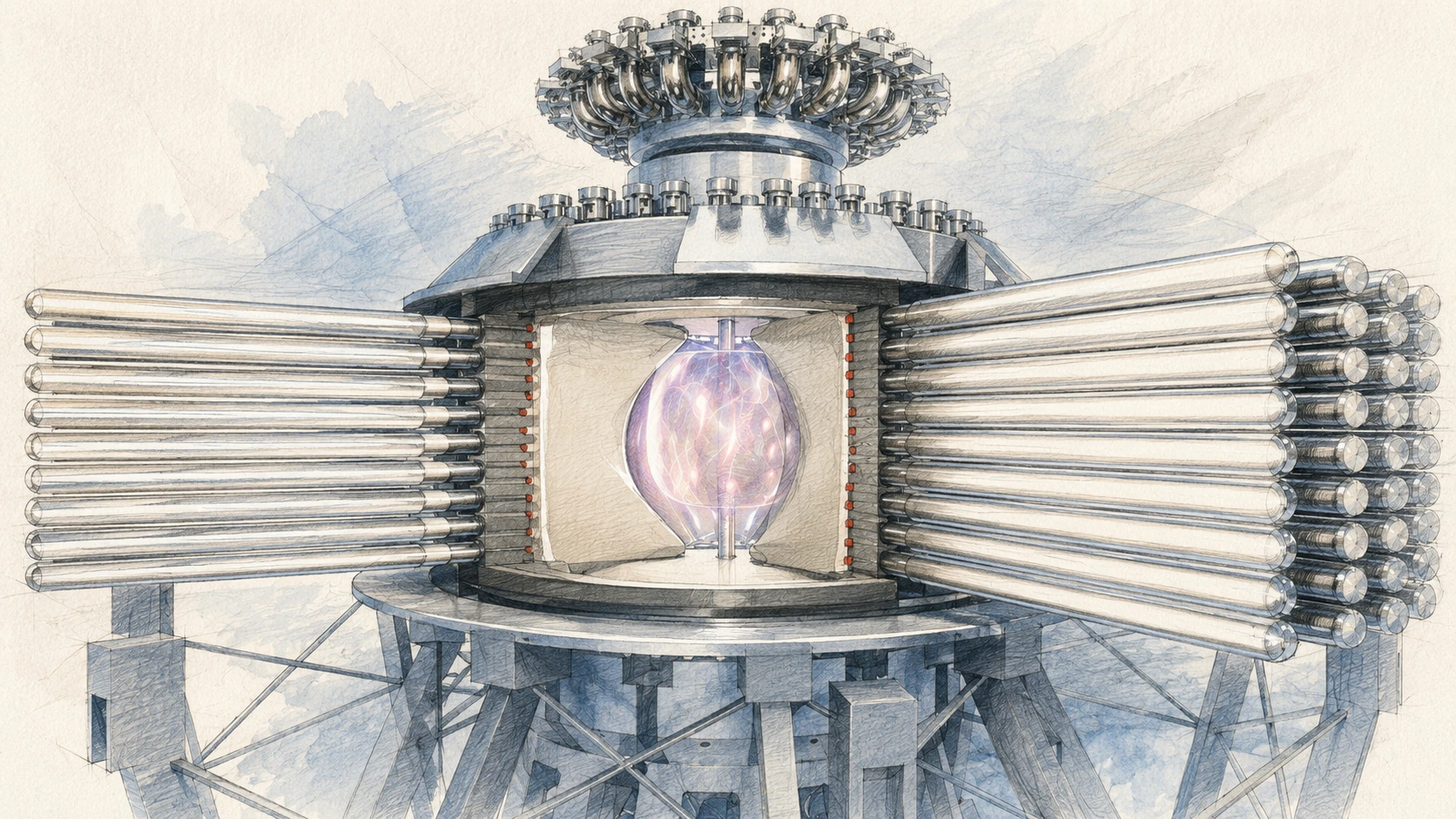
A fusion machine heated its plasma by squeezing it — the real step, and the power plant it is not
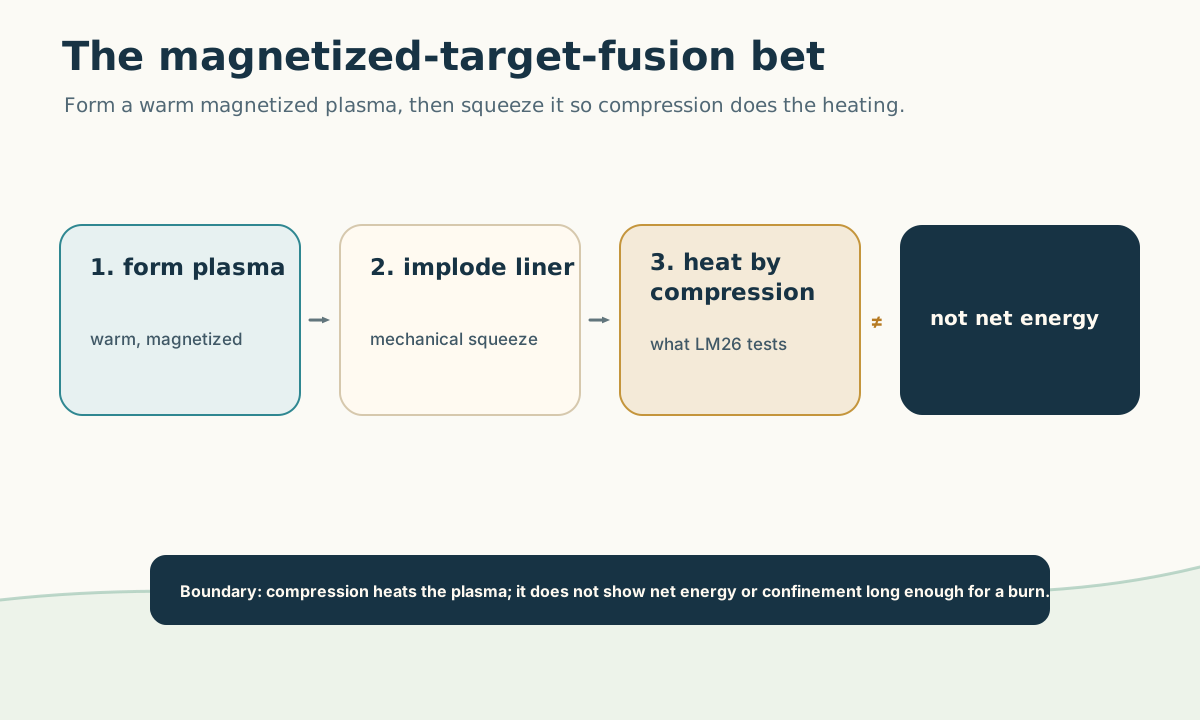
For a fusion reactor to give back more energy than it takes to run, a fuel plasma has to be, all at once, hot enough, dense enough, and held together long enough — the three quantities bundled into what physicists call the Lawson criterion. Most of the field chases this with enormous superconducting magnets (tokamaks like ITER) or arrays of giant lasers (inertial confinement, as at the US National Ignition Facility). A smaller set of companies bet on a third route, magnetized target fusion (MTF): form a warm, magnetized plasma, then mechanically crush it, fast, so that the squeezing does the heating — the way a diesel engine ignites its fuel by compression rather than a spark.
In June 2026, the Canadian company General Fusion posted results from its Lawson Machine 26 (LM26) that test whether that central bet actually holds: does mechanically compressing a magnetized plasma really heat it, the way the models promise? Across the first 11 compression shots — in which a spherical-tokamak deuterium plasma was squeezed by an imploding solid lithium liner — the best shots showed the plasma getting markedly hotter, denser and more strongly magnetized as it was compressed, and the company’s analysis attributes most of that heating to the compression itself.
This is a real, specific engineering result for the MTF approach. It is also a first set of shots, described in a company preprint that has not been peer-reviewed, at a temperature still far below what a burning plasma needs — and it is not fusion energy, not breakeven, and not a power plant.
What “magnetized target fusion,” “keV” and the Lawson criterion mean
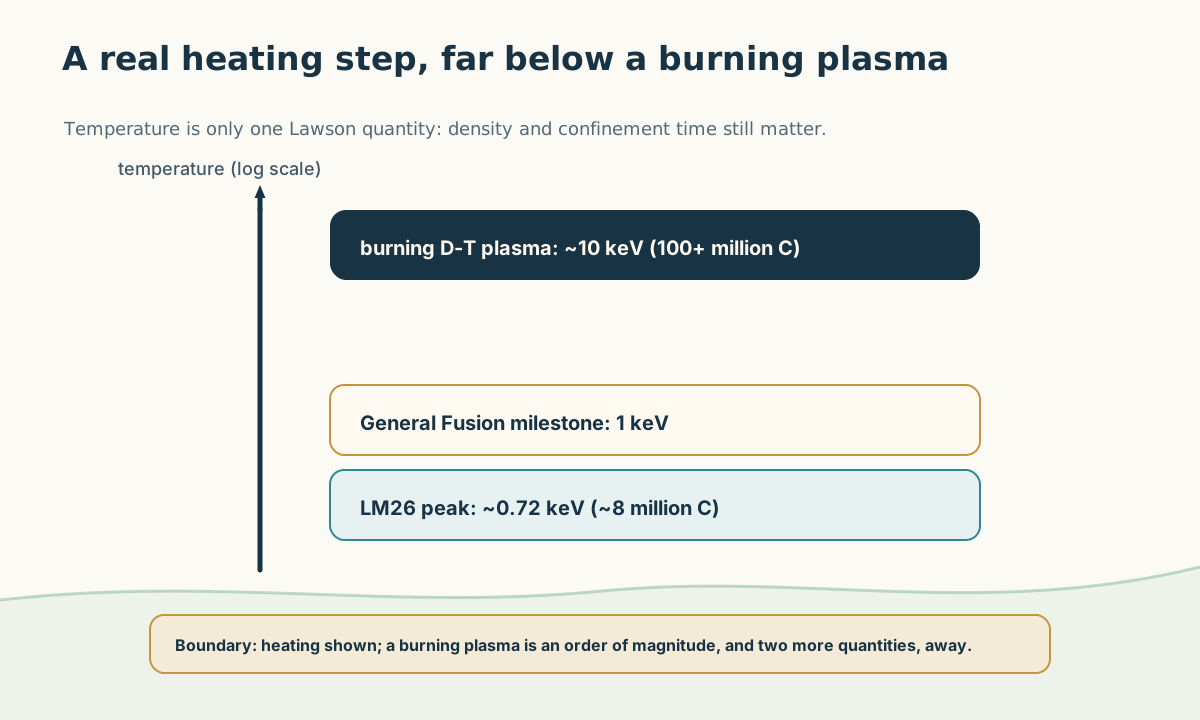
Plasma temperature in fusion is usually quoted in kiloelectronvolts (keV) rather than degrees: 1 keV is about 11.6 million °C. A deuterium–tritium fuel needs to reach roughly 10 keV (over 100 million °C) to fuse efficiently — but temperature is only one of three things that must be met at once. The Lawson criterion says a reactor also needs enough density and enough confinement time, usually combined into a single “triple product” (temperature × density × confinement time). Heating the plasma is necessary, but on its own it is nowhere near sufficient.
Magnetized target fusion (MTF) is a middle path between the two mainstream approaches. Instead of confining a hot plasma for a long time with huge magnets, or heating a tiny target almost instantly with lasers, MTF forms a magnetized plasma and then mechanically compresses it over microseconds. If it works, the compression both heats the plasma and raises its density — potentially reaching fusion conditions without ITER-scale magnets or NIF-scale lasers. Whether the compression really delivers that heating, in a real machine, is exactly what a test like LM26 is for.
What they found
- The plasma heated up as it was squeezed. In the best shots, electron temperature rose by more than 3×, electron density by about 10×, and the poloidal magnetic field by about 10×, driven by the 3× radial compression. In the best shot, the paper measures a peak electron temperature of about 0.72 keV (718 ± 80 eV, by Thomson scattering) — roughly 8 million °C.
- Most of the heating is attributed to the compression. Their integrated model concludes that a majority of the temperature rise came from the mechanical compression itself — the mechanism the whole MTF approach depends on — rather than from Ohmic heating.
- Neutron emission rose during compression, consistent with a hotter, denser deuterium plasma.
What this does not show
- It is not fusion energy, breakeven, or net gain. Nothing here produced more energy than it took to run. The result is about heating a plasma — one step in the fusion cycle — not about the energy balance of a reactor.
- The temperature is still about ten times short of a burning plasma. About 0.72 keV is roughly 8 million °C; deuterium–tritium fuel needs on the order of 10 keV (over 100 million °C) and enough density × confinement time to sustain a burn. General Fusion’s own next milestone is 1 keV — itself far from ignition.
- “Most of the heating is from compression” is a model-based conclusion, not a direct reading. It comes from an integrated physics model fit to the diagnostics; how much you trust the split between compression, Ohmic heating and losses depends on how much you trust that model.
- It is a company preprint, not peer-reviewed. The results are self-reported by the team that built the machine and has raised money on its promise; independent review has not yet happened.
- The neutron increase is not an energy-relevant fusion yield. Some neutrons are expected from deuterium at these conditions, far below anything useful for power.
- It says nothing about the separate company statement that a future plant would deliver electricity to the grid — a claim independent reporting has treated with heavy caution.
How strong is the evidence
- The core claim is narrow and checkable. “We compressed a magnetized plasma and it got hotter, mostly because of the compression” is exactly the mechanism test the MTF approach needs to pass, and the paper backs it with a heavily instrumented set of shots and an explicit energy-balance model. If it survives peer review, it is a genuine — if early — validation of the approach.
- The caveats are structural, not cosmetic. Eleven shots, one machine, one team, not yet reviewed, and a headline temperature an order of magnitude below a burning plasma. The load-bearing conclusion — majority of heating from compression — rests on a model, so the central peer-review question is whether that model’s split is robust.
- The honest status is a mechanism demonstrated, not a milestone toward energy claimed. It nudges MTF from “the compression should heat the plasma” toward “the compression does heat the plasma,” and nothing grander than that.
Why it matters
The interesting thing about magnetized target fusion is economics, not records. If mechanical compression can heat a plasma toward fusion conditions, you might get there without ITER-scale magnets or NIF-scale lasers — a cheaper, faster-iterating path, if it works. That “if” is the whole game, and it turns on unglamorous checkpoints like this one: does the compression actually deliver the heating the models promise? LM26’s answer, on its first shots, is a qualified yes. That is worth noting precisely because it is qualified — a rung on a long ladder, reported by the people climbing it, not yet checked by anyone else, and a long way below the top.
Clean summary
General Fusion’s LM26 compressed a magnetized deuterium plasma with an imploding lithium liner and showed it heating up — more than tripling its electron temperature to a measured peak of about 0.72 keV (718 ± 80 eV, ~8 million °C) — with the company’s analysis attributing most of the heating to the compression itself, the mechanism its magnetized-target-fusion approach relies on. That is a real, specific engineering step for this route to fusion. It is also the first 11 shots on one machine, described in a company preprint that has not been peer-reviewed, at a temperature about ten times below what a burning plasma needs, with no net energy, no breakeven, and no electricity. A mechanism shown, not a power plant built.
Sources
Based on: The science of compressional heating on the LM26 magnetized target fusion experiment — S. J. Howard et al. (General Fusion), arXiv:2606.23974 [physics.plasm-ph] (preprint).
- Preprint — S. J. Howard et al. (General Fusion), The science of compressional heating on the LM26 magnetized target fusion experiment, arXiv:2606.23974 [physics.plasm-ph] (2026)
- Source — General Fusion, 'General Fusion Achieves Compressional Plasma Heating with LM26 Magnetized Target Fusion Machine' (company announcement, June 2026)
- Source — Nature news, 'Nuclear-fusion firm says plant will deliver electricity to grid - but big questions remain' (2026)
Written by
Lucio Vaglio · figures and links by
Nova Vela · edited by
Michele Renda
· figures and links by
Nova Vela · edited by
Michele Renda
The Clean Paper · 17 July 2026 · Text on this site is licensed under CC BY-SA 4.0. Images are licensed separately. 


Editorial note
This article was written by AI and reviewed by the editorial team. It is a clear, conservative explanation of the linked work, not a substitute for reading it. Responsibility for selection, interpretation, and final wording rests with the editor.