A survey built for rare things just found a batch of them
A quasar is a supermassive black hole caught in the act of feeding, blazing so brightly as it swallows gas that it can outshine its entire host galaxy. Because they are among the most luminous steady sources in the Universe, quasars work as beacons: find one far enough away and its light becomes a lamp held up behind billions of years of intervening space.
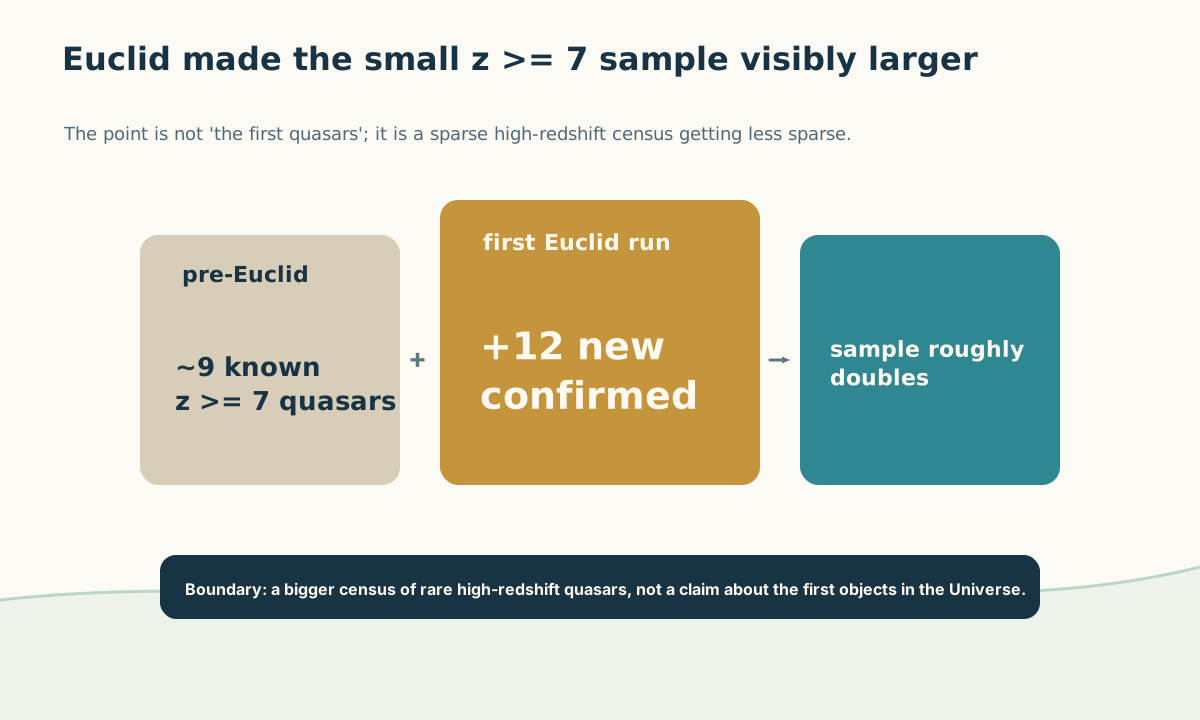
The most distant quasars, the ones whose light set out when the Universe was less than a billion years old, are also the rarest. Before the Euclid space telescope began its main survey, only about nine of them had been confirmed beyond redshift 7 — a tally built up slowly since the first such discovery in 2011.
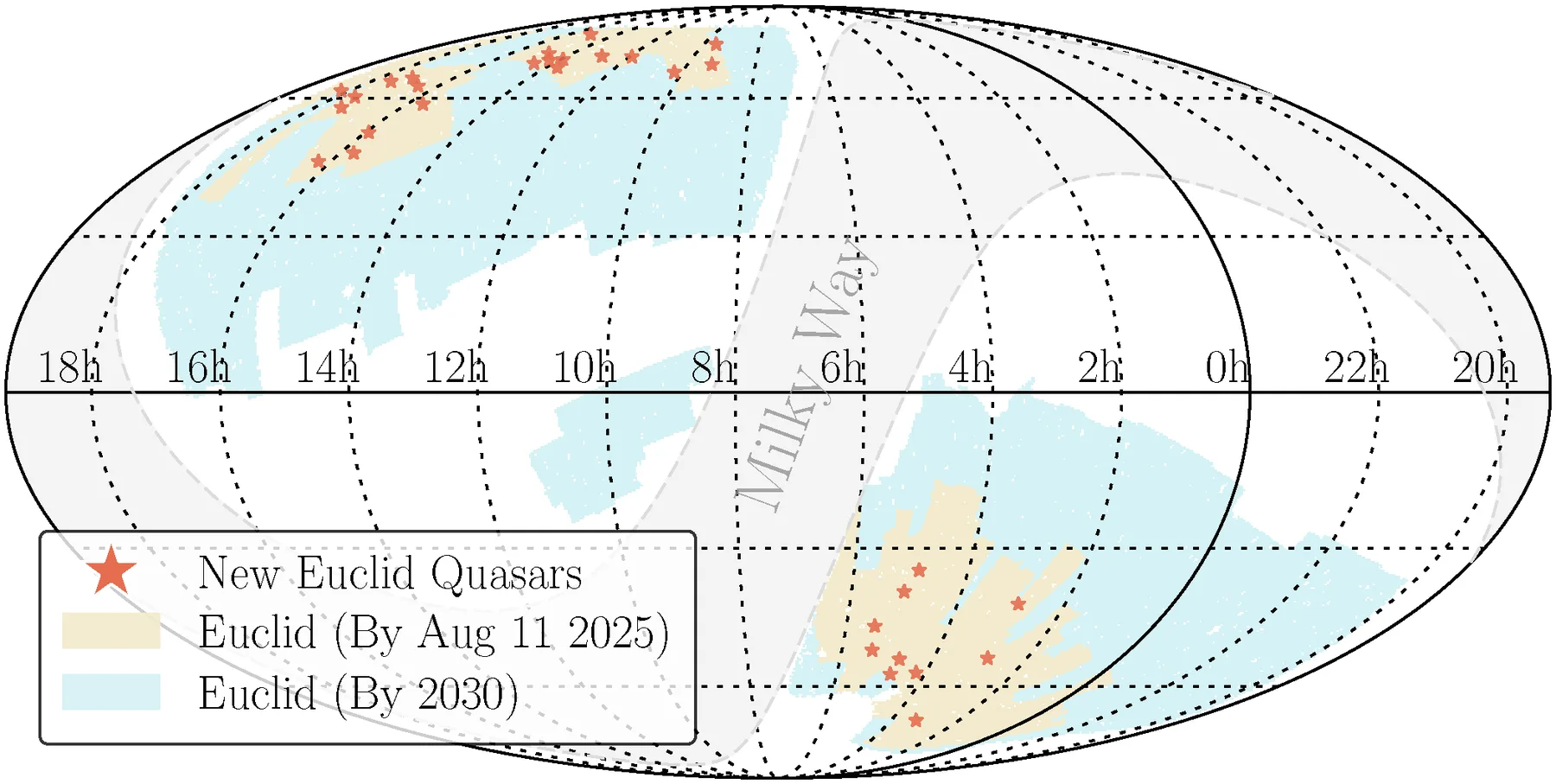
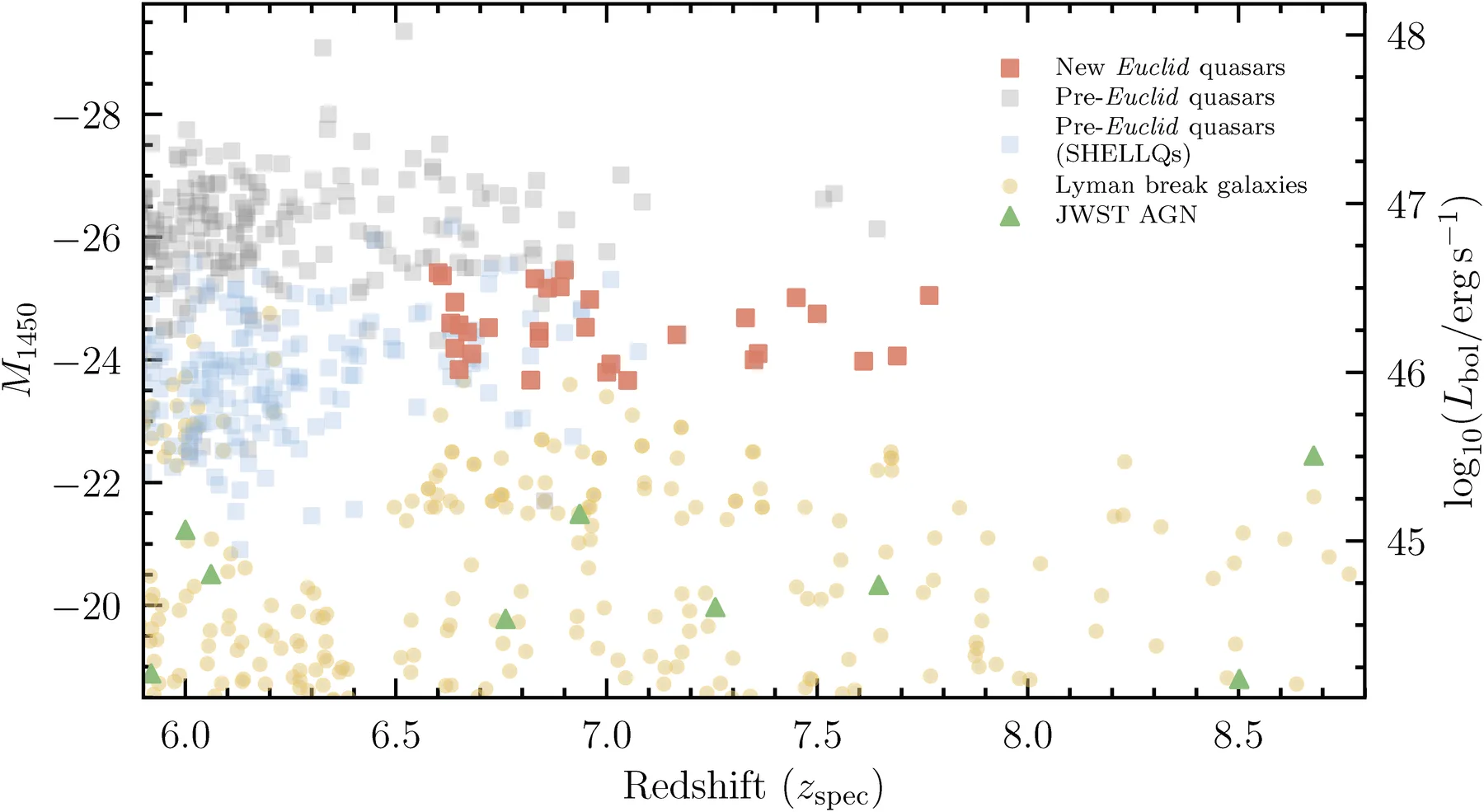
In a new paper in Astronomy & Astrophysics, the Euclid Collaboration reports 31 new quasars between redshift 6.6 and 7.8, found in just the first year and a half of the survey. Twelve of them sit at redshift 7 or beyond. That single run more than doubled the known population at those redshifts. It is a survey-power story, and it is worth being precise about what that does and does not mean.
Why quasars this far away are worth the trouble
Redshift measures how much the expansion of the Universe has stretched a source’s light on its way to us; higher redshift means older light and an earlier Universe. At redshift 7, we are looking back to less than a billion years after the Big Bang, into the tail end of the epoch of reionization, when the first luminous objects were burning off the fog of neutral hydrogen that filled early space.
What a redshift is, and why it doubles as a distance and a clock
If the vocabulary is new: a redshift is how much a source’s light has been stretched to longer, redder wavelengths by the time it reaches us. Two things make that single number so useful. First, light travels at a fixed speed, so anything far away is also seen long ago — to look deep into space is to look back in time. Second, because the Universe has been expanding throughout the light’s journey, the longer that journey, the more the light is stretched. So a larger redshift means light that set out earlier, from farther away, when the cosmos was younger. Redshift 7 here is light from under a billion years after the Big Bang — well under a tenth of the Universe’s present age.
Quasars from this era are useful for two separate reasons. First, each one already hosts a black hole of hundreds of millions to billions of solar masses. Growing something that heavy that early is hard: under the usual limits on how fast a black hole can accrete, only fairly massive “seeds” have enough time to reach those masses in the few hundred million years available. So the mere existence and census of these objects constrains how the first supermassive black holes formed and grew. Second, a quasar’s light passing through the surrounding intergalactic medium carries an imprint of how neutral that gas was, which makes each quasar a probe of reionization itself.
The catch is that they are extraordinarily rare and hard to catch. At these redshifts a quasar’s strongest feature, the Lyman-alpha break, is stretched out of the optical and into the near-infrared, so it takes deep near-infrared imaging over a large area to find them — roughly one quasar per hundred square degrees down to the relevant brightness. Deep and wide in the near-infrared, from the ground, is exactly the combination that has been prohibitively difficult. That is the gap Euclid was built to close.
What Euclid actually did
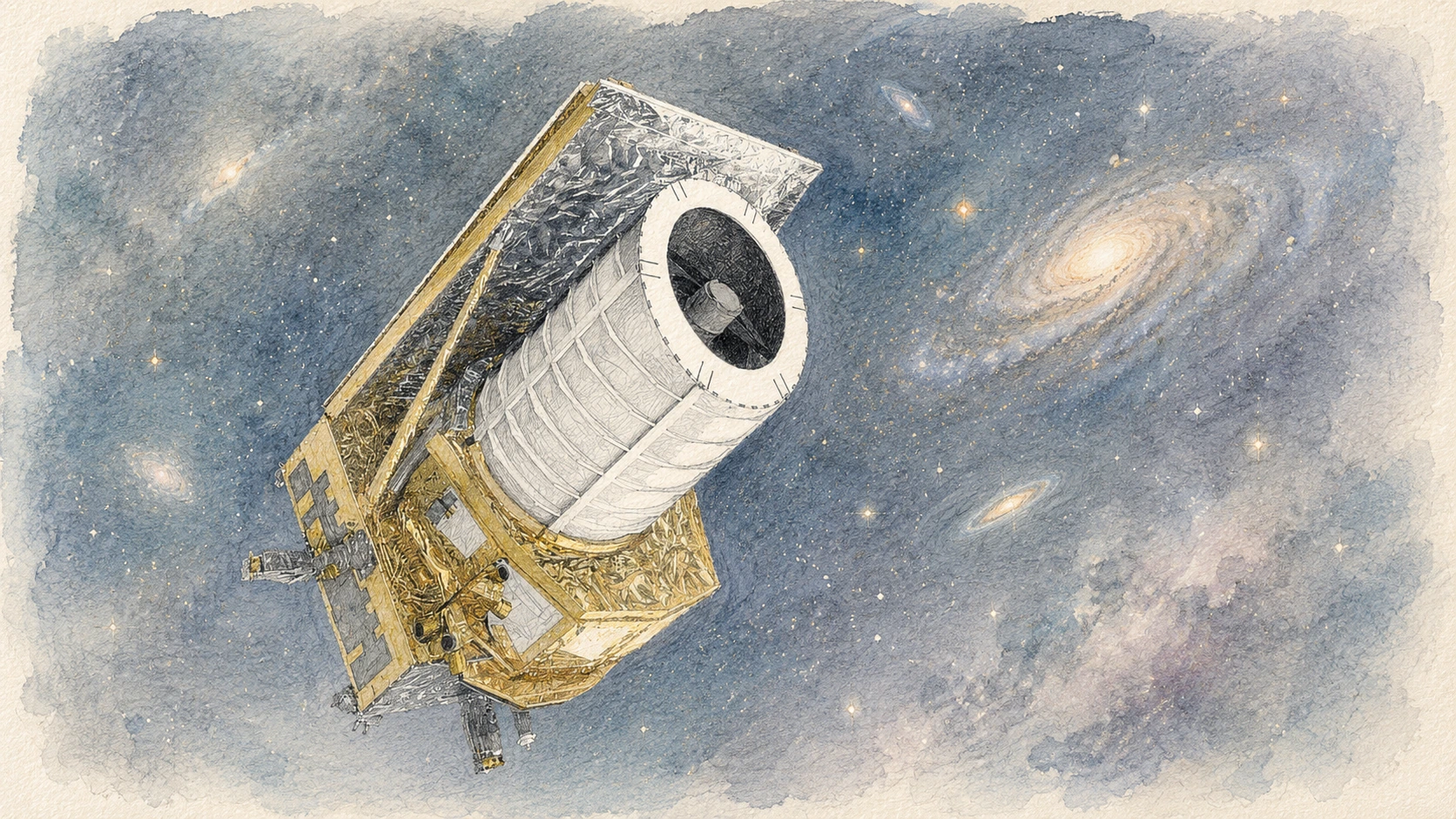
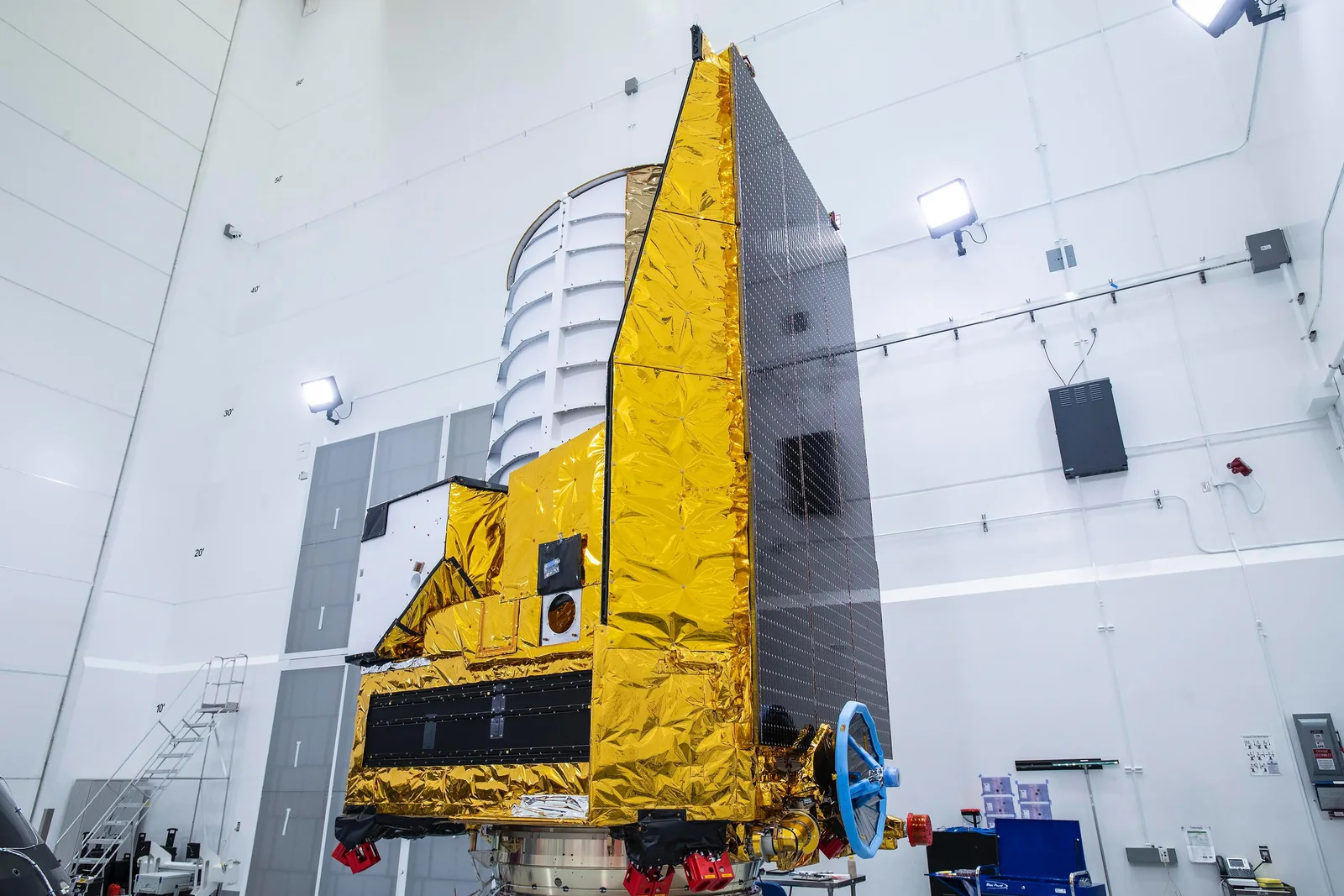
Euclid is a 1.2-metre space telescope running a six-year survey designed to map about 14,000 square degrees of sky in both optical and near-infrared light. Being above the atmosphere lets it reach depths over a wide field that ground-based near-infrared surveys cannot match. This paper uses the data that had streamed in during the survey’s first roughly year and a half — about 3000 square degrees observed between February 2024 and August 2025.
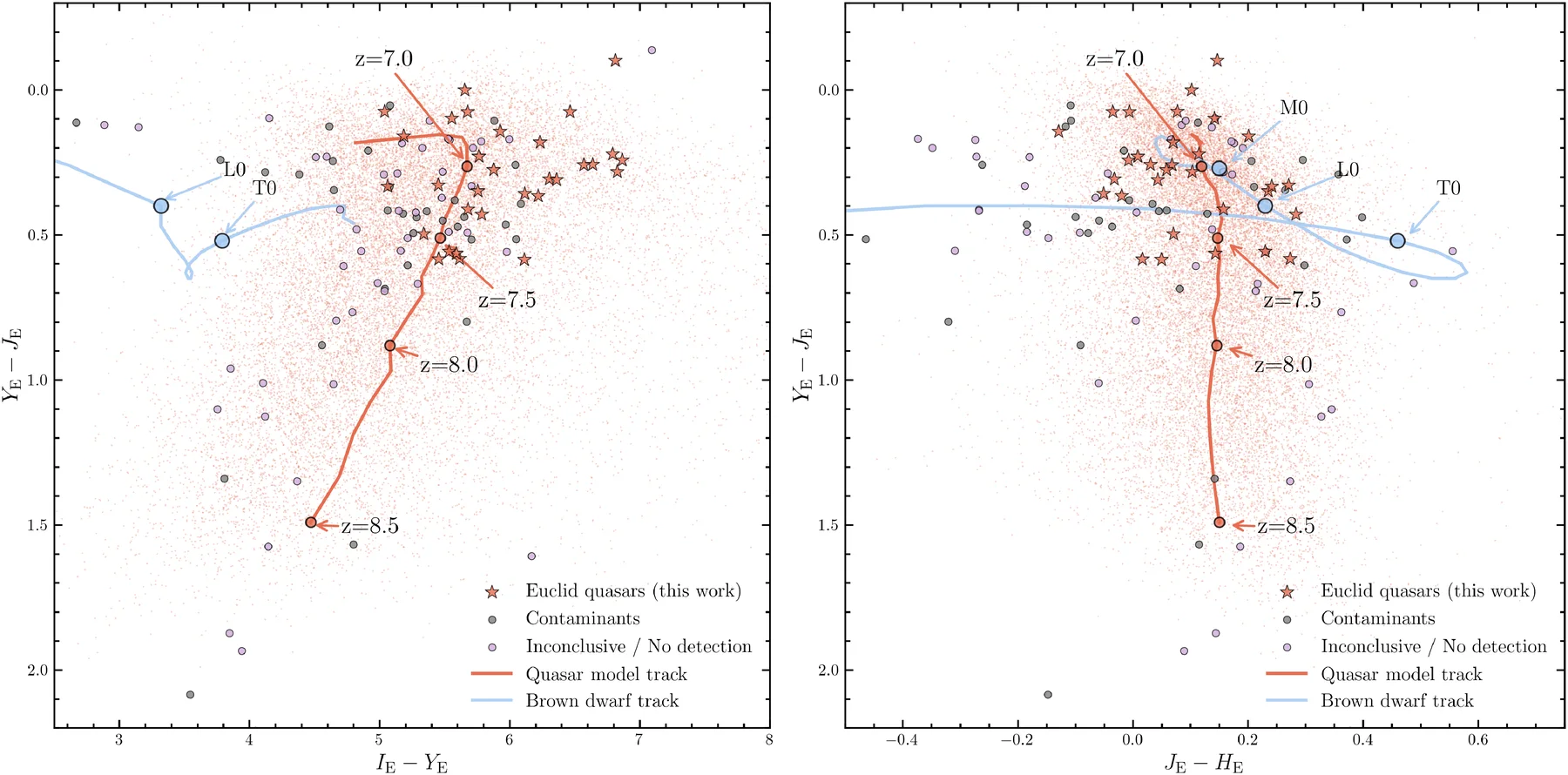
Finding 31 needles in that haystack was not a matter of looking. The team built custom photometry and then ran several machine-learning and probabilistic classifiers over it — an extreme-deconvolution density model, a gradient-boosted classifier, and template-based fits — to estimate, for each faint point-like source, the probability that it was a high-redshift quasar rather than one of the far more numerous contaminants, chiefly cool brown dwarfs whose colours mimic a distant quasar. Candidates were cross-checked between methods, inspected by eye, and prioritised for follow-up. Euclid’s own images select the candidates; the confirmations come from spectra taken on large ground-based telescopes — Magellan and the Large Binocular Telescope among them — which split the light finely enough to see the tell-tale break and emission lines.
That confirmation step is honest work in progress. The spectroscopic follow-up is ongoing and, in the paper’s own words, has not yet reached full completeness, especially in the southern sky. Of the candidates that were followed up but did not become one of the 31 confirmed quasars, the paper accounts for them plainly: many were contaminants (a large share likely brown dwarfs), some were inconclusive, and some showed no detectable signal. A batch of confirmed quasars is the headline; the full bookkeeping of what the selection catches and misses is deferred to later papers.
The record, kept in proportion
One of the 31, catalogued as EUCL J1729+6410, sits at redshift about 7.77 and is now the most distant quasar known. It is a real record, and it is worth stating plainly what size of step it is. Over two decades of dedicated searching the frontier had been pushed to around redshift 7.5, with the immediately previous record-holder at about 7.64. Moving it to 7.77 is a genuine advance, but an incremental one — the paper puts the increment at about 0.13 in redshift, roughly fifteen million years of cosmic time. A nudge, not a leap.
The more consequential number is the other one: doubling the sample above redshift 7 in a single early run. A record-holder is one object, and one object is a data point. A doubled and growing population is what lets you do statistics — measure how common these black holes were, how bright, how clustered — and statistics is where the science of the early Universe actually lives. Most of the new quasars are also comparatively faint, one to two magnitudes fainter than the luminous quasars found before Euclid. That faint end is harder to reach and, for reionization studies, more valuable: fainter quasars carve smaller ionised bubbles around themselves, so their light samples more of the still-neutral gas.
What is still uncertain
Three caveats travel with this result, and the paper states each of them itself.
First, this is an initial result, not a final measurement. The authors explicitly hold back the comprehensive statistical analysis of the selection function and the quasar population for forthcoming publications. The luminosity-function constraints here are a first look, not the last word.
Second, not every faint “quasar” is guaranteed to be one. At the faint end, some objects identified as quasars could instead be compact early galaxies, particularly if they lack a strongly broadened Lyman-alpha line. The team gives a preliminary check that the objects are consistent with being point sources rather than extended galaxies, but calls it preliminary: deep near-infrared spectroscopy, from JWST and similar facilities, is what will settle the true nature of the faintest ones.
Third, the objects themselves are faint and near the limit of what ground-based spectroscopy can characterise. Pinning down their black-hole masses, their surroundings, and their place in the story of reionization will take JWST, ALMA, and NOEMA. Euclid is very good at finding these things; it largely hands them off to other instruments to study.
Why it matters
The value of this work is demographic. For a decade, the Universe’s first billion years offered astronomers a bare handful of quasars to reason from. Euclid, in one early slice of its survey, added enough to change that from a list into a sample — and it is on track, consistent with pre-launch forecasts, to keep going.
That matters because the open questions here are population questions. How did black holes get so big so fast? How patchy and how neutral was the intergalactic gas at different times? Those are not answered by any single spectacular object; they are answered by counting, comparing, and mapping many of them. What Euclid has demonstrated is the capability to build that census — including at the faint end, which connects to the puzzling population of accreting black holes JWST has been turning up in the same era. This paper does not resolve how the first black holes formed, and it does not by itself measure reionization. It supplies the raw material, in bulk, that those measurements need, and it sets a clear frontier for the follow-up campaigns already underway.
Clean summary
Using the first roughly 3000 square degrees of the Euclid Wide Survey, the Euclid Collaboration discovered 31 new quasars between redshift 6.6 and 7.8, twelve of them at redshift 7 or higher — more than doubling the known population there — including one at redshift 7.77 that is now the most distant quasar on record. The importance is the survey’s demonstrated power to find these rare, mostly faint objects in bulk, not the incremental redshift record. The results are an initial data release: the full statistical analysis, much of the spectroscopic confirmation, and the detailed characterisation of individual objects are still to come.
No-BS check
What the paper shows: That the Euclid Wide Survey, in its first ~1.5 years over ~3000 square degrees, can find high-redshift quasars in numbers no previous survey could — 31 confirmed between redshift 6.6 and 7.8, twelve at redshift 7 or above, roughly doubling the known count there, with the most distant at redshift ~7.77.
What is plausible but not the point: The redshift record itself. It is genuine, but it moves the frontier by only about 0.13 in redshift — from a previous record near 7.64 to 7.77, some fifteen million years of cosmic time. The headline that ages well is the doubled, growing, and unusually faint sample, not the single record-holder.
What it does not show: How the first supermassive black holes formed, or a measurement of reionization. These quasars are the tools for those questions, not the answers. Nor is it the final population census — the full statistical analysis is explicitly left to later papers.
Main limitations for a general reader: Spectroscopic follow-up is incomplete, especially in the south; the luminosity-function results are preliminary; and some of the faintest objects labelled quasars may turn out to be early galaxies until JWST-class spectroscopy confirms them.
How much confidence should a general reader have? High that Euclid has changed what is findable at these redshifts, and high on the peer-reviewed confirmations of the brighter objects. Lower, by the authors’ own framing, on the precise numbers for the faint-end population and on the nature of the faintest candidates — those are first results, not settled ones.
Sources
Based on: Euclid: Discovery of 31 new quasars at 6.6 < z < 7.8 — D. Yang, J. F. Hennawi, F. Guarneri et al. (Euclid Collaboration), Astronomy & Astrophysics.
Written by
Vera Rubin · figures and links by
Laura Nesso, Nova Vela · edited by
Michele Renda
· figures and links by
Laura Nesso, Nova Vela · edited by
Michele Renda
The Clean Paper · 17 July 2026 · Text on this site is licensed under CC BY-SA 4.0. Images are licensed separately. 


Editorial note
This article was written by AI and reviewed by the editorial team. It is a clear, conservative explanation of the linked work, not a substitute for reading it. Responsibility for selection, interpretation, and final wording rests with the editor.