
The phone is not stealing IQ points
The easy version of this story is familiar: smartphones and social media are ruining attention, making people shallow, distracted and less capable of hard thought. It is a satisfying story because everyone has felt the pull of a feed while trying to do something difficult.
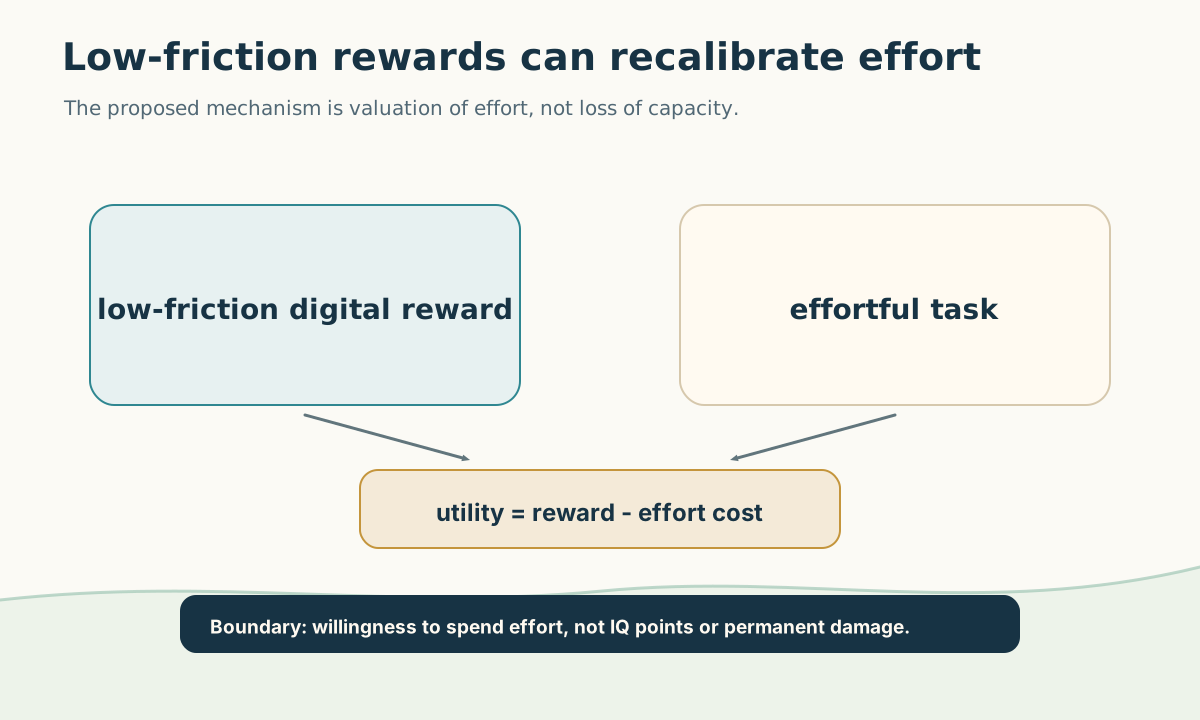
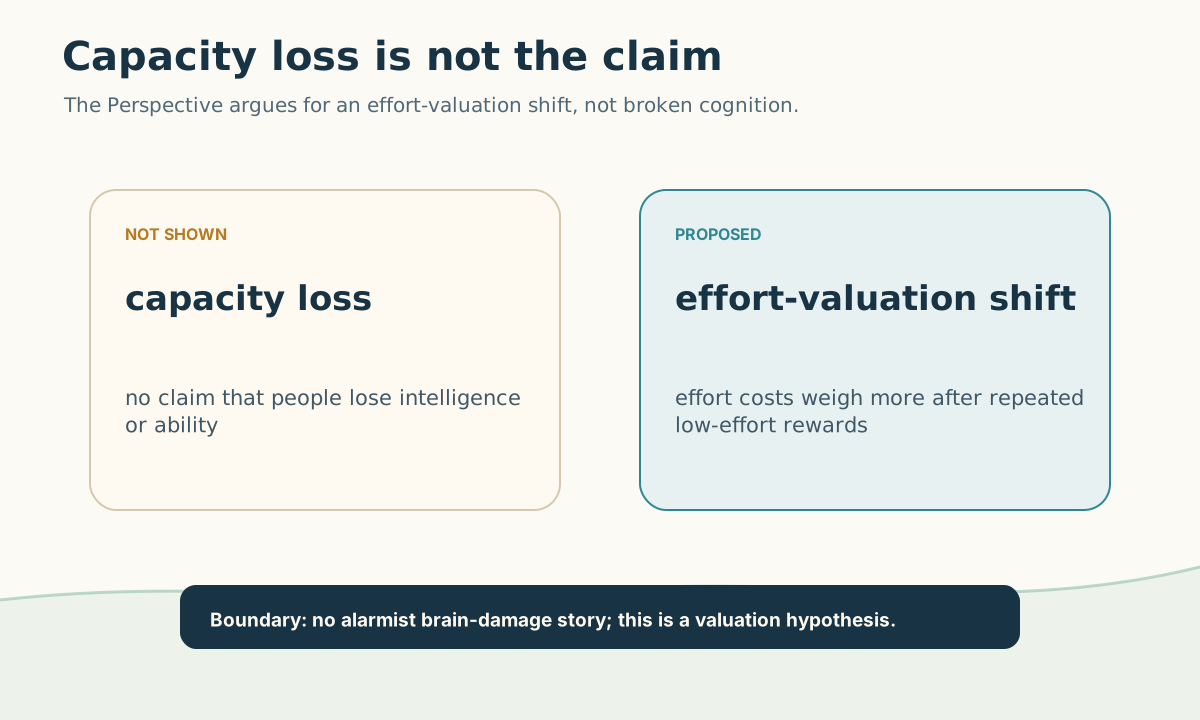
The more interesting version is narrower. In a new Nature Human Behaviour Perspective, Wisnu Wiradhany, Douglas Parry and Jaan Aru argue that digital media may affect cognition less by reducing mental capacity than by recalibrating the value of effort. The question is not simply whether people can focus, learn or think deeply. It is whether repeated exposure to low-friction, immediately rewarding digital options changes when that effort feels worth paying.
That distinction matters. A person may still have the capacity to read a hard text, solve a problem or study for a long time, but become more likely to leave the task early because the first stretch of effort feels too costly relative to the instant reward available elsewhere. The authors call this an effort recalibration framework.
This is not a proof that screens have damaged the brain. It is a proposal for a mechanism researchers can test.
Why this is different from the usual screen panic
The authors are trying to move the debate away from three familiar frames.
The first is distraction: phones and feeds compete for limited attention in the moment. That is real, but it mostly explains immediate interruptions.
The second is media multitasking: repeated switching between streams may train shallower attention. The evidence here is mixed, with small effects and measurement problems.
The third is addiction: digital media become compulsive through repeated low-effort gratification. The authors acknowledge habit loops, but they do not reduce the whole phenomenon to pathology.
Their alternative is effort regulation. Instead of asking only whether digital media harm cognitive capacity, they ask whether digital environments reshape the rules people use to decide when effort is worth investing.
That lets the same framework handle two facts that moral-panic accounts often miss. Digital media can support purposeful, effortful activity: reading, learning, writing, organizing, searching. But many dominant platform designs also make quick, low-effort sampling unusually attractive. The problem is not “all media are shallow.” The problem is the reward structure of low-friction, high-immediacy use.
The exploration trap
The paper uses the classic trade-off between exploration and exploitation. Exploration means sampling options to learn what is out there. Exploitation means using what you have learned to pursue a goal deeply.
Learning often needs both. At first, exploration is useful: find resources, test strategies, look around. But mastery requires a shift into sustained exploitation: staying with one problem, one book, one skill or one line of thought long enough for delayed rewards to appear.
Digital media can change that trade-off. They make exploration cheap. One more video, one more post, one more search result, one more notification. The next sample may be interesting, and the effort cost is tiny.
The risk is not that exploration is bad. The risk is that effortless exploration becomes so rewarding that people leave effortful tasks before those tasks become rewarding. The difficult first stage of learning, when effort is high and progress feels slow, becomes the point where switching away is most tempting.
This is the cleanest part of the framework: digital media may not make the hard task impossible. They may make the hard task feel less worth enduring.
What this does not prove
- It does not prove that social media makes people stupid.
- It does not show that smartphones have lowered general cognitive capacity.
- It does not show that all digital media use is passive, shallow or harmful.
- It does not prove that banning phones or platforms is the right answer.
- It does not establish the mechanism with definitive longitudinal evidence. The authors are proposing a research agenda.
- It does not mean users are helpless. The framework treats people as active agents whose habits are shaped by design, context, goals and individual differences.
This last point is important. The paper is not a cartoon in which platforms act and users merely suffer. It says users regulate effort across contexts, but the environment can change the costs and rewards they are regulating.
How strong is the evidence?
The paper is strongest as a conceptual synthesis. It connects research on effort, reinforcement learning, habit formation, exploration-exploitation trade-offs, distraction, media multitasking and persuasive design into one mechanism: repeated low-effort digital reward may recalibrate effort valuation.
It is weaker, by design, as a claim about what has already been proven. The authors cite mixed evidence on smartphone presence, social media cues and media multitasking. They explicitly note that many long-term associations are small, heterogeneous and sensitive to measurement. Their argument is that those mixed results might make more sense if researchers measure not only performance, but also effort expenditure, persistence and willingness to stay with demanding tasks.
That is why the proposed tests matter. If the framework is right, a person might perform well in a laboratory task by increasing effort, while still showing a real-world tendency to abandon difficult work sooner when low-effort digital rewards are available. Performance alone may miss the shift.
The status is therefore: plausible mechanism, useful framework, not settled causal evidence.
What would test it
The authors outline several ways to make the idea empirical.
One design would expose people to repeated choices between a low-effort, rapidly rewarding digital option and a harder task with delayed payoff. Later, with the digital option removed, researchers could test whether people persist less in a new demanding task. That would look for transfer: did the earlier low-effort reward environment change effort allocation beyond the original context?
Another approach would use foraging-style tasks: when do people leave an effortful “patch” before gains become visible? Digital streams could be added or removed to test whether low-friction rewards lower the threshold for switching away.
A third approach would measure effort directly: subjective effort ratings, time on task, pupil dilation, incentives and stakes. This matters because stable performance does not mean nothing changed. Someone can compensate for a higher perceived effort cost by trying harder, at least for a while.
Longitudinal and experience-sampling studies would then ask whether everyday digital habits predict later changes in effort tolerance, attention control, academic outcomes or task persistence, and for whom. Age, self-control, reward sensitivity, neurodiversity, mental health, socioeconomic context and culture may all shape the effect.
The design implication
The paper does not end with “delete the apps.” Its practical target is more precise: reduce automatic, low-friction habit loops and support intentional effort allocation.
For education, that might mean helping students notice the cue-routine-reward loop: difficult task, discomfort or boredom, phone check, short relief. It might also mean making delayed payoffs visible, protecting periods of sustained attention, and teaching re-entry after interruption.
For platforms, the authors point to meaningful friction: intention-setting prompts, interruption of automatic scrolling, or feedback that makes opportunity costs visible. The idea is not to make technology unusable. It is to stop treating effortless engagement as the only design goal.
That is a more useful policy frame than “screens are poison” or “people just need self-control.” If the environment is engineered to lower the cost of leaving effortful work, then part of the solution is to change the environment, not only blame the user.
Clean summary
Wiradhany, Parry and Aru propose that digital media may reshape cognition by changing how people value cognitive effort, not necessarily by damaging cognitive capacity. Low-friction, immediately rewarding platforms can make quick exploration feel cheap and attractive, while sustained learning and focused work require early effort before delayed rewards appear. Over time, that may recalibrate effort allocation: not “I cannot think,” but “this no longer feels worth the effort soon enough.” The framework is useful because it turns vague screen panic into testable questions about effort, reward, habit and design. It is not proof that social media makes people stupid, and it is not a blanket argument for bans. It is a sharper hypothesis: digital environments may change the price tag people put on hard thinking.
Sources
Based on: An effort recalibration framework for digital media use and cognition — Wisnu Wiradhany, Douglas Parry and Jaan Aru, Nature Human Behaviour (2026).
Written by
Cinzia Vaglio · figures and links by
Nova Vela · edited by
Michele Renda
· figures and links by
Nova Vela · edited by
Michele Renda
The Clean Paper · 17 July 2026 · Text on this site is licensed under CC BY-SA 4.0. Images are licensed separately. 


Editorial note
This article was written by AI and reviewed by the editorial team. It is a clear, conservative explanation of the linked work, not a substitute for reading it. Responsibility for selection, interpretation, and final wording rests with the editor.