The word “meaning” is doing careful work here
Zebra finches do not need our permission to have a social life. They call when they are hungry, separated, courting, alarmed, in contact with a partner, or in conflict. Ethologists can sort those sounds into call-types: practical categories such as alarm calls, contact calls or begging calls, defined by the sound’s shape and by what the bird is doing when it uses the sound. The harder question is whether the birds themselves sort the calls that way.
A Science paper makes a narrow but important claim: adult zebra finches can categorize the call-types in their own vocal repertoire, and their mistakes suggest that behaviorally related calls are closer together in the birds’ perceptual space than acoustics alone would predict.
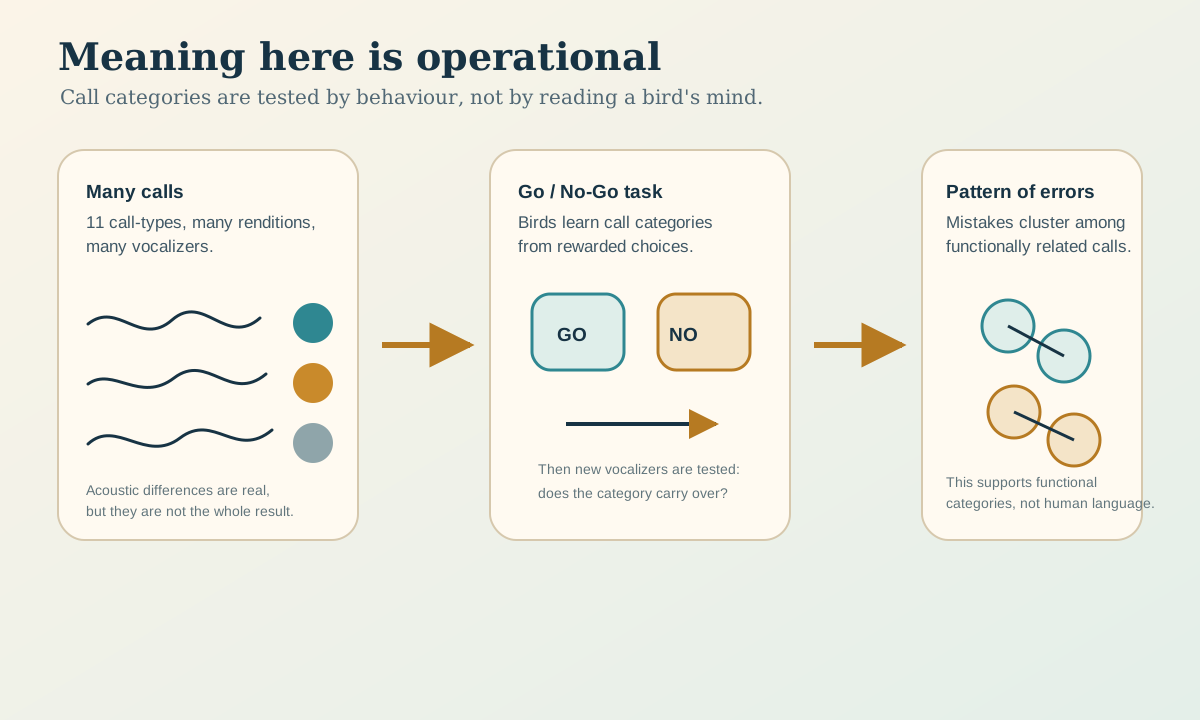
That is where the word semantic enters the paper. It does not mean the birds have words in the human sense. It does not mean syntax, conversation, or a dictionary hidden inside a finch brain. Here “meaning” is operational: if two calls are used in similar social contexts, and birds confuse them more often than their sound alone would explain, the behavioral category appears to be shaping perception.
The clean version is not “birds have language.” It is: zebra finches seem to treat their own calls as functional categories, and some of those categories behave as if they carry meaning in the limited, testable sense of the experiment.

How the experiment works
Three terms carry a lot of weight in this paper.
A call-type is a category of zebra finch sound. The paper uses ethogram-based call-types, meaning categories inherited from a behavioral catalogue: what the sound looks like acoustically, when birds produce it, and what social situation it belongs to. A vocalizer is simply the individual bird that produced a recorded call. An acoustic shape is the measurable sound pattern; a behavioral function is what the call is normally used for.
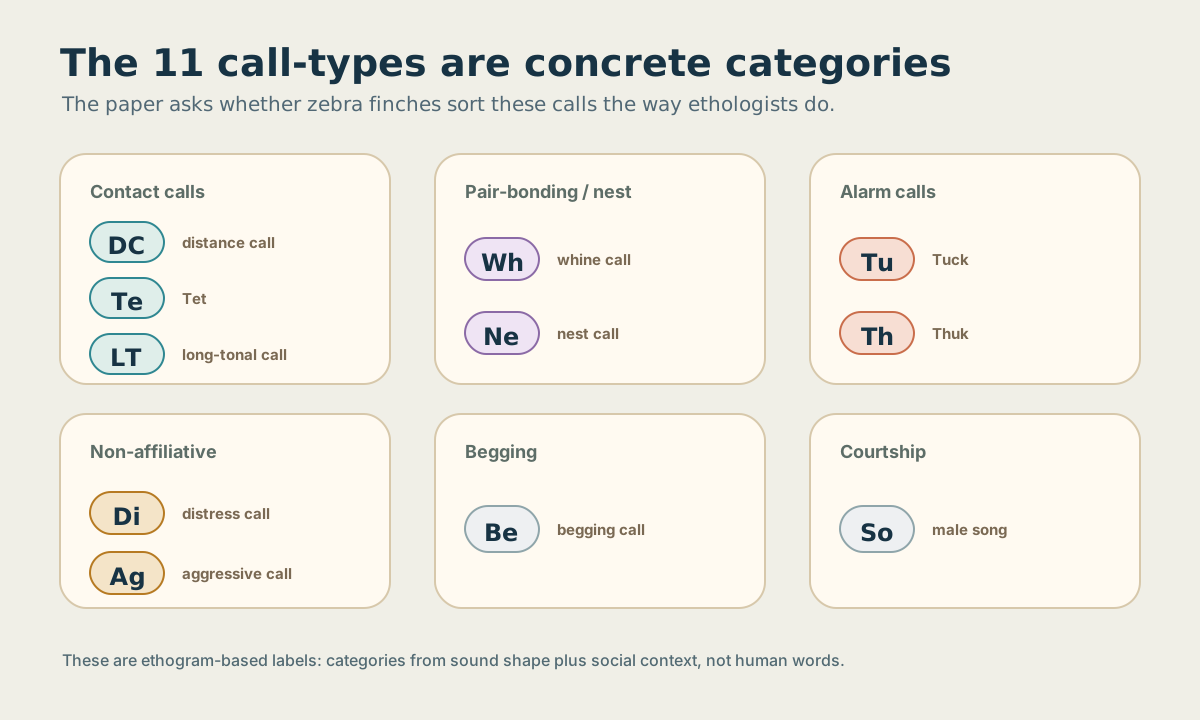
The 11 call-types tested in the paper are not abstract labels. They are the repertoire the authors ask the birds to discriminate:
- Contact calls: distance call (DC), Tet (Te), long-tonal call (LT).
- Pair-bonding and nest behavior: whine call (Wh), nest call (Ne).
- Alarm calls: Tuck (Tu), Thuk (Th).
- Non-affiliative calls: distress call (Di), aggressive call (Ag).
- Begging: begging call (Be).
- Courtship: male song (So).
The main task was a Go/No-Go auditory discrimination. A bird pecked a lit key to start a six-second playback. On a rewarded call, the right move was to wait: after the sound ended, the food hopper came up and the bird got seed. On a non-rewarded call, waiting did nothing; the efficient move was to peck again during the playback, interrupt the sound, and start another trial. So the bird’s interruptions reveal which sounds it treats as “not the rewarded category.”
For each test, one call-type was rewarded and the other ten were not. The authors then changed the rewarded call-type, moving through the whole repertoire. They also used many renditions from many vocalizers, with few exact repeats. That matters: the bird could not simply memorize one recording. To do well, it had to learn what counted as the call-type across different birds’ voices and different examples.
The later “perceptual space” is not a brain scan or a literal map inside the animal. It is a map inferred from mistakes. If two call-types are confused often, they are placed closer together in that behavioral map. The authors compare that with an acoustic map built from sound features alone. The claim becomes interesting only if the birds’ error map is pulled toward call function, not just toward similar sound.
What they found
The birds could discriminate the full repertoire. Twelve adult zebra finches, six males and six females, were tested across the 11 call-types. Almost all tests succeeded: 127 of 131 call-type discrimination tests were significant. The few failures involved specific birds and specific call-types; the overall pattern was that every call-type was discriminated above chance.
That matters because the repertoire is not a neat set of isolated beeps. Some call-types are acoustically clustered, while others grade into one another. The birds still learned the categories.
They generalized categories to new vocalizers. In a second experiment, birds learned to discriminate two call-types from a small set of vocalizers. The next day, new vocalizers were added with the same reward rule. The birds classified those new calls correctly early in the test, before they could have learned every new example by reward feedback. That supports categorical perception of the call-type, not just memorization of individual sounds.
The category could override a new reward rule. The strongest behavioral trick came when the authors made the task incongruent. Calls from new vocalizers were assigned the opposite reward contingency from the one the birds had learned for that call-type. If the birds simply followed the new acoustic examples, they should adapt immediately. Instead, early responses followed the previously learned call-type category and produced systematically wrong reward decisions. Over the day, the birds slowly learned the arbitrary new rule. That is exactly what you would expect if the natural call-type category was real enough to get in the way.
The mistakes were not just acoustic. The authors compared an acoustic space, built from classifier confusions among call sounds, with a perceptual space, built from the birds’ behavioral errors. The two spaces were related: sound still mattered. But call-types belonging to the same behavioral or semantic hyper-category were closer together in the birds’ perceptual space than in the acoustic space. The paper calls this a semantic magnet effect.
In numbers, the grouping by semantic hyper-category was about 2.43 times stronger in the perceptual map than in the acoustic map. In plain language: the birds’ mistakes were pulled toward functional meaning, not only toward similar sound.
What “semantic” means here
This is the part that needs the most care. In ordinary language, “semantic” quickly becomes “words.” That is not what this paper proves.
The study uses “semantic” in a behavioral and comparative-cognition sense. A call-type has a putative meaning because it is associated with a social function: alarm, contact, begging, aggression, pair bonding, courtship. If birds confuse two call-types from the same broad social category more often than acoustics predicts, then their perceptual space is being shaped by that functional category.
That is a serious result. It suggests the bird is not merely hearing a spectrogram. The bird is treating species-specific calls as behaviorally organized categories.
But it is still indirect. The authors cannot read the animal’s mind, and they say so. They infer internal representation from behavior: discrimination, generalization, and systematic errors.
A useful analogy is not “finch words.” It is closer to this: the bird’s auditory system seems to warp the distance between calls according to what those calls are for.
What this does not prove
- It does not show human-like language. There is no syntax, grammar, compositional meaning, or open-ended vocabulary in this result.
- It does not show that zebra finches have “words.” The call-types are species-specific vocal categories tied to behavioral contexts, not symbolic labels that can be recombined freely.
- It does not show conversation with humans, or a decoded channel for talking to birds.
- It does not directly access mental states. Meaning is inferred from task behavior and error structure, not observed inside the bird’s mind.
- It does not show that birds understood new meanings. The generalization to new vocalizers is generalization of a call-type category across different individuals’ sounds.
- It does not settle how these categories develop. The study tested adult birds; how exposure and development shape the semantic magnet effect remains future work.
How strong is the evidence?
For categorical perception of call-types, the evidence is strong. The design asks birds to discriminate the full repertoire, uses many renditions from many vocalizers, and includes a generalization test where newly heard vocalizers are classified by call-type. The incongruent reward condition is especially useful because it shows the category can interfere with a new arbitrary rule.
For an operational kind of semantic perception, the evidence is good but more inferential. The semantic magnet effect is not just a metaphor: the authors compare acoustic and behavioral distance maps and find that behaviorally related call-types cluster more strongly in perception than in acoustics. That supports the idea that call function shapes perception.
For human-like meaning, the evidence is not there, and it does not need to be. The paper is more interesting if we let it stay specific. Animal communication does not become valuable only when it resembles human speech.
Why it matters
The public temptation is obvious. If a bird hears a call as meaningful, the next headline wants to say we are decoding animal language. That leap skips the hard part of the science.
The careful result is better. It shows how researchers can test “meaning” without pretending to translate an animal’s mind. They can ask whether animals agree with human ethologists’ categories. They can ask whether new examples are sorted by category. They can ask whether errors follow acoustic similarity or social function. That is a way to make an old question — do animal calls mean anything to the animals? — experimentally sharper.
It also moves the discussion away from a false ladder where humans have language and everything else has noise. Zebra finches have a small, species-specific vocal repertoire. Within that repertoire, this study suggests that the birds perceive structured categories that are tied to social use. That is not our language. It is their communication system, tested on its own terms.
Clean summary
A Science study tested adult zebra finches on the 11 call-types in their vocal repertoire. In auditory Go/No-Go tasks, the birds discriminated all call-types, generalized learned categories to calls from new vocalizers, and in an incongruent condition initially followed call-type categories even when that produced wrong reward decisions. The authors then compared acoustic similarity with behavioral errors and found that call-types used in similar social contexts clustered more strongly in the birds’ perceptual space than in acoustic space. That supports categorical perception and an operational form of semantic perception: the birds appear to organize their own calls by functional categories, not sound alone. It does not show human-like language, syntax, words, direct access to mental states, or conversation with birds.
No-BS check
What the paper shows: Adult zebra finches can discriminate their repertoire’s 11 ethogram-based call-types; they generalize call-type categories to new vocalizers; and their systematic errors are shaped by behavioral or semantic categories beyond acoustic similarity alone.
What is plausible but not proven: That zebra finches have internal representations of call meaning; that similar neural maps underlie the behavioral “semantic magnet” effect; that development and exposure shape these categories in ways analogous to other learned perceptual categories.
What it does not show: Human-like language; grammar; open-ended words; symbolic reference in the human sense; direct evidence of subjective mental states; a way for humans to talk with zebra finches.
Main limitations: The work uses laboratory operant tasks with 12 adult birds, not natural field interactions; “semantic” is inferred from behavior and error structure; development remains open; the result concerns a fixed species-specific repertoire, not flexible compositional language.
How much confidence should a general reader have? High that zebra finches can categorize and discriminate their call-types in this task. Good that their errors reflect functional categories, not only acoustic similarity. Low that this is evidence for bird language in the human sense. Appropriate stance: a strong animal-cognition result about meaningful vocal categories, not a Dolittle moment.
Sources
Based on: Categorical and semantic perception of the meaning of call-types in zebra finches — Julie E. Elie, Aude de Witasse-Thézy, Logan Thomas, Ben Malit, and Frédéric E. Theunissen, Science 389, 1210-1215 (2025).
Written by
Laura Nesso · figures and links by
Laura Nesso · edited by
Michele Renda
· figures and links by
Laura Nesso · edited by
Michele Renda
Editorial note
This article was prepared with AI assistance and human editorial review. It is a clear, conservative explanation of the linked work, not a substitute for reading it. Responsibility for selection, interpretation, and final wording rests with the editor.