A missing line in the catalogue
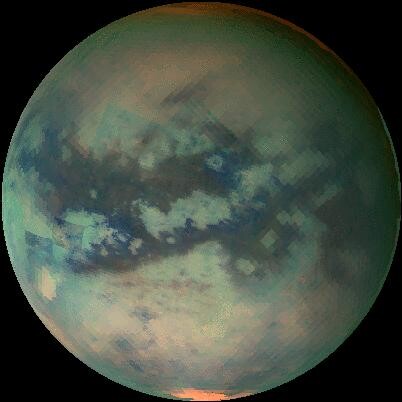
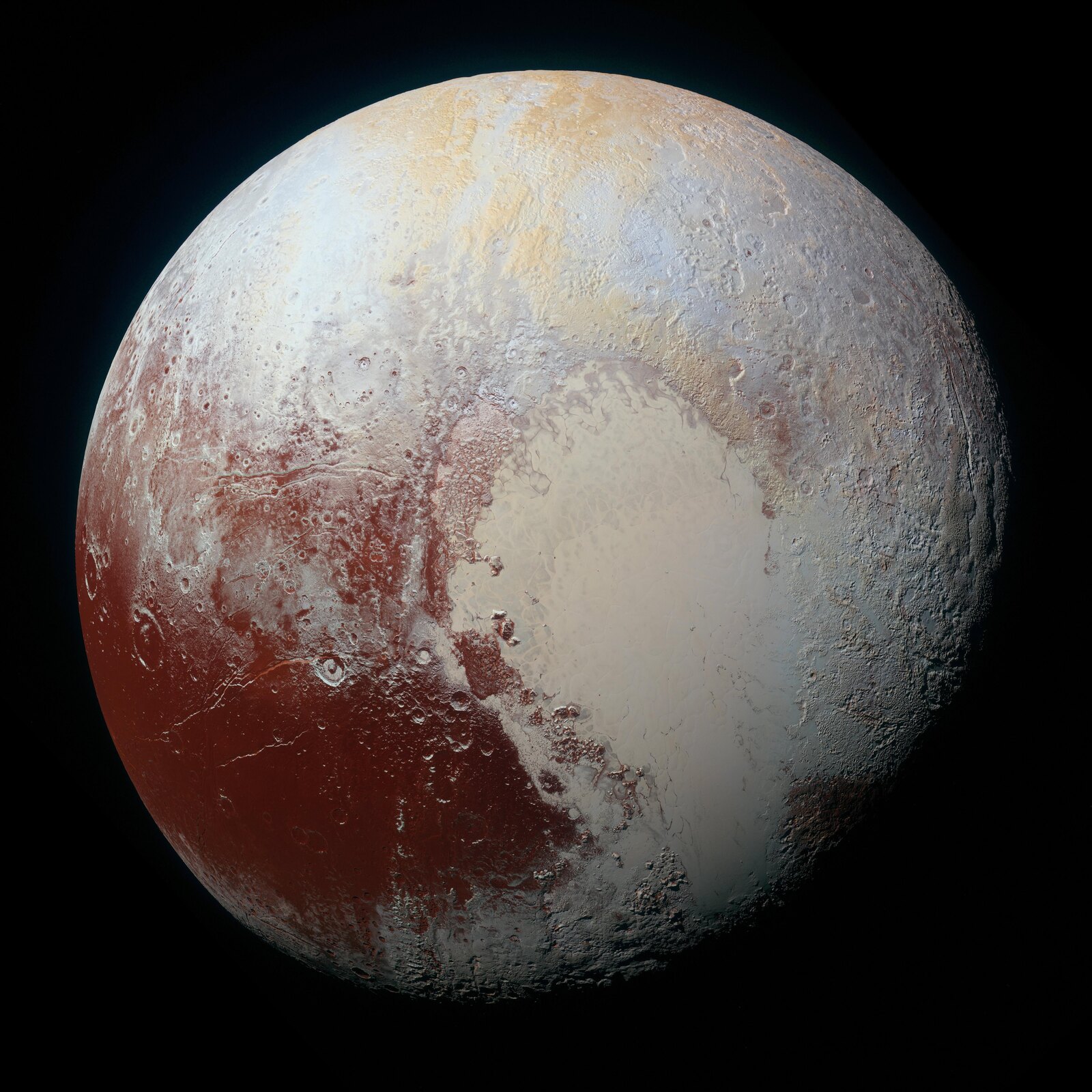
Titan and Pluto are not easy places to read. Titan hides its surface under a thick orange haze. Pluto has a much thinner atmosphere, but it is small, cold and very far away. Neither world is in the habit of making itself convenient.
JWST found a way through, at least partly. Around five micrometers in the infrared, Titan’s haze opens a narrow enough window for surface light to get out. In that window, astronomers saw a small absorption feature near 5.11 micrometers. The same feature appears on Pluto.
That is the real result. Two distant icy worlds, very different atmospheres, the same missing bit of light.
The tempting version is obvious: a mysterious substance on Titan and Pluto. The better version is more precise, and more interesting. This is a measured spectral fingerprint whose carrier is not yet matched to published laboratory spectra. There is a line in the data. There is not yet a secure name in the catalogue.
That distinction matters. An unidentified feature is not a magic compound. It is a problem handed to spectroscopists: find which ice, mixture, grain size, radiation history or laboratory condition can make this mark.
How spectroscopy reads ice
Spectroscopy works by looking at light after matter has had a chance to remove some of it. A surface reflects incoming light, but molecules and solids absorb particular wavelengths according to their structure and physical state. In a spectrum, those missing wavelengths show up as dips or bands.
That makes a spectrum a kind of imperfect fingerprint. The next step is comparison: take the observed band and check it against laboratory spectra of candidate ices measured under relevant conditions. If one candidate matches the position, width and companion bands, you have an identification. If none matches, you do not have a monster under the ice. You have a real fingerprint without a secure name.
What they found
A real absorption band appears on Titan. In both JWST instruments, Titan shows an absorption centered at about 5.113 micrometers (1956 cm⁻¹). The feature is about 5.8% deep in the NIRSpec data and 7.5% deep in the MIRI data. In the NIRSpec spectrum recorded on Titan’s trailing side, its width is about 0.024 micrometers.
Pluto shows a similar feature. In the MIRI spectrum of Pluto, an absorption appears at essentially the same wavelength. It is shallower, about 4.5% deep, and roughly three times broader than the Titan feature.
The signal most likely comes from the surface region. On Titan, the band is about half as deep near the limb as at disk center. A haze feature should generally grow toward the limb, because the line of sight passes through more haze. This one weakens. The same feature also appears on Pluto, whose atmosphere is far thinner. Together, those facts point toward the ground, or possibly a thin condensate layer just above it — not the high haze.
The carrier is not identified. The authors compared the band with published laboratory spectra of ices relevant to Titan and Pluto chemistry. None matched well enough. Acetylene is the closest provisional candidate, but it has a problem: if acetylene were responsible, another band expected near 4.83 micrometers should also appear, and it does not. Other candidates, including propadiene, benzene mixtures and ketene, remain possible but not secure. HCN is ruled out.
So the answer is not “unknown substance discovered.” It is: the observed feature is real, likely surface-related, and not yet matched to a known laboratory spectrum under the right conditions.
What this does not prove
- It does not show an exotic or previously impossible substance. “Unidentified” means unmatched, not supernatural.
- It does not point to biology. Nothing in the feature, the setting or the authors’ interpretation supports that leap.
- It does not prove Titan and Pluto have the exact same compound. The shared wavelength is suggestive, but the different width on Pluto could reflect grain size, mixing, irradiation or physical state.
- It does not securely identify acetylene or any other candidate. Acetylene remains the nearest provisional match, not the answer.
- It does not mean Dragonfly will settle this directly. The next Titan mission is not carrying an infrared surface spectrometer able to see this band.
How strong is the evidence?
For the existence of the band, the evidence is strong. On Titan it appears in two independent JWST instruments, NIRSpec and MIRI. It is absent on Ganymede at the same wavelength, which argues against an instrumental artifact. Pluto shows a similar absorption in its own MIRI spectrum.
For the surface-region origin, the evidence is also good. The center-to-limb behavior on Titan is the cleanest argument: a haze feature should become stronger toward the limb, but this band becomes weaker. Pluto’s much thinner atmosphere gives the same interpretation another push. The authors leave room for a thin layer of condensate just above Titan’s surface, but that is still a near-surface explanation, not a high-atmosphere one.
For the chemical identification, the evidence is deliberately weak because the authors keep it weak. They do not claim a secure carrier. They list plausible candidates and then explain why each is incomplete. That restraint is not a flaw in the paper. It is the paper doing its job.
The limits are clear. This is a short letter. The MIRI data are noisier than the NIRSpec data. The exact width of the feature, especially on Titan’s leading side and on Pluto, needs more data. Laboratory spectra of candidate ices under the relevant temperatures, mixtures and radiation histories are incomplete. The bottleneck is not only telescope sensitivity. It is the library used to name the thing the telescope saw.
Why it matters
The outer Solar System is full of cold organic chemistry, but its surfaces are hard to read. Titan’s haze blocks much of the view. Pluto is distant and faint. A small, repeated absorption band in the right infrared window is therefore useful even before it has a name.
It tells researchers where to look. A feature at 5.11 micrometers, seen on both Titan and Pluto and probably tied to their surfaces, narrows the problem. Laboratory chemists can test candidate ices and mixtures. Observers can map whether the band changes across Titan’s disk or Pluto’s surface. The result becomes a coordinate for future work.
It also shows why careful language matters. The public version of this story almost writes itself as mystery. The scientific version is better: two worlds show a shared spectral clue, and the clue survives several checks, but the dictionary is missing the entry.
That is not less wonder. It is cleaner wonder. A telescope has noticed the same small absence of light on two distant worlds. Now someone has to teach the laboratory catalogue how to say its name.
Clean summary
JWST spectra of Titan and Pluto show an absorption feature near 5.11 micrometers. On Titan, the band appears in both NIRSpec and MIRI data, is about 5.8-7.5% deep, and weakens toward the limb, which points to a surface-region origin rather than high haze. Pluto shows a similar feature at the same wavelength, though shallower and broader. The band is absent in a control spectrum of Ganymede and does not match any published laboratory spectrum of expected ices well enough for identification. Acetylene is the closest provisional candidate, but a companion band expected near 4.83 micrometers is missing. The result is a real, probably surface-related spectral fingerprint whose carrier is unidentified — not evidence for an exotic substance, biology, or a solved chemical detection.
No-BS check
What the paper shows: JWST detected a real absorption band near 5.11 micrometers on Titan and Pluto. The evidence is strong that the feature is not an instrument artifact and good that it originates at or very near the surface.
What is plausible but not proven: That the carrier is an ordinary frozen organic compound present on both worlds; that different grain size, mixing, irradiation or physical state explains the broader Pluto band; that laboratory spectra under the right conditions will eventually identify it.
What it does not show: A new exotic substance; a biological signal; a secure identification of acetylene or any other compound; proof that Titan and Pluto share exactly the same surface chemistry.
Main limitations: Short letter; noisy MIRI data; incomplete laboratory spectral catalogues; no direct identification; more JWST mapping and laboratory work needed.
How much confidence should a general reader have? High that the 5.11-micrometer feature is real. Good that it comes from the surface region. Low that anyone yet knows exactly what compound makes it. Appropriate stance: a well-measured clue, not a mystery sold as a discovery.
Sources
Based on: An unidentified absorption feature at 5.11 micrometers on the surface of Titan and Pluto from JWST spectroscopy — B. Bézard, E. Lellouch, M. Camarca, J. I. Lunine, E. Quirico, C. A. Nixon, N. A. Teanby, P. Rannou, S. Rodriguez, M. Es-Sayeh, S. K. Trumbo, A. C. Souza-Feliciano, P. Lavvas, T. Bertrand, I. Wong, N. Pinilla-Alonso, and G. L. Villanueva, Astronomy & Astrophysics (accepted, 2026).
Written by
Cinzia Vaglio , Vera Rubin · figures and links by
Lucio Vaglio · edited by
Michele Renda
, Vera Rubin · figures and links by
Lucio Vaglio · edited by
Michele Renda
Editorial note
This article was prepared with AI assistance and human editorial review. It is a clear, conservative explanation of the linked work, not a substitute for reading it. Responsibility for selection, interpretation, and final wording rests with the editor.