A new branch on the tree of RNA-guided machines
Every so often a biology paper arrives wearing a headline it never asked for. This one’s was “a new CRISPR.” The work behind it is more interesting than that — and, as usual, more modest.
Start with the thing CRISPR made famous: an RNA-guided system. The trick is that the protein does not have to be hard-wired to recognise one target. Instead it carries a short piece of RNA — a guide — and goes wherever that guide’s sequence matches. Change the guide, change the target. That programmability is the whole reason CRISPR became a tool. But CRISPR is not the only RNA-guided system in nature, and the question this paper asks is the patient one: how many other kinds are out there, and what can they teach us?
To go looking, the authors did not search for matching gene sequences — those drift too much over evolutionary time to reveal distant relatives. They searched for shapes. Starting from the part of CRISPR’s Cas9 protein that grips its guide RNA, they hunted through databases of predicted protein structures for anything built the same way. That trail led — by way of a bacterial “jumping gene” and a piece of machinery that ordinary cells use to chemically tweak their own RNA — to something genuinely new.
What they found
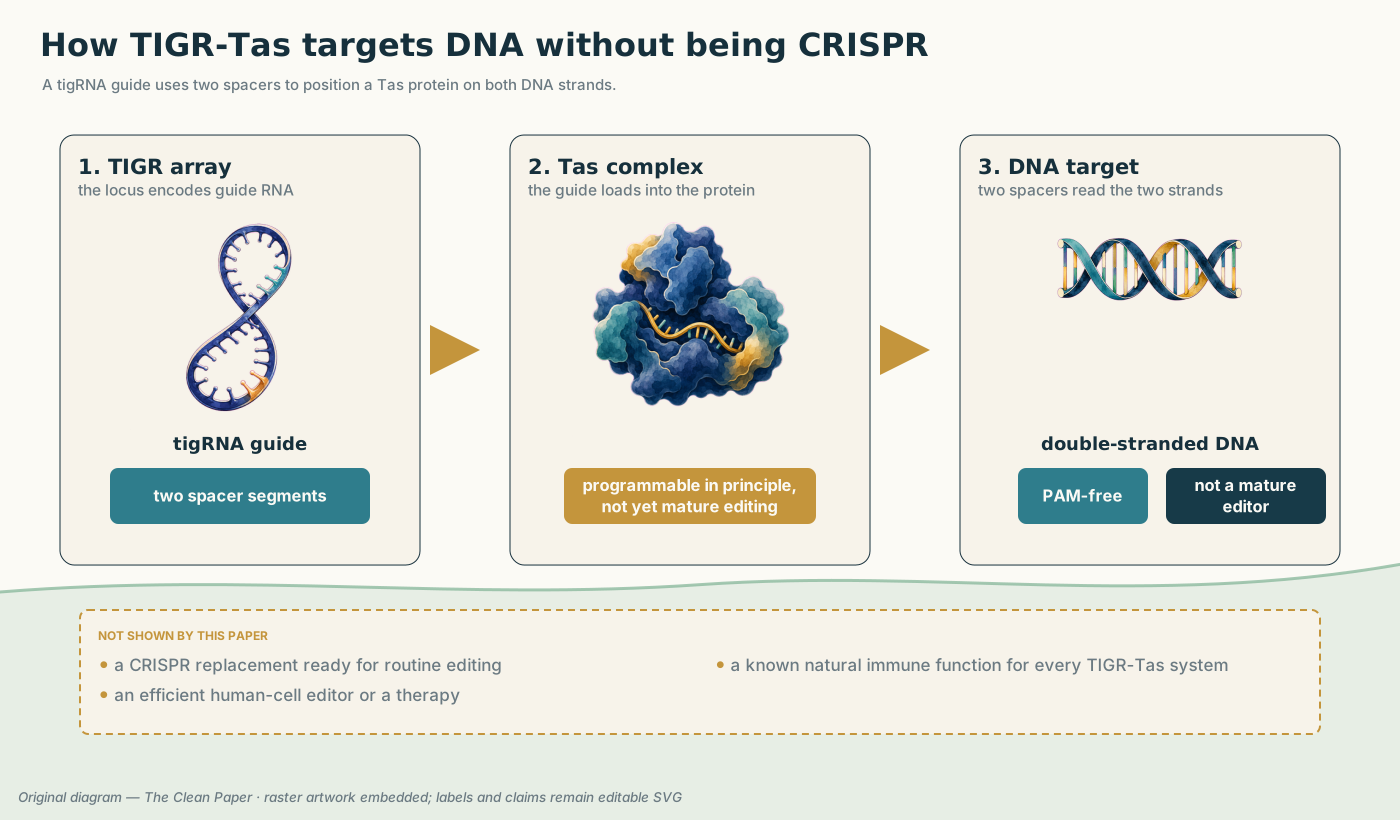
The guide comes in two pieces. The TIGR array is processed into short RNAs of about 36 letters, each carrying two separate targeting segments. One segment reads one strand of the target DNA; the other reads the opposite strand. The two work in tandem to pin down a site. This is a real mechanistic departure from CRISPR, whose guide matches a single strand in one continuous stretch.
And it needs no “landing pad.” Many CRISPR nucleases can only cut next to a short, specific DNA motif (a “PAM”) sitting beside the target — a constraint that limits where they can aim. The TIGR systems showed no such requirement: they relied on the target sequence alone. A system that does not need a PAM can, in principle, be pointed at more places.
The cutting versions cut, precisely. Guided by the little RNA, the RuvC- and HNH-bearing Tas proteins made clean, sequence-specific breaks in DNA — and did nothing without the guide.
One version could be programmed to edit human cells — barely. Moved into human cells in a dish and aimed at six different genes, a Tas protein did make edits, confirming the system is programmable in our cells too. But the efficiency was low: at best a few percent of cells. For comparison, today’s optimised CRISPR tools routinely edit a large fraction of the cells they are put into. This is a proof that it can work, not a tool that works well.
The structure explained the mechanism — and hinted at its origins. The imaged complex is a mirror-symmetric pair of proteins clasping the figure-eight-shaped guide RNA, with the target DNA bent through a sharp turn. Strikingly, that architecture closely resembles a machine found in our own cells’ relatives — the box C/D “snoRNP,” which guides chemical edits to RNA rather than cutting DNA.
Its natural job is unclear. When the authors expressed one system in E. coli, it did not fend off invading viruses or plasmids — the day job of CRISPR. Instead it gradually purged a targeted plasmid over many generations, hinting that its real role may lie in slow competition between mobile pieces of DNA rather than front-line immune defence. But this was a borrowed, artificial setting, and the honest answer is that nobody yet knows what these systems do in the wild.
What this probably means
Two things, held at different levels of confidence.
The solid one: the known world of RNA-guided systems is larger and more varied than CRISPR and its recently found cousins. TIGR-Tas is a genuinely distinct branch, with its own two-part, PAM-free way of recognising DNA. That is a real addition to the map.
The deeper, more speculative one: because the TIGR machinery is built like the snoRNP that edits RNA in cells like ours, and like a known “jumping gene,” it may mark an evolutionary link between RNA-guided RNA-modifying systems and RNA-guided DNA-targeting systems — a possible missing piece in the story of how programmable RNA guides arose across life.
What this does not prove
- It is not a ready gene-editing tool. Editing in human cells was demonstrated but feeble — a few percent at best. That is proof of programmability, not a mature editor, and a long way from anything clinical.
- It is not “CRISPR 2.0.” Measured as a tool today, CRISPR-Cas9 vastly out-edits it. TIGR-Tas is a new architecture at the proof-of-concept stage, not a better version of an existing product.
- Its biological role is unknown. It did not act as an anti-virus immune system in the one test of that idea; “a new bacterial immune system” is not established.
- Much of the basic mechanism is still open — including how the guide RNA is cut to its final length, and what these systems actually target in nature (most live in microbes we can barely culture).
- There is nothing therapeutic here. This is discovery and characterisation in microbes and cell culture — no disease, no treatment, no patient.
How strong is the evidence?
The discovery itself is on firm ground, and unusually well-rounded: it rests on large-scale structural mining, then laboratory confirmation of how the RNA is made and how it finds and cuts DNA, then a near-atomic structure of the complex in the act, plus the human-cell test. The claim “this is a new, distinct, RNA-guided DNA-targeting family” is well supported from several directions at once.
What is early is everything about usefulness: the editing works but barely, and all the optimisation that turned CRISPR from curiosity into tool is, for TIGR, still ahead. And what is inferential is the rest of the story — the natural role is a reasonable guess from an artificial experiment, and the evolutionary link, though elegant, is an argument from shared structure, not a settled history. The paper is careful about which is which.
Why it matters
Several previous widenings of the RNA-guided catalogue have eventually paid off. The systems behind today’s tools — Cas9, Cas12, Cas13, and more recently the smaller IscB/OMEGA proteins and the eukaryotic Fanzors — were each, at first, just newly described biology. None arrived as a finished tool. A system with a two-part guide and no PAM requirement is a genuinely different starting point, and PAM-free targeting is exactly the kind of flexibility tool-builders prize.
But the quieter result may matter more than the tool prospect. By tying a DNA-cutting system to the RNA-editing snoRNP machinery and to a jumping gene, the work sketches a possible thread connecting very different RNA-guided systems across the tree of life. That is the kind of finding that reorganises how a field understands where its tools came from — which is worth more, in the long run, than another headline about scissors.
Clean summary
By searching for protein shapes rather than sequences, researchers discovered TIGR-Tas: a previously unknown family of RNA-guided DNA-targeting systems, found mostly in bacterial viruses and parasitic bacteria. Its guide RNA is unusual — about 36 letters carrying two separate targeting segments that read opposite strands of the DNA — and, unlike CRISPR, it needs no adjacent “PAM” motif. The DNA-cutting members cut precisely, one could be programmed to edit human cells (though only at a few percent efficiency), and a near-atomic structure revealed a complex built like the snoRNP machinery that edits RNA in our own cells — suggesting a deep evolutionary link between RNA-guided RNA-modifying and DNA-targeting systems. It is a real expansion of RNA-guided biology and a possible new chassis for future tools — a basic-science discovery and proof of concept, not a mature gene editor, not “CRISPR 2.0,” and not a therapy. Its natural job in the wild remains unknown.
No-BS check
What the paper shows: A new, distinct family of RNA-guided DNA-targeting systems (TIGR-Tas) in prokaryotes and their viruses, found by structural mining; a two-segment, PAM-free guide RNA (~36 nt) that targets both DNA strands in tandem; precise RNA-guided DNA cleavage by the nuclease-bearing members; programmable editing in human cells at low efficiency (up to a few percent); a near-atomic cryo-EM structure; and structural/evolutionary links to box C/D snoRNPs and IS110 transposons.
What is plausible but not proven: The systems’ natural biological role (a non-defence role in mobile-element competition is suggested by one artificial experiment); the proposed evolutionary bridge between RNA-modifying and DNA-targeting RNA-guided systems (a structural argument).
What it does not show: A mature or high-efficiency gene-editing tool; superiority to CRISPR as a tool; a confirmed natural function; how the guide RNA is matured; any therapeutic application.
Main limitations: Human-cell editing efficiency is low (proof of concept only); most systems live in hard-to-study metagenomes, so natural targets are largely unknown; the biological-role and evolutionary-origin claims are inferential; characterisation is in microbes and cell culture, not any disease context.
How much confidence should a general reader have? High that this is a genuine, distinct new family of RNA-guided DNA-targeting systems with a novel two-part, PAM-free mechanism, and that the structural and evolutionary insights are real. High that it is not a ready gene-editing tool, not “CRISPR 2.0,” and not a therapy. Low on its natural role and on how far it will go as a tool. Appropriate stance: genuine excitement about new biology and a possible evolutionary missing link — and patience about the applications, which are at the very beginning.
Source
Based on: TIGR-Tas: A Family of Modular RNA-Guided DNA-Targeting Systems in Prokaryotes and Their Viruses — Guilhem Faure, Makoto Saito, Max E. Wilkinson et al.; Feng Zhang (corresponding author), Science 388, 6746, eadv9789 (2025).
Written by
Lucio Vaglio · figures and links by
Laura Nesso · edited by
Michele Renda
· figures and links by
Laura Nesso · edited by
Michele Renda
Editorial note
This article was prepared with AI assistance and human editorial review. It is a clear, conservative explanation of the linked work, not a substitute for reading it. Responsibility for selection, interpretation, and final wording rests with the editor.