The “first synthetic cell” story, stripped back to droplets
The headlines are enormous: the world’s first synthetic cell with a complete life cycle, life built from non-living matter, a “Sputnik moment” for biology. The paper underneath is quieter, and honestly more interesting than the slogans. A team at the University of Minnesota reports a microscopic fatty droplet — the kind of greasy bubble that cell membranes are made of — that carries a set of genetic instructions and can feed by fusing with smaller supply droplets, copy those instructions, grow, and split into daughter droplets, over several rounds. In one experiment, a helpful change in the instructions spreads through the population because the droplets carrying it reproduce faster.
That is a real advance, in a specific and honest sense: building a cell-like system from the bottom up, out of known parts, and getting the basic moves of a cell cycle to run together in one place. It is also a preprint that has not yet been through peer review, and — in the authors’ own words — it is not a self-sufficient organism and not spontaneous Darwinian evolution. The clean version is not “life was created from scratch.” It is: for the first time, researchers ran a full cell-cycle routine inside a fully defined synthetic droplet, using purified biological parts.
What they found
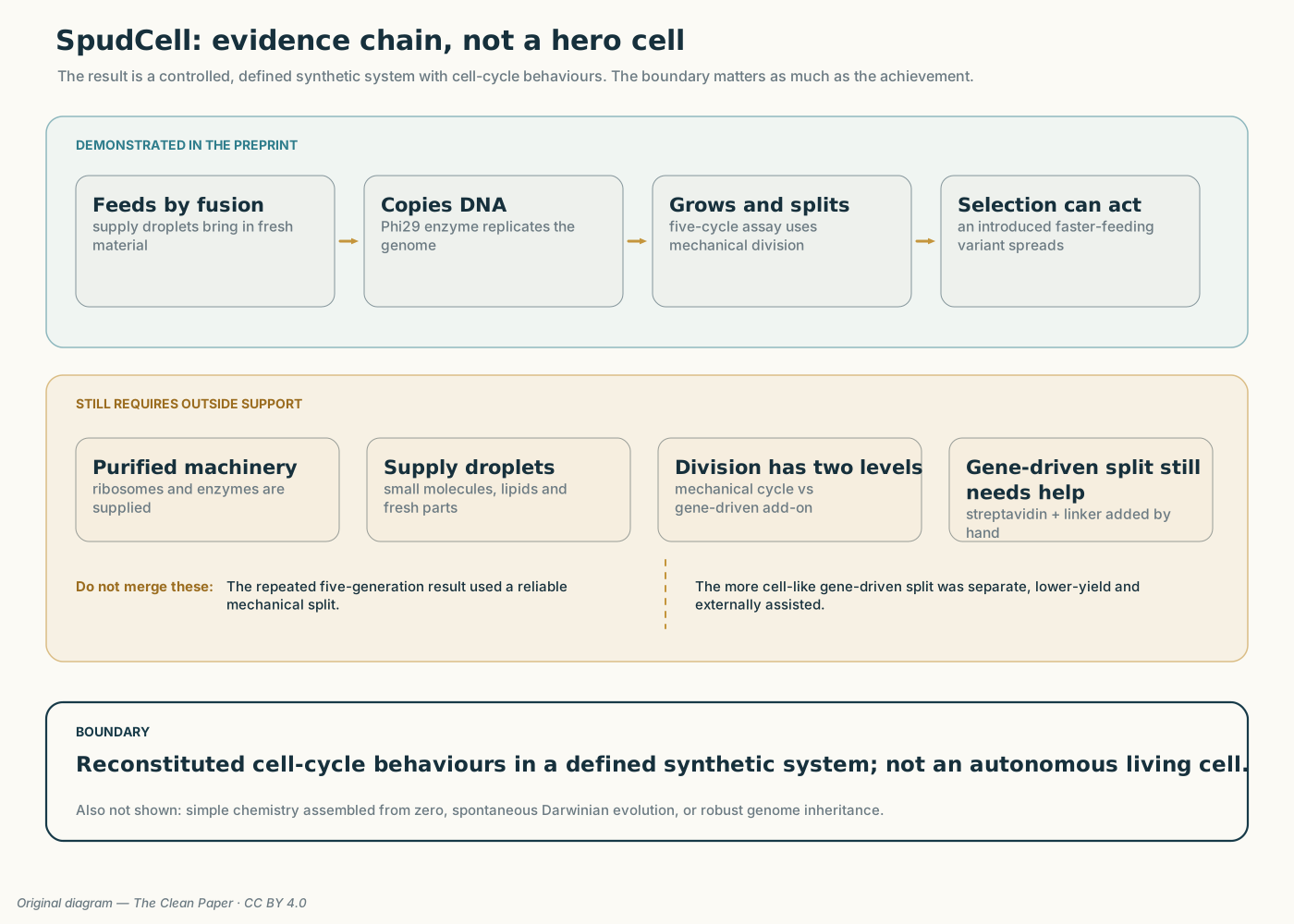
The full cycle runs together. Across five “generations,” the droplets fed, replicated their DNA, grew, and divided as a repeating routine, rather than as separate one-off demonstrations. Getting these steps to work in the same defined system, coupled to the cell’s own gene expression, is the paper’s core result.
Feeding and division can be driven by the genes. The cell can make the protein that drives its own feeding and — in a separate, lower-yield demonstration that still needs extra ingredients added by hand — the protein that drives its own division. It is a step toward a system that runs on its own instructions rather than on the experimenter’s hands.
A beneficial change spreads by selection. A variant with a stronger “on-switch” for the feeding protein (a more active promoter) grows faster, leaves more descendants, and, under scarcity, outcompetes the original. That is a genuine link from a genetic change to reproductive success inside a synthetic system.
Inheritance is imperfect. After five generations, only a minority of the analysed cells still carried the complete set of all seven DNA loops. Sharing the genome cleanly between daughter droplets is not yet reliable.
What runs on its own — and what doesn’t
The word carrying the most weight in the headlines is complete. In the paper, a “complete cell cycle” means the operational steps — feed, replicate, grow, divide — were reconstituted and measured together. It does not mean the cell is self-sufficient. Two limits matter, and the authors state both.
First, the cell cannot make its own protein-building machinery. The ribosomes and most enzymes are supplied — purified in advance and fed in — not manufactured by the cell. In the authors’ framing, the system has a very limited metabolism and cannot make ribosomes; real metabolic independence would require a much larger genome. So the droplet runs a cell cycle, but it does not run its own biochemistry from scratch.
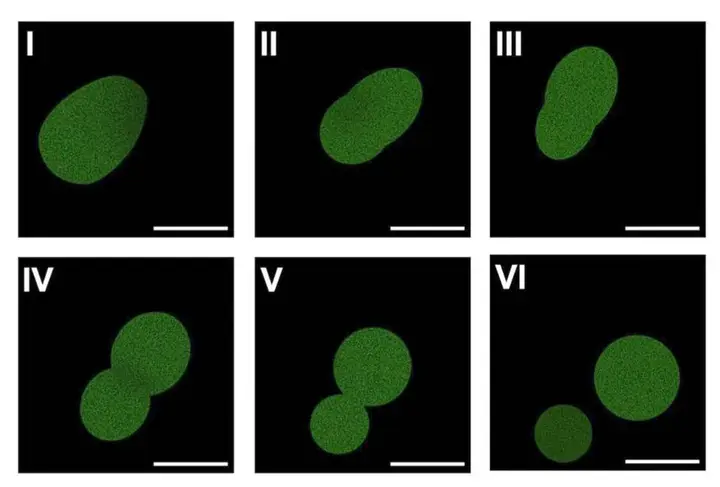
Second, the everyday division is mechanical. In the five-generation experiments, the droplets are split by being pushed through a fine filter — a method chosen because it reliably yields daughters. The more cell-like, gene-driven division (where a protein the cell makes drives the split) is shown separately, needs extra ingredients added from outside (a bridging system: streptavidin and a linker), and works at lower yield. The authors are explicit that a more robust, higher-yield, controllable division still needs work — probably a synthetic internal skeleton the cell does not yet have.
This is why the figure keeps the two kinds of division apart: the headline five-generation cycle uses the mechanical split; the gene-driven split is a promising but fragile add-on.
Selection, not spontaneous evolution
The selection result is elegant, and worth stating precisely. A beneficial change — the stronger feeding “on-switch” — makes cells grow faster, so they leave more descendants, so the change spreads. That is real selection acting on a heritable difference.
But the change did not arise on its own. The authors put it there. In their own words, the beneficial mutation did not appear spontaneously in the population but was introduced artificially, which is different from natural Darwinian evolution; letting mutations arise on their own is named as future work. So: selection and competition for resources, yes. Open-ended, spontaneous evolution, not yet.
What this does not prove
- It does not show a cell created from non-living chemistry. The parts are purified biological components — ribosomes and enzymes from living organisms, a viral copying enzyme — assembled into a defined droplet. “Chemically defined” means fully specified, not synthesized from scratch; the paper’s own Figure 1 describes the cells as assembled from individually purified natural components.
- It does not show a self-sufficient organism. The cell cannot make its own ribosomes or run its own metabolism; it depends on supplied machinery and on the feeder droplets.
- It does not show spontaneous evolution. The beneficial mutation was introduced by the researchers, not generated by the system.
- It does not show robust inheritance. Only a minority of cells kept the full genome after five generations.
- It does not show a cell-driven division as the standard mechanism. The repeating five-generation cycle relies on mechanical splitting; the gene-driven division is lower-yield and externally assisted.
- It is not peer-reviewed. This is a preprint; per Science’s reporting it was rejected by Cell and peer review is said to be underway elsewhere. Treat the specific numbers as provisional.
How strong is the evidence?
For the central claim — that a defined synthetic droplet can run the operational steps of a cell cycle, coupled to its own gene expression, across several generations — the paper presents direct, quantified demonstrations, and the claim is bounded and specific. On its own terms, it is a substantial piece of engineering.
For self-sufficiency and evolution, confidence should be low, and here the authors agree: the system is not metabolically independent, and it does not evolve spontaneously.
For the exact numbers — generation counts, the fraction of cells retaining the full genome, division yields — treat them as provisional, because the work has not been peer-reviewed. A preprint is a first draft in public, not a verified result.
What the public-facing story adds — and why that matters
Here the interesting gap is not between the paper and reality. It is between the paper and the package built around it.
The manuscript’s own language is measured. It calls the work a step toward the minimum components needed for life, a possible “chassis” for future systems, a “foundation for fully artificial organisms” — and it hedges the big applications with words like ultimately and may. The University of Minnesota press release leads instead with “the world’s first synthetic cell with a complete life cycle” that “could revolutionize” biology, describes the cell as built from non-living components, and lists applications across medicine, materials, and industry. The caveats are present — but they arrive after the breakthrough frame, where they can no longer act as a brake.
None of this needs an assumption of bad faith. Sharing results before peer review can be a legitimate, even generous, choice: it lets other labs examine the methods and try to reproduce them sooner, which is the reason the authors give. A rejection from a high-profile journal does not mean the work is weak — ambitious, retraction-risk results are genuinely hard to place, and the fear of being scooped is real. Those pressures are human, and understandable.
But precisely because the communication was so loud, and arrived before peer review, the duty of precision goes up, not down. The order is the whole point. A press release chooses the maximal reading first and adds the limits later. The clean version does the opposite: it states the evidence and its status first, and only then the ambition. That habit — evidence and status before ambition — is something a reader can carry to the next “breakthrough,” not just this one.
Clean summary
A University of Minnesota team reports a fully defined synthetic cell: a fatty droplet carrying a ~90,000-base genome and a purified protein-building system, which feeds by fusing with supply droplets, copies its DNA, grows, and divides across five generations. They show that a beneficial genetic change, introduced by the researchers, spreads through the population by selection, and that both feeding and division can be driven by the cell’s own genes. The parts are purified biological components assembled into a defined system, not chemistry built from scratch; the cell cannot make its own ribosomes or run its own metabolism; the routine five-generation division is mechanical, while the gene-driven division is lower-yield and externally assisted; the beneficial mutation was introduced rather than arising spontaneously; and inheritance of the full genome is imperfect. The work is a preprint and has not been peer-reviewed.
No-BS check
What the paper shows: A defined synthetic droplet that feeds (via genetically encoded fusion with supply droplets), replicates its ~90 kbp genome, grows, and divides across five generations; a separate demonstration of gene-driven division; and selection of an introduced beneficial mutation, including competition under scarce resources.
What is plausible but not proven (pending peer review): The exact generation counts, division yields, and the fraction of cells retaining the full genome; the robustness and reproducibility of the full cycle across labs.
What it does not show: A cell built from non-living chemistry; a self-sufficient organism; spontaneous mutation or open-ended Darwinian evolution; robust inheritance of the genome; a cell-driven division as the standard mechanism; readiness of the medical, materials, or industrial applications named in the press materials.
Main limitations: No peer review yet; no metabolic independence (ribosomes and enzymes are supplied); the headline cycle uses mechanical division; gene-driven division is lower-yield and needs added components; imperfect genome inheritance.
How much confidence should a general reader have? Reasonably high that the authors ran the operational steps of a cell cycle together inside a defined synthetic droplet — a real engineering result, though it awaits peer review. Medium-to-low on the precise numbers, until peer review. Low that this is a living, self-sufficient, or self-evolving cell — the authors themselves say it is not. Appropriate stance: an impressive step in building cells from known parts, not the creation of life.
Sources
Based on: A Chemically Defined Synthetic Cell Capable Of Growth And Replication — Nathaniel J. Gaut, Christopher Deich, Brock Cash, Tanner Hoog, Aaron E. Engelhart, Katarzyna P. Adamala, Preprint (not peer-reviewed) — University of Minnesota.
- Preprint — Gaut, Deich, Cash, Hoog, Engelhart & Adamala — 'A Chemically Defined Synthetic Cell Capable Of Growth And Replication', author-hosted preprint (not peer-reviewed), 2026
- Article — Science — news coverage of the synthetic-cell preprint (2026)
- Source — University of Minnesota — press release
This article is based on an author-hosted preprint that has not been peer-reviewed. According to Science's reporting, the manuscript was previously rejected by Cell and peer review is said to be underway elsewhere; treat the specific figures as provisional. Quotations are from the preprint text; the final section compares the preprint's own wording with the University of Minnesota press release.
Written by
Lucio Vaglio · figures and links by
Laura Nesso · edited by
Michele Renda
· figures and links by
Laura Nesso · edited by
Michele Renda
Editorial note
This article was prepared with AI assistance and human editorial review. It is a clear, conservative explanation of the linked work, not a substitute for reading it. Responsibility for selection, interpretation, and final wording rests with the editor.