The slow route to being good
If you force a three-year-old to decide quickly whether to share, cooperate or tell the truth, what do you expect to happen?
The easy story says impulse is selfish and reflection is moral. The child grabs the candy; the older, more thoughtful child learns restraint. This paper complicates that story. In a large sample of Italian-speaking children, the youngest children were more prosocial when they answered fast than when they had to wait. The older children did not become less prosocial under intuition. What changed was the slow side: deliberative prosociality rose with age until it caught up.
That is the important shape of the result. It is not “children are born good.” It is not “thinking makes children selfish.” It is a developmental claim: early prosocial responses appeared in fast choices and stayed roughly stable, while prosocial choices made under delay strengthened across childhood.
What they found
The main result is a crossover in how fast and slow prosocial choices develop.
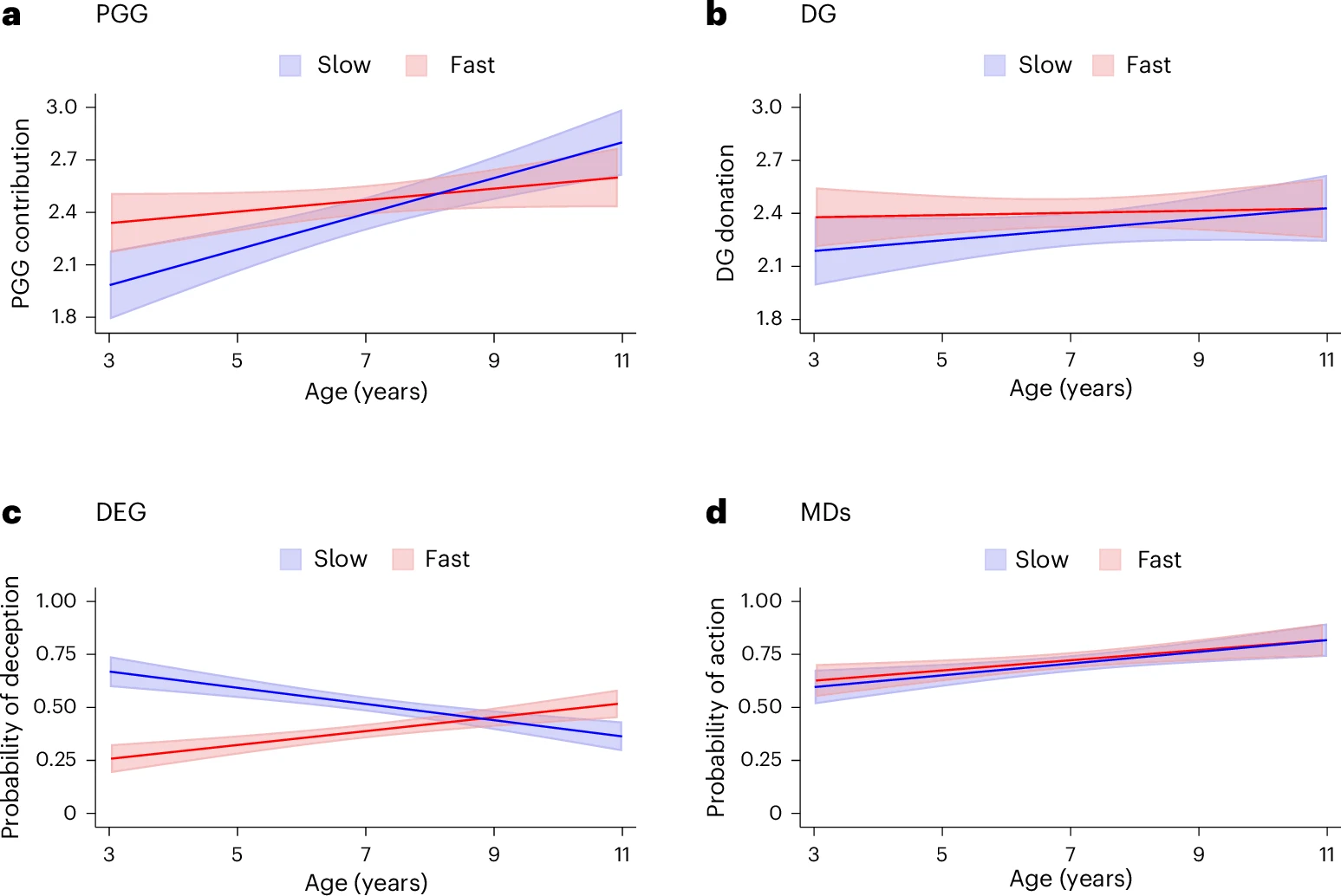
At age 3, children in the fast condition scored higher on the Prosociality factor than children in the slow condition. The reported effect was beta = 0.66 with a 95% confidence interval from 0.35 to 0.97 (guide). In plain language: among the youngest children, the quick-choice condition was associated with more prosocial behaviour.
That fast prosociality did not show clear evidence of increasing or decreasing with age. The authors report no strong evidence for an age trend in intuitive Prosociality.
The slow condition was different. Deliberative Prosociality increased with age (beta = 0.09, 95% CI 0.04 to 0.13). As children grew older, the gap between fast and slow choices narrowed. By ages 9 to 10, the paper found no significant difference between decision modes.
The other two factors behaved differently:
- Social Optimism showed no evidence of varying by age or decision mode.
- Acquiescence declined with age, especially under time delay: older children were less broadly willing to accept others’ offers.
The task-level results add texture. The fast condition was linked to more cooperation in the youngest children in the Public Goods Game and to more honesty in the Deception Game. It did not clearly make young children more altruistic in the Dictator Game. The paper is therefore not saying “intuition makes every prosocial behaviour stronger.” It is saying that a broad prosocial factor, built from several tasks, was higher under time pressure early in childhood, while deliberative prosociality rose with age.
The result is not the slogan
There are two tempting slogans, and both are too simple.
The first is: children are naturally good. The paper does not prove that. The sample was Italian-speaking children from Northern Italy, recruited through schools and kindergartens serving a middle-income population. The authors explicitly warn against broad cultural generalization.
The second is: thinking makes people selfish. The paper does not show that either. Among older children, slow prosocial choices became stronger. The developmental story is not a fall from innocence. It is more like a transfer: what appears early in fast choices becomes increasingly available to reflective decision-making.
That distinction is the piece. The study does not ask whether children are good or bad. It asks how different modes of choice - fast and slow - relate to prosocial behaviour as children grow.
How strong is the evidence?
For the main pattern, reasonably strong. The sample is large for this kind of developmental experiment: 537 children, spread across ages 3 to 10. The design randomized children into fast and slow conditions. The authors did not rely on one game, but combined multiple social tasks and checked whether the pattern survived several robustness tests.
The paper also reports the less exciting checks that matter. The results held when age was grouped into bands rather than treated as a continuous line; when the youngest children were excluded; when children who failed comprehension checks were included; when children who did not comply with the fast condition were excluded; and when the factor structure was estimated separately for younger and older children.
But the limits are real.
First, there was no neutral condition. Children were either pushed to answer quickly or asked to wait. That means the paper compares fast versus delayed choices, not either one against an unconstrained baseline.
Second, the partners were fictitious, although children were led to believe they were real. That is normal for controlled lab games, but it is not the same as watching children negotiate with actual classmates in a live social setting.
Third, the study was not preregistered. The data and materials are available through OSF, but the current study did not lock its analysis plan in advance.
Fourth, the sample is culturally narrow. Northern Italy is not “childhood” in general. Prosocial development can vary across social norms, schooling, family ecology and economic context.
So the safe confidence level is this: high that this sample, under these tasks and time conditions, showed the reported developmental pattern. Lower that the same curve would appear unchanged in other cultures, tasks or real-world interactions.
Why it matters
Adult debates about morality often smuggle in a simple model: impulse is the animal part, deliberation is the civilized part. Developmental psychology makes that model harder to keep.
In this study, the youngest children’s fast choices were not the selfish baseline that reason had to correct. Fast prosociality was already there. The developmental change was that slow, reflective choices became more prosocial with age.
That has a useful implication. Moral development may not be only the suppression of bad impulses. It may also be the process by which children learn to carry early cooperative, honest and other-regarding responses into slower, more deliberate reasoning.
This is a quieter and better story than “children are pure.” It says that prosociality can start as something children do quickly, and become something they can also do deliberately.
Clean summary
Researchers tested 537 Italian-speaking children aged 3 to 10 in social decision tasks involving cooperation, giving, honesty, acceptance of unfair offers and moral dilemmas. Children were randomly assigned either to answer quickly, within 10 seconds, or to wait at least 10 seconds before answering. A factor analysis found three broad patterns: Prosociality, Social Optimism and Acquiescence. The main result was developmental: among the youngest children, fast choices were more prosocial than delayed choices; fast prosociality stayed relatively stable with age; and deliberative prosociality increased with age until the gap closed by about 9 to 10 years. The study does not prove that children are universally or innately good. It shows, in one Northern Italian sample and under specific lab conditions, that early prosocial impulses can be stable while reflective prosocial decision-making strengthens across childhood.
No-BS check
What the paper shows: In a sample of 537 Italian-speaking children, time pressure was associated with higher Prosociality in the youngest children, while deliberative Prosociality increased with age and caught up by late childhood.
What is plausible but not proven: That early prosocial intuitions provide a foundation that children later learn to express through reflection. The pattern fits that interpretation, but the design cannot cleanly separate innate dispositions from early social learning.
What it does not show: That all children are naturally good; that thinking makes children selfish; that the same developmental curve holds across cultures; or that every kind of prosocial behaviour follows the same path.
Main limitations: No time-neutral condition; fictitious partners; a Northern Italian school sample; no preregistration; and lab games that simplify real social life.
How much confidence should a general reader have? Fairly high for the reported pattern inside this study. Moderate for the broader developmental interpretation. Low for any sweeping claim about human nature.
Sources
Based on: Stable intuition and the rise of deliberative prosociality in childhood — Francesco Margoni, Francesco Nava, Chiara Sotis, Matthew R. Levy, Valerio Capraro and Elena Nava, Nature Human Behaviour (2026).
Written by
Cinzia Vaglio
Editorial note
This article was prepared with AI assistance and human editorial review. It is a clear, conservative explanation of the linked work, not a substitute for reading it. Responsibility for selection, interpretation, and final wording rests with the editor.