A southern witness near the end
The last dinosaurs are often told through the northern Great Plains: Montana, the Dakotas, the Hell Creek world. That record is good enough to become familiar, and familiarity has a way of pretending to be completeness. Fossils are not evenly distributed because history was not kind enough to file itself for us.
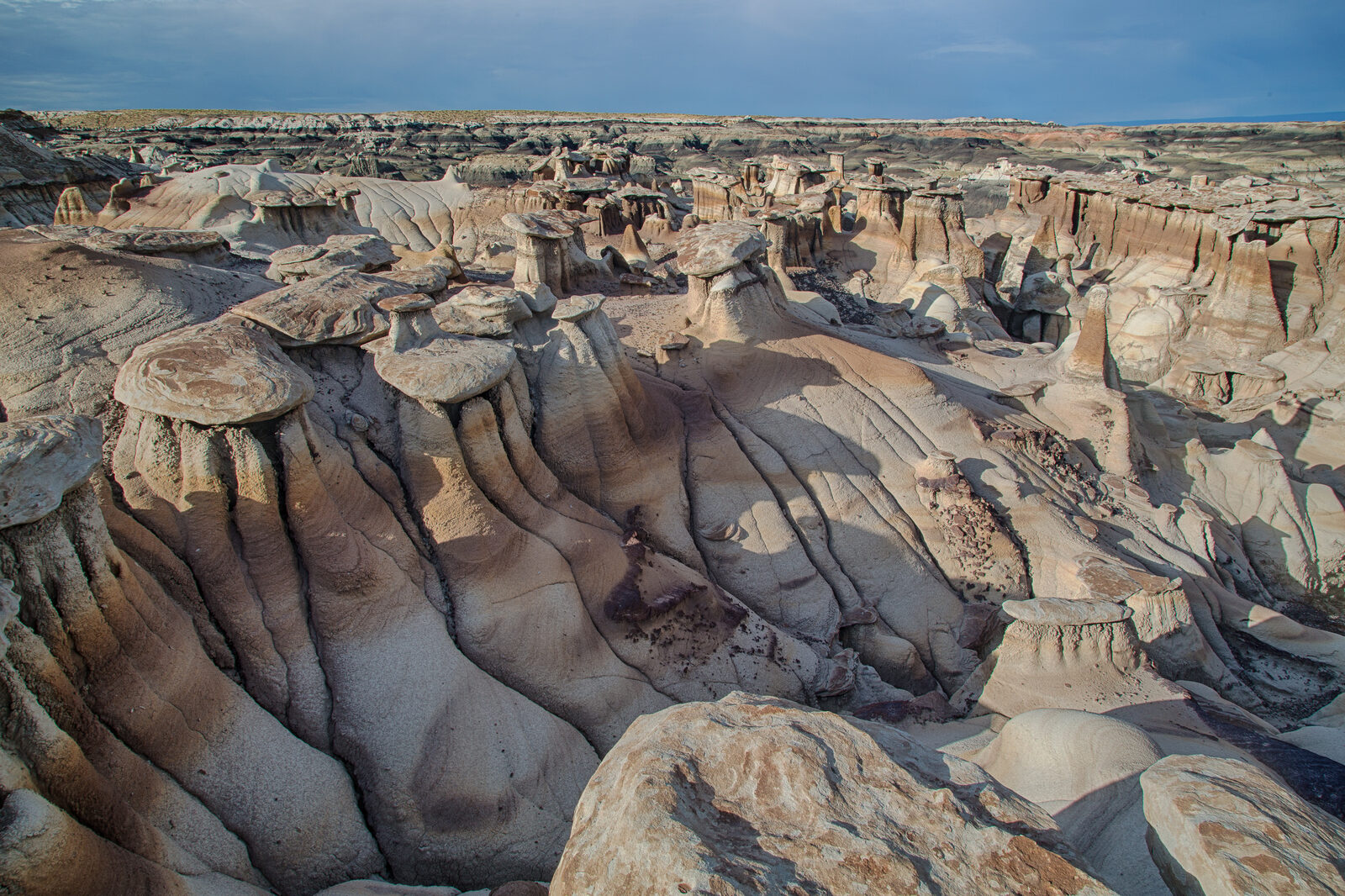
A new Science paper adds a southern witness. The authors studied the Naashoibito Member in the San Juan Basin of New Mexico, a fossil-bearing rock unit whose age has been argued over for decades. If those fossils were older, they would say little about the final moments before the asteroid impact. If they were very late Cretaceous, they would matter a great deal.
The paper’s answer is the second one. Using new geochronology and magnetostratigraphy, the team argues that the main dinosaur-bearing horizons in the Naashoibito Member sit within about 340,000 years of the Cretaceous-Paleogene boundary. That places New Mexico’s dinosaurs close enough to the end to speak to the old question: were dinosaurs already in a long decline, or were many ecosystems still regionally diverse when the impact arrived?
The careful answer is not “dinosaurs were all doing great, then boom.” That sentence has good rhythm and bad manners. The better answer is narrower and more useful: in western North America, a well-dated southern record supports a picture of late dinosaur faunas that were still regionally distinct, not a single low-diversity community fading everywhere at once.
That is enough. It does not need a louder hat.
.jpg)
What does “within 340,000 years” mean here?
The asteroid impact and the Cretaceous-Paleogene boundary are dated to about 66.052 million years ago. The question is where the fossil-bearing rocks sit relative to that line.
The authors did not date dinosaur bones directly and call the matter closed. They dated volcanic mineral grains, especially sanidine, from sandstones in the Naashoibito section using ⁴⁰Ar/³⁹Ar geochronology, and combined those dates with magnetostratigraphy: the record of Earth’s magnetic reversals preserved in rocks.
The short version: one sample gives a maximum depositional age of 66.87 ± 0.04 million years, another dinosaur-bearing sample gives 66.38 ± 0.08 million years, and the magnetic pattern places the upper part of the section in the final reversed-polarity interval of the Cretaceous. Together, those constraints put the main dinosaur-bearing horizons very near the boundary. It is a geological clock, not a stopwatch, but it is close enough to change the argument.
What they found
The dating is the hinge. Two dinosaur-bearing Naashoibito samples carry late Maastrichtian constraints. One sandstone sample, H08-Sand-08, yielded a maximum depositional age of 66.87 ± 0.04 million years. A sample from the “34-Bone Site”, which contains a partial lambeosaurine hadrosaur skeleton, yielded a maximum depositional age of 66.38 ± 0.08 million years. Combined with the magnetic polarity record, the authors place the major Naashoibito dinosaur-bearing horizons within about 340,000 years of the K-Pg boundary.
That makes the San Juan Basin record broadly contemporaneous with the better-known Hell Creek faunas farther north. It also separates the Naashoibito dinosaurs from the earliest Paleocene Nacimiento fauna by about 700,000 years, which matters because nobody wants to accidentally put non-avian dinosaurs on the wrong side of the extinction boundary. That would be untidy, and also wrong.
The ecological result is the other half. Across the latest Cretaceous intervals they analyzed, the authors found evidence for two bioprovinces in western North America. Dinosaurs, when analyzed on their own, separated into two bioprovinces across all latest Cretaceous time intervals in the study. The paper argues that these regional differences did not simply collapse into a single uniform fauna before the asteroid impact.
The driver was not just a line drawn north to south. Their analyses point to temperature as the main factor shaping those bioprovinces in the Cretaceous, with geography playing a secondary role. Warmer southern regions may have favored some animals, such as sauropods, while cooler northern regions favored others, such as hadrosaurines. The point is not that every province was healthier than every other. It is that the late Cretaceous map still had structure.
What this does not prove
- It does not prove dinosaurs everywhere on Earth were thriving until the asteroid hit. The authors are explicit that this is still largely a North American picture.
- It does not erase evidence for decline in some groups, regions or analyses. It pushes against an overly smooth continent-wide story, not against every possible version of stress before extinction.
- It does not show the asteroid was unimportant. The impact remains the main event at the boundary; this paper asks what kind of ecosystems were hit.
- It does not turn New Mexico into a perfect window on the whole planet. It adds a southern data point that had been missing from a record dominated by northern sites.
- It does not make “flourishing until impact” a safe headline. That is the claim at its broadest, not the result at its cleanest.
How strong is the evidence?
For the age of the Naashoibito dinosaur-bearing horizons, the main-text evidence is strong enough to matter. The authors combine radioisotopic dates from detrital sanidine grains with magnetostratigraphy, and the key dates line up with a latest Cretaceous interpretation. The paper also deals directly with the older controversy over whether these fossils were much older, latest Cretaceous, or even Paleocene.
There is still a technical caveat. The detailed geochronology, magnetic interpretation and data tables live in the Science supplementary materials. The main paper gives the necessary claims and numbers, but a final publication pass should check the supplement before treating every methodological detail as closed.
For the broader ecological claim, the evidence is suggestive and useful, but more model-dependent. The authors use occurrence datasets, clustering and resampling to infer bioprovinces. That is the right kind of tool for the question, but it also means the result depends on fossil sampling, taxonomic assignments, time binning and the way absences are handled. Fossil records are data with missing teeth.
The safest reading is therefore split: the New Mexico record is a real and important late Cretaceous southern record; the conclusion that western North America retained regional faunal structure near the end is well supported by the authors’ analyses; the jump from that to global dinosaur health should be resisted.
Why it matters
The old debate about dinosaur decline is not only about dinosaurs. It is about how much weight one fossil record can carry.
If the best end-Cretaceous record comes from the northern Great Plains, it is tempting to let that record stand for the continent, and then let the continent stand for the world. That is efficient. It is also how a regional pattern turns into a global story by taking the elevator without a ticket.
The New Mexico result makes the story less smooth. It says: look south. Here is a dinosaur-bearing unit close to the boundary. Here are faunas that do not simply duplicate the northern ones. Here is evidence that temperature and regional ecology still mattered late in the game.
That does not make the asteroid less catastrophic. If anything, it makes the catastrophe sharper. The impact did not arrive at the end of a single simplified ecosystem. It struck a set of regional worlds that still had their own arrangements.
There is also a quieter lesson in the paper. Good dating changes narrative. A fossil assemblage without a secure age can become a rumor with bones. Put it on the right part of the clock, and the same fossils become evidence.
Clean summary
A Science study re-examines the Naashoibito Member in New Mexico, a dinosaur-bearing unit whose age has long been debated. Using detrital sanidine ⁴⁰Ar/³⁹Ar dating and magnetostratigraphy, the authors constrain major dinosaur-bearing horizons to within about 340,000 years of the Cretaceous-Paleogene boundary, making them among the last known non-avian dinosaurs in North America and broadly contemporaneous with the Hell Creek faunas farther north. They then use ecological and biogeographic analyses of western North American vertebrate occurrences to argue that late Cretaceous faunas retained regional structure: dinosaurs separated into two bioprovinces, and temperature appears to have been a major driver of those differences. The result pushes back against the idea of one low-diversity, continent-wide dinosaur fauna fading uniformly before the asteroid impact. It does not prove global dinosaur health, solve every decline debate, or show that all dinosaurs were flourishing until the end. It shows that a better-dated southern record makes the final North American story more regional, more structured and less smooth.
No-BS check
What the paper shows: The Naashoibito Member dinosaur-bearing horizons in New Mexico are latest Cretaceous, probably within about 340,000 years of the K-Pg boundary, and the western North American vertebrate record supports persistent regional bioprovinces near the end.
What is plausible but not proven: That many dinosaur ecosystems were still robust just before the asteroid impact; that temperature helped maintain distinct northern and southern faunal worlds; that the older idea of a simple continent-wide decline is too smooth.
What it does not show: That dinosaurs everywhere were thriving; that no groups or regions were declining; that the asteroid was not the main extinction trigger; that New Mexico alone rewrites the global end-Cretaceous.
Main limitations: Regional fossil record; model-dependent provinciality analysis; fossil sampling biases; detailed geochronology and occurrence methods still need a final check against the Science supplementary materials.
How much confidence should a general reader have? High that New Mexico now provides an important late Cretaceous southern dinosaur record. Good that western North America retained regional faunal structure near the end. Low that this can be compressed into “dinosaurs were fine everywhere until the asteroid.” The real result is better: the last chapter was not one flat continent-wide story.
Sources
Based on: Late-surviving New Mexican dinosaurs illuminate high end-Cretaceous diversity and provinciality — Andrew G. Flynn, Stephen L. Brusatte, Alfio Alessandro Chiarenza, Jorge Garcia-Giron, Adam J. Davis, C. Will Fenley IV, Caitlin E. Leslie, Ross Secord, Sarah Shelley, Anne Weil, Matthew T. Heizler, Thomas E. Williamson, and Daniel J. Peppe, Science 390, 400-404 (2025).
Written by
Cinzia Vaglio · figures and links by
Lucio Vaglio · edited by
Michele Renda
· figures and links by
Lucio Vaglio · edited by
Michele Renda
Editorial note
This article was prepared with AI assistance and human editorial review. It is a clear, conservative explanation of the linked work, not a substitute for reading it. Responsibility for selection, interpretation, and final wording rests with the editor.