The footprint is not just the hole in the forest
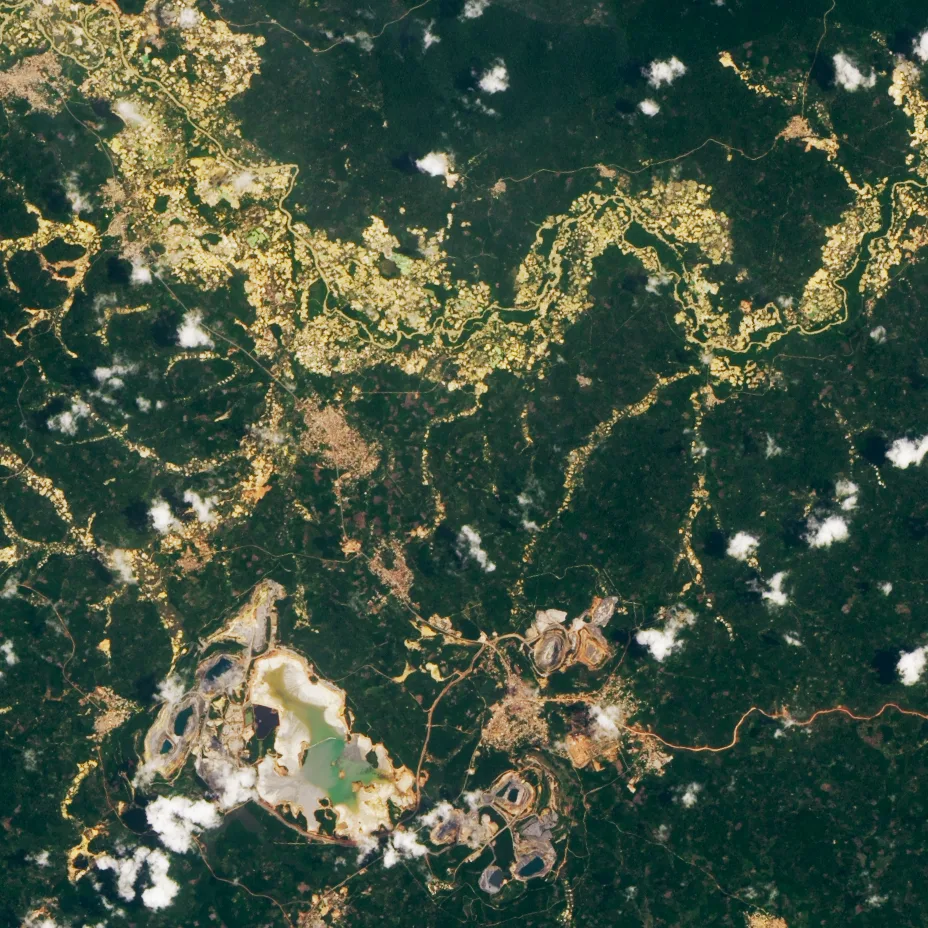
A mine has an obvious shape. A pit, a tailings pond, a spoil heap, a road cut into forest. Those are the marks a satellite can see and a regulator can draw around.
But extraction also changes the land around it. People arrive. Roads make forest easier to reach. Settlements grow. Agriculture expands. A mine is not only a scar on a map; it can become a new center of gravity.
A Nature paper puts numbers on that difference across sub-Saharan Africa. The authors estimate direct mining-driven deforestation in dense forests from 2001 to 2020, then ask how much additional forest loss appears around mines compared with similar places that had not yet been mined. Their conclusion is simple and uncomfortable: the direct mine footprint is only the visible part.
That is a useful result for climate and biodiversity politics, because it keeps two thoughts in the same frame. Modern infrastructure and the energy transition need minerals. But minerals do not come from nowhere. The clean question is not whether mining is good or bad in a slogan. It is whether the full forest cost is being measured honestly.
What they found
Direct mining loss was large. Across dense forests in sub-Saharan Africa, the authors estimate 187,070 hectares of direct mining-induced deforestation between 2001 and 2020. The Democratic Republic of the Congo, Ghana and Côte d’Ivoire together accounted for 45% of that direct loss.
The surrounding loss was larger than the footprint. After a mine was established, cumulative deforestation within 1 km was 8 points higher on a 0-to-100 scale after ten years compared with unmined areas. That is an absolute gap in deforestation rate, not an 8% relative increase. The effect weakened with distance, but did not disappear: after ten years the study estimates additional gaps of 3.6 points at 1-5 km, 1.9 points at 5-10 km, and 1.1 points at 10-20 km.
Those numbers are time-specific. They are ten-year effects, not immediate losses.
The offsite/direct ratio was striking. In a separate calculation, the authors estimate that for every hectare cleared directly by the mine footprint, an additional 33.9 hectares of dense forest were lost offsite within five years. Most of that additional offsite loss was linked to agricultural expansion triggered by mine establishment, with settlement expansion also important and roads a smaller share in their breakdown.
That number is also time-specific: it is a five-year offsite/direct ratio. It should not be mixed with the ten-year 0-to-100-scale effects.
The effect was not the same everywhere. The study reports severe concern for the Democratic Republic of the Congo because it combined a large direct mining footprint with large additional offsite loss. Other countries showed high relative offsite impacts, but with smaller direct footprints. At the commodity level, mines extracting cobalt and copper — minerals central to batteries, electrical infrastructure and the energy transition — caused the highest total additional deforestation in the study’s estimates.
Why the offsite part matters
Environmental assessment often starts with the direct project boundary. That is understandable. The pit is visible, the permit has a perimeter, and a company can describe the infrastructure it plans to build.
But forests do not only respond to legal boundaries. They respond to access and incentives. A mine can bring roads, workers, money, settlements and demand for food. That can turn nearby forest into land that is easier, more profitable or more necessary to clear.
This is why the paper’s strongest idea is not one number. It is the distinction between direct and triggered loss.
If a supply chain counts only the mine footprint, it may undercount the land-use change caused by extraction. If an environmental impact assessment stops at the lease boundary, it may miss the forest loss that the project helps make likely. And if a product is marketed as clean because it supports renewable energy, that does not automatically make its material chain clean.
What this does not prove
- It does not show that the energy transition is bad. It shows that minerals used in modern infrastructure, including energy-transition minerals, can carry large land-use costs.
- It does not mean every mine causes exactly 33.9 hectares of offsite loss per direct hectare. That is an average estimate across a large set of mine clusters, not a prediction for one specific project.
- It does not prove that every tree lost near a mine was cut because of that mine. The study uses a quasi-experimental design to estimate additional loss at population scale.
- It does not assign responsibility to individual companies, permits or buyers. That would require project-level tracing beyond this article.
- It does not cover all mining impacts. Water pollution, labor conditions, biodiversity fragmentation, rights conflicts and social displacement are outside the main forest-loss measurement here.
- It does not cover the whole world. The analysis is focused on dense forests in sub-Saharan Africa.
How strong is the evidence?
For the direct-deforestation estimate, the evidence is strong at continental scale. The study uses published land-use and forest-cover datasets to identify forest loss directly associated with mining features.
For additional offsite loss, the evidence is also substantial, but it is model-based. Difference-in-differences is designed to estimate causal effects from observational data, especially when randomized experiments are impossible. The authors use recent heterogeneity-robust methods and test robustness with alternative estimators. That is good practice.
Still, the result should be read at the right scale. The paper is strong evidence that mining establishment is associated with additional deforestation beyond the mine footprint across the study system. It is not a satellite confession from each individual tree.
The most useful public reading is therefore neither panic nor dismissal. It is measurement discipline: if mining opens a landscape, the impact assessment should look beyond the fence.
Why it matters
The phrase “clean energy” can hide a material world. Solar panels, batteries, transmission lines, electric vehicles and data centers all require mined materials. Some of those materials come from places with globally important forests and biodiversity.
That does not make decarbonization a mistake. The alternative — continuing fossil-fuel dependence — has its own enormous land, air, water and climate costs. But it does mean that a transition can be cleaner than the fossil system and still not be clean by default.
The value of this paper is that it makes the hidden geography harder to ignore. It says: do not count only the pit. Count the forest changes around the pit. Count the roads, farms and settlements that follow extraction. Build offsite deforestation into environmental impact assessments, no-net-loss claims and zero-deforestation supply chains.
That is a more adult story than “green minerals are good” or “green minerals are bad.” It is: the material basis of the transition has consequences, and those consequences need to be visible before the supply chain calls itself clean.
Clean summary
A Nature study analyzed 16,627 mine clusters in dense forests across sub-Saharan Africa from 2001 to 2020. It estimates 187,070 hectares of direct mining-driven deforestation from mine features such as pits, tailings ponds and spoil heaps. Using a difference-in-differences framework, the authors also estimate additional deforestation around mines compared with unmined areas: after ten years, cumulative deforestation was 8 points higher on a 0-to-100 scale within 1 km and remained elevated out to 20 km. In a separate five-year calculation, each hectare of direct mining deforestation was associated with an average 33.9 hectares of additional offsite dense-forest loss, mostly through agricultural expansion and settlements. Mines extracting cobalt and copper contributed the highest total additional deforestation in the study. The result does not show that the energy transition is bad. It shows that mineral supply chains have land-use costs that extend beyond the mine footprint.
No-BS check
What the paper shows: Mining in dense forests across sub-Saharan Africa caused substantial direct forest loss from 2001 to 2020; mine establishment was followed by additional deforestation around mines compared with unmined areas; offsite loss can greatly exceed the direct mine footprint; and some energy-transition minerals are associated with high total additional deforestation in this dataset.
What is plausible but not proven: That many individual mines have larger offsite impacts than their permit footprints suggest; that stricter environmental impact assessments and supply-chain rules could reduce some of this loss; that similar hidden offsite effects may matter in other tropical mining regions.
What it does not show: That all mining is equally damaging; that every nearby forest loss event is caused by a specific mine; that the energy transition is bad; that individual companies or buyers are responsible for particular losses without project-level tracing; or that forest loss is the only environmental or social cost that matters.
Main limitations: Observational causal inference rather than randomized evidence; continent-scale estimates rather than project-level attribution; focus on dense forests in sub-Saharan Africa; direct and offsite effects depend on data quality, mine detection and model assumptions.
How much confidence should a general reader have? High that direct mining deforestation in the study region is substantial. Good that mining establishment is linked to additional offsite deforestation at population scale. Lower for applying the average 33.9:1 ratio to any one mine. Appropriate stance: mineral supply chains can be necessary and still need honest accounting beyond the pit.
Sources
Based on: Mining triggers extensive additional deforestation in sub-Saharan Africa — Oscar Morton, Christopher G. Bousfield, Prince Dégny Valé, Ieuan Lamb, Victor Maus, Robert G. Bryant, and David P. Edwards, Nature (2026).
Written by
Laura Nesso · figures and links by
Laura Nesso · edited by
Michele Renda
· figures and links by
Laura Nesso · edited by
Michele Renda
Editorial note
This article was prepared with AI assistance and human editorial review. It is a clear, conservative explanation of the linked work, not a substitute for reading it. Responsibility for selection, interpretation, and final wording rests with the editor.