The distance between a hint and a headline
In April 2025, a planet 124 light-years away briefly became the most famous world in the sky. A team led by Nikku Madhusudhan reported that the James Webb Space Telescope had picked up, in the atmosphere of the sub-Neptune K2-18 b, a possible trace of dimethyl sulfide — a molecule that on Earth is made almost entirely by living things, chiefly ocean plankton. The coverage that followed reached for the biggest words available: the strongest signs of life beyond the solar system yet found. The paper itself was far more careful, and the gap between those two things is the whole story.
K2-18 b is a genuinely interesting place. It is about 8.6 times the mass of Earth and 2.6 times its radius, orbiting in the temperate zone of a small red star. One idea about planets like it is that they could be hycean worlds — a global ocean beneath a thick hydrogen atmosphere — which would make them roomy, observable places to look for life. But that identity is not settled: the same measurements are also consistent with a mini-Neptune or a rocky “gas dwarf,” and which one K2-18 b actually is remains an open question. The habitable-ocean reading is a hopeful hypothesis, not an established fact.
Against that backdrop, this paper adds one new piece of evidence, from a part of the spectrum — the mid-infrared, roughly 6 to 12 microns — that the earlier K2-18 b observations had not covered. And the honest way to describe that evidence is with the paper’s own numbers, not the headline’s adjectives.
What the paper reports is a roughly 3σ statistical hint that one of two similar molecules is present — below the threshold scientists normally require even to call something a firm detection, and several steps short of a sign of life. The distance between that and “life found” is where careful reading matters.
What DMS, a “biosignature,” and “3σ” actually mean here
Dimethyl sulfide (DMS) and dimethyl disulfide (DMDS) are sulfur-bearing molecules. On Earth they are made overwhelmingly by life — marine microbes — and are not produced in large amounts by ordinary non-biological chemistry. That is what makes them candidate biosignatures: gases whose presence, in the right context, might point to biology. “Candidate” is doing real work in that phrase.
A biosignature is not a detection, and a detection is not life. Finding a molecule is one thing; showing it is really there (not a modelling artefact or instrument quirk) is another; and showing that life is the best explanation — rather than some non-biological chemistry — is a third, much harder thing. Each step can fail independently.
“3σ” is a measure of how unlikely a signal is to be a fluke of noise — here, very roughly a fraction of a percent. It sounds strong, but in physics and astronomy 3σ is the level of a hint: the convention for claiming a discovery is 5σ, and even that would only be a claim about the molecule, not about life. The authors say as much: their evidence sits “at the lower end of the robustness typically required for scientific evidence.”
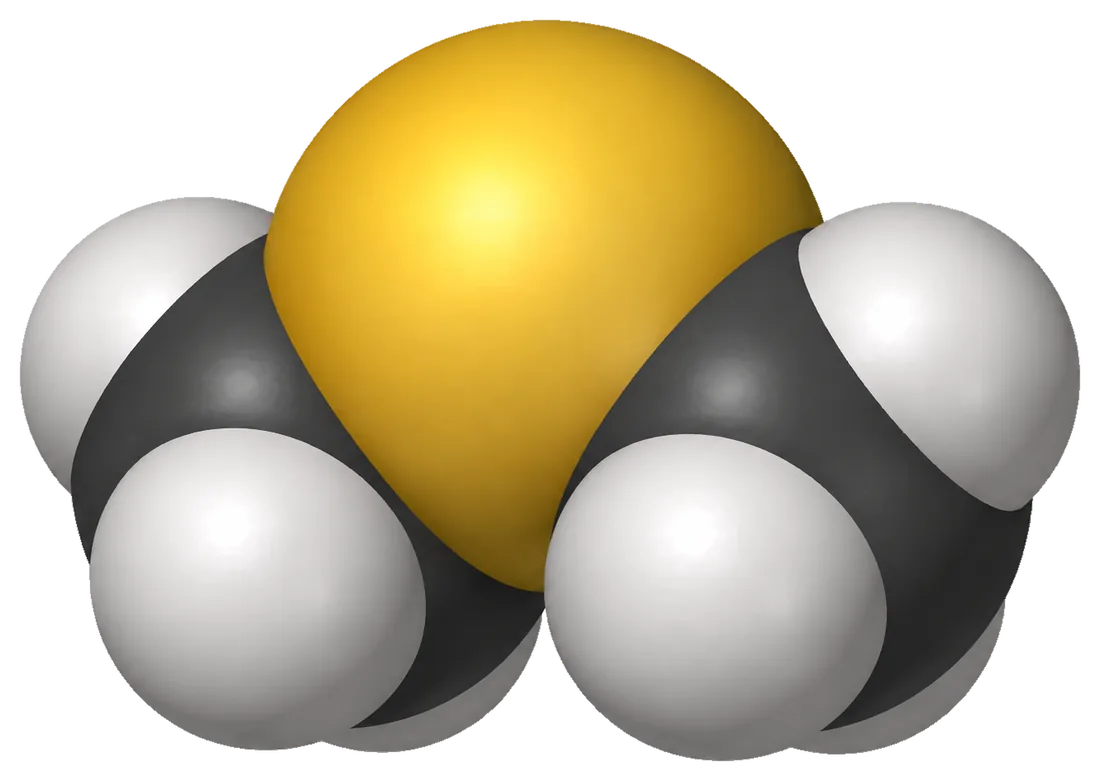
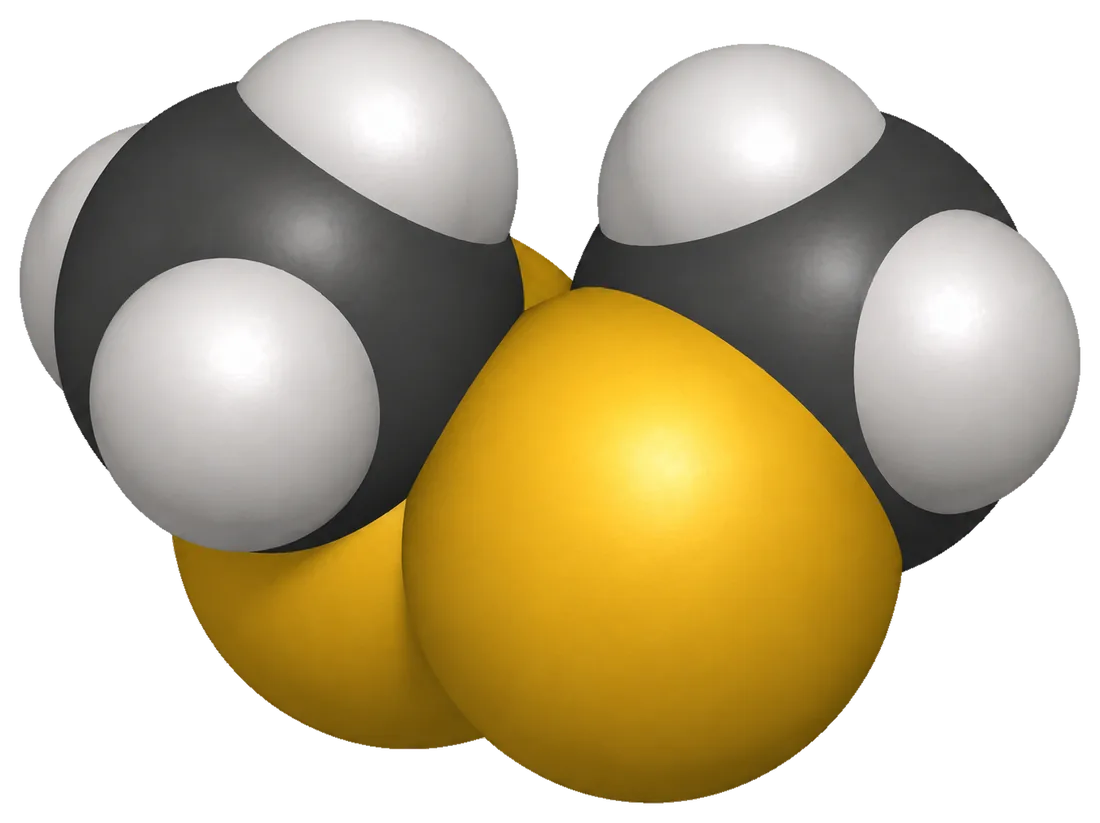
What they found
- The mid-infrared spectrum is not flat: it departs from a featureless line at 3.4σ against the authors’ canonical model. Something is shaping it.
- Of the 20 molecules tested, the authors report that the features are best explained by DMS and/or DMDS, with evidence at about 3σ (individual model fits range from 2.9σ to 3.2σ across the two pipelines).
- The inferred abundance is high — of order 10 parts per million by volume — for at least one of the two molecules.
- The data cannot tell DMS and DMDS apart: the two are degenerate, so even taking the signal at face value, which molecule it is remains unresolved.
- The earlier, near-infrared hint of DMS had been weak (about 2σ) and sensitive to instrument settings; this is an independent line of evidence from a different instrument and wavelength range, which is why the authors regard it as a step forward.
What this does not prove
- It is not a detection. About 3σ is a hint, not the 5σ scientists conventionally require even to claim a molecule is really there — a point the authors make themselves, calling the result low in robustness and in need of verification.
- It does not identify a specific molecule. The DMS/DMDS degeneracy means the data support “one of these two,” not either one in particular.
- It does not show life. DMS and DMDS are only possible biosignatures. The paper’s own false-positive section notes that such molecules can form abiotically (in lab experiments, and DMS has even been seen on a comet), and states plainly that a conclusive biosignature requires assessing robustness, environmental context, and false positives together — and “is unlikely to be instantaneous or unambiguous.”
- It does not establish that K2-18 b is a habitable ocean world. The hycean interpretation is one of several the bulk data allow, and remains contested.
- The molecular identification leans on laboratory measurements of how these gases absorb light — cross-sections the authors say still need to be pinned down.
How strong is the evidence
- A real signal in the spectrum, weakly constrained in its meaning. That the mid-infrared spectrum is not featureless (3.4σ) is the firmest part; the leap from “there are features” to “they are DMS and/or DMDS” to “this hints at life” gets progressively softer at each step.
- The authors are measured; the amplification was external. The paper hedges throughout — “possible,” “tentative,” “further work is needed” — and notes the significance could be pushed to 4–5σ with just 8–24 more hours of JWST time, or could fail to reproduce. The confident “signs of life” framing came from the coverage, not the claim.
- Independent scrutiny has pushed back. In the months after publication, other teams reanalysed the same data and did not find the signal robust. Taylor (2025) asked directly whether the MIRI spectrum contains real spectral features at all, and found no strong statistical evidence for them — only about 2σ support over a flat line. A joint reanalysis of the NIRISS, NIRSpec and MIRI observations by Luque and colleagues (2025) reported insufficient evidence for DMS or DMDS, with no statistically significant detection across a range of data reductions. And a broader assessment led by Stevenson (2025) concluded the data do not meet the standards of evidence for a biosignature, attributing the mid-infrared features to instrumental systematics. That back-and-forth is not a failure of the process; it is the process, and it is why a 3σ hint is a beginning, not a conclusion.
Why it matters
This is one of the cleanest examples in recent memory of how a careful result and a runaway headline can share the same day. The science here is real and worth doing: JWST can now probe the atmospheres of small, temperate planets, and sulfur molecules are a sensible thing to look for. But the honest status of K2-18 b is a faint, ambiguous hint of one-of-two molecules, on a planet whose very nature is uncertain, at a confidence the discoverers themselves call low — and contested by other analyses since. None of that is disappointing unless you were promised aliens. The right way to hold it is the way the field actually works: as an interesting thread to pull, with more JWST time and independent checks, over the next few years. The search for life elsewhere will not arrive as a single headline; it will accumulate, or dissolve, one careful measurement at a time.
Clean summary
Using JWST’s mid-infrared instrument, astronomers found that K2-18 b’s spectrum is not featureless, and that the best-fitting explanation among the molecules they tested is dimethyl sulfide and/or dimethyl disulfide — possible biosignature gases — at about 3σ, with the two molecules indistinguishable in the data. That is a hint, not a detection, and a detection would not by itself be a sign of life: the authors say so, flag possible non-biological sources, and call for more observations. Independent reanalyses have since found the evidence weaker still. K2-18 b is a real and worthwhile target, and this is a real measurement. It is not the discovery of life, and the paper never claimed it was.
Sources
Based on: New Constraints on DMS and DMDS in the Atmosphere of K2-18 b from JWST MIRI — Nikku Madhusudhan, Savvas Constantinou, Mans Holmberg, Subhajit Sarkar, Anjali A. A. Piette, and Julianne I. Moses, The Astrophysical Journal Letters 983, L40 (2025).
- Paper — Madhusudhan et al., New Constraints on DMS and DMDS in the Atmosphere of K2-18 b from JWST MIRI, ApJL 983, L40 (2025)
- Paper — J. Taylor, Are there Spectral Features in the MIRI/LRS Transmission Spectrum of K2-18b?, Research Notes of the AAS (2025), DOI 10.3847/2515-5172/add881 (arXiv:2504.15916)
- Paper — R. Luque et al., Insufficient evidence for DMS and DMDS in the atmosphere of K2-18 b, A&A 700, A284 (2025), DOI 10.1051/0004-6361/202555580 (arXiv:2505.13407)
- Paper — K. B. Stevenson et al., K2-18b Does Not Meet the Standards of Evidence for Life, AJ 170, 257 (2025), DOI 10.3847/1538-3881/ae0338 (arXiv:2508.05961)
Written by
Vera Rubin
Editorial note
This article was prepared with AI assistance and human editorial review. It is a clear, conservative explanation of the linked work, not a substitute for reading it. Responsibility for selection, interpretation, and final wording rests with the editor.