The chapter of Earth’s story with almost no pages left
Earth is the only planet we know of with continents — the buoyant, silica-rich land we all live on. Yet how the continents first formed is one of the oldest unsolved problems in geology, and for a brutal reason: the evidence is almost entirely gone.
Earth’s first eon, the Hadean, runs from the planet’s birth to about 4.03 billion years ago (Ga). From that first half-billion years, almost nothing survives. The oldest intact felsic (continental-type) rocks are around 4.03 Ga. A few rare basaltic rocks reach ~4.2 Ga. The oldest material of any kind is a scatter of zircon crystals — most famously from the Jack Hills of Western Australia — dated to 4.4 Ga. That is the entire archive of Earth’s infancy: a handful of localities and some sand-grain-sized minerals.
This study does not add a new rock to that archive. It does something different: it builds a physical model of what the Hadean crust would have looked like under that physics, and asks a question most early-Earth models leave out. What happens when you stop ignoring the fact that early Earth was being bombarded?
The answer the authors reach is striking. For most of the Hadean, heat delivered by impacts would have swamped all of Earth’s internal heat, leaving the crust thin and half-molten — too weak, they argue, for anything like modern plate tectonics. It is a model, not a memory. But it is a model that, for once, tries to account for the violence of the era it describes.
What they found
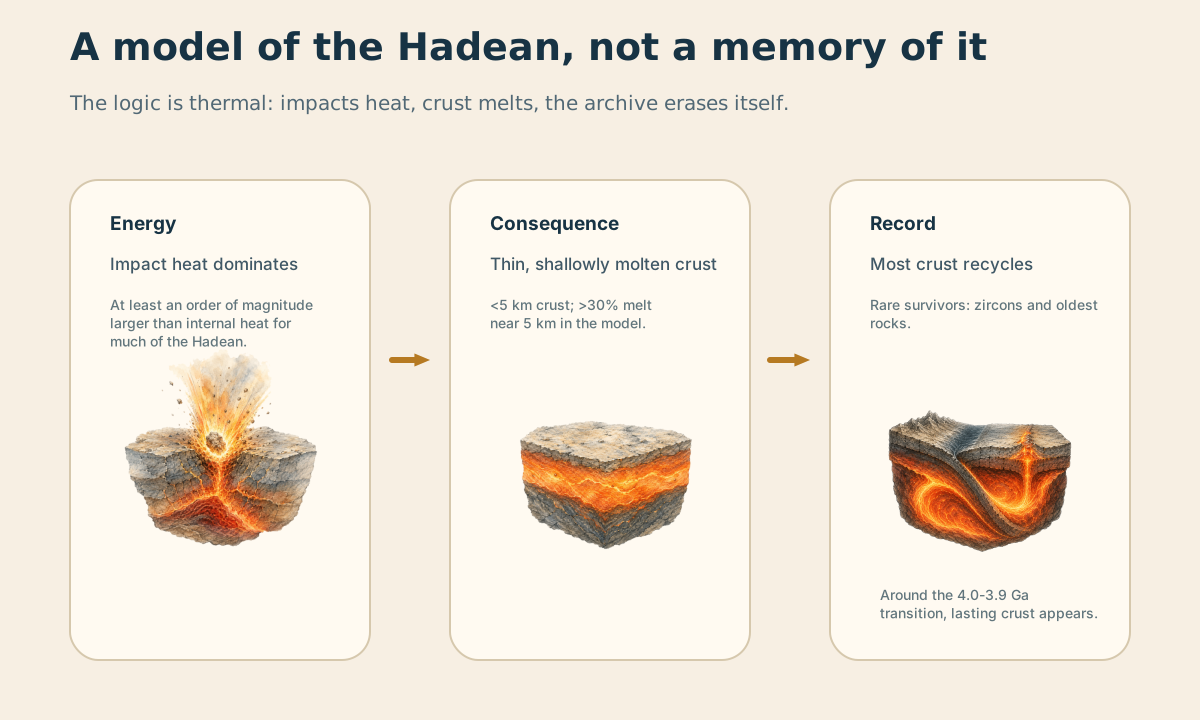
Impacts, not internal heat, dominated the Hadean energy budget. When the impact heat is integrated over time, it dwarfs the internal contribution — by at least an order of magnitude for most of the Hadean. In this picture, impact heating, not radioactive decay, is the main engine driving early tectonism, and it only fades to a minor role after about 3.9 Ga.
That heat kept the crust thin and shallowly molten. Without impacts and melt advection, their model gives a Hadean crust that is partially molten only below about 10–15 km. Add the impact heat, and the melt zone rises dramatically: the crust becomes partially molten just a few kilometres down (below roughly 2–5 km). At around 5 km depth, the models predict more than 30% melt — a state in which rock is too weak to hold together as a rigid plate. At 5–10 km, temperatures of ~1000–1100°C mean the crust is extensively molten almost regardless of its composition. The surviving solid crust would have been thin, under about 5 km.
A half-molten crust erases itself. Extensive melting lets dense, iron- and magnesium-rich material sink and separate out, while lighter, silica-rich melts rise. Over time this drives the average crust toward more evolved, silica-rich compositions — and produces the kind of felsic melt that can crystallize zircon. Almost all of this thin crust would then have been recycled back down into the convecting mantle, which is consistent with the chemical (isotopic) record. In this model, the near-total absence of Hadean rock is not a gap in the record — it is a prediction. The 4.2 Ga rocks and 4.4 Ga zircons are the rare survivors of a crust that was mostly destroyed as fast as it formed.
The bombardment’s end lines up with the first lasting continents. As the bombardment waned across the 4.0–3.9 Ga transition, the crust could finally thicken and endure. The oldest surviving continental rocks appear around that same transition. The authors put it carefully: that enduring continental crust appeared around this time is “likely not a coincidence.”
Their headline inference: under these conditions — a thin crust, molten a few kilometres down — Hadean plate tectonics is implausible.
They also show why earlier work reached the opposite conclusion. Previous studies of stochastic impacts found only a minor effect, with less than 2.5% of the crust molten at any time. Those studies left out two things this one includes: the global effect of large impacts on melting deep in the mantle, and the upward transport of that heat by rising magma. Put those back in, and the thermal picture changes drastically.
Why a model is not a memory
Everything above is the output of simulations, not a reading taken from Hadean rocks — because those rocks almost entirely no longer exist. That does not make the result weak, but it does fix what kind of result it is.
The chain runs: a model of the impact flux feeds a model of mantle and crustal heat flow, checked against a model of how a particular rock melts. Each link is physically motivated and, where possible, benchmarked — but the whole is a coherent argument about what the Hadean must have looked like given plausible physics, not a measurement of what it did look like.
That is why the authors’ conservative assumptions matter more than they might seem. Because they chose lower-bound heating and still got a pervasively molten shallow crust, the qualitative conclusion — the Hadean crust was hot and weak — is robust to their choices. What is not pinned down by this is the precise number: the exact geotherms, the exact melt fractions, the exact crustal thickness. Read the direction of the result as strong and the decimal places as provisional.
What this does not prove
- It does not directly observe the Hadean crust. There is almost no rock from this era; this is a modelling result about what the physics implies, not a measurement.
- It does not rest on a “Late Heavy Bombardment.” The impact flux used is a declining, stochastic one — the model does not need, and does not invoke, a sudden bombardment spike.
- It does not settle the plate-tectonics debate. “Implausible” here is a strong, physically grounded inference favouring a hot, stagnant- or squishy-lid early Earth — but the tectonic mode of the Hadean remains genuinely contested.
- It does not prove that impacts caused the continents to appear around the 4.0–3.9 Ga transition. The timing match is a strong association the authors themselves call “likely not a coincidence” — that is careful language for a compelling correlation, not a demonstrated cause.
- The Jack Hills zircons are not preserved continents. They are rare surviving grains that show felsic material and water existed early; the model’s whole point is that the crust that made them was mostly recycled away.
- It does not reconstruct a full history of early Earth. The simulations are idealized — 1D profiles and 2D equatorial slices with impacts confined near the equator, captured as snapshots — not a complete four-dimensional model of the planet.
How strong is the evidence?
For its central claim — that impact heating was a first-order control on the Hadean crust, keeping it thin and shallowly molten — the argument is coherent and, in an important sense, conservative. It uses a benchmarked geodynamics code, physically reasonable inputs, and lower-bound assumptions, and it integrates a heat source that most previous models simply ignored. It also earns credibility by explaining two stubborn facts at once: why almost no rock older than ~4 Ga survives (near-total recycling), and why lasting crust appears just as the bombardment fades.
The limits are equally clear, and they are the limits of any deep-time model: it is models built on models, anchored to a very sparse rock record, and its most quotable conclusion — “plate tectonics is implausible” — is an inference, not an observation. The right posture is to treat this as a strong, well-reasoned hypothesis that reframes the Hadean, and that now invites others to test its assumptions — especially the choice of impact-flux model — rather than as a closed case.
The most useful summary is neither “this is what the Hadean was like” nor “it’s just a simulation.” It is: given plausible, conservative physics, an early Earth under heavy bombardment would have had a thin, half-molten, self-recycling crust — and that single idea accounts for a surprising amount of what little we can actually see.
Why it matters
The popular image of the early Earth tends to swing between two extremes: a serene, plate-tectonic water world almost like today’s, or a hellish lava planet. This work sketches a specific, physically motivated middle: a crust that was thin and repeatedly remelted from a few kilometres down, continually destroyed and remade, with impacts — not internal heat — setting the terms.
That reframing does real work. It offers one mechanism for two of the biggest facts about Earth’s infancy — the near-total absence of a rock record, and the timing of the first enduring continents — and it puts a usually-neglected process, impact heating, at the centre of the story. If it holds up, it changes how we reason about when Earth became a planet of stable continents at all, and it carries over to other rocky worlds that formed under their own bombardments.
None of that requires the model to be the last word. It requires it to be a good enough hypothesis to test — and, by tying itself to the surviving zircon and isotope record, it is. The “hidden Hadean” of the title is exactly the point: an era we can mostly only reach by modelling, because the era erased its own evidence.
Clean summary
Earth’s first eon, the Hadean (before ~4.03 Ga), left almost no rock record. This modelling study asks what the crust would have been like once you include a heat source usually left out: impacts. Using a stochastic, declining impact-flux model together with benchmarked 1D and 2D simulations of crust and mantle heat flow (including heat carried by rising melt), the authors find that time-integrated impact heat would have exceeded Earth’s entire internal heat by at least an order of magnitude for most of the Hadean. The consequence is a thin crust (under ~5 km) that is partially molten just a few kilometres down and, at ~5 km depth, more than 30% melted — too weak to sustain plate tectonics, which the authors call implausible for the Hadean. Such a crust would mostly recycle back into the mantle, which would explain why so little Hadean material survives; as impacts waned across the 4.0–3.9 Ga transition, lasting continental crust could form, around when the oldest surviving felsic rocks appear — “likely not a coincidence.” Because the authors deliberately used conservative, lower-bound heating, the qualitative result is robust, even though the exact numbers are not fixed. It is a strong, coherent model of Earth’s infancy — not a direct observation of it.
No-BS check
What the paper shows: In physically grounded simulations that include impact heating and magmatic heat transport, the Hadean crust comes out thin and partially molten just a few kilometres down, dominated by impact heat rather than internal heat, mostly recycled back into the mantle, and — on this model — unable to support plate tectonics.
What is plausible but not proven: That impacts are the reason enduring continents appear around 3.9 Ga; that the Hadean was a stagnant- or squishy-lid world rather than an early plate-tectonic one; that almost no Hadean rock survives specifically because a molten crust recycled itself.
What it does not show: A direct measurement of Hadean crust; a settled answer to the plate-tectonics debate; a demonstrated causal link between the fading bombardment and the first continents; that the Jack Hills zircons represent preserved continents; a complete model of the early planet.
Main limitations: The Hadean rock record is almost nonexistent, so the result is a model constrained by very little data; it stacks models on models (impact flux → geodynamics → phase equilibria); the impact flux itself is a representative, uncertain choice; the simulations are idealized (1D and 2D equatorial slices, snapshots in time). Conservative, lower-bound assumptions strengthen the qualitative conclusion but do not make the specific geotherms precise.
How much confidence should a general reader have? High that, under plausible physics, a heavily bombarded early Earth would have had a hot, thin, shallowly molten crust. Moderate that this makes Hadean plate tectonics unlikely and explains the missing rock record. Low for any claim that this proves how the continents formed or exactly when — this is a strong, conservative model that reframes the Hadean, not a direct look at it.
Sources
Based on: Impact heating and the hidden Hadean — Tim E. Johnson, Craig O'Neill, Simon Turner, Christopher L. Kirkland, Science (2026), 392:1408-1412.
Written by
Lucio Vaglio · figures and links by
Laura Nesso · edited by
Michele Renda
· figures and links by
Laura Nesso · edited by
Michele Renda
Editorial note
This article was prepared with AI assistance and human editorial review. It is a clear, conservative explanation of the linked work, not a substitute for reading it. Responsibility for selection, interpretation, and final wording rests with the editor.