Breaking a cycle instead of treating a patient
Lyme disease is the most common tick-borne illness in the United States, and the usual way we fight it is personal: check for ticks, pull them off, take the antibiotics if a bite turns into a bull’s-eye rash. But the bacterium that causes Lyme, Borrelia burgdorferi, does not really live in us. We are a dead end for it. Its actual home is a cycle that runs between ticks and small woodland mammals — on the US East Coast, largely the white-footed mouse. A tick picks the bacterium up by biting an infected mouse, carries it as it grows, and passes it to the next mouse — or, by accident, to a person. The mice are the reservoir; the ticks are the needle; we are a bystander who occasionally gets stuck.
So there is another way to think about the problem. Instead of treating people one bite at a time, what if you could make the mice immune — and keep them immune, generation after generation, without ever vaccinating a single animal by hand? That is the idea this paper tests, and it has an unfortunate gravitational pull toward headlines about “GMO mice,” “gene drives,” and “vaccinating the wild.” What the paper actually reports is narrower, more careful, and — if you care how such an intervention would have to be proven before anyone released anything — more reassuring than the headlines.
The idea has a name: heritable immunization — writing the instructions for an antibody directly into an animal’s genome, so the animal is born already making it, and passes that ability to its offspring. A vaccine has to be given to each individual, again and again. A heritable gene can be passed on by ordinary breeding — without anyone vaccinating each new generation by hand.
What they found
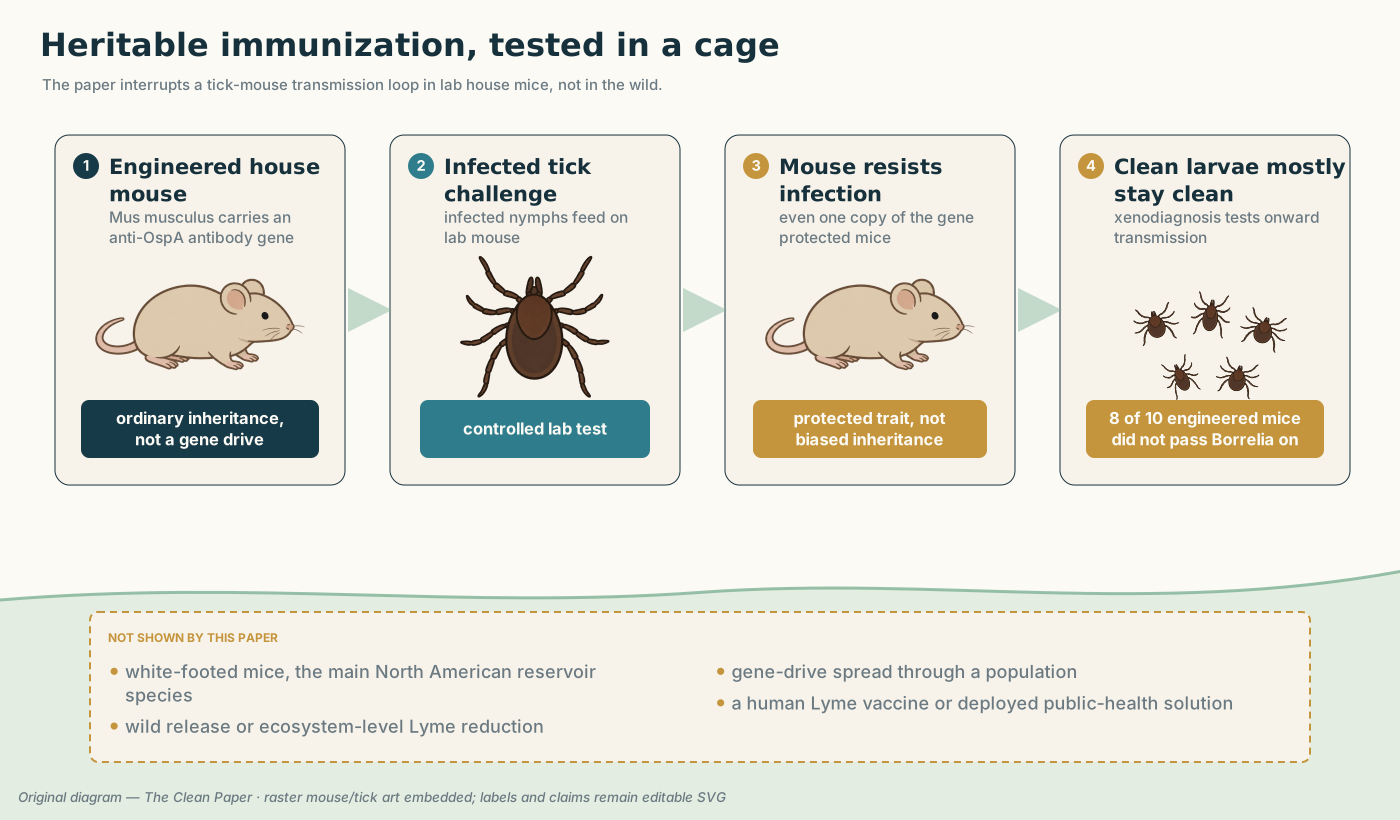
The antibody was inherited, stably, for generations. The working design produced roughly a thousand times more antibody than the failed one, at consistent levels across at least six generations — mice with two copies of the gene made about twice as much as mice with one. There was none of the animal-to-animal variability that had plagued the first attempt.
The mice resisted infection — even with a single copy of the gene. Challenged with Borrelia-infected ticks, both two-copy and one-copy engineered mice showed a statistically significant drop in markers of infection compared with normal mice. Two-copy mice were strongly protected, but the protection in single-copy (heterozygous) mice is the result with the most far-reaching consequences, for a reason we will come back to.
They largely stopped passing the bacterium on. In the key ecological test, clean larval ticks were allowed to feed on engineered mice that had been deliberately challenged with many infected ticks. In that test, 8 of 10 engineered mice came through completely free of infection and did not seed the next generation of ticks, against only 1 of 10 normal mice — a highly significant difference. The cycle, in the cage, was being interrupted. (That is a controlled-challenge result, not a measurement of how much Lyme would fall in an actual forest.)
One honest surprise about the mechanism. Unlike earlier anti-OspA work, the engineered antibody protected the mice but did not appear to clear the bacterium out of the ticks that had already fed. So the antibody is blocking transmission by some route the authors could not fully pin down — binding seems to be enough, but exactly how is left for further study.
What this probably means
The headline idea — that you can build durable resistance into a reservoir animal’s genome and break a disease’s transmission cycle — held up, in the lab, in this mouse.
And one detail quietly defuses the scariest version of the story. A gene drive is a genetic system engineered to bias inheritance, so that a chosen gene spreads through a population faster than ordinary breeding would allow — even one that gives the animal no advantage. That is what makes a drive powerful, and hard to control or recall once released. This work uses no such thing. Because a single copy of the antibody gene already protected the mice, the authors argue that ordinary breeding and targeted releases could, in principle, raise it to useful levels without forcing it through the population — and they are explicit that this is not a gene drive. That is an argument, not yet a demonstration; but the single-copy result is what makes it available to them, and it makes the approach far more controllable than the thing most people picture.
Why not use a gene drive?
A gene drive is not the same thing as a dominant gene. Dominant is about effect — one copy is enough to show the trait, as the antibody gene is here. A drive is about inheritance: it rigs the odds so a gene is passed to far more than the usual half of an animal’s offspring. The classic engineered version, a CRISPR “homing” drive, carries molecular scissors that cut the matching spot on the partner chromosome; the cell repairs the cut by copying the drive across, so an animal with one copy passes it to almost all of its offspring. Released into the wild, such a drive can sweep through a whole population from a small start — powerful, and very hard to recall. (Nature has invented several other ways to cheat the fifty-fifty rule, but the principle is the same.)
Why does this matter here? Because the paper’s senior author, Kevin Esvelt, is one of the researchers who helped invent gene drives — including the safer, self-limiting “daisy-chain” versions meant not to spread uncontrollably. He knows the tool intimately, and in this work he deliberately did not use it: the protection rides on an ordinary inherited gene, to be spread — if ever — by normal breeding and targeted release, not by a drive. That is the quiet lesson, worth more than the result: having a powerful tool is not a mandate to use it everywhere.
What this does not prove
- It is in the wrong mouse, on purpose. The work was done in lab house mice (Mus musculus), not the white-footed mouse (Peromyscus leucopus) that actually maintains Lyme across the eastern US. The authors have begun developing tools for Peromyscus, but the protective gene has not yet been built into the species that matters.
- It is in the lab, not the field. No engineered mouse was released. Costs to an animal’s survival or breeding that don’t show up in a cage can still show up in the wild.
- It is a proof of concept, not a solution. Protection was strong but not total (8 of 10 mice blocked transmission in the challenge), and “Lyme eliminated” is nowhere in the paper.
- The mechanism is not fully understood — the antibody works, but not by the route earlier studies expected.
- It is not a gene drive, and does not claim to be.
- Releasing engineered mammals into the wild has no regulatory precedent. The ecological risk assessment, the governance, and the consent of the communities who would live with it are all explicitly unresolved — the authors say so plainly.
How strong is the evidence?
Split it in two, because the two halves are not equally settled.
- The laboratory result is solid. Stable, heritable antibody across six generations; statistically significant protection from infection; a statistically significant drop in onward transmission measured the hard way, by feeding clean ticks. Several independent experiments point the same direction.
- The leap to the real world is almost entirely untested. A different species, survival in the wild, the messy ecology of multiple reservoir hosts, a release strategy, and the regulation of all of it — none of that is data in this paper, and the authors present it as the work still ahead, with community-guided field-trial planning only in its earliest stages.
One housekeeping note in the same spirit: we read this from the peer-reviewed accepted manuscript (“article in press”), not the final copyedited version. The structural findings above should not change, but we will re-check the numbers against the final paper before this goes further.
Why it matters
Most of how we fight vector-borne disease is reactive and endless: spray, repel, check, treat, repeat, every season, forever. This is a sketch of something different — intervene once in the animal reservoir, and let inheritance do the maintenance. Done in the white-footed mouse, and shown to be safe and effective in the field, it could in principle lower the background level of Lyme in a place rather than just defending individuals within it.
That “in principle” is carrying a great deal of weight, and the paper is honest about it. The genuinely valuable thing here is not a cure; it is a careful demonstration that heritable immunization can work and can interrupt transmission — built, deliberately, in a controllable, non-gene-drive form, with the hardest questions (the right species, the open field, the ethics of releasing engineered life) named and left open rather than waved away.
Clean summary
Lyme disease cycles between ticks and reservoir mice; people are incidental. Researchers engineered lab house mice to produce, from their own genome, an antibody against the Borrelia surface protein OspA — an antibody that disables the bacterium inside a feeding tick. The mice inherited this ability stably for at least six generations; when bitten by infected ticks they resisted infection, even with a single copy of the gene, and most of them (8 of 10, against 1 of 10 normal mice) stopped passing the bacterium on to new ticks, interrupting the transmission cycle in the lab. Crucially, single-copy protection means the approach does not require a self-spreading gene drive. But this was done in the lab house mouse, not the white-footed mouse that actually spreads Lyme in North America; there was no field release; the mechanism is not fully understood; and the ecology, regulation and ethics of releasing engineered mammals are entirely unresolved. It is a careful proof of concept for “heritable immunization” of a reservoir species — not a gene drive, and not “Lyme solved.”
No-BS check
What the paper shows: Lab house mice (Mus musculus) engineered to express an anti-OspA antibody (LA-2, as a single-chain–albumin fusion from a safe-harbour locus) inherited it stably for ≥6 generations, resisted Borrelia infection on tick challenge (significant even in single-copy heterozygotes), and largely stopped transmitting the bacterium to clean ticks (8 of 10 challenged engineered mice transmission-free vs 1 of 10 controls; significant). Single-copy protection means a gene drive is not required to make the approach work.
What is plausible but not proven: The exact mechanism by which the antibody blocks transmission (it did not clear bacteria from already-infected ticks, unlike earlier anti-OspA work); that the same construct will work, and be inherited stably, in the white-footed mouse.
What it does not show: Anything in the wild or in the actual reservoir species; whole-population or whole-ecosystem effects; that Lyme can be eliminated; that releasing engineered mammals is safe, effective, or permissible; a gene drive (the opposite — it is explicitly not one).
Main limitations: Done in lab Mus musculus, not wild Peromyscus leucopus; laboratory only, no field release; transmission blocking strong but not total (8 of 10); mechanism unclear; ecological, regulatory and ethical questions around release explicitly unresolved; read from the accepted manuscript pending the final version.
How much confidence should a general reader have? High that, in the lab, engineered mice inherited Lyme resistance and interrupted transmission, and that this is deliberately not a gene drive. High that this is not a deployed solution and not “Lyme solved.” Low on whether and how it could ever work in the wild, which is the entire unfinished second half. Appropriate stance: a careful, hopeful proof of concept about changing the reservoir instead of the patient — with the hardest questions still ahead, and named honestly.
Source
Based on: Heritable immunization of mice against Lyme disease enables ecological disease prevention — Joanna Buchthal et al.; Kevin M. Esvelt (corresponding author), Nature Communications (2026, accepted manuscript / article in press — not the final copyedited version).
Written by
Lucio Vaglio · figures and links by
Laura Nesso · edited by
Michele Renda
· figures and links by
Laura Nesso · edited by
Michele Renda
Editorial note
This article was prepared with AI assistance and human editorial review. It is a clear, conservative explanation of the linked work, not a substitute for reading it. Responsibility for selection, interpretation, and final wording rests with the editor.