The light that cleared the fog
For its first several hundred million years, the universe was opaque. Space was filled with neutral hydrogen — atoms with their electrons still attached — and neutral hydrogen is very good at absorbing ultraviolet light. Then, over the next billion years or so, something flooded the cosmos with enough ultraviolet to strip those electrons back off, ionizing the hydrogen and letting light travel freely. Astronomers call this the epoch of reionization, and the obvious suspects are the first galaxies: the hot, short-lived stars in them pour out ionizing ultraviolet, and if enough of it escaped into intergalactic space, they could have done the job.
The trouble is the word escaped. Most of a galaxy’s ionizing light never gets out — it is absorbed by the same hydrogen inside the galaxy that the stars are trying to ionize. Only some fraction leaks into space, and that fraction, the escape fraction, is the single hardest number to pin down in the whole story. Worse, during reionization itself the leaked light is almost impossible to catch: the intergalactic fog it is helping to clear absorbs it long before it reaches us. So to study the leak, astronomers have to look just after the fog lifts, at galaxies close enough to the era to stand in for it.
A team led by Ilias Goovaerts has now caught that leak about as far back as it has ever been seen. Using deep imaging from Hubble and the JWST, they report a single faint galaxy — catalogued as MXDFz4.4 — whose escaping ionizing ultraviolet shows up as a smudge of light in one Hubble filter. The galaxy sits at redshift 4.442, roughly 250 million years after reionization ended: the most distant directly-detected “leaker” on record.
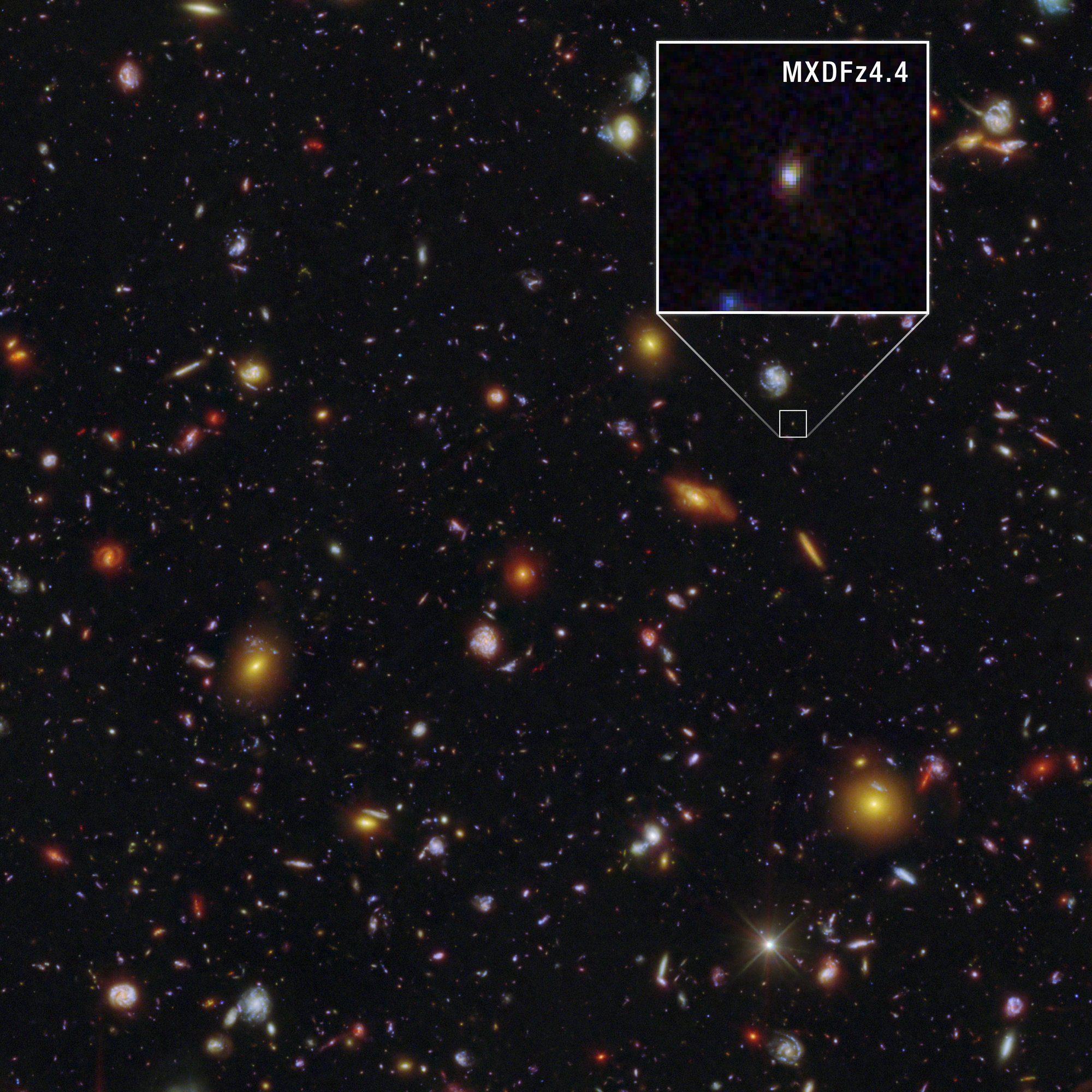
The number that will travel from this paper is the escape fraction, and it is high — somewhere between half and all of the galaxy’s ionizing light. That number is real, but it is worth being careful about what “real” means here. It was not measured off the image; it was reconstructed through a chain of models, and its range is wide for an honest reason. The more useful story has two parts: what a single caught leak can and cannot tell us, and a quieter second result — the first attempt, this far back, to check an indirect way of spotting the leak, against the day the direct way stops working.
What an “escape fraction” is, and why it’s so slippery
Stars — especially the biggest, hottest, youngest ones — give off ultraviolet energetic enough to knock electrons off hydrogen atoms. Astronomers call this ionizing radiation, or, at the specific wavelengths involved, Lyman-continuum light. It is the currency of reionization: the universe became transparent when enough of these photons were set loose to keep intergalactic hydrogen ionized.
But a galaxy is full of hydrogen too. Much of the ionizing light a galaxy makes is soaked up before it ever leaves — spent ionizing the galaxy’s own gas. The escape fraction is the share that gets out into intergalactic space, where it can actually help reionize the wider universe. It is the crux of the whole question, and it is hard to measure, for two reasons.
First, during reionization the intergalactic medium is still full of neutral hydrogen, which absorbs exactly the light you are trying to detect — so the leaked light usually never reaches us at all. Second, even when you can see some of it (just after the era, along an unusually clear line of sight), turning that detection into an escape fraction means dividing what you observe by what the galaxy produced — and what it produced you cannot see directly either. You have to model it: from the galaxy’s other light, its inferred star-formation history, and assumptions about the stars themselves.
That is why escape fractions come with wide error bars, and why — once the intergalactic absorption has to be modelled too — the same detection can support a broad range of answers. The number is a reconstruction, not a reading.
What they found
- The most distant directly-detected Lyman-continuum emitter to date, at z = 4.442.
- A real detection of the escaping ionizing light itself — not an inference, a signal in the image at 5.2–5.3σ.
- A high escape fraction, in the range of 50–100%, depending on the assumptions — large, but model-dependent. (A separate relative estimate runs higher still, past 100%. That is a quirk of how it is defined — it compares the escaping ionizing light to the galaxy’s ultraviolet without first correcting for dust — not a sign that more light escapes than the stars actually make.)
- Evidence, from the fitted starlight, that a recent burst of star formation is driving both the production and the escape of the ionizing light.
- “Cautious support,” in the authors’ words, for using the Lyman-alpha line’s shape as a tracer of escape at high redshift.
What this does not prove
- It does not identify “the galaxies that reionized the universe.” This is one galaxy, and one sitting about 250 million years after reionization ended, not during it. It is a stepping-stone toward the era, not a picture of the event.
- The escape fraction is not a measurement. It is reconstructed by dividing the observed light by a modelled estimate of the light produced, then correcting for a modelled amount of intergalactic absorption — and the authors deliberately adopt a favourable line of sight, because a galaxy whose leaked light reaches us at all must sit in a clearer-than-average direction. The wide range (50–100%, and higher in relative terms) is the honest signature of that model-dependence.
- It does not validate the new Lyman-alpha tracer. “Cautious support” from a single object is a first test, not a confirmation.
- It does not, on its own, settle that bursty star formation drove reionization. That is a reasonable interpretation built on one galaxy plus the tracer analysis, not a demonstrated law.
How strong is the evidence
- Strong where it is direct: the redshift (a distinctively-shaped Lyman-alpha line, with a 0.0076% chance of foreground contamination) and the detection of the escaping light (5.2–5.3σ, checked against a million empty apertures, with the foreground-interloper trap — the thing that has undone high-redshift escape claims before — carefully closed).
- Weaker, and openly so, where it is modelled: the value of the escape fraction (which rides on the stellar model and the chosen intergalactic sightline), the reionization “significance” (one object, plus interpretation), and the new tracer (a first, cautious test).
- The paper’s honesty is in its ranges. It reports spans rather than single numbers, calls its tracer support “cautious,” and even declines to trust one of its own estimates of the intergalactic transmission. This is a careful paper that does not oversell itself; the hype risk is entirely on the outside.
Why it matters
Direct detections of escaping ionizing light have now been pushed about as close to the reionization era as they can go — to the edge of where the light still, barely, gets through. That is worth something on its own. But the quieter result may matter more: once you are inside reionization, the direct method fails completely, and everything rests on indirect tracers calibrated on nearer, easier galaxies. Testing one of those tracers here, where you can still check it against a real detection, is how you earn the right to trust it later, where you can’t. The value of MXDFz4.4 is less “we found a galaxy that reionized the universe” and more “we are learning to read the leak, and starting to check our instruments for the dark.”
Clean summary
Astronomers using Hubble and the JWST have directly detected the ionizing ultraviolet escaping a single galaxy at redshift 4.442 — the most distant such detection yet, about 250 million years after cosmic reionization ended. The detection itself is solid. The widely-quotable escape fraction of 50–100% is not measured but reconstructed, through models of the galaxy’s stars and of intergalactic absorption along a deliberately favourable sightline, which is why its range is so wide. Alongside the detection, the team ran the first high-redshift test of an indirect way to spot escaping light — the shape of the Lyman-alpha line — and found “cautious support” for it. It is a careful, single-object result: a real catch of the leak, an honestly uncertain number attached to it, and a first step toward the tools astronomers will need once the leak can no longer be seen at all.
No-BS check
What the paper shows: A direct, 5.2–5.3σ detection of escaping ionizing (Lyman-continuum) light from a galaxy at z = 4.442 — the highest-redshift such detection to date — with the foreground-contamination trap carefully ruled out.
What is plausible but not proven: That the galaxy’s escape fraction is 50–100%. The detection is real; the fraction is reconstructed through stellar-population and intergalactic-absorption models (along a favourable sightline), which is why it spans such a wide range. Also plausible-but-unproven: that the Lyman-alpha line shape works as an escape tracer this far back — the paper offers “cautious support” from one object.
What it does not show: That this is a galaxy “that reionized the universe” (it sits after the era, and is a single object), or that bursty star formation drove reionization (an interpretation, not a demonstration).
Main limitations: A sample of one; an escape fraction that depends on model choices and a deliberately clear sightline; a first, cautious test of the new tracer; and the sheer difficulty of studying escaping ionizing light so close to the era where it becomes invisible.
How much confidence should a general reader have? High that the escaping light was really detected, and that this is the most distant such catch yet. Low-to-moderate on the exact escape fraction — treat “50–100%” as a modelled range, not a measurement. Moderate on the new tracer: a promising first check, not a settled tool.
Sources
Based on: MXDFz4.4: A LyC emitter 250 Myr after the epoch of reionization and a first test of Lyman-alpha morphology as a tracer of LyC escape at high redshift — Ilias Goovaerts, Marc Rafelski, Alexander Beckett, Grecco Oyarzun, Annalisa Citro, Farhanul Hasan, Kalina V. Nedkova, Calum Hawcroft, Anton M. Koekemoer, Mitchell Revalski, Matthew J. Hayes, Claudia Scarlata, Ray A. Lucas, Norman A. Grogin, David V. Stark, Paolo Sun, Nor Pirzkal, and Louis-Gregory Strolger, The Astrophysical Journal (accepted, 2026).
Written by
Vera Rubin · edited by
Michele Renda
· edited by
Michele Renda
Editorial note
This article was prepared with AI assistance and human editorial review. It is a clear, conservative explanation of the linked work, not a substitute for reading it. Responsibility for selection, interpretation, and final wording rests with the editor.