Aristotle’s question, asked of a mouse’s toe
Why can a salamander regrow a whole amputated leg — bone, muscle, nerve, skin, all of it — while a mouse, or a person, simply heals the stump over and stops? The question is old: the paper notes it goes back to Aristotle, more than two thousand years ago. The animals that can do it regrow the missing part from a small mound of un-specialised cells called a blastema, which gathers at the wound and rebuilds what was lost. Mammals mostly never form one. We close wounds with scar.
So a paper titled “digit regeneration in mice” lands in the middle of one of biology’s oldest open questions — and, lately, in the middle of a lot of noise. Ask the internet what it says and you will be told humans are about to regrow lost fingers and limbs. It says something narrower, stranger, and more interesting: in mice, at a digit amputation that normally heals over with a scar, two growth factors delivered in the right order — first FGF2, then BMP2 — coaxed the stump to rebuild the bone it had lost. Not a whole limb. Not in humans. Not perfectly. But a wound that mammals usually close with fibrosis was made to regenerate, and that is the result worth understanding.
What the authors did
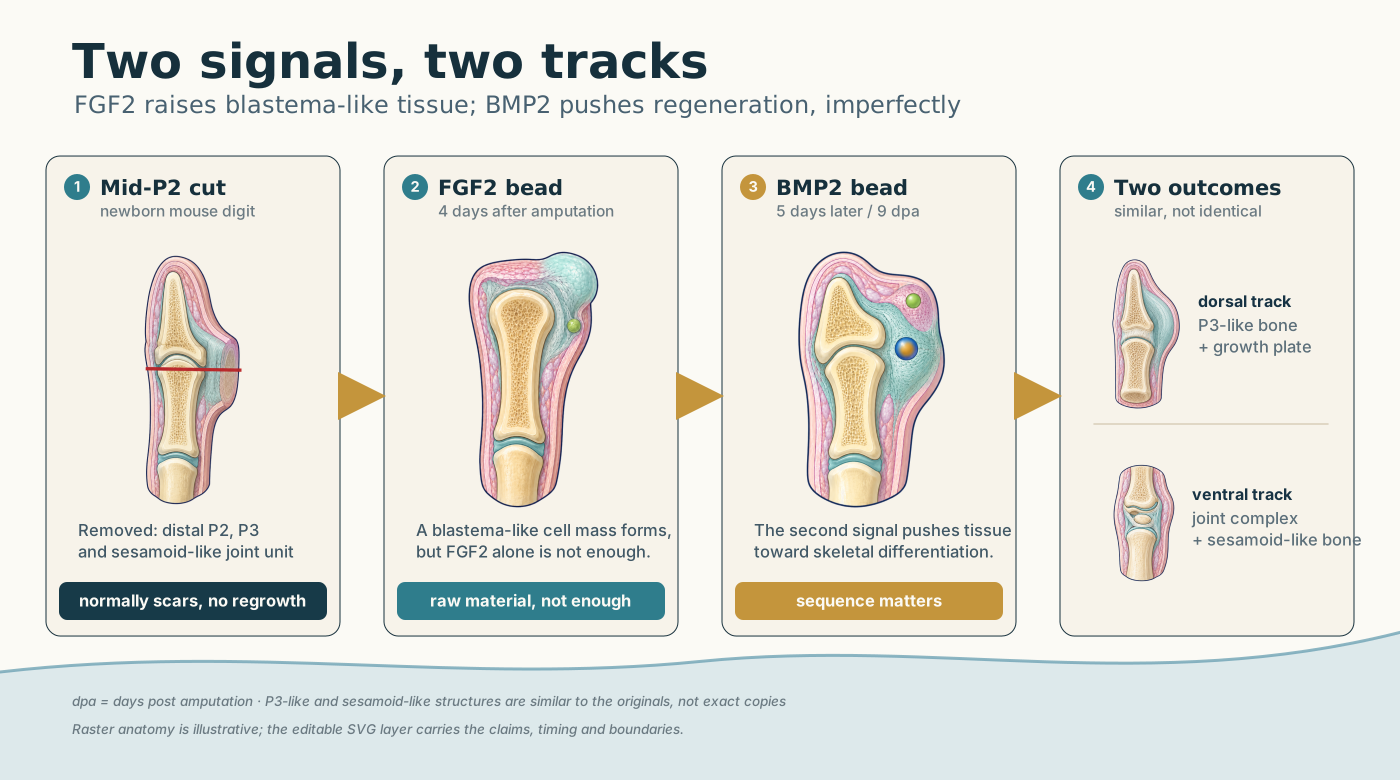
The mouse digit is one of the few places a mammal regenerates anything at all. Cut a digit at its very tip and it grows back; cut it lower — through the second bone of the digit, the P2 phalanx — and it does not. The stump heals over with scar tissue and stops. That non-regenerating P2 amputation, in newborn mice, is the model the authors used on purpose: a wound where mammals reliably fail to regenerate.
To it they applied two signalling proteins, one after the other. A few days after amputation, once the wound had closed, they implanted a tiny bead releasing FGF2 (a fibroblast growth factor). Five days later they implanted a second bead, releasing BMP2 (a bone morphogenetic protein). They then followed the digits for weeks with micro-CT scans and tissue staining, sequenced the wound cells one at a time, and used genetic labelling to trace where individual wound cells ended up.
What they found
FGF2 alone built the raw material but rarely the result. It pushed the wound to accumulate a mass of dividing cells resembling a blastema — the cell cluster that drives true regeneration in animals like salamanders — and switched on the genes a blastema uses. But on its own it mostly stopped there: roughly 70% of treated digits grew no new bone, and only about 30% formed a single, misplaced one.
FGF2 then BMP2 finished the job — imperfectly. When a BMP2 bead followed the FGF2 bead, every treated digit grew new bone. Most regrew the lost distal phalanx (P3) as a recognisable bone with a growth plate at its base — the same structure a digit bone uses while it develops — and many also regenerated a small joint: a sesamoid-like bone, plus a tendon and ligament reconnecting to the stump. Measured carefully, the regenerated parts were similar to the originals but not identical, and the stump bone, though it grew, never reached its normal size. The authors call the outcome “a complete but imperfect digit” — complete in that every amputated structure had some counterpart, imperfect in that none was an exact copy.
The wound cells were genuinely reprogrammed. Single-cell sequencing showed FGF2 remodelled the wound’s fibroblasts within a day, switching on genes (Hmga1, Hmga2) associated with a return to a more embryonic, developmental state. Genetic labelling then showed that ordinary stump cells were re-specified — redirected to build structures belonging to a more distal part of the digit than where they started — contributing both to the regrown phalanx and to the synovial and connective tissues of the new joint (the small sesamoid-like bone formed largely from other cells).
What this probably means
Two readings the authors draw, stated conservatively.
First: the reason mammals fail to regenerate here is not that the right cells are missing. Cells capable of regeneration are present at the wound; what is missing are the signals to switch them on. Supply FGF and BMP signalling in the right sequence, and a wound that would have scarred regenerates instead. In the authors’ phrase, this signalling is sufficient to trigger a regenerative outcome at a wound that normally heals by fibrosis.
Second: the induced regeneration runs on two tracks — a blastema-dependent one that rebuilds the phalanx by re-running its embryonic development (hence the growth plate), and a blastema-independent one that rebuilds the joint complex. Together they can replace, roughly, what the amputation removed.
What this does not prove
- It is in mice — newborn mouse digits, in a model chosen because it normally fails to regenerate. Nothing here was done in humans.
- It is a digit bone, not a limb. The amputation removes the end of one finger-equivalent (the distal P2, the P3, and a small sesamoid bone); the result is regrowth of those small parts. “Regrow limbs” is not in this paper.
- It is imperfect. The regenerated bones are similar but not identical to the originals, the stump bone never returns to full size, and FGF2 alone fails most of the time.
- It is two growth-factor beads, in sequence — not a drug, a serum, a cream, or a single treatment. The timing mattered: FGF2 first, BMP2 five days later.
- It does not show this works in adult or large mammals, or that it is safe. These are newborn mice in a tightly controlled experiment.
How strong is the evidence?
Within its own terms, the core result is solid. Every FGF2→BMP2 digit grew new bone where no control digit did, and four independent kinds of evidence — 3D bone imaging, tissue staining, shape statistics, and cell-lineage tracing — point the same way.
The honest limits are about scope, not soundness. The response is variable and imperfect; it is in newborn mice; and the strong word “sufficient” applies to this model wound, not to people. The paper demonstrates that mammalian regenerative failure can be overcome by supplying the right signals in a mouse digit. It does not demonstrate a route to human limb — or even human finger — regrowth.
Why it matters
For a long time the open question was whether mammals lack the cells for regeneration or merely fail to use them. This work is a concrete vote for the second: the competent cells are sitting at the wound, and the right signals, in the right order, can wake them. That is a genuinely hopeful idea — and a slow one. Turning “sufficient in a newborn mouse digit” into anything a person would notice is a long road, and the paper does not pretend otherwise. The value here is the proof of principle, not a promise.
Clean summary
In newborn mice, an amputation through the second digit bone (P2) normally heals with a scar and no regrowth. Implanting a bead of FGF2 and then, five days later, a bead of BMP2 changed that: FGF2 raised a blastema-like mass of dividing cells, BMP2 made it differentiate, and the digit regrew its lost phalanx — complete with a developmental growth plate — plus, often, a small joint, tendon, ligament and sesamoid bone. The regenerated parts were similar but not identical to the originals, and the result was imperfect. Cell-tracing showed ordinary wound cells were reprogrammed and re-specified to build the missing structures. The takeaway: here, mammalian regenerative failure is a problem of missing signals, not missing cells, and FGF + BMP signalling is sufficient to overcome it in this model. It is a proof of principle in mice — not a human therapy, and not “regrowing limbs.”
No-BS check
What the paper shows: In newborn mice, sequential FGF2-then-BMP2 treatment of a normally-non-regenerating P2 digit amputation induces regrowth of the amputated distal phalanx (through a blastema that forms a growth plate) and, often, an associated joint complex (sesamoid-like bone, tendon, ligament). Five lines of evidence — micro-CT, histology, shape morphometrics, single-cell sequencing, and lineage tracing — support it. The induced structures are similar but not identical to the originals.
What is plausible but not proven: That FGF2 alone, with different timing or dosing, could complete regeneration; the precise developmental programme the re-specified cells follow.
What it does not show: Anything in humans, or in adult or large mammals; whole-limb or whole-finger regrowth; a drug, serum, or single-step treatment; safety; that the result is perfect or reliably complete.
Main limitations: Newborn mice; a digit-bone model, not a limb; an imperfect, variable response (FGF2 alone mostly fails); “sufficient” applies to this model wound, not to people; no human or adult-mammal data.
How much confidence should a general reader have? High that, in this mouse model, FGF2→BMP2 genuinely induced partial digit regeneration, and that the competent cells were present but simply un-signalled. High that this is not human limb regrowth and not a therapy. Low-to-moderate on how far the principle will translate. Appropriate stance: a real, elegant proof of principle about why mammals fail to regenerate — and a long way from the headline.
Source
Based on: Digit regeneration in mice is stimulated by sequential treatment with FGF2 and BMP2 — Ling Yu et al.; Ken Muneoka (corresponding author), Nature Communications 17, 5346 (2026).
Written by
Lucio Vaglio · figures and links by
Laura Nesso · edited by
Michele Renda
· figures and links by
Laura Nesso · edited by
Michele Renda
Editorial note
This article was prepared with AI assistance and human editorial review. It is a clear, conservative explanation of the linked work, not a substitute for reading it. Responsibility for selection, interpretation, and final wording rests with the editor.