A ruler made of sound
Early in the universe, before there were stars, the hot plasma of ordinary matter and light rang. Pressure waves ran through it at more than half the speed of light, until the universe cooled enough for atoms to form and the ringing stopped — freezing a faint preferred distance into the distribution of matter. That distance, the sound horizon, is about 150 megaparsecs (roughly 490 million light-years) today, and it shows up as a slight excess of galaxies separated by that span, in every direction and at every epoch. Cosmologists call it the baryon acoustic oscillation, or BAO, and they use it as a standard ruler: measure how big that frozen scale looks on the sky at different distances, and you chart how fast the universe has expanded across its history.
The Dark Energy Spectroscopic Instrument (DESI) was built to measure that ruler better than anyone has. Its first data release maps the BAO scale in galaxies, quasars, and the Lyman-alpha forest of distant gas clouds — over six million objects, spread across seven redshift bins from redshift 0.1 to 4.2. To keep human expectation out of the result, the team ran the analysis blind, hiding the cosmological answer from themselves until the methods were locked. It is, by a wide margin, the most precise BAO measurement made.
_installed_on_the_Nicholas_U_Mayall_4-meter_Telescope_(noirlab-mayall-desi-4).jpg)
What is DESI
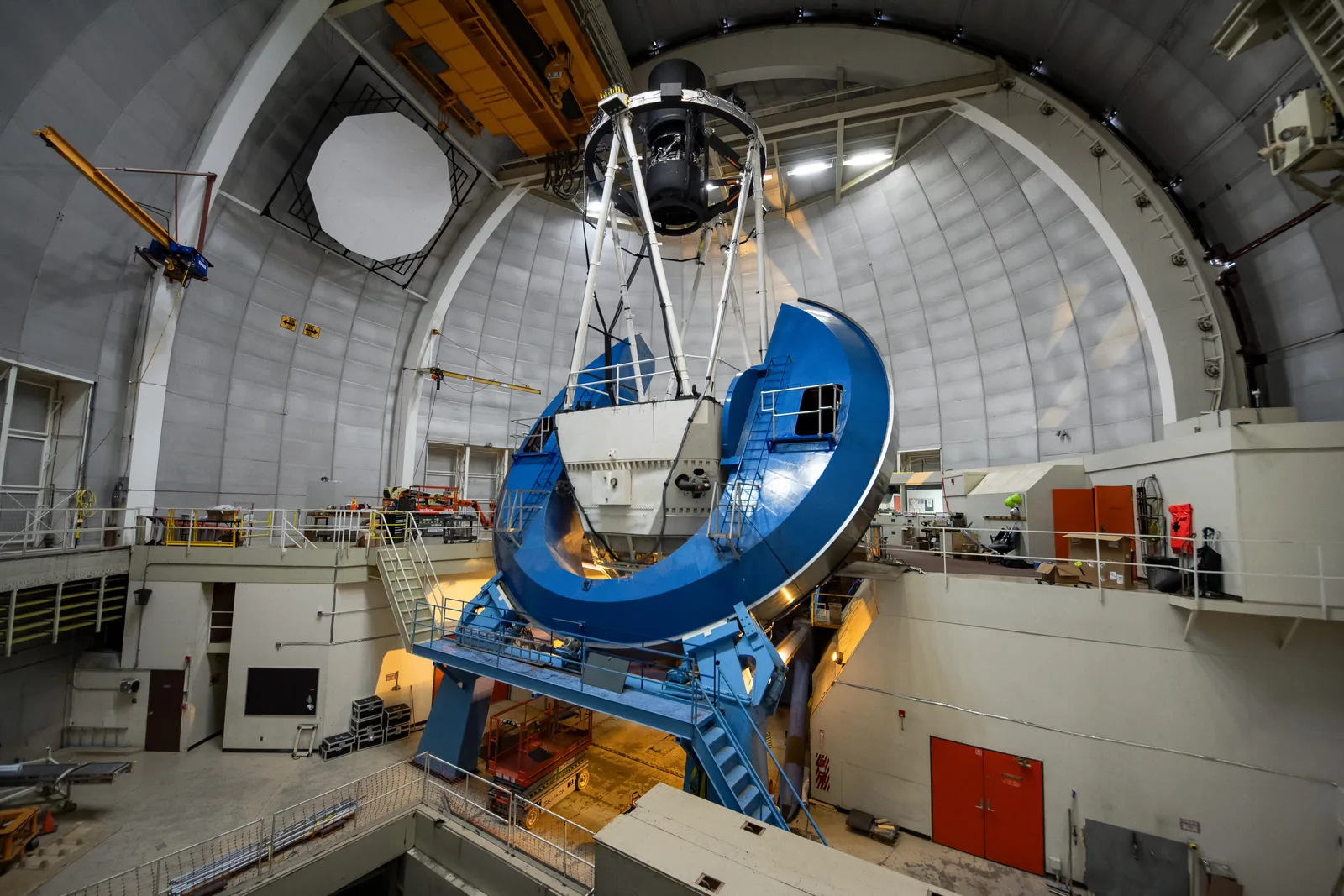
The Dark Energy Spectroscopic Instrument is a spectrograph on the Nicholas U. Mayall 4-metre telescope at Kitt Peak, Arizona. It does not see dark energy directly — nothing can, since dark energy gives off no light. Instead it records the spectra of about 5,000 galaxies and quasars at once, reads each object’s redshift from how the expanding universe has stretched its light, and builds a three-dimensional map of millions of them. Dark energy is then inferred from how that map shows cosmic expansion changing over time. For the full chain — from the robotic fibres to the acoustic ruler — see How DESI works.
The headline that travelled from it was that dark energy might not be a constant — that the mysterious thing accelerating the universe’s expansion could be weakening over time, cracking the standard cosmological model. That claim is not made up, but it is easy to over-read. The honest version is more specific, and more interesting: DESI’s own ruler, on its own, agrees with the plain-vanilla model. The hint of something new appears only when you combine DESI with other data — and how strong the hint looks depends on which other data you choose.
DESI’s baryon-acoustic ruler by itself is consistent with a constant dark energy (a cosmological constant). The preference for evolving dark energy emerges only when DESI is combined with the cosmic microwave background and a supernova sample — and its strength shifts with which supernova sample is used.
Standard ruler, and the two ways dark energy can vary
The BAO scale is a standard ruler: because we know its true length from the physics of the early universe, comparing its true length to its apparent size at a given distance tells us how much the universe had expanded by then. Measured across many distances, the ruler traces the whole expansion history — which is what dark energy governs.
In the standard model, called ΛCDM, dark energy is a cosmological constant: a fixed energy density of empty space that never changes. Physicists label its behaviour with an “equation of state” parameter, w, which for a true cosmological constant is exactly −1, everywhere and always.
To test that, you can relax it two ways. The simpler is to let w be some other constant (still fixed in time) — this is “wCDM.” The richer is to let w change as the universe expands, described by two numbers: w₀, its value today, and wₐ, how fast it drifts. This “w₀wₐCDM” model reduces to ΛCDM at the single point w₀ = −1, wₐ = 0. A preference for w₀ greater than −1 with wₐ negative is what “evolving dark energy” means here: dark energy that was more repulsive in the past and is easing off now.
What they found
- DESI BAO alone are consistent with the standard model. They give a matter density Ωm = 0.295 ± 0.015, and, when dark energy is allowed a constant w, w = −0.99 (+0.15/−0.13) — sitting right on the cosmological-constant value of −1.
- Combined with the CMB and its lensing, DESI gives Ωm = 0.307 ± 0.005 and a Hubble constant H₀ = 67.97 ± 0.38 km s⁻¹ Mpc⁻¹ (68.52 ± 0.62 when paired with nucleosynthesis and the CMB’s acoustic scale instead).
- In the time-varying model, the combinations prefer evolving dark energy — w₀ > −1 and wₐ < 0. The preference is 2.6σ for DESI+CMB, and when a supernova sample is added it becomes 2.5σ, 3.5σ, or 3.9σ for Pantheon+, Union3, or DES-SN5YR respectively (sigma measures how far a result sits from the standard-model expectation; 5σ is the usual threshold for a claimed discovery, and it is not a statement that the interpretation is correct — guide).
- Left free, the summed neutrino mass is bounded tightly — under 0.072 eV (95% confidence) for DESI+CMB — but the paper is explicit that this bound loosens substantially if the dark-energy background is allowed to depart from ΛCDM.
What this does not prove
- It does not show that dark energy is evolving. DESI’s own ruler is consistent with a cosmological constant; the hint of evolution appears only in combined fits, and only in the richer two-parameter model.
- It does not mean “ΛCDM is dead” or “Einstein was wrong.” The strongest number, 3.9σ, is below the 5σ convention physicists require before calling something a discovery — and the standard model remains a good fit to DESI alone.
- The result is not sample-independent. Swapping the supernova compilation moves the significance from 2.5σ to 3.9σ — more than a full sigma. A signal whose size depends that much on which external dataset you bolt on is a hint to be pursued, not a measurement to be banked.
- The DESI-alone lean toward w₀ > −1 is driven partly by a single anomalous point — the redshift-0.51 galaxy bin, which sits slightly high against ΛCDM. But this is where the paper does its homework: it treats that point as a statistical fluctuation, and shows that replacing all of DESI’s low-redshift (z < 0.6) measurements with the older SDSS ones leaves the dark-energy result unchanged. The odd point tugs DESI on its own; it does not prop up the combined hint. (Independent groups have since looked harder at its role.) So this caveat cuts the opposite way from how it is sometimes told: the result was stress-tested against its most anomalous data, and held.
- The neutrino-mass limit is not a model-independent verdict. It is tight only if the background expansion is held to ΛCDM; relax that, and the bound relaxes with it.
How strong is the evidence
- Very strong as a distance measurement. The BAO ruler is one of the cleanest tools in cosmology, DESI’s is the most precise yet, and the blind analysis is exactly the safeguard you want against reading a hoped-for answer into the data.
- Genuinely intriguing, but not decisive, as a dark-energy claim. A 2.6σ preference from DESI+CMB, rising to 3.9σ with the most constraining supernova set, is the kind of result that earns more telescope time — not the kind that overturns a model. The honest reason for caution is the spread across supernova samples; to their credit, the authors also checked that their single most anomalous BAO point does not drive the result — exactly the homework a claim like this needs.
- The paper is careful with itself: it reports the significance three ways rather than quoting the largest, and it flags the model-dependence of its neutrino result. The overreach, where it exists, is in the retelling, not the paper.
Why it matters
For a quarter-century, “dark energy” and “cosmological constant” have been used almost interchangeably, because every measurement was consistent with a w of exactly −1. DESI is the first dataset precise enough that, combined with others, it can even ask whether that −1 drifts — and get an answer that is not a flat no. That is a real shift in what the data can do, and it is why the result deserves attention. But the same precision is what lets us see how conditional the hint is: alive in some data combinations, quiet in others, and sensitive above all to which supernova catalogue is paired with DESI. The right posture is neither dismissal nor a revolution announced early. It is to watch the next, larger DESI release — DR2, already out in 2025 — and the independent supernova samples, and see whether the drift firms up or fades. This is what a genuine maybe looks like in cosmology, and it is worth reporting as a maybe.
Clean summary
DESI has measured the universe’s expansion history with the best baryon-acoustic ruler yet built, from six million objects. On its own, that ruler agrees with the standard model in which dark energy is a constant. Combine it with the cosmic microwave background and a supernova sample, and a preference emerges for dark energy that changes over time — at 2.6σ to 3.9σ, depending on which supernovae you add. That is a real and interesting hint, not a discovery: it stays below the threshold physicists demand, and it shifts with which supernova data you pair it with. Dark energy might be evolving. DESI has made that a question worth asking precisely — not yet a question it has answered.
Sources
Based on: DESI 2024 VI: Cosmological Constraints from the Measurements of Baryon Acoustic Oscillations — DESI Collaboration: A. G. Adame, J. Aguilar, S. Ahlen, S. Alam, D. M. Alexander, et al., Journal of Cosmology and Astroparticle Physics (JCAP) 02 (2025) 021.
Written by
Vera Rubin
Editorial note
This article was prepared with AI assistance and human editorial review. It is a clear, conservative explanation of the linked work, not a substitute for reading it. Responsibility for selection, interpretation, and final wording rests with the editor.