The shape that refuses to be identified
Imagine measuring a surface without being allowed to step outside it. You can measure distances along it: how far one point is from another if you travel on the surface itself. That is the surface’s metric. Now add one more measurement from outside: at every point, record the average bending of the surface, its mean curvature.
That sounds like a lot of information. For many surfaces, it is enough. If you know the intrinsic distances and the mean curvature function, you might expect the shape in three-dimensional space to be pinned down.
Alexander Bobenko, Tim Hoffmann and Andrew Sageman-Furnas have now constructed compact surfaces that defeat that expectation. Their paper gives two tori - doughnut-shaped surfaces, though not ordinary round doughnuts - that are isometric and have the same mean curvature at corresponding points, but are not congruent. You cannot rotate, translate or reflect one into the other. They are genuinely different immersions in space.
In the language of the field, they are compact Bonnet pairs. The paper calls them the first such examples.
What the problem is
Classical surface theory separates two kinds of information.
The metric tells you distances measured on the surface. A flat sheet rolled into a cylinder keeps the same intrinsic metric: a small ant walking on the sheet would not notice the roll by measuring distances alone. The full second fundamental form tells you much more about how the surface bends in space. The classical Bonnet theorem says that, with the metric and the full bending data satisfying the right compatibility equations, the immersion is determined up to a rigid motion.
But in 1867, Pierre Ossian Bonnet asked a sharper question. What if the bending data is reduced? Since the metric already determines Gaussian curvature intrinsically, can a surface be characterized by the metric plus the mean curvature function?
Generically, the answer is yes. That word matters. Geometry often has exceptional cases: special surfaces where the usual uniqueness statement fails. The open question was whether compact smooth examples existed in which the metric and mean curvature agree but the surfaces are not the same in space.
This is the Global Bonnet Problem. The new paper answers it with tori.
What the authors built
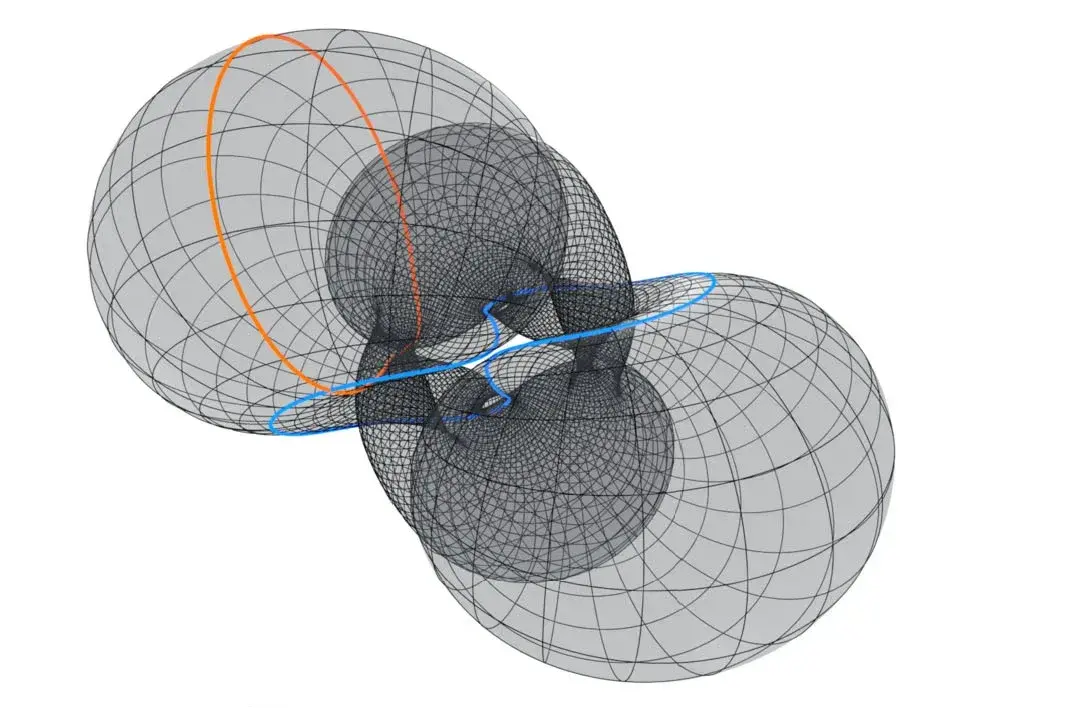
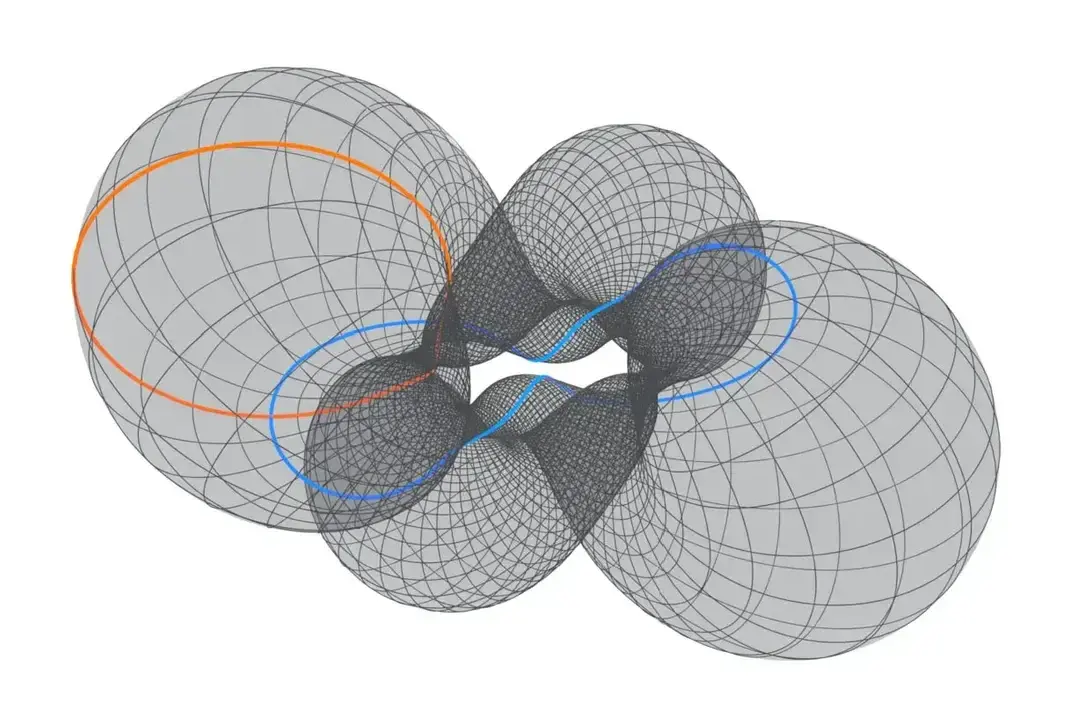
The authors construct a pair of smooth tori in R3 related by a mean-curvature-preserving isometry. That means corresponding points have the same intrinsic distances around them and the same mean curvature value, but the two surfaces are not congruent.
The construction does more than produce a single numerical curiosity. The tori are real analytic - as regular as power-series geometry, not rough patched objects - and the authors prove that generically their examples are not related by any ambient isometry. They also state that their construction gives uncountably many such pairs, because it contains a functional parameter.
The route is technical. It uses the relation between Bonnet pairs and isothermic surfaces, a class of surfaces with special curvature-line coordinates. The examples arise by starting from isothermic tori with one family of planar curvature lines and applying a construction that produces the Bonnet pair. The authors say the approach grew out of computational experiments with a 5x7 quad decomposition of a torus, using discrete differential geometry as a guide toward the smooth result.
The visual result is easier to grasp than the proof. The two tori in the paper have matching geometric data but visibly different global placement: in the authors’ Figure 1, corresponding large “bubbles” sit closer together on one torus than on the other. That visible difference is not a trick of drawing. The theorem says the surfaces are not the same shape in space, even though the selected local data agrees.
Why this is not a contradiction
The result does not say geometry is arbitrary, or that measurements are useless.
It says a particular reduced data set - metric plus mean curvature - is not always enough to identify a compact surface uniquely. The full classical uniqueness theorem uses richer bending information. Mean curvature is only an average of the two principal curvatures. It tells you how much the surface bends on average at a point, but it does not preserve all directional bending information.
That distinction is the whole point. Two surfaces can agree on distances along the surface and on average bending at every corresponding point, while differing in the way that bending is arranged in space.
The paper also does not say this ambiguity is typical. The introduction is careful: generically, metric plus mean curvature determines a surface. Bonnet pairs are exceptional. Their value is exactly that they show the exception exists in the compact, smooth, analytic setting where it had remained unresolved.
What old questions it closes
The first closed question is the Global Bonnet Problem: do there exist two non-congruent compact smooth immersions in three-dimensional Euclidean space related by an isometry with the same mean curvature at corresponding points? The authors answer yes.
The second is the Cohn-Vossen-Berger problem: do there exist two isometric compact analytic surfaces in Euclidean three-space not related by an ambient isometry? Again, the answer is yes, using the analytic tori obtained by the same construction.
The analytic part is important. Earlier non-uniqueness examples for compact surfaces could rely on lower regularity or local alterations. These tori are not just a smooth object with a bump swapped in one patch. The paper emphasizes that the corresponding neighbourhoods are nowhere locally congruent: the difference is spread through the construction, not hidden in a repair seam.
Why it matters
This is pure mathematics, but the intuition is broad. A shape can be overdetermined in one sense and still underidentified in another. What counts is not how much data you have, but whether the data contains the right kind of information.
Metric plus mean curvature feels strong because it combines internal distances with an extrinsic bending measure. The compact Bonnet pair shows the gap: average bending is not full bending. Local agreement is not always global identification. Analytic regularity is not a magic uniqueness guarantee.
That is a useful lesson beyond this theorem. In geometry, inverse problems often ask whether a set of measurements determines the object that produced them. This paper gives a sharp new answer for one classical surface problem: not always, even when the object is compact, smooth, and analytic.
Clean summary
Bobenko, Hoffmann and Sageman-Furnas construct the first compact Bonnet pairs: two non-congruent smooth tori in R3 that are related by an isometry and have the same mean curvature at corresponding points. Their examples are real analytic and generically not related by any ambient isometry, resolving both the Global Bonnet Problem and the Cohn-Vossen-Berger analytic uniqueness question as stated in the paper. The result does not overturn classical surface theory; it shows that the reduced data of metric plus mean curvature is not always enough to identify a compact surface uniquely.
No-BS check
What the paper shows: Compact smooth Bonnet pairs exist. More specifically, the authors explicitly construct tori in R3 with the same metric and mean curvature function at corresponding points, but which are not congruent.
What is plausible but not the point: That computational and discrete-geometric exploration can guide difficult smooth constructions. The paper says this route was important, but the result rests on the proof, not on the numerical picture.
What it does not show: That all or most surfaces are ambiguous. The generic uniqueness statement remains part of the background. These are exceptional but decisive counterexamples.
Main limitations for a general reader: The proof is highly technical and lives in differential geometry: isothermic surfaces, Bonnet pair classifications, period conditions and analytic construction. A reader can understand the meaning of the theorem without following the machinery.
How much confidence should a general reader have? High on the theorem statement as a peer-reviewed mathematical result. The right caution is interpretive, not evidential: read it as “this reduced geometric data does not always determine the shape,” not as “geometry cannot identify shapes.”
Sources
Based on: Compact Bonnet pairs: isometric tori with the same curvatures — Alexander I. Bobenko, Tim Hoffmann, and Andrew O. Sageman-Furnas, Publications mathematiques de l'IHES.
Written by
Laura Nesso
Editorial note
This article was prepared with AI assistance and human editorial review. It is a clear, conservative explanation of the linked work, not a substitute for reading it. Responsibility for selection, interpretation, and final wording rests with the editor.