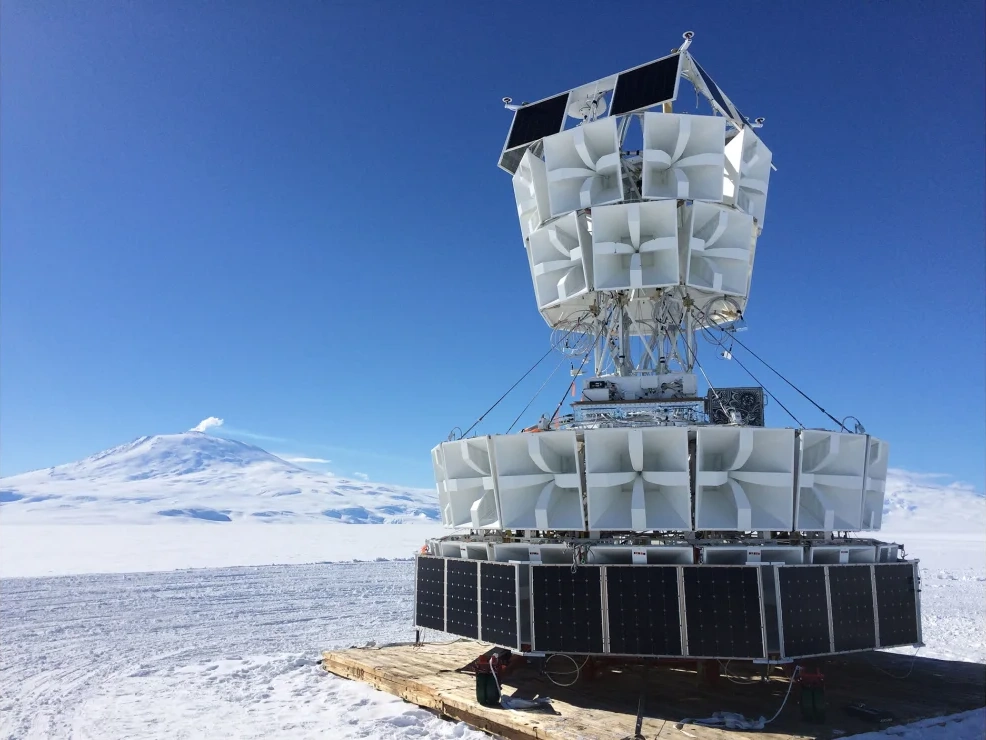
The balloon, the ice, and two pulses from below
For most of its working life, the Antarctic Impulsive Transient Antenna — ANITA — hangs beneath a NASA balloon, thirty-odd kilometres up, and drifts for weeks over the emptiest place on Earth, listening.
What it listens for are radio signals from space. When a very high-energy particle — a cosmic ray, or a neutrino — hits the air or the ice, it shatters into a shower of smaller particles, and that shower gives off a brief flash of radio. Antarctica is close to ideal for catching them: kilometres of clean, cold ice that radio crosses almost as if it were glass, and nothing for hundreds of kilometres to clutter the signal. ANITA’s job is to catch those flashes and read, from their shape and timing, what made them.
Most of what it hears is well-behaved. Some flashes arrive straight from above. Many more glance off the ice and bounce back up to the antenna — and these carry a giveaway: the bounce turns the wave upside down (a reversal of the signal’s polarity), a signature physicists can read at a glance. It is how you tell a reflection from the real thing.
Twice, something arrived that broke the pattern.
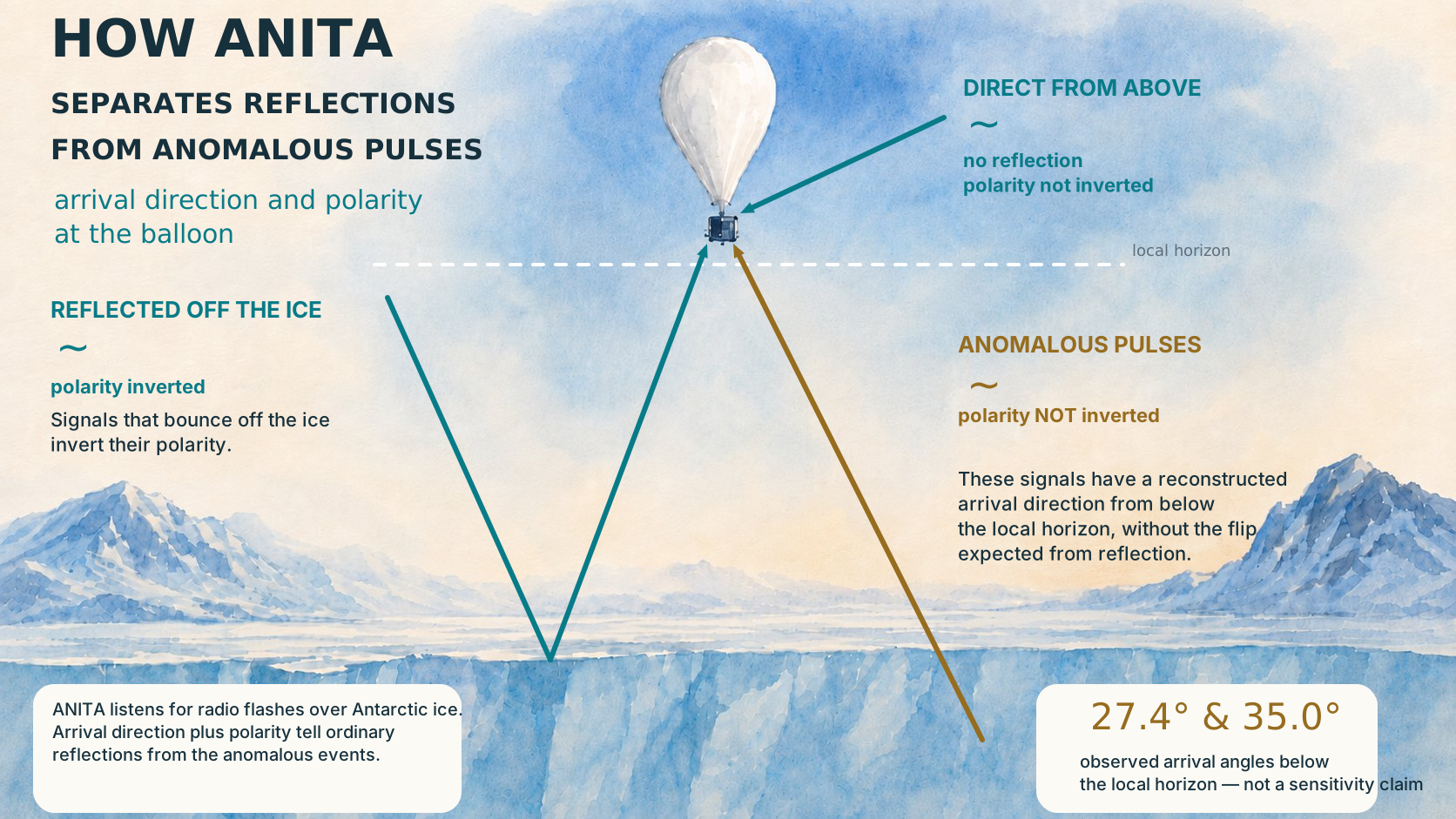
On one flight in 2006 and another in 2014, ANITA caught a pulse from steeply below the horizon — 27.4° and 35.0° beneath it, respectively — as if it had come up out of the continent, with no inversion. Not a reflection, then. Something that genuinely travelled upward, out of the ice, toward the balloon.
Here is why that is close to scandalous. To reach the antenna at so steep an upward angle, whatever made the pulse had to come up through the body of the planet — six or seven thousand kilometres of solid rock. Almost nothing can. The one known particle that passes through ordinary matter as if it were barely there is the neutrino, which slips through the whole Earth without noticing — so the natural idea is that a neutrino travelled up through the rock, struck an atom just beneath the ice, and produced a shower of particles racing upward, whose radio flash ANITA caught. The trouble is a twist: a neutrino energetic enough to make this signal is, in fact, too easy to stop. Across that much rock it should be absorbed many times over. And a stream of neutrinos strong enough that two still got through ought to have shown up in the giant detectors built to catch exactly that. None of the tidy explanations quite closed.
So the two pulses sat there, refusing to behave. Not a discovery — two events are never a discovery — but not nothing, either. A genuine anomaly: the kind that is interesting precisely because no one could yet say whether it was a crack in the Standard Model of physics or merely a quirk of the ice, the antenna, or the arithmetic.
This is the point where a certain kind of coverage reaches for the word mysterious, dims the lights, and asks what might be living under Antarctica. Resist it. The real question was never what monster is in the ice. It was the patient, unglamorous one that actually moves science forward: how would you find out?
What they found
After unblinding, one candidate event survived — fully consistent with the 0.27 ± 0.12 events expected from ordinary cosmic rays occasionally being misreconstructed as upward-going. No genuine upward-going signal, in other words; just the trickle of background you would expect.
The force of the result is in the comparison. If the ANITA pulses came from a steady flux of upward-going showers, Auger should have recorded many — roughly 34 to 69 such events for one plausible energy spectrum, and at least about 8 even under deliberately conservative assumptions. It found one, consistent with background. The authors describe this as “strong disagreement” with the upward-going-shower interpretation.
What this probably means
A non-detection of this size is informative. If the ANITA events came from a real population of particles arriving from those directions — ordinary tau-neutrinos, or the hypothetical new particles proposed to explain them — Auger’s long exposure should have caught a sizeable number. It did not. That effectively rules out the “diffuse flux of upward-going showers” explanation — the category into which most beyond-the-Standard-Model ideas fall — barring contrived special conditions.
What survives are explanations that are not a flux of showering particles: most discussed, a reflection or propagation effect peculiar to the ice and the near-horizon geometry, or an instrumental or analysis artifact. None is confirmed. So the honest summary is: the most exciting interpretation just took a serious hit, and the cause is still unknown.
What this does not prove
- It does not identify what the two pulses are. “Strongly disfavours new physics” is not “solved.”
- It does not confirm a mundane cause. A leading candidate — reflections from beneath the Antarctic surface — remains a hypothesis, not a result.
- It does not detect anything “from under the ice” in any literal sense. ANITA’s antennas hang from a balloon above Antarctica; “from below” describes a radio pulse’s reconstructed arrival direction — not a sound, a voice, or anything emanating from within the ice.
- It does not support claims of a confirmed new particle. The most widely shared version of this story points the opposite way from the evidence.
How strong is the evidence?
Modest, and stated as such.
- The beyond-the-Standard-Model interest rests on essentially two events, from two ANITA flights.
- This paper is a null result: powerful for excluding possibilities, but it cannot say what the events are.
- The exclusion is quantitative and strong (dozens of events expected, one background-like event seen) — but it targets the “upward-going shower flux” interpretation, not every conceivable cause.
- A leading mundane explanation (near-surface reflection) is plausible but unproven; some alternatives (certain transition-radiation models) have been disfavoured by other work.
- No experiment has independently reproduced the original anomaly.
This is a sharp constraint laid on top of a small, stubborn puzzle — not a discovery.
Why it matters
The proposed explanations ran all the way to exotic new particles. Rather than chase the most exciting one, the field did the unglamorous thing: it tested the idea against an independent, far larger detector — and the data said no. A larger, more sensitive successor instrument, PUEO, is being built to look again.
The anomaly may yet turn out to be mundane. That would not make it a failure. Narrowing an unexplained measurement until it either dissolves or forces a real discovery is the work — and it is worth watching precisely because the honest answer, for now, is still “we don’t know.”
Clean summary
Two radio pulses from ANITA’s 2006 and 2014 Antarctic balloon flights appear to come from steep below-horizon angles that the Standard Model struggles to explain. A dedicated 2025 search with the Pierre Auger Observatory found only one candidate event, consistent with background, where dozens were expected if the pulses came from a flux of upward-going showers. That strongly disfavours the exotic “new particle” interpretation and points toward a reflection, propagation, or instrumental effect specific to ANITA — but the cause is still genuinely unknown. Not a confirmed new particle, and not a mysterious signal from inside the ice.
No-BS check
What the paper shows: A blind Pierre Auger search (2004–2018) for upward-going air showers found one candidate, consistent with the expected 0.27-event cosmic-ray background. If the ANITA anomalies came from a flux of such showers, Auger should have seen roughly 34–69 (or at least ~8 under conservative assumptions). This strongly disfavours the upward-going-shower interpretation, including beyond-Standard-Model “new particle” scenarios.
What is plausible but not proven: A reflection or radio-propagation effect near the ice and horizon, or an instrumental/analysis artifact specific to ANITA.
What it does not show: That the events are caused by a new particle; that they are signals from under the ice; that anything paranormal, artificial, or audible is involved; that the cause is now known.
Main limitations: The beyond-Standard-Model interest rests on ~two events; this is a null result that constrains but cannot identify; the exclusion targets the “shower flux” interpretation specifically; no independent reproduction of the original anomaly.
How much confidence should a general reader have? High confidence that this is not a confirmed new particle and not a signal from within the ice, and that the exotic-flux interpretation is now strongly disfavoured. Low confidence about the true cause, which remains open. Appropriate stance: curiosity about an unsolved anomaly that is most likely mundane.
Source
Based on: Search for the Anomalous Events Detected by ANITA Using the Pierre Auger Observatory — Pierre Auger Collaboration, Physical Review Letters 134, 121003 (2025).
Written by
Lucio Vaglio · figures and links by
Laura Nesso · edited by
Michele Renda
· figures and links by
Laura Nesso · edited by
Michele Renda
Editorial note
This article was prepared with AI assistance and human editorial review. It is a clear, conservative explanation of the linked work, not a substitute for reading it. Responsibility for selection, interpretation, and final wording rests with the editor.