The eyes do not wander at random
Put two people in front of the same busy scene and they will not explore it in the same way. One person’s eyes jump quickly to faces. Another keeps landing on text. Those differences are not just momentary choices. In this study, they were stable traits: across hundreds of images, people showed reliable personal tendencies in what they looked at first and how long they stayed there.
The interesting question is what those habits are attached to. Are they just preferences - a social person looking at faces, a reader looking at words - or are they tied to how each person’s visual brain represents those categories?
Diana Kollenda, Elaheh Akbari, Maximilian Broda and Benjamin de Haas tested that link directly. They combined eye tracking during free viewing of natural scenes with a separate fMRI experiment that mapped how each participant’s visual cortex responded to categories such as faces and words. Their result is simple enough to state carefully: people who preferentially looked at faces had more distinctive face representations in the right ventral visual cortex; people who preferentially looked at text had more distinctive word representations in the left ventral visual cortex.
That does not mean the brain forces the eyes to move in one way, or that looking at words builds a word area by itself. The paper is not causal. But it does say that active vision - the way a person samples the world with their eyes - is matched to the fine-grained layout of that person’s visual system.
What the authors did
The study has two cleanly separated parts.
First, 102 adults freely viewed 700 complex scene images while their eye movements were recorded. The researchers measured two things for faces and text: where a participant looked first, and how long they kept looking there. That total looking time is called dwell time.
They also checked whether these habits were stable. The simple idea behind split-half reliability is this: divide the images into two sets, measure the same habit in both sets, and see whether the same people still rank high or low. If the answer is yes, the habit is reliable. Here the reliability was high: for faces, r = 0.93 for first fixations and r = 0.95 for dwell time; for text, r = 0.87 and r = 0.88. Values near 1 mean the tendency is very stable.
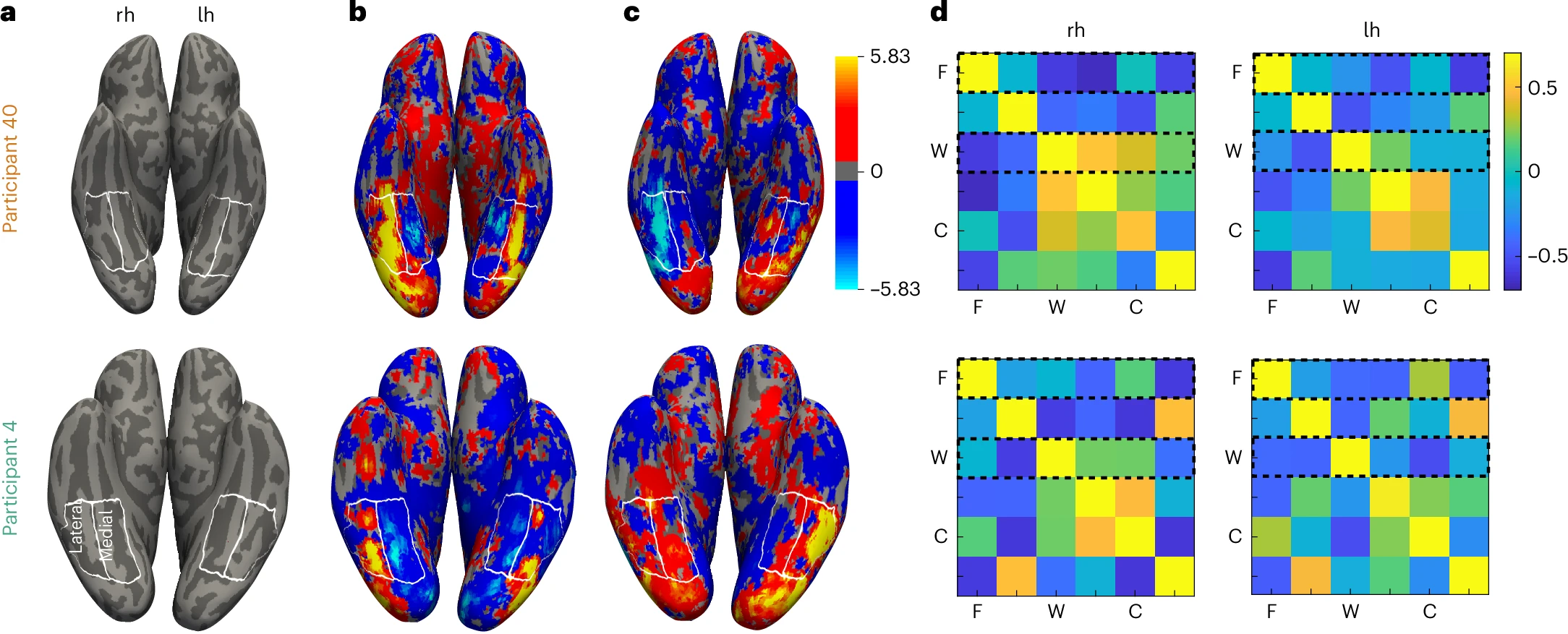
Second, 61 of those participants completed a separate functional MRI experiment. Functional MRI, or fMRI, tracks changes in blood oxygenation as an indirect signal of which brain areas are more active during a task. A localizer is a standard mapping task: show known categories, such as faces or words, and identify the patches of cortex that respond more to one category than to others. This was not free viewing. Participants fixated centrally while blocks of faces, pseudowords, bodies, houses, cars and limbs were shown. That design matters: the brain measure was not simply the result of participants moving their eyes toward the same objects inside the scanner.
The researchers then asked how distinctive each person’s category response was in the ventral temporal cortex. A more distinctive face pattern means that the brain activity for faces was more reliably face-like and more separable from other categories. A more distinctive word pattern means the same for words and characters.
What they found
The main pattern was category-specific.
Face distinctiveness in the right lateral ventral temporal cortex correlated with a participant’s tendency to look at faces in the independent free-viewing task. The relationship appeared for first fixations and dwell time. Word distinctiveness in the left lateral ventral temporal cortex correlated with the tendency to look at text.
The paper also checked that this was not just a generic “visual cortex is stronger in some people” effect. The strongest links followed the expected category and hemisphere: faces in the right lateral VTC, words in the left lateral VTC. Cross-category links were not the story.
The neural measures also connected to behaviour. In smaller subsamples, stronger face distinctiveness was linked to better performance on the Cambridge Face Memory Test, and stronger word distinctiveness was linked to faster reading performance. That gives the neural measure some external meaning: it is not only a scanner statistic, but a signal related to what people can do.
What this does not mean
The tempting headline would be “your brain decides what you see.” That is too strong.
The study does not establish the direction of causality. A person may look more at faces because their face representations are more precise. Or their face representations may be more precise because years of looking at faces shaped that part of the visual system. Or both may develop together. The authors explicitly leave that developmental question open.
It also does not mean people with different gaze habits see different physical scenes. Everyone was looking at the same images. The difference is in sampling: which objects get priority, which information is gathered first, and which categories are represented more distinctly in the visual cortex.
Nor is this a diagnostic test for individuals. The correlations are meaningful at the group level, but they are not a tool for saying “this person’s brain map predicts exactly how they will look at this picture.”
Why it matters
Vision is often described as if the eyes were a camera feeding a brain. Real vision is more active than that. The eye chooses, moment by moment, what information to bring into high resolution. Those choices become the input from which the brain learns and acts.
This paper puts that loop on firmer ground. It links the active part - eye movements through scenes - to the representational part - category-selective maps in the ventral visual cortex - within the same individuals. The result makes it harder to treat “visual cortex organization” and “visual behaviour” as separate levels. In adults, at least, they appear matched.
That match is the real story. Not that face-lookers are one kind of person and text-lookers another. Not that one brain region explains a personality. The result is narrower and more useful: stable differences in how people explore visual scenes line up with stable differences in how sharply their visual cortex represents the things they tend to seek.
Clean summary
A Nature Human Behaviour study tracked how 102 adults looked at 700 complex scenes, then scanned a subset of 61 participants with fMRI to map category-selective visual responses. People who tended to look first and longer at faces showed more distinctive face representations in right lateral ventral temporal cortex; people who tended to look at text showed more distinctive word representations in left lateral ventral temporal cortex. Those neural measures also related to face recognition and reading performance in smaller subsamples. The study is correlational, not causal: it shows that active gaze habits and category-selective brain organization are matched in adults, not which one produces the other.
No-BS check
What the paper shows: Stable individual tendencies to look at faces or text in natural scenes are linked to matching category-selective representations in the ventral visual cortex.
What is plausible but not proven: That long-term visual experience and brain tuning reinforce each other over development. The paper is consistent with that idea, but it does not test the developmental direction.
What it does not show: That people literally see different worlds; that gaze habits are hardwired; or that the fMRI maps cause the eye movements.
Main limitations: Correlational design; adult university sample; smaller behavioural subsamples for face recognition and reading; and a separate fMRI localizer rather than simultaneous free-viewing fMRI.
How much confidence should a general reader have? High that the gaze tendencies are real and stable in this sample, and moderate-to-high that they are linked to matching category-selective visual representations. Low on any causal story until developmental or intervention work tests it directly.
Sources
Based on: Active vision is linked to category selectivity in the individual brain — Diana Kollenda, Elaheh Akbari, Maximilian D. Broda, and Benjamin de Haas, Nature Human Behaviour.
Written by
Laura Nesso
Editorial note
This article was prepared with AI assistance and human editorial review. It is a clear, conservative explanation of the linked work, not a substitute for reading it. Responsibility for selection, interpretation, and final wording rests with the editor.