The other fusion, and a step we had never actually seen
There is a kind of nuclear fusion that needs no star, no plasma, no giant magnets or laser arrays. You just need a muon — a heavy, short-lived cousin of the electron — and some hydrogen. It is called muon-catalysed fusion (μCF), and it has spent about seventy years being almost useful. So when a paper about it appears, the headline risk is obvious: muon fusion breakthrough. This paper is genuinely a breakthrough, but in a precise and narrower sense than that phrase suggests. It did not make μCF a power source. It let physicists, for the first time, watch a hidden step of the reaction happen directly — a step they had only ever inferred.
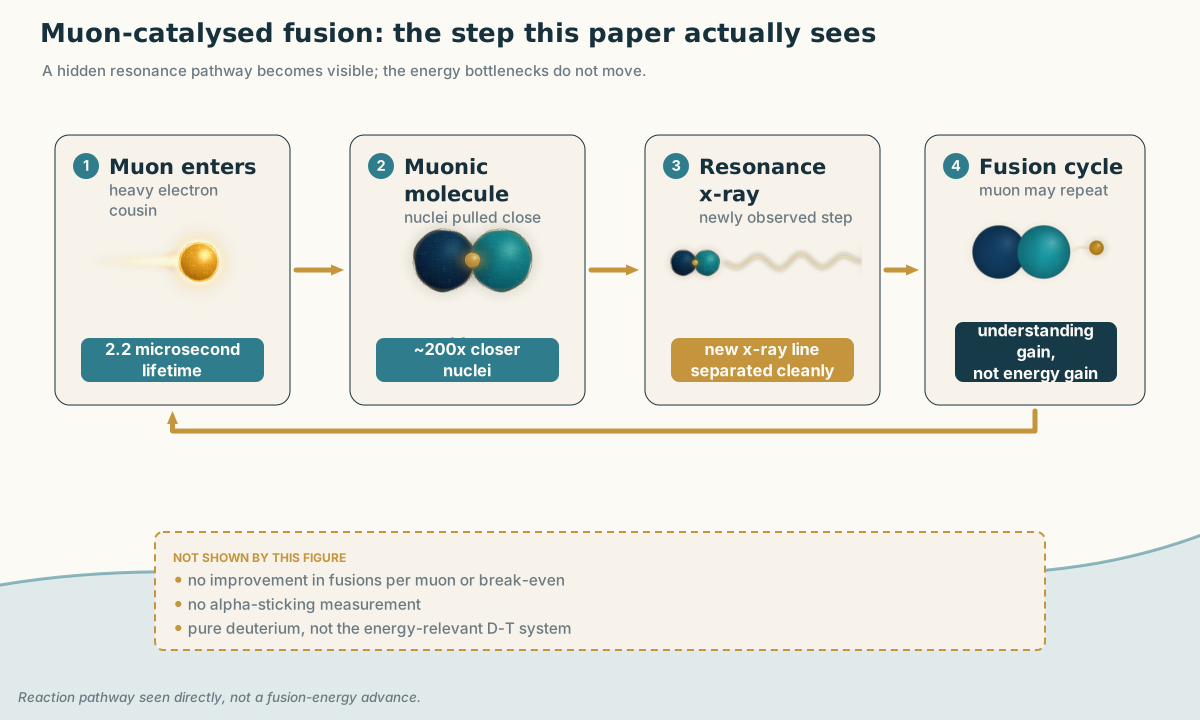
Here is the trick that makes μCF possible at all. A muon has the same charge as an electron but is about 207 times heavier. If a muon takes an electron’s place around hydrogen nuclei, the orbit it draws is roughly 200 times smaller. Two hydrogen nuclei bound into such a muonic molecule are pulled about 200 times closer than in an ordinary hydrogen molecule — close enough that they fuse almost instantly, with no need for the enormous heat or pressure that fusion normally demands. After the nuclei fuse, the muon is usually spat back out, free to grab another pair and do it again. One muon can catalyse this cycle many times within its brief 2.2-microsecond life.
Why it has never become an energy source
The reason μCF is not powering anything is captured by one number: to break even on energy, a single muon would need to catalyse roughly 300 fusions before it dies or gets stuck. The best deuterium–tritium experiments have managed somewhat more than 100. Two stubborn bottlenecks keep the count down. The first is “alpha sticking”: now and then the muon clings to the helium nucleus (the alpha particle) made in the fusion, and is dragged out of the game. The second is simply how fast muonic molecules form in the first place. Decades of work have circled these two problems, but the detailed choreography of how the muonic molecule forms has stayed frustratingly out of view — inferred from the particles that come out, never watched directly.
This is the gap the new work addresses. Not the energy balance — the visibility.
What the authors did
The team worked at the J-PARC accelerator complex in Japan, firing a pulsed beam of negative muons into a small disc of solid deuterium frozen onto a silver plate at about 3 kelvin. They deliberately used pure deuterium rather than the more energetic deuterium–tritium mix. In deuterium the fusion itself is slow, but the muonic molecule it forms — called ddμ — gives a clean, simple signal, where the busier D–T system would smear several overlapping signatures together. The goal here was clarity, not yield.
Their real instrument was the detector. They used an array of superconducting transition-edge sensor (TES) microcalorimeters, developed at the US National Institute of Standards and Technology — quantum sensors that measure the energy of an individual X-ray by the tiny temperature rise it causes. In the relevant range around 2,000 electron-volts, this detector resolved X-ray energies to about 8 electron-volts — more than ten times sharper than the conventional silicon detectors used in earlier μCF work. That sharpness is the whole story: the signal they were after sits right next to a much brighter line, and only a detector this precise could pull the two apart.
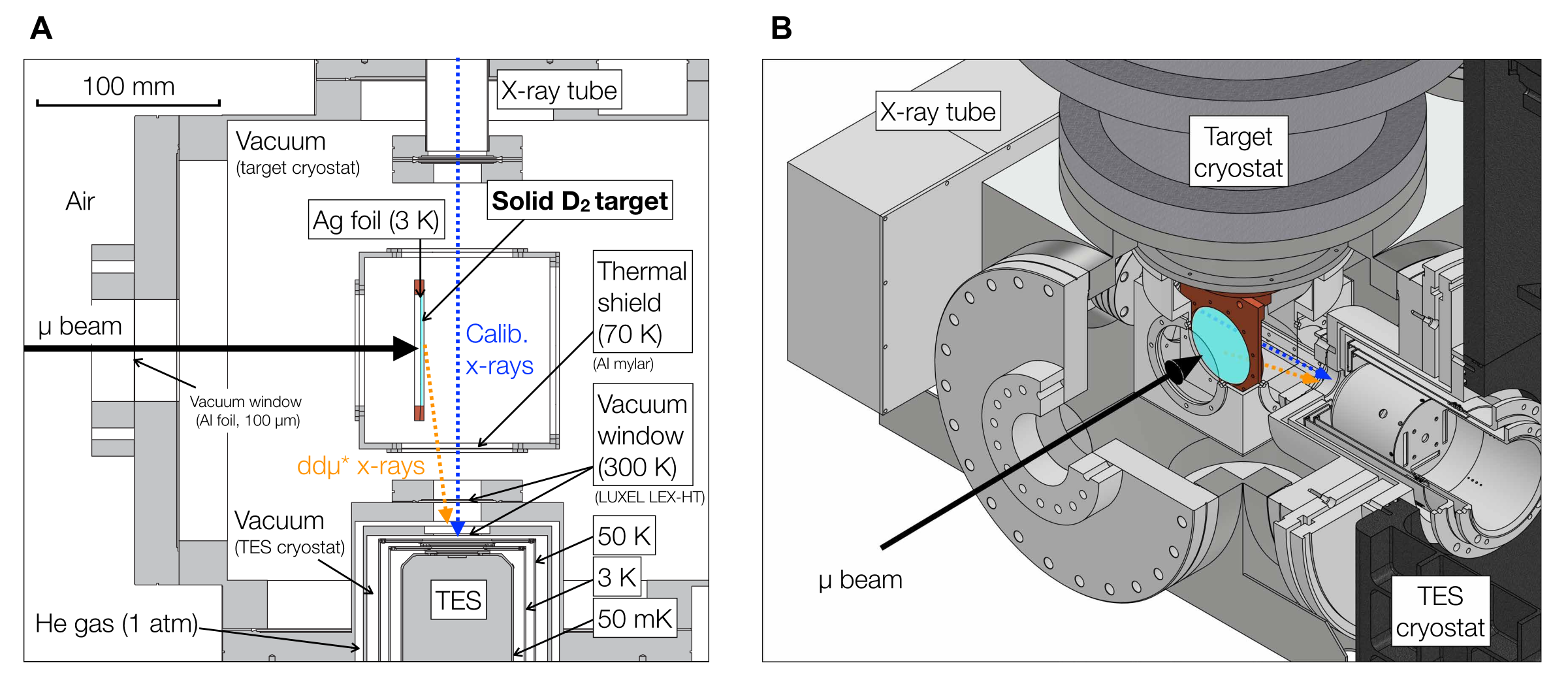
Over roughly 57 hours of beam time they recorded the X-rays coming out of the frozen deuterium, then compared the spectrum to high-precision theoretical calculations of what each quantum state of the muonic molecule should emit.
What they found
A hidden ledge in the spectrum. Next to the bright, expected X-ray line at 2.00 keV (emitted by ordinary muonic deuterium atoms), they resolved a distinct structure spread across the 1.6–2.0 keV range. That structure is the fingerprint of muonic molecules caught in fleeting “resonance” states — short-lived, quasi-bound arrangements — as they break apart and emit an X-ray on the way down.
Theory matched it, in detail. The measured shape was well reproduced by summing the calculated X-ray spectra of specific quantum states of the ddμ molecule (particular vibrational and rotational levels). The fit was statistically clean — close to an ideal match — which is strong evidence that what they were seeing really is the resonance-state pathway the theory predicted, and not some artefact.
About half the muons take this route. From the brightness of the new structure relative to the familiar line, they measured a ratio of 0.64 ± 0.03 (statistical) ± 0.05 (systematic). Folding in the cases where the molecule falls apart without emitting an X-ray, the conclusion is that nearly half of the muons pass through this resonance-state detour — a pathway that had been left out of the standard accounting of how μCF works.
It confirms a long-proposed mechanism. The pattern supports the so-called Vesman mechanism, in which the muonic molecule forms by a precise energy-matching (“resonant”) handoff to a neighbouring molecule, then cascades down through its vibrational rungs. This had been the textbook explanation for decades; now there is direct spectroscopic evidence for it.
What this probably means
The cautious, well-supported reading: physicists now have a direct, quantum-state-resolved window into the molecular step of muon-catalysed fusion. For seventy years that step was a black box, reconstructed only from the fusion debris. A whole reaction channel that was quietly omitted from the standard kinetic models turns out to carry roughly half the traffic. That means those models — including the ones used to interpret recent, more promising μCF experiments — need to be revisited with this pathway included.
The more forward-looking (and more speculative) reading: the same detector technology could now be aimed at the field’s actual obstacles. The authors point out that their TES array could, in principle, study alpha sticking directly in future experiments by measuring a tell-tale broadened X-ray from muonic helium — the very loss mechanism that caps μCF efficiency. They did not do that here; they flag it as next.
What this does not prove
- It is not a step toward fusion energy. Nothing here improves the energy balance, raises the number of fusions per muon, or addresses break-even. The work is about seeing and understanding a step, not making it more productive.
- It does not touch the alpha-sticking problem. The single biggest limit on μCF as a power source is untouched; studying it is named as future work, explicitly not done in this experiment (there was not enough beam time even to attempt a related measurement).
- It was done in pure deuterium, not deuterium–tritium. D–T is the combination that matters for energy, and it was deliberately avoided here because its signal is messier. The clean result lives in the system that is not the energy-relevant one.
- The headline interpretation leans on theory. The identification of specific quantum states rests on agreement between the measured spectrum and detailed few-body calculations. The agreement is excellent, but the claim is “measurement consistent with high-precision theory,” not a model-free readout.
- A possible faster “shortcut” pathway (a direct resonance-to-bound transition) is not confirmed — the data are consistent with it but do not establish it.
- This is one experiment at one facility. It is a strong first direct observation, not yet a cross-checked body of measurements.
How strong is the evidence?
The core claim — that muonic molecules in resonance states were directly observed, via the X-rays they emit on dissociating — is on firm ground. It rests on a genuinely better instrument (a tenfold gain in energy resolution), a clean spectrum with a statistically convincing fit, and a background run that showed nothing where the signal sits. The measured ratio comes with honest statistical and systematic error bars.
What is more inferential is the layer of interpretation on top: assigning the structure to particular quantum states, and concluding that “about half” the muons take this route, both depend on the theoretical spectra being right. They fit strikingly well, and the physics community has good reason to trust these few-body calculations — but this is the part a careful reader should hold a notch more loosely than the bare observation. The authors are clear about which is which.
One housekeeping note for honesty: this explainer is based on the open-access published article (via PubMed Central). The full numerical detail of the systematic uncertainties and the energy calibration lives in the Supplementary Materials, which we did not separately parse; nothing in the main text appears to hinge on a number we could not see.
Why it matters
Muon-catalysed fusion is one of science’s great “so close” stories, and that makes it a magnet for overclaiming. The honest interest here is not energy. It is that a reaction step which had been invisible for decades — and which, it turns out, carries half the muons — can now be watched directly, one quantum state at a time. That is the sort of result that quietly corrects the textbooks: the standard model of how μCF proceeds was incomplete, and now there is a tool sharp enough to complete it.
It also marks a coming-of-age for a piece of instrumentation. Quantum-sensing TES microcalorimeters, until recently the preserve of delicate lab setups, now work reliably in the rough environment of an accelerator beamline. That detector, more than any single fusion number, may be the durable result: a new pair of eyes for atomic and nuclear physics — including, eventually, for the loss mechanisms that have kept μCF from ever paying its way.
Clean summary
Using an exceptionally sharp quantum-sensor X-ray detector at the J-PARC accelerator, physicists fired muons into frozen deuterium and, for the first time, directly observed muonic molecules in fleeting “resonance” states — by catching the X-rays they emit as they break apart. The measured spectrum matched high-precision theory in detail, and revealed that roughly half of the muons take this resonance pathway, a channel left out of the standard description of muon-catalysed fusion. It confirms a long-proposed mechanism and forces a revision of the field’s kinetic models. It is a real advance in understanding and seeing the reaction — not a step toward fusion as an energy source: it does not improve efficiency, does not address the muon-loss (“alpha sticking”) bottleneck, and was done in deuterium rather than the energy-relevant deuterium–tritium mix.
No-BS check
What the paper shows: The first direct, quantum-state-resolved observation of muonic deuterium molecules (ddμ) in resonance states, via the X-rays emitted when they dissociate, using a TES microcalorimeter array with ~8 eV resolution at 2 keV (>10× better than conventional detectors) at J-PARC. The spectrum matches few-body theory; the resonance-pathway X-rays are 0.64 ± 0.03 ± 0.05 as intense as the reference line, implying ~half of muons pass through this previously-unaccounted resonance channel; the result supports the Vesman formation mechanism.
What is plausible but not proven: The exact assignment of vibrational/rotational states and the “about half” figure (both depend on the theoretical spectra, which fit very well); a faster direct “resonance-to-bound” shortcut (consistent with the data, not established).
What it does not show: Any improvement in μCF energy efficiency or fusions-per-muon; any handling of alpha sticking; any result in the energy-relevant deuterium–tritium system; a model-independent measurement.
Main limitations: One experiment at one facility; interpretation depends on theoretical spectra; pure-deuterium (not D–T) system; supplementary-level uncertainty/calibration detail not separately reviewed here; published-version specifics taken from the open-access full text.
How much confidence should a general reader have? High that muonic molecules in resonance states were directly observed for the first time, and that a significant, previously-neglected pathway has been revealed and quantified. Medium on the precise state-by-state breakdown, which leans on theory. High that this is not a fusion-energy advance and does not touch the bottlenecks (alpha sticking, formation in D–T) that keep μCF from breaking even. Appropriate stance: real excitement about a new, direct window into a 70-year-old reaction — and patience about energy, which this work does not move.
Source
Based on: Direct observation of muonic molecules in resonance states critical to muon catalyzed fusion — Y. Toyama, S. Okada, Y. Kino, T. Yamashita, et al. (HEATES collaboration), Science Advances 12, 16, eaed3321 (2026).
Written by
Lucio Vaglio · figures and links by
Laura Nesso · edited by
Michele Renda
· figures and links by
Laura Nesso · edited by
Michele Renda
Editorial note
This article was prepared with AI assistance and human editorial review. It is a clear, conservative explanation of the linked work, not a substitute for reading it. Responsibility for selection, interpretation, and final wording rests with the editor.